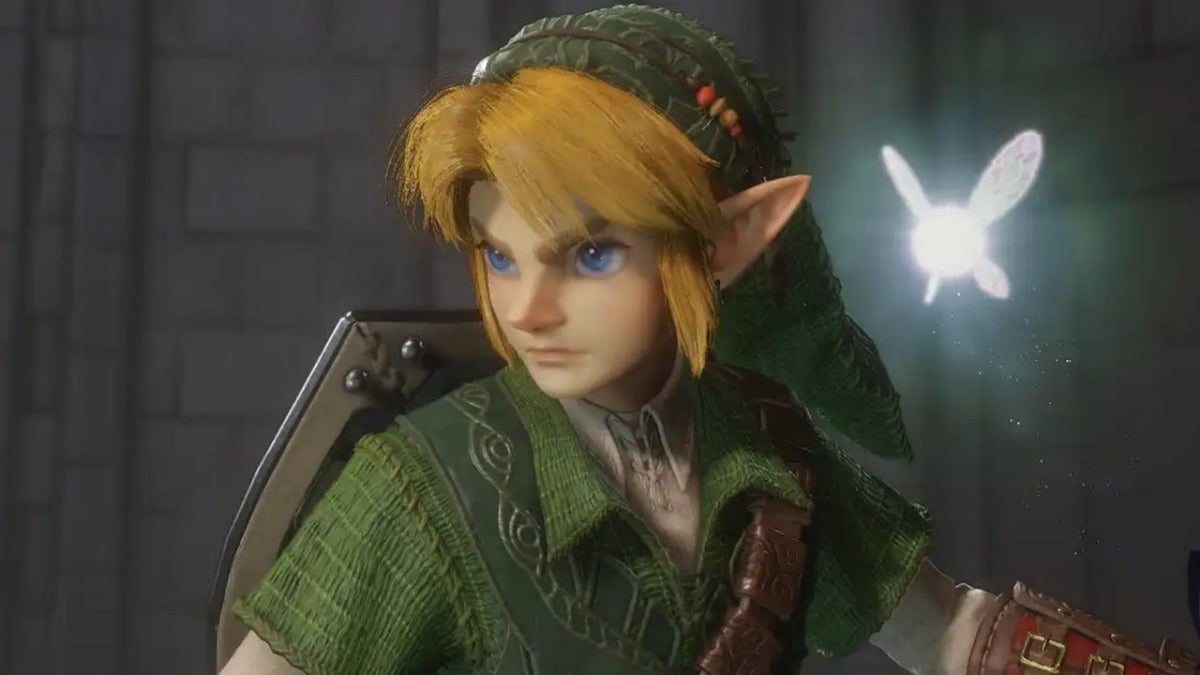
There are games that transcend their time. No matter what one thinks of them, whether one likes them more or less, they go beyond their era. They define what videogames will be beyond what videogames are doing at the time and, in hindsight, they seem grandiose. Almost prophetic. They invent other ways of playing, of seeing the medium, and they become masterpieces, precisely, because of how they do things that today seem normal, but at the time were not.
Obviously, there aren’t many of these games. And not all of them are obvious. One of the most obvious is Super Mario 64: a game without which 3D platformers, or 3D games in general, that came after it wouldn’t be understood. One of the least obvious is Metal Gear Solid V: Phantom Pain: a game that has shaped a way of interacting with the environment and the tools at your disposal that even today we still don’t fully grasp. But if one game is obvious, yet we’re not always aware of it, it’s The Legend of Zelda: Ocarina of Time.

A game that is already absolutely modern
Originally released in 1998 for Nintendo 64, the game was revolutionary from its very first minute. Widely considered the best game ever made, a masterpiece even even by the series’ and Nintendo’s standards, and receiving astonishing critical acclaim and public enthusiasm, it was a game received as a triumph. And rightly so. Especially in hindsight.
Everything about it feels modern. At least, in its most relevant aspects. There are obvious limitations in the graphics and in the controls, but not in the design. Although the dungeons translate what the franchise’s 2D games were doing into a 3D framework, this translation felt natural. The fact that there were different heights gave more layers of depth to the design, but it was still essentially the same kind of game. And that’s what they sought to emphasize. And they took advantage of it in another field: playing with what is specific to 3D.
Moving across open terrain, the danger of falling, and the very immersion offered by more realistic graphics (at least, by the standards of the time) in adding the missing dimension needed to resemble reality, makes the game feel more believable. It still had the spirit of the classics, but it knew exactly what to add to make them feel deeper and more lived-in. And for a 1998 game, neither did the camera betray us nor did the movement feel rough or clumsy, which was an achievement in itself.
Its achievement was carrying everything they had learned in 2D over into 3D without anything being lost along the way. Or with as little being lost as possible. And taking advantage of everything 3D offered: cutscenes, stronger audiovisual storytelling, and greater realism. And that made it revolutionary.
A game you have to be faithful to
In that sense, what can a remake contribute to a game that is, literally, the game that showed what 3D should add when, in gameplay terms, the most important aspects can carry over almost entirely from what they were already doing in 2D? On paper, it can’t contribute anything. Except one thing. It can bring a new version of the classic to a new generation. And that’s exactly what Nintendo has done. But they’ve done it in the only way that isn’t an insult to it: recognizing that its choices weren’t flaws to be fixed, but decisions they wouldn’t make today.
The Legend of Zelda: Ocarina of Time Remake is essentially the same game. It can be beaten from beginning to end with guides from 1998. Its most substantial changes are in graphical terms, now explicitly inspired by puppets, and in some minor aspects, like the introduction of a jump button, but not in any way that changes the game. Because it doesn’t need it. Its design is immortal. And that’s what they wanted to preserve in the game.
Everything in the game is still there. As we remember it. But passed through a filter to be kind to the standards of 2026. Now everything is more detailed, polished, and powerful: the dialogues are more elaborate, the animations and the textures more refined. And the player has to take fewer extra steps. There’s no need to go into the menu so much to perform actions: there are quick-action shortcuts. Does that make this version better? No. It makes it an updated version for a different audience with different standards. Especially because the foundation remains the same.
That’s how remarkable it is. Not a comma has changed in almost 30 years and it remains a masterpiece. How is that possible? Because Nintendo had already refined the Zelda formula with 2D and did nothing more than bring it into 3D, and what Ocarina of Time did was give shape to the possibilities of cinematic presentation. That’s something recent entries, like Breath of the Wild, have exploited at the cost of losing part of their essence: the prodigious mechanical design of games like Ocarina of Time, if we’re talking about 3D, or A Link to the Past, if we’re talking about 2D. And Nintendo itself has decided that it’s time we remember that The Legend of Zelda doesn’t live on that excellent cinematic presentation alone.
