More and more people are getting informed through YouTube, known for being a center of misinformation. But researchers have developed a browser extension that allows users to increase (or decrease) the credibility of a video by adding their own citations. A bit like on Twitter.

In 2023, the Pew Research Center reported that 26% of Americans regularly obtained their news from YouTube. Since YouTube’s search results are influenced by the user’s viewing history, there is a possibility that users may come across misinformation, either unintentionally or deliberately.
Researchers from the University of Washington (UW) noticed a gap that needed to be filled and created Viblio. This browser extension allows YouTube users and content creators to assign credibility to a video through citations, similar to those seen at the end of a Wikipedia entry.
What is the extension against disinformation on YouTube?
“The problem is that many YouTube videos, especially the most educational ones, do not offer a good way to demonstrate that they present accurate information,” explains Emelia Hughes, lead author of the study. “People can report an entire video, but it is a rather extreme measure when someone makes one or two mistakes.”
To justify the design of Viblio, researchers studied how users interacted with existing “credibility signals” on YouTube.
Interviewing 12 YouTube users between the ages of 18 and 60, they discovered what factors helped them select and trust a video and what signals could be confusing or misleading. All participants relied on channel familiarity, channel name, and production quality to assess the reliability of a video.
Eight out of every 12 (67%) were based on the video description, 58% on how interesting the video seemed, and 50% on the thumbnail. Interestingly, the video quality, which is not actually an indicator of reliability, was used as a substitute variable, even if the source of the channel was unknown. The researchers observed that the production quality compensated for the lack of other credibility signals.
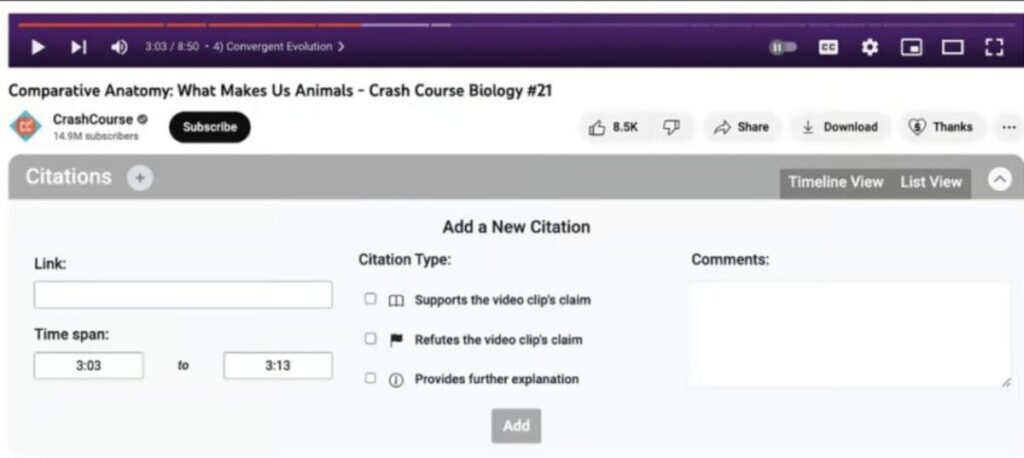
Based on this information, Viblio was created, which allows any user or content creator to insert a quote – or several – in the timeline of a YouTube video. The quotes are displayed during video playback so that other viewers can access the information if they wish. The browser extension appears below the video and next to the channel information, making it easily visible.
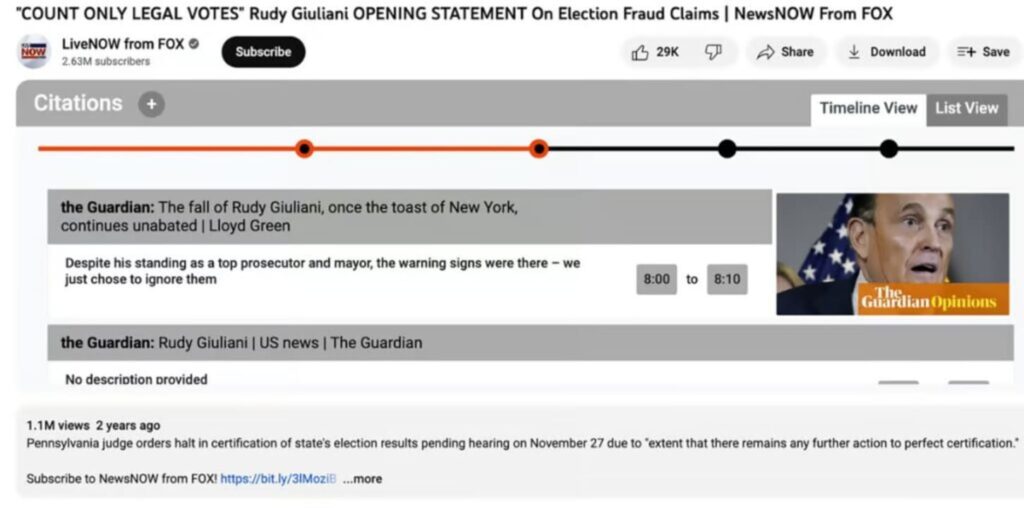
Users only need to press a button to add a quote. Then, they can add a link and select the time period to which the quote refers. They have the option to add comments and can select the type of quote, which corresponds to a different color point on the video timeline: “refutes the video’s claim” (red dot), “supports the video’s claim” (green) or “provides further explanations” (blue).
The researchers plan to conduct further studies, expanding Viblio to other video platforms such as TikTok or Instagram to see if users are motivated enough to add citations. Then, they will investigate if a similar approach to Community Notes can be incorporated into the program.
Viblio seems to be an incredibly useful program. We hope that when it’s in its final form, Google also considers it as such and adds it to YouTube. This kind of initiative can only work with a critical mass of users behind it, and the people who need to fact-check the most are the least likely to install something like Viblio.
This initiative can only have a great impact if it becomes part of the user’s global experience. Let’s hope it does.
The researchers will present the results of their study at the CHI Conference on Human Factors in Computing Systems of the Association for Computing Machinery (ACM), which will take place in Honolulu, Hawaii, on May 14th. The study is available on the arXiv preprint website.
