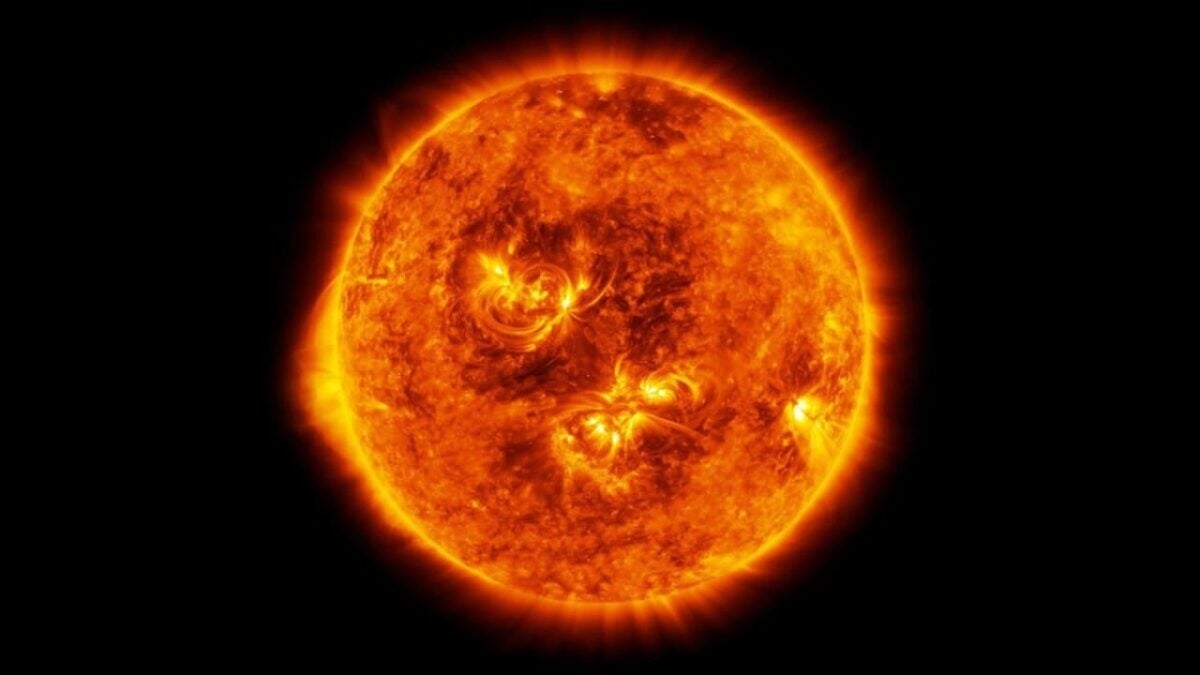
Nothing fascinates us more than space. Out there lies the vastness of the cosmos, filled with planets, stars, black holes, gravitational waves, and more. We have been studying the universe for as long as we have been conscious.

But it’s not always about studying what lies beyond our atmosphere. Sometimes, we just need to observe and enjoy the scenery. And that’s exactly what Miguel Claro did, a professional photographer and scientific communicator who creates spectacular images of the night sky.
As an ambassador photographer for the European Southern Observatory, member of The World At Night, and official astrophotographer of the Dark Sky Alqueva Reserve, he specializes in capturing astronomical landscapes that connect the Earth and the night sky. That’s how he was able to capture something truly unique.
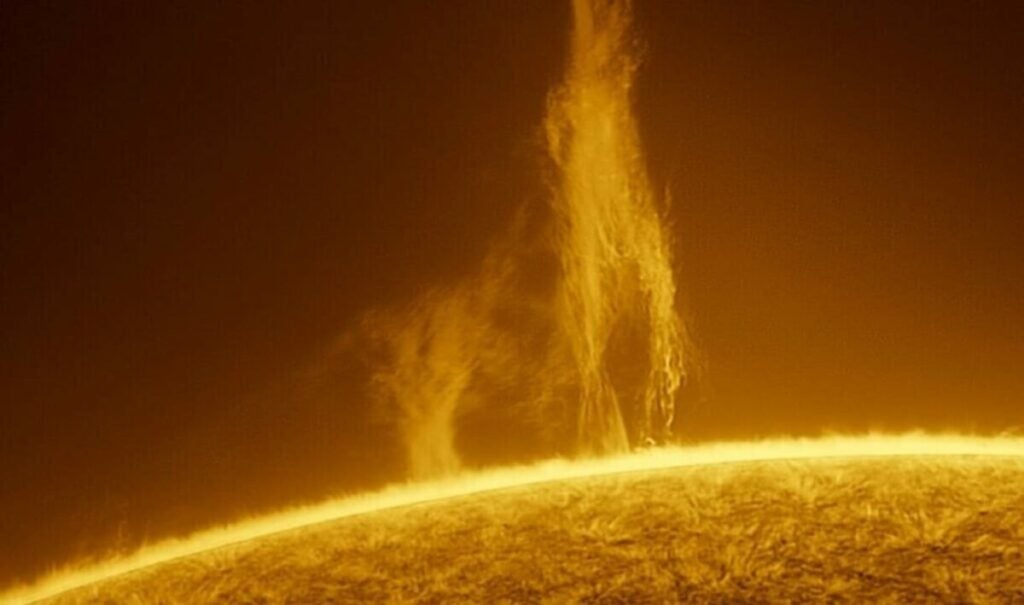
A solar tornado suspended over the Sun
“I noticed that the atmosphere of the Sun had a gigantic prominence on April 20th, so I set up my solar telescope to begin the photography session,” the photographer explains.
“After about an hour of capturing images, I realized that this solar prominence was growing even larger, which meant that something significant was about to happen,” he continues.
These types of solar tornadoes are “controlled by magnetism,” caused by solar magnetic fields twisting into a furious spiral, dragging along clouds of plasma, which makes them challenging to observe.
The final result, created from a time-lapse sequence of photographs, is a high-resolution 4K solar movie composed of 290 images taken over a span of approximately two hours.
A fascinating universe full of possibilities
And since we’re talking about space, did you know that there is an impossible planet a few light-years away?
The exoplanet is approximately the size of Neptune, making it the largest “mirror” in the Universe that we know of today,” writes the European Space Agency, whose exoplanet satellite Cheops made the observation.
By observing LTT9779 b, located about 262 light-years away, Cheops was able to see the strong combination of light coming from both the planet and its star, as opposed to light coming solely from the star.
While Earth reflects approximately 30% of sunlight, LTT9779 b reflects 80% of its star’s light. It’s fascinating, isn’t it?
Some of the links added in the article are part of affiliate campaigns and may represent benefits for Softonic.
