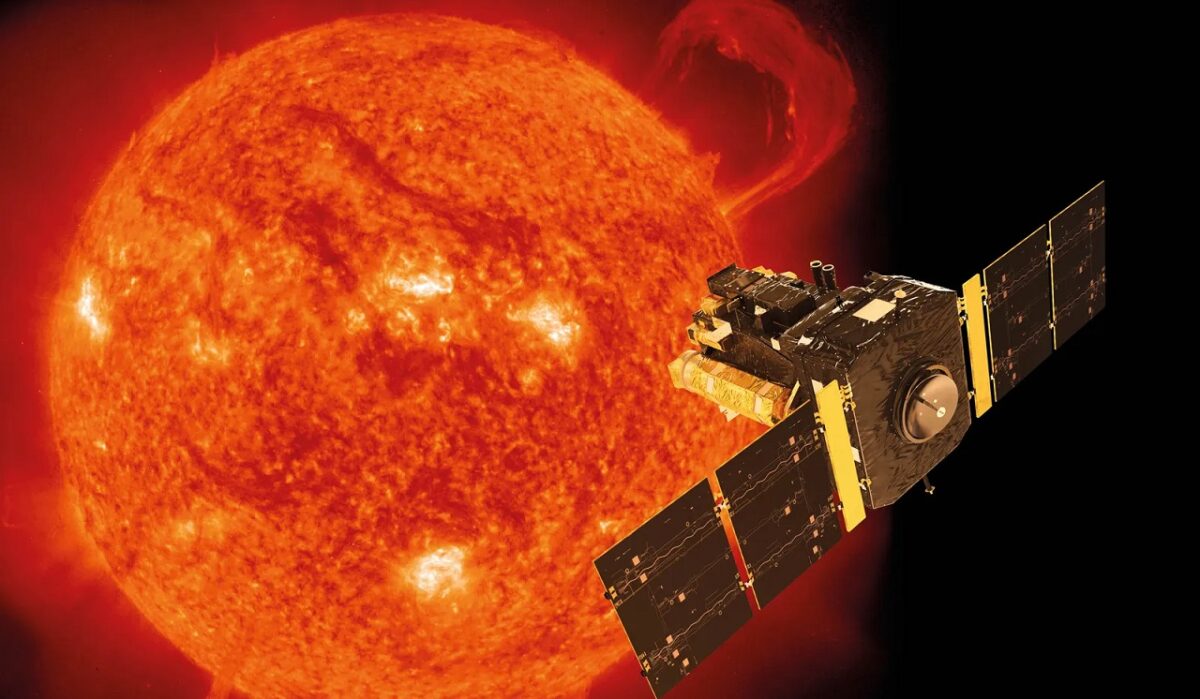
SOHO, a joint mission of ESA and NASA, continues to operate after almost thirty years since its launch as an essential part of the space infrastructure. It is one of our key weather tools.

The director of the SOHO mission, Luis Sánchez Duarte, describes the spacecraft as something far from perfect or innovative, as it has been dedicated to the study of the Sun for three decades.
“It has its peculiarities,” explained to the media The Register. “Today it has some weak points. For example, the battery. As long as we can maintain orientation towards the Sun, everything is fine. But if there is an accident and we lose orientation, something bad can happen.”
A probe that plays with death… and with science
That being said, aside from some downgrades and a few near-death experiences, the spaceship continues to function admirably.
“SOHO has gone from being the spearhead of physical research to being a surveillance tool,” says Sánchez. Its main application is space weather prediction, which is what keeps the spacecraft operational.
The National Oceanic and Atmospheric Administration (NOAA) of the United States uses SOHO data to monitor solar activity. “The main operational requirement we have is to have LASCO data in a more or less continuous manner, with gaps not exceeding four hours”.
From this data, predictions can be made and alerts can be issued. Although monitoring space weather was not the main objective when SOHO was launched in the 90s, the spacecraft’s data on solar phenomena have kept it operational and will keep it in flight until a replacement is finally launched.
There is a real fleet of spacecraft observing the Sun. NASA’s Solar Dynamics Observatory (SDO) was launched in 2010, the agency’s Parker Solar Probe flew through the Sun’s corona in 2021, and Sánchez’s Solar Orbiter was launched in 2020.
However, in the absence of a spacecraft capable of doing what SOHO can do, it persists. SOHO orbits slowly around the Lagrange point L1, from where it monitors solar eruptions, etc. Although there are other spacecraft in the region, LASCO is what makes SOHO unique.
The NOAA has plans for another spacecraft – the Space Weather Follow On Lagrange 1 (SWFO-L1) mission – which will also feature a Coronagraph, but according to Sánchez, it is unlikely to be launched before May 2025.
SOHO is in the fortunate position of having enough fuel for decades. It only uses its propulsion for momentum management, which happens approximately once every three months.
However, even though the fuel levels may be fine, Sánchez is concerned about the condition of the solar panels. The rate of degradation of the energy produced decreases by slightly less than 1% per year. Initially, this degradation was not worrisome, however, the spacecraft has exceeded all reasonable expectations of lifespan.
At some point, SOHO will not have enough power to keep its instruments running, although current predictions indicate that this point will occur in the next decade.
As a reminder, the expected lifespan of SOHO was two years, with enough consumables on board for another four years. Engineers have managed to extend it to 28 years.
