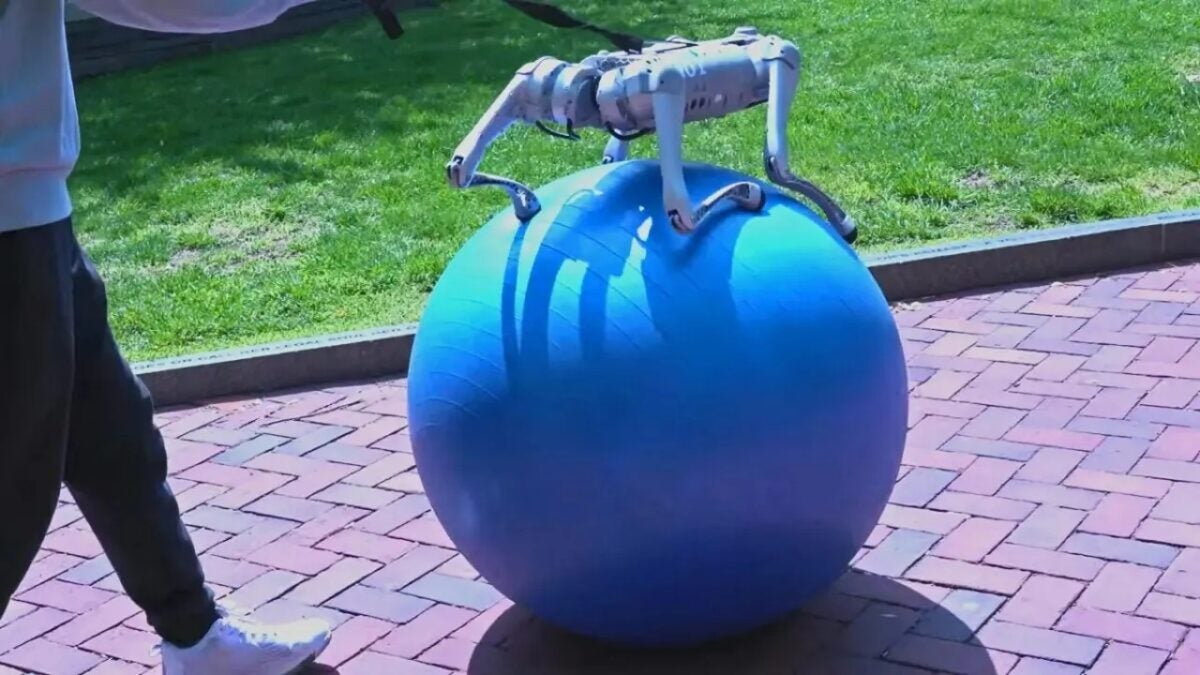
This four-legged creature balancing on an exercise ball is a fun experiment to watch, but ultimately it demonstrates that AIs like GPT-4 can train robots to perform complex tasks in the real world much more effectively than humans.

DrEureka, a new open-source software package, is used to train robots to perform real-world tasks using large language models (LLM) like ChatGPT 4. It is a “sim-to-reality” system, which means it teaches robots in a virtual environment using simulated physics before deploying them in the physical space.
Dr. Jim Fan, one of the developers of DrEureka, used a quadruped robot Unitree Go1 to make headlines. It is a “low-cost” and open-source robot, which is very useful because even with AI, robot pets are prone to falling. As for the “low-cost” part, well… It is sold on Amazon for $5,899 and has a 1-star rating.
Robots that are better than us in almost everything
The “Dr” in DrEureka stands for “Domain randomization”, which means randomizing variables such as friction, mass, damping, center of gravity, etc. in a simulated environment.
With a few instructions in an LLM like ChatGPT, AI can write code that creates a reward/punishment system to train the robot in the virtual space, where 0 = failure, and anything above 0 is a victory. The higher the score, the better.
You can create parameters by minimizing and maximizing failure/breakage points in areas such as ball bounce, driving force, degree of freedom of your limbs, and damping, to name a few. As LLM, you have no problem creating them in large volumes for the training system to execute them simultaneously.
After each simulation, GPT can also reflect on how well the virtual robot has performed and how it can improve. Exceeding or violating parameters, for example, overheating a motor or attempting to articulate a limb beyond its capabilities, will result in a 0… And no one likes to get zero points, not even an AI.
How did he do? Better than us. DrEureka was able to outperform humans in robot training, with a 34% advantage in speed and a 20% advantage in distance covered on real-world mixed terrains.
