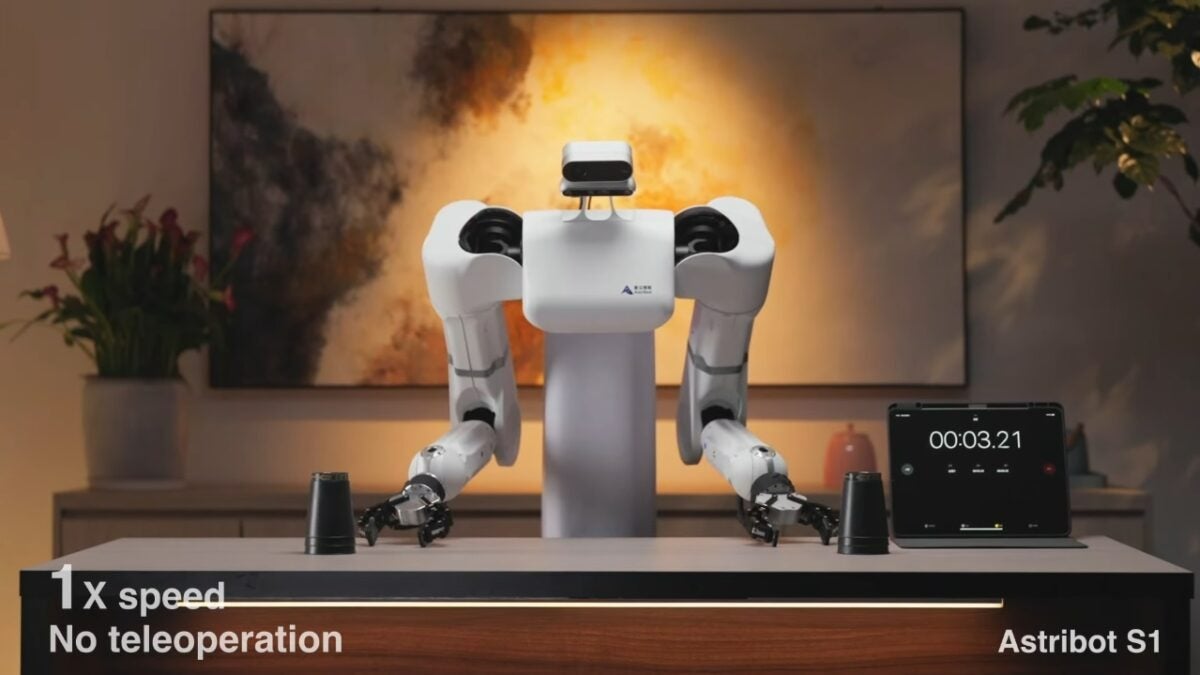
Although it seems that every week a new humanoid robot hits the market, we have not yet seen one that moves as quickly and precisely as the model just presented by the Chinese company Astribot.

This month, Boston Dynamics left us speechless with the amazing skill of their new robot Atlas, and the Chinese company UBTech impressed with their robot Walker S, which speaks with a gentle touch.
But today’s video showcasing the skills of a robot equipped with artificial intelligence known as S1, from a relatively unknown subsidiary of Stardust Intelligence based in Senzhen called Astribot, has sent shivers down our spines.
It’s fast. It’s accurate. And it’s like nothing we’ve ever seen before
According to Astribot, the humanoid can perform movements at a maximum speed of 10 meters per second and handle a payload of 10 kg per arm.
The fact that your website shows that an adult man falls very short in these and other Astribot metrics should not be a cause for alarm at all. That speed, as shown in the video, is enough to remove a tablecloth from under a stack of wine glasses without them falling to the ground.
But the robot is not only fast, but also incredibly precise: it can open and serve wine, cut a cucumber smoothly, flip a sandwich in a pan or write calligraphy. The video also shows that the robot is very skilled at imitating human movements, which means it should be a good learner.
Of course, the video has raised some questions for us. Does the S1 have a lower half? All the humanoid robots we have seen so far have some means of locomotion, but this one seems quite immobile.
We are also curious to know more about the history and support of Astribot, as well as the likelihood of the S1 being manufactured. Several media outlets have contacted the company for answers, but there is no new information at the moment.
For now, we can deduce from the Astribo website that the company was founded in 2022 in Shenzhen, that the robot took about a year to develop and is expected to be commercially available by the end of this year.
The site also indicates that the parent company, Stardust Intelligence, was founded by Lai Jie, who also worked with Tencent Robotics Laboratory, Baidu, and the Hong Kong Polytechnic University.
The company also states: The name Astribot comes from the ancient Latin proverb “Ad astra per aspera”, which means “a journey through difficulties to reach the dust of the stars”, representing the company’s long-term plan and strong commitment to the development and popularization of AI robot technology.
If Astribot is the future of robotics, which it seems to be, we could say that in a decade robots will populate the Earth… doing all those manual jobs that until now were our thing. Not even street sweepers will be left alive.
