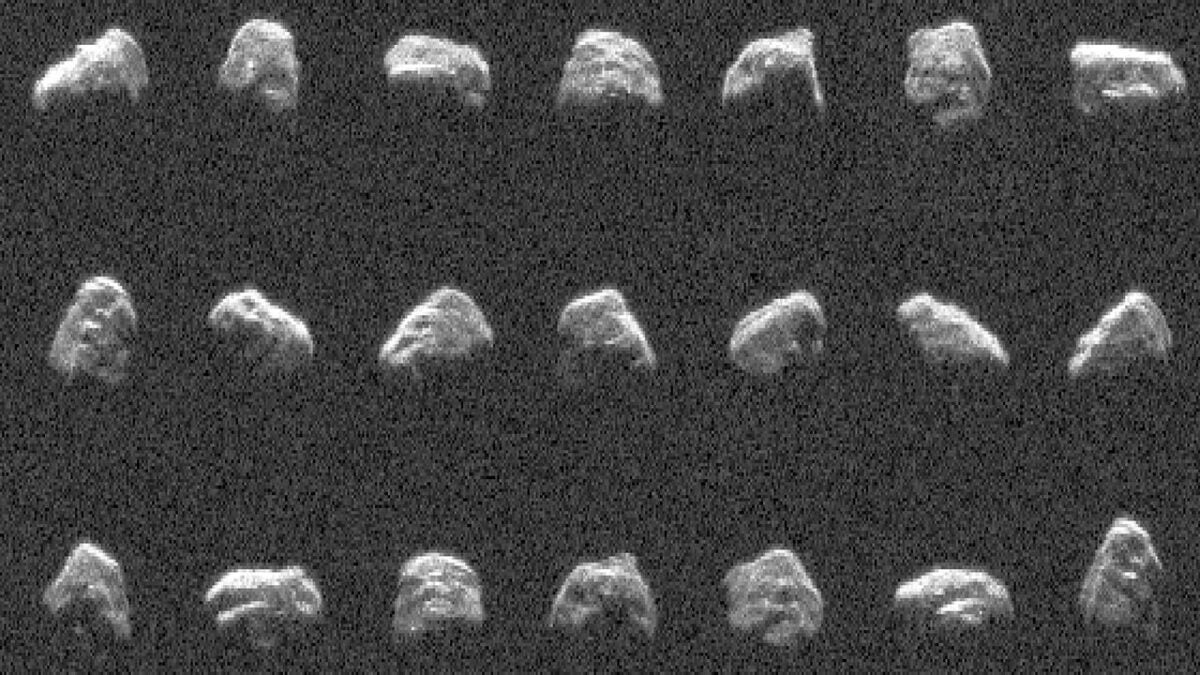
The Goldstone radar of NASA in California has recently observed two large asteroids that approached Earth in late June. The images obtained by the radar were shared on July 3, 2024, revealing fascinating details about these celestial bodies.

The first of these asteroids, called 2011 UL21, was observed for nine days and it was discovered that it has a small moon about 3 km away. This asteroid has a diameter of approximately 1.5 km and it is one of the largest near-Earth asteroids visible this year with amateur telescopes. It passed at a safe distance of 6,634,279 km from Earth on June 27th, which is about 17 times the distance between Earth and the Moon.
The second asteroid, known as 2024 MK, was observed for three days. Discovered on June 16, 2024, this asteroid is smaller, with an estimated diameter of 150 meters. Despite its smaller size, its proximity to Earth was notable, passing at only 3/4 of the distance between Earth and the Moon on June 29. This approach modified its orbit due to Earth’s gravity, reducing its orbital period around the Sun by approximately 24 days.
The Minor Planet Center has classified both 2011 UL21 and 2024 MK as potentially hazardous asteroids. However, there is no danger of impact in the near future. Furthermore, observations of these celestial bodies provide a unique opportunity to better understand the composition and formation of asteroids, as well as to develop possible planetary countermeasures.
“The radar observations taken during these two close approaches will provide valuable practice for planetary defense, as well as information about their sizes, orbits, rotation, surface details, and clues about their composition and formation,” explained NASA.
