
Your passwords may already have been leaked: here’s how to check in 2 minutes

Millions of accounts are created online every day. We sign up for stores, entertainment platforms, social networks, banking services, and more.
For most people, this process is so routine that they barely pay attention to it: we enter an email address, set a password, and move on. However, behind that apparent simplicity lies a digital ecosystem where the security of data stored in the cloud is under constant threat.
Data breaches are no longer an exception that affects only high-profile targets, but an everyday reality in which we are all potential victims. Every week, databases belonging to companies of all sizes are breached. When this happens, millions of records containing email addresses, full names, phone numbers and, worse still, passwords, are exposed.
What is most alarming for the average user is not only that a breach happens, but how little visibility there is into the incident. It is very common for a person’s personal information to circulate for months or even years in clandestine forums without them having the slightest knowledge of it. The good news is that checking whether your credentials have been compromised does not require technical knowledge or hours of research, because, thanks to tools like Avast‘s, we can find out whether our data has ended up in someone else’s hands.
The invisible market: what happens when your data is leaked?
To understand the importance of regular checks, it helps to understand the path data follows once it leaves a breached server. When attackers manage to access a database, they rarely use the information immediately to attack a specific user. Instead, they package millions of credentials and put them up for sale or share them on the so-called Dark Web.
On this black market, cybercriminals acquire massive lists of usernames and passwords to launch automated attacks known as credential stuffing. This technique takes advantage of one of the most widespread and dangerous habits on the internet: password reuse.
If you use the same combination of email and password at an online store that suffered a breach and in your main email account or banking service, attackers may be able to access your bank accounts in seconds.
For this reason, spotting early which data has been leaked is not just an exercise in curiosity, it is a fundamental preventive measure to avoid identity theft, unauthorized access to financial accounts, or the hijacking of social media profiles.
How to do a quick diagnosis from your computer
It’s a good idea to check your digital security status. The key is to use specialized tools that continuously monitor Dark Web databases and present the results clearly.
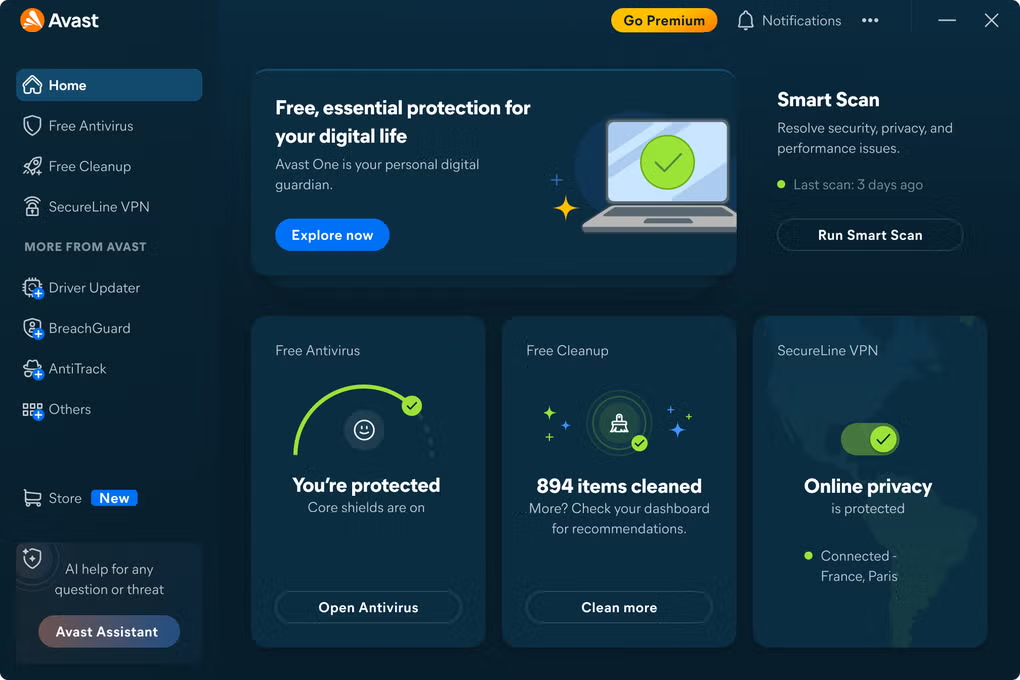
Today there are integrated solutions designed specifically to simplify this task for beginner users. One of the most complete and accessible options for desktop users is Avast One Free, a comprehensive security suite that combines traditional antivirus protection with advanced privacy and data monitoring tools at no cost.
Unlike outdated security solutions that are limited to blocking viruses, modern platforms approach security more broadly, focusing primarily on the user’s digital identity.
Step by step: assess your risk with Avast BreachGuard and Risk Monitor
Within the Avast One security ecosystem, the technology responsible for checking whether your personal data has been exposed is Avast BreachGuard, which includes the Risk Monitor feature.
This tool can help scan Dark Web data sources to help identify whether your accounts have appeared in a known breach.
Running this initial analysis on your desktop or laptop is an extremely simple process consisting of the following steps:
- Installing the suite: Download and install Avast One Free on your device. The setup wizard guides you intuitively in just a few clicks.
- Accessing the privacy module: Once the application is open, go to the privacy and identity section.
- Starting the scan: Enter your primary email address into Risk Monitor. The tool can cross-check your address against billions of leaked records.
- Reviewing the report: In less than two minutes, the screen will display a clear picture of the status of your accounts. If your email has not been detected in any breach, the tool can help you to know data hasn’t been found in a breach. If any exposure is detected, the report will specify precisely which website or service the breach occurred on and what type of data was compromised (for example, whether only the password, the physical address, or the phone number was leaked). The biggest benefit of this feature is that it doesn’t just give you a vague alert, but provides clear guidance on what to do next, such as changing the affected password immediately and enabling two-factor authentication on critical services.
Active prevention: stay in control with Hack Alert
The initial scan is an excellent snapshot of the current state of your cybersecurity, but cybersecurity is a dynamic process. A password that is safe today could be leaked tomorrow due to an incident on a platform you use regularly.
To avoid having to run manual searches constantly, Avast One Free integrates the Hack Alert function. This component runs quietly in the background:
- 24/7 monitoring: Link your email account to Hack Alert and the system can help monitor for newly compromised databases.
- Instant notifications: If in the future any password linked to that email shows up in a new major breach, the application can send you a warning.
- Fast response: Receiving the alert can help you act before compromised credentials are used elsewhere.
Beyond passwords: reduce your digital footprint with Ads Opt Out
Making sure your passwords have not been leaked is the first step in protecting your online identity, but it is not the only one. Digital privacy is also compromised by the massive tracking carried out by data collection companies (data brokers), which build detailed profiles of your browsing habits, tastes, and personal information.
The greater the amount of data third-party companies store about you, the greater the impact if any of those companies suffers a security breach in the future. Reducing unnecessary data collection is therefore a fundamental preventive strategy.
To address this problem directly, Avast One Free includes the Ads Opt Out feature (opt out of personalized ads and ad tracking). This tool greatly simplifies managing your privacy preferences by allowing you to:
- Block trackers: Help limit advertisers’ ability to collect detailed information about your behavior on the web.
- Send automatic opt-out requests: It makes it easier to stop the collection of your data by the main advertising networks without having to manually search for privacy settings forms on dozens of different websites.
- Limit your exposure: By limiting the amount of personal data circulating through the servers of advertising agencies, you directly reduce the chances that your information will end up exposed in future security incidents.
Essential tips to keep your digital life protected
Using automatic diagnostic tools like those in Avast One Free is the most effective way to keep yourself safe, but combining technology with good digital habits guarantees robust long-term protection. Here are some guidelines that are easy to apply in your day-to-day life:
- Use unique and complex passwords: Avoid repeating the same password across multiple sites. If one service suffers a breach, your other accounts will remain completely safe.
- Rely on a password manager: Remembering dozens of complex passwords is impossible. A password manager allows you to generate and store random, secure passwords under a single master password.
- Enable two-factor authentication (2FA): Whenever possible, add a second verification step (such as an authentication app on your phone) to log in. Even if an attacker gets your leaked password, they’re much less likely to be able to access your account without that second code.
- Keep your software updated: Make sure your operating system, browser, and security programs are always up to date with the latest security patches.
Conclusion: digital peace of mind is just a click away
The current cybersecurity landscape shows that data breaches are an inevitable risk of modern digital life. However, this does not mean that you should live with constant worry. The key is not to avoid using technology, but to have the right tools to react quickly and effectively.
Spending two minutes running a scan with free and user-friendly tools like Avast BreachGuard and its Risk Monitor within Avast One Free can help give you greater control over your information. Combined with the continuous protection of Hack Alert and the reduction in tracking offered by Ads Opt Out, this can help you browse with more peace of mind about your identity and personal data. Prevention and knowledge are, today more than ever, your best defense on the web.
