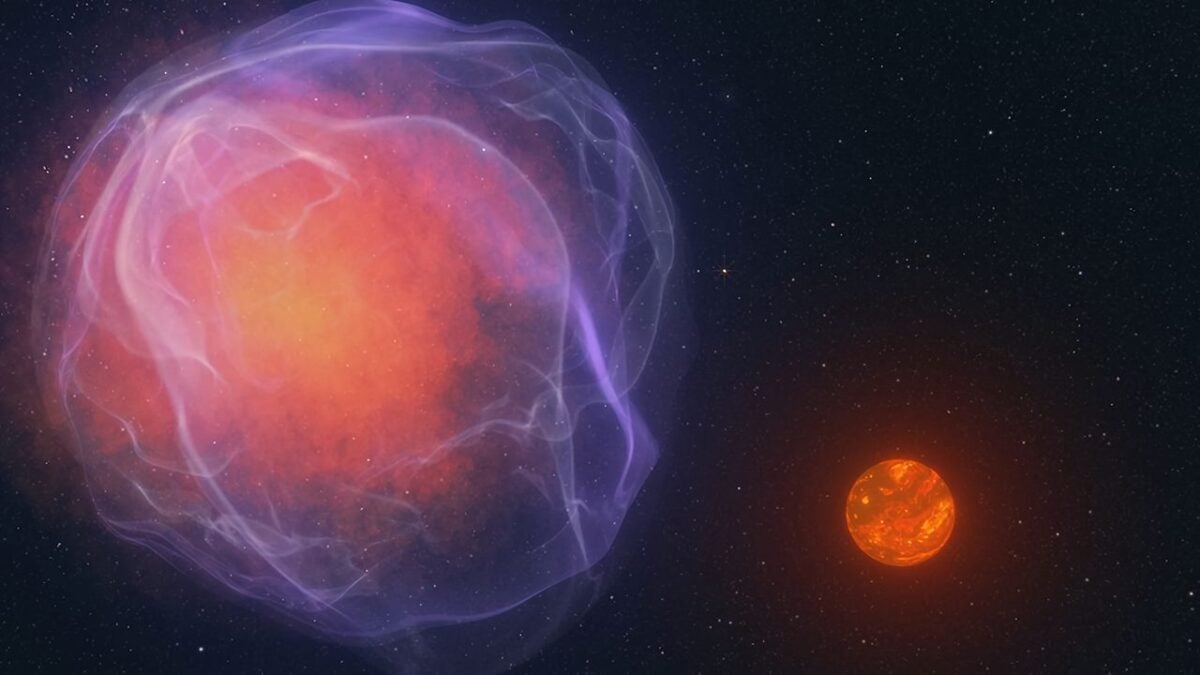
NASA has echoed the discovery in the Milky Way of an unusual celestial object that is moving at a speed of one million kilometers per hour, which could lead it to leave our galaxy. Identified as CWISE J1249, this colossal body, about 27,306 times the size of Earth, was discovered thanks to the collaboration of citizen scientists who analyzed data from the WISE telescope (Wide-field Infrared Survey Explorer) of NASA.

Despite its detection, experts have not yet been able to determine the exact nature of CWISE J1249. Although it shares a similar size to that of a star, its mass and other characteristics differentiate it from conventional stars that orbit in the Milky Way. NASA has indicated that it could be a low-mass star or a brown dwarf. The latter are celestial bodies that, unlike stars, do not manage to constantly fuse hydrogen in their cores. Among the 4,000 brown dwarfs discovered in WISE data, none have been observed traveling into intergalactic space like CWISE J1249 does.
Another intriguing factor is its composition, as it contains much less iron and other metals compared to typical stars and brown dwarfs, suggesting that it is a very ancient object, possibly originating from one of the first generations of stars in our galaxy.

Scientists are puzzled by the incredible speed of CWISE J1249. One of the proposed theories suggests that the object originated in a binary system with a white dwarf that exploded as a supernova. Another possibility is that it was expelled from a globular cluster after a close encounter with a pair of supermassive black holes. According to Kyle Kremer, assistant professor in the Department of Astronomy and Astrophysics at the University of California, San Diego, “when a star encounters a binary black hole, the complex dynamics of this three-body interaction can launch it out of the globular cluster.”
