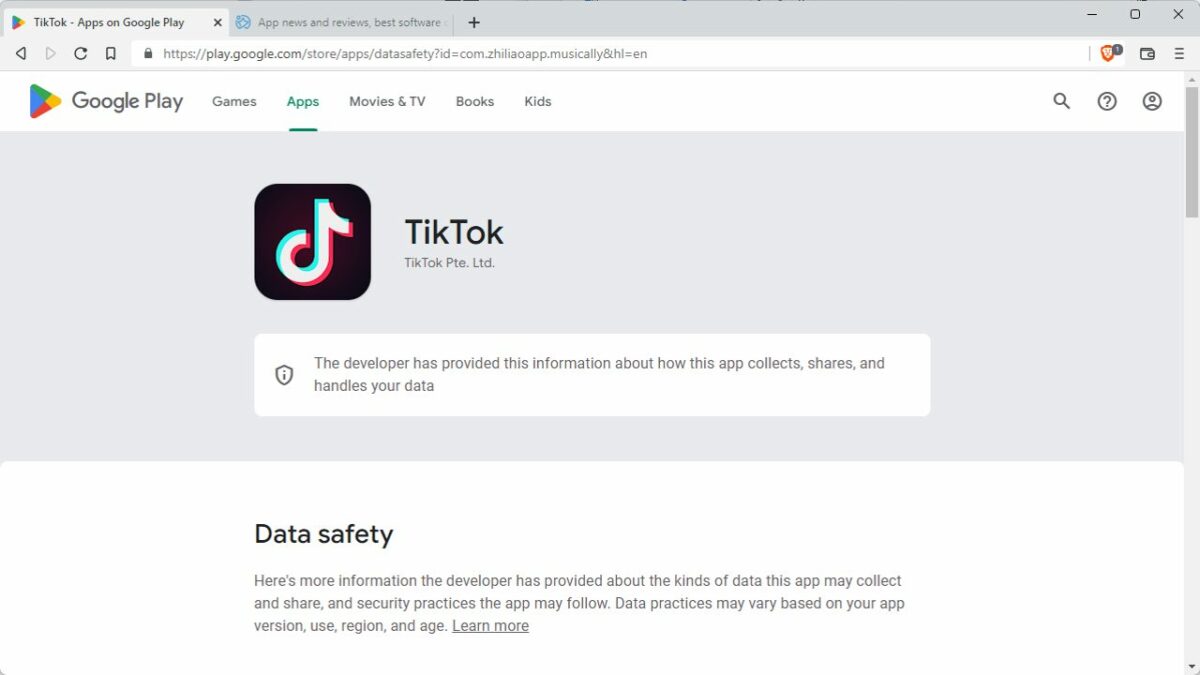
There is a good chance that the majority of Android apps that you have installed on your Android devices are collecting data and sharing it with third parties.

A recent study conducted by Incogni analyzed the top 1000 free and paid applications on Android. The company interacts with data brokers on the behalf of customers to get collected user data removed.
Of the 2000 Android applications, 55.2% share data that they collect with third parties. Free apps, those available without a price tag on Google Play, share seven times more data points with third parties than paid applications.
Google Play’s new Data Safety section
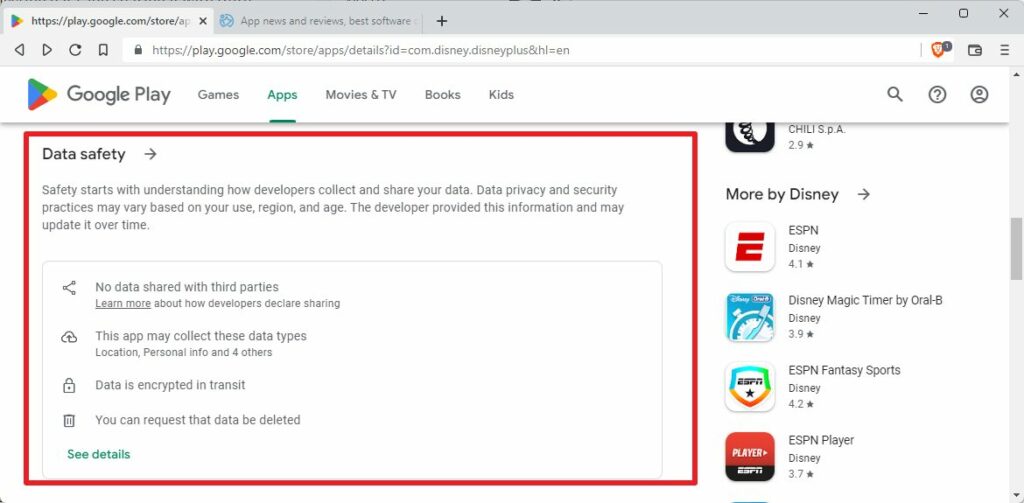
Google introduced a new Data Safety section on Google Play in July 2022. All Android developers, small one-person teams, and the largest international organizations needed to fill out data safety information for their applications before the deadline.
The section informs Android users about how applications collect, share and handle user data. The whole system is honor-based, which means that developers provide the data without it being verified by Google.
Here is how you check the data safety information on Google Play:
- Open Google Play on the Android device or in any web browser on mobile or desktop systems.
- Select the application or game that you want to verify.
- Scroll down to the Data Safety section.
There, you find a summary, which reveals major points. If you want to know more, you may activate the data safety link to open a page with additional details.
For example, opening the Disney+ app reveals that is does not share data with third-parties, that it collects six different data types, uses data encryption, and supports data deletion requests.
While that sounds good on paper, Incogni discovered that Google has a specific definition of data sharing. According to Google’s definition, data sharing refers to the “transfer of user data to any third party”.
Anonymous data, as well as transfers “made to a service provider or for legal purposes”, does not need to be revealed in the Data Safety section on Google Play.
In other words; if an app anonymizes collected data before it transfers it, it may not be revealed in the Data Safety section.
Apps collect lot of data on Android
Social applications like Facebook, Messenger or LinkedIn collect the most data points according to the study.
The top 10 apps that collect the most data points:
- Nextdoor
- Microsoft Teams
- Messenger
- Oculus
- Ebay
- Snapchat
- DoorDash – Dasher
The top 4 applications collected 36 out of 37 available data types. Only race and ethnicity is not collected.
While social applications collect the most data, most social apps share very little. Meta’s applications, Facebook, Facebook Lite, Messenger, Instagram, and Messenger Lite, share only 4 data types with third parties, according to the Data Safety section on Google Play.
It is important to realize, again, that certain forms of data sharing do not need to be revealed.
Social, business, and shopping applications collect the most data points on average on Android. Consequently, apps in those categories know more about their users than apps in other categories.
The Data Safety section does not reveal the purpose of the data collection, but the list of shared data points gives some clues.
Android apps share a lot of data as well
Incogni analyzed the main data points that Android applications shared.
The top 10 apps that share the most data points with third parties:
- Cast for Chromecast & TV Cast
- DoorDash – Dasher
- Booking.com Hotels and more
- The Home Depot
- Fetch Rewards: Earn Gift Cards.
- DoorDash – Food Delivery.
- Picsart Photo & Video Editor
- Dave – Banking & Cash Advance
- Drum Pad Machine – beat maker
App interactions, crash logs, diagnostics, the approximate location, and other actions top the third-party data sharing list. Diagnostic data, including crash logs and performance data, is used by developers to find and resolve errors and issues.
A significant number of apps shared user names (4.77%), email addresses (6.77%), and home addresses (3.85%). 13.4% of apps share the approximate location, 3.85% the exact location.
All in all, 55.2% of the 2000 analyzed applications share that with third parties. Almost 70% of apps that do not share data with third parties are paid applications.
As a result, free apps share an “average of 7 times more data points than paid ones” according to Incogni.
Closing Words
Incogni’s study demonstrates that Google Play’s Data Safety section lacks information that Android users may consider important.
Data Safety, on the positive side, reveals some information on an application’s data collecting, sharing and handling.
On the negative side, the filled-out information is not verified. If that was not bad enough, Google’s own definition of data sharing gives developers the go-ahead to omit some of the data sharing of their applications.
Free apps share more data points than paid Android applications; this should not come as a surprise. The saying that free is not really free seems to be confirmed by this, as users pay with their data.
To be clear, there are free Android apps out there that do not collect or share data, and paid apps that do. On average though, free apps share more data points than paid applications.
