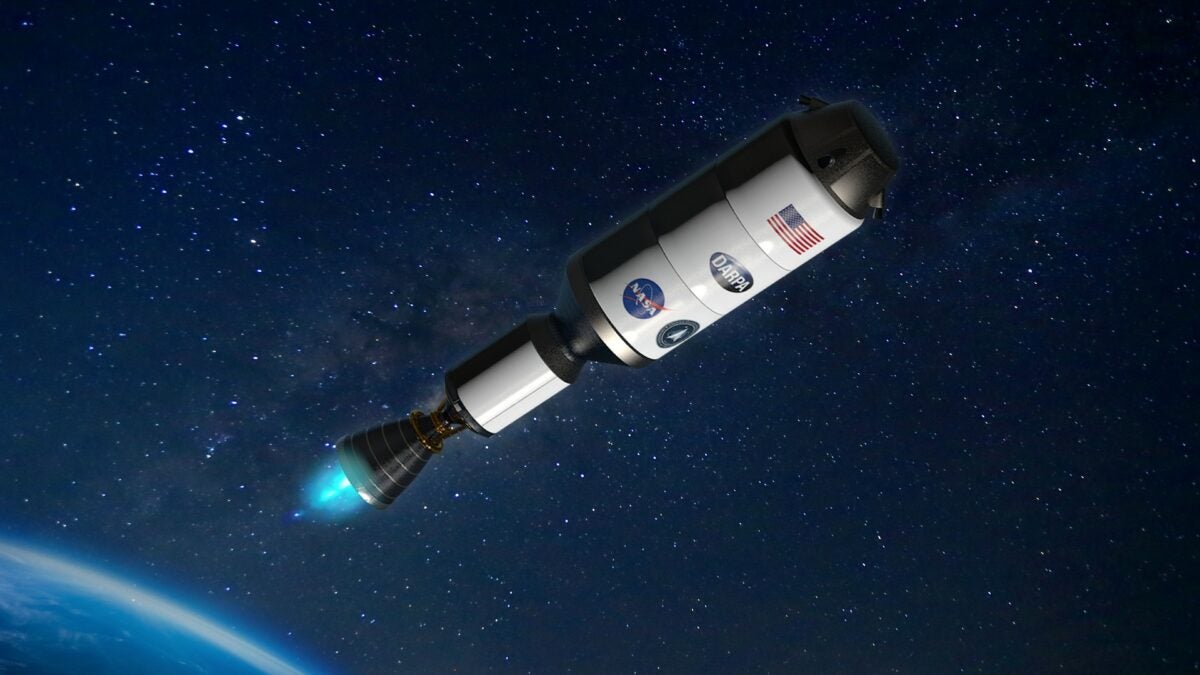
NASA and the U.S. military are planning to launch a nuclear-powered spacecraft into Earth’s orbit by late 2025 or early 2026. Yes, it sounds brutal, and it truly is.

The project, known as DRACO (Demonstration Rocket for Agile Cislunar Operations), aims to test nuclear thermal propulsion (NTP) in space, a potentially revolutionary technology that could aid humanity in establishing settlements on Mars and other distant worlds.
The DRACO spacecraft will be developed and built by Lockheed Martin, the world’s largest military contractor.
Conquering the stars with a nuclear punch
You are correct. DRACO is not something entirely new. The U.S. Defense Advanced Research Projects Agency (DARPA) initiated the program in 2021, and NASA joined in early 2023.
The involvement of NASA shouldn’t come as a surprise, as the agency’s interest in NTP technology dates back a long time. For instance, NASA aimed to launch a crewed mission to Mars aboard a nuclear-powered spacecraft in 1979 through a program called NERVA (Nuclear Engine for Rocket Vehicle Application). However, the NERVA program was canceled in 1972.
NASA continues to set its sights on Mars, with the goal of sending astronauts there by the end of the next decade or early 2040s. The agency still views nuclear thermal propulsion as a critical breakthrough that could make this goal more achievable by reducing travel time to and from the Red Planet.
How a ship with a nuclear reactor works
Nuclear thermal rockets carry small fission reactors that release incredible amounts of heat by splitting atoms. This heat is applied to a propellant gas, which expands and is then expelled into space through a nozzle to create thrust.
This process is different from that employed by radioisotope thermoelectric generators (RTGs), a nuclear technology that has been flying aboard probes since the early days of the space age. RTGs do not provide propulsion but harness the heat from radioactive decay to generate electricity, which then powers instruments, engines, and other spacecraft equipment.
In previous updates on DRACO, DARPA and NASA stated their goal was to launch the first space demonstration of the program in 2027. However, the timeline may have been accelerated, as the current target launch timeframe is late 2025 or early 2026.
The spacecraft will be directed to a relatively high Earth orbit, probably between 700 and 2,000 kilometers, as explained by the team members during today’s briefing.
From that altitude, the DRACO demonstrator will take at least 300 years to return to Earth due to atmospheric drag, providing enough time to ensure that all its nuclear fuel is depleted by the time it descends.
The mission team will also prioritize safety during the ascent: The nuclear engine of the DRACO vehicle will only be activated when it reaches orbit.
During launch, the engine will be equipped with a “poison cable,” a piece of metal that absorbs neutrons, preventing them from initiating a chain reaction. According to the team members, the poison cable acts similarly to the control rods in terrestrial nuclear reactors.
And, of utmost importance: the funding. The contracts awarded to Lockheed and BWX Technologies for their work on DRACO have a total value of 499 million dollars, provided all objectives are met. Half of the funding will come from DARPA, and the other half from NASA. Mars is the target.
Some of the links added in the article are part of affiliate campaigns and may represent benefits for Softonic.
