Role-playing games can be a bit intimidating. The idea of playing with a group of people, acting as someone else, can feel a bit strange. It can even be a bit daunting. Not to mention taking on the role of the master. The person who must tell the story, react to what the characters do, and present the challenges to overcome. It is the most difficult role, but also the most central. Without a master, there is no role-playing game. And for that reason, it requires special care and preparation.
This is something that Wizards of the Coast has taken into account. Or so it seems when one flips through the pages of their new Dungeon Master’s Guide, from Dungeons & Dragons.
We already talked about this book in a preview, and we shared the good impressions we had of it. But now those impressions have been confirmed. Now being published in English, but still having to wait until 2025 to enjoy the Spanish version, what impresses most about this book is the attention to detail. The number of illustrations, the help sheets for the master and players during the games, and the number of reference tables is overwhelming. And it is in a way that is easy to find at any time.
Anyone with experience with previous iterations of the Dungeon Master’s Guide knows that this is important. This is a book that has not always been easy to use. Even when it communicates its content well, its tables are often very scattered. Or it lacks adequate content to easily transfer to the games. But everything in this new Dungeon Master’s Guide, fully compatible with all current 5th Edition material, is designed with one thing in mind: its usability. Which also means that players can learn the noble art of being a role-playing master. Something that is not without difficulty.
A book designed to be used
If the first 20 pages of the book are about what the role is and how a game should be approached on a human level, the next 30 are about the basic rules and how to apply them. The next 50? More advanced and contextual rules. And this is wonderful. By synthesizing all the basics in its first 50 pages, continuing with the specifics in the next 50, it fulfills a dual purpose. For newcomers, they can quickly know how to start playing without much hassle. For those who need to look up a specific rule or table, having to check the index of only 80 pages makes the task much easier. Making this book, as a reference, absolutely unsurpassable by any of its previous versions.
But that is only half the purpose of this book. 100 pages out of almost 400. Because, what are the other 280 pages of this, somehow, very manageable book dedicated to? To teaching you some of the more complex aspects of creating a good role-playing game. For example, how to create an adventure. Or an entire campaign.
The book goes into great detail about everything you need to know to create adventures that are interesting and memorable. Focusing on all aspects and the different forms they can take, it touches on how to get players involved, how monsters and adversaries should behave, or even how to build adventures without conflict. Brushstrokes, all of it, partly also to avoid conditioning how you create these adventures. They are flexible guides to work with and not rails on which to build your stories.
The same happens with campaigns. Providing the tools so that we can build our own campaigns, it focuses on their most important keys, such as what their premise will be, or how time will pass in them. Placing special emphasis on this kind of elements that, even the most experienced masters, often overlook when creating campaigns. And that they could take into consideration to make them better.
If you want to be a master, this book is essential in your library
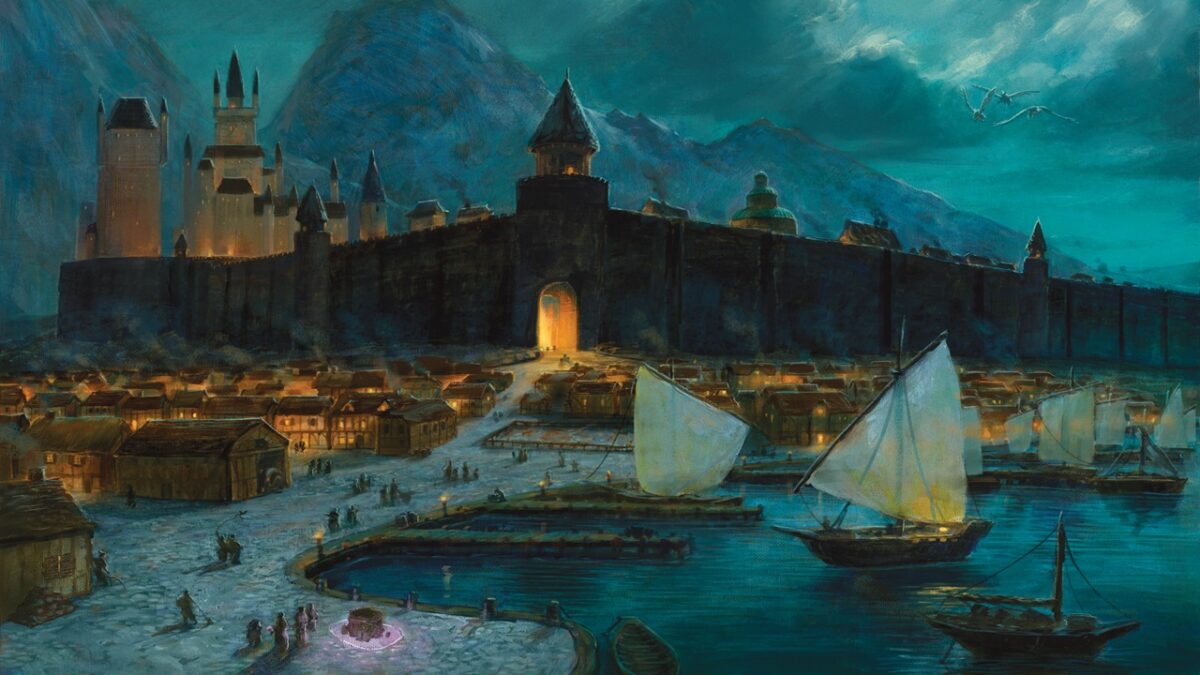
The rest of the book is divided between treasures, the new rules for strongholds—a type of building that serves as the players’ group’s base of operations—and even a small campaign setting. And surprisingly, it’s not the Forgotten Realms. This time they have chosen to return to Greyhawk, presenting some of its most iconic locations, possible adventure hooks, and very good reasons to play adventures in this iconic world that gave birth to Dungeons & Dragons. And if you don’t like it, you can always create your own world, use any other from the Dungeons & Dragons multiverse, well detailed in the book, or any fantasy world from literature, film, or any other medium.
For all these reasons, the new Dungeon Master’s Guide for Dungeons & Dragons is absolutely essential. It is more. It is better. It is more usable. It is even more beautiful. Anyone who wants to start playing Dungeons & Dragons will not find a better entry point to become a master than this book. At least not from Wizards of the Coast. And if that’s not the best thing that can be said about a new version of the Dungeon Master’s Guide, may a beholder strike us down right now.