Best election apps for voters (2019)

Stay ahead of the curve this election season with these great apps!

Voting Day

We’re always interested to see what happens on election day, and 2020 is shaping up to be quite an event! If you’re feeling a little behind and want to catch up on the who’s who and what’s what of the political races, we’ve got some helpful apps for you!

Our options today come in pairs: the first two are summary services that provide an overview of current candidates and delineate their stances on a list of important topics. It’s the type of information you’d be likely to find in a nonpartisan info pamphlet the day of the election.

The second two are news outlets. Why? There are surprisingly few apps for polling services, and most of the ones that do exist were created specifically for prior elections, especially 2016. If you’re looking for real-time information, these are the places to go.

Best election apps

’20 Matters

20Matters

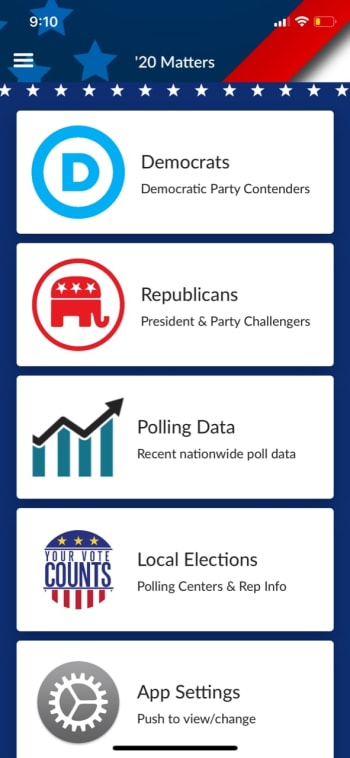
The front page of ’20 Matters has a helpful menu with links to both political parties’ contenders, recent polling data from multiple sources, information on local elections, settings for the user interface, and an “about this app” button. The latter gives information on how they gather dataIf you’re interested in knowing more, go there!

For first-timers looking to inform themselves, we recommend heading into the party lists:
20Start

Here in the Democratic section – the first by alphabetical order – you’ll find the current candidates. You may notice they’re not in alphabetical order: the app puts the frontrunners at the top:
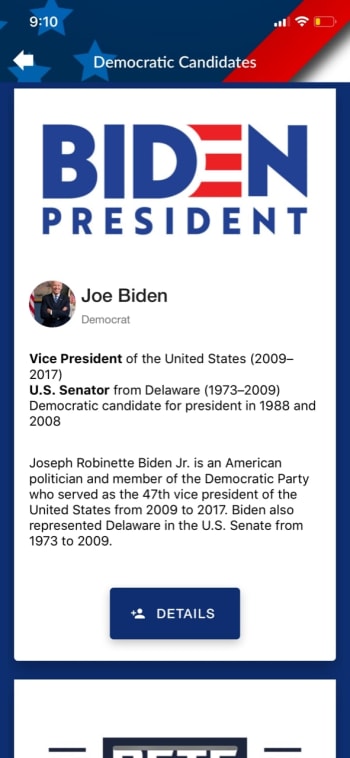
20Candidates

If you click on the leading profile (Joe Biden at this time), you’ll find more information about the candidate, including biographical details of their life, along with aspects of their political views and much more (campaign videos, latest tweets, recent news).
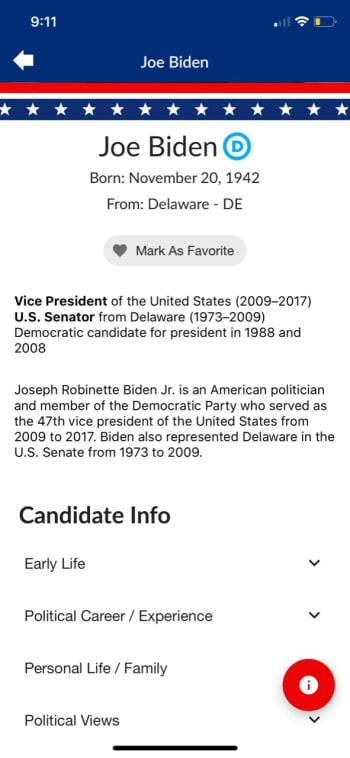
20Info

Overall review? We believe this is the best election tracking app due to its quality data and intuitive interface.

The system updates frequently so you can stay in touch with who’s still in. And, perhaps most importantly, the negative reviews on the Apple Store were related to a bug with the app’s release, not political bias accusations. At this time, it’s clean!

20 Matters Download Free ►
10

PoliTalk

PoliTalk

While it lacks a few of the amenities found in ’20 Matters, PoliTalk has good information and refreshing simplicity of design. On their main page, you’ll find all candidates (Dem, Rep, etc.) organized in alphabetical order:
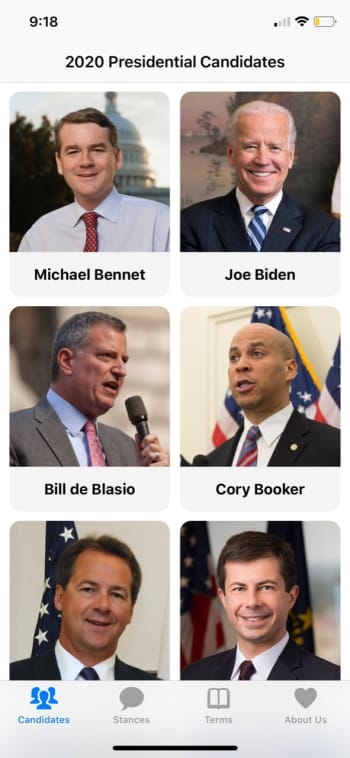
PolStart

When you click a profile, the app delivers a long list of their policy stances, with a summary of the most crucial views at the top, and a link to their campaign website at the bottom (if available):
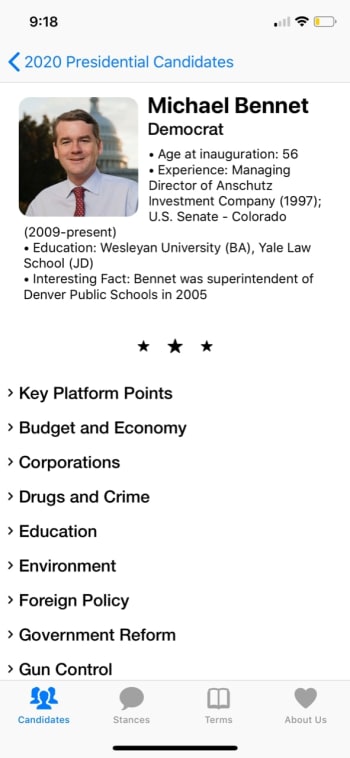
PolInfo

We strongly believe in the importance of staying informed. While PoliTalk may not have all the information found in other apps, the simplicity may be a great introduction to the 2020 political race.

PoliTalk USA Download Free ►
9

News sources

While we support the summary apps, we also recommend using them in conjunction with a news outlet for the most recent updates!

CNN
CNN

With almost five stars from 363K reviews on the Apple app store, CNN tops the charts!

The moment you step into the CNN app, they’ll have a short personalization questionnaire, where you can choose between options like “U.S.” or “World News.” From there, you can venture between their many categories:

JustCNNStuff

A few more positives about the app: their search menu works well, and the “save” ability makes it easy to bookmark articles for later reading, a feature that shouldn’t go ignored. All in all, it’s a well-rounded application.

There are many other news apps that can give you balanced, unbiased reporting. Consider NPR and Associated Press as sources that can give you just the facts without the spin. Remember, if you’re reading a news source that bangs the drum for only one side, you’re likely not getting the full picture.

It’s also worth keeping the candidates accountable by checking their statements with PolitiFact. If a candidate makes a claim, PolitiFact will cross-check their words against the truth. It may not seem like it, but the truth still matters!

After the Russian interference in 2016, we can expect an even greater disinformation campaign in 2020. It’s your civic duty to be informed on all the issues and get out to vote.

Conclusion

We get it: it’s hard to keep up with the elections. Politics can be divisive, sources need to be trustworthy, and everyday life gets in the way so easily. You’re trying to stay on top of it but work starts at 9 a.m., your cat needs to go to the vet soon, and you’re out of milk again!

These apps are quick, easy, and effective ways to keep informed on the go. Whether or not you decide to use one of them, they’re a great place to start your journey.


Illustrated Mueller Report tries to finally get you to read the darn thing

No one is reading the Mueller Report. Maybe some cartoons will help.

Illustrated Mueller Report
Chad Hurd/Business Insider

The Mueller Report is 448 pages. In today’s daily blitzkrieg of information, it’s hard to find time to read a handful of tweets, let alone a long and winding document outlining possible high crimes and misdemeanors.

Hollywood celebrities tried their hand at drawing attention to the report with a staged reading of the key moments. John Lithgow makes a good Trump:

Vice spent nearly 12 hours reading the whole thing:

Our representatives aren’t reading it, either. Sen. Lisa Murkowski (R-Alaska) said she finds it “tedious.” Sen. Tim Scott (R-South Carolina) says he doesn’t see the point of reading it.

Since none of this is working (and our entire democracy might be at stake), the folks at Insider took another approach. They hired the writer of “Black Hawk Down” and an illustrator who works on “Archer” to create a more compelling version. This one reads like a thriller and catches the eye like a graphic novel. You can read the illustrated Mueller Report here.

You didn’t click that, did you?

(Sigh.)

What if we show you another picture from it?

Obstruction of justice
Courtesy: Chad Hurd/Business Insider

Will you click now? Will you read it? Will you at least vote next year? Please?

This is why Facebook can’t stop election interference

Facebook unveils some futile policies to safeguard our elections.

Politics

When you’re not scrolling through wedding photos or baby photos on Facebook, you’re being pelted with ads that have been tailored especially for you. Don’t believe us? Go here and click “Your interests” to see what Facebook has learned about you.

That’s right. Every click you’ve made leaves a trail that helps Facebook put you into a box. Advertisers can then perform a surgical strike on your timeline, serving up an ad that’s tailor-made to get you to buy something or vote a certain way.

Facebook’s plan to fight global election interference

voting

Today, Facebook announced that it’s trying to prevent a repeat of history. Over the last several years, foreign groups have weaponized Facebook’s data to manipulate voters. Now, Facebook’s ad transparency tools are available globally.

A post on Facebook’s blog states, “as part of the authorization process for advertisers, we confirm their ID and allow them to disclose who is responsible for the ad, which will appear on the ad itself. The ad and ‘Paid for by’ disclaimer are placed in the Ad Library for seven years, along with more information such as range of spend and impressions, as well as demographics of who saw it.”

Until now, Facebook’s ad verification program was only available in 50 countries and territories. Now, “proactive enforcement” will begin in Ukraine, Singapore, Canada, and Argentina. Humans and computers will review the ads.

See all the political ads Facebook is running

Facebook will also give more countries access to its Ad Library Report. The library reveals that in the United States, more than $649 million has been spent on ads related to social issues, elections, or politics since May 2018. So groups are spending nearly $50 million per month to try to influence you.

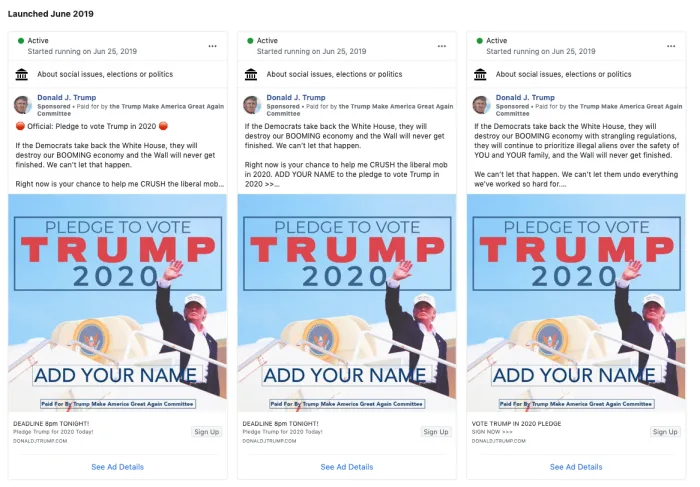
The ad library can reveal some interesting stats. Donald Trump’s page has spent more than $14 million on Facebook ads since May 2018. And you can see them all.

Trump adsYou can also click on a specific ad to see who saw it.
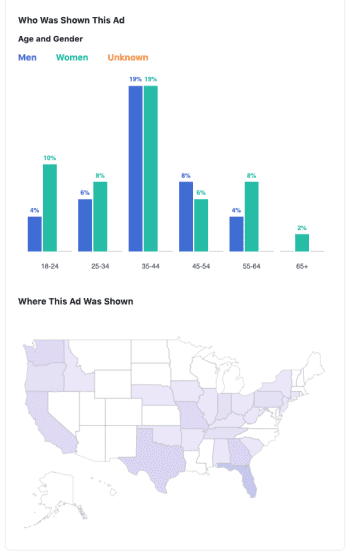
Trump ad performanceRemember, an advertiser can specifically target or exclude audiences. This map shows us that 13% of the ad’s audience was in Florida, a key state to any candidate’s electoral strategy.

We can also see that over the last 90 days, Trump’s campaign has spent $2.5 million, while former Vice President Biden spent the second most at $1.5 million. Something called the International Rescue Committee is third with $1.2 million, and ClassAction.com is fourth with $1.1 million.

Why this won’t work

The real issue is that this tool only helps with ads run by legitimate campaigns or Political Action Committees (PACs). Many of the forces working to undermine democracy keep a significantly lower profile.

Jesus adAccording to Politico, this ad of an arm-wrestling Jesus was created in October 2016. For $1.10, the Kremlin-linked Internet Research Agency was able to spread it around Facebook, targeting people age 18 to 65+ interested in Christianity, Jesus, God, Ron Paul and media personalities such as Laura Ingraham, Rush Limbaugh, Bill O’Reilly, and Mike Savage.

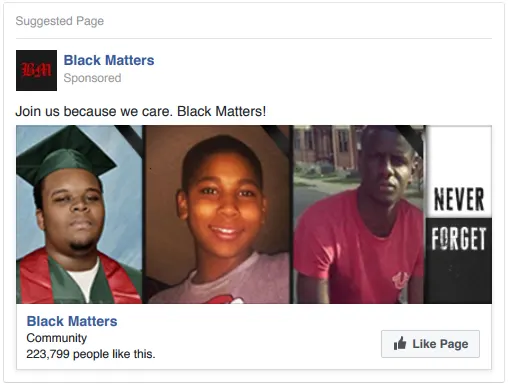
Russian ad

The same Russian group spent $915 to target this ad to people ages 18 or older in Georgia, Maryland, Missouri or Virginia. By accumulating “likes” on these fabricated pages, the Russians were able to amplify future divisive messages organically.

While 29 million Americans saw these kinds of Russian-backed posts directly, the algorithm ended up pushing them out to 126 million Americans during the 2016 U.S. presidential election.

The total number of voters in 2016? Just under 139 million.

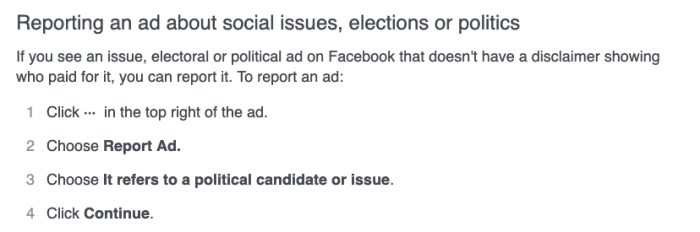
Another issue is that Facebook is expecting these advertisers to self-report their goals. According to their policy, “when ads about social issues, elections or politics appear on Facebook products, they’re required to include information about who paid for them.” And what happens if a group doesn’t disclose that information? Facebook expects you, the regular user, to report the ad.

Facebook reportingWhat’s more likely, that Facebook users will police the platform or that they’ll simply scroll by or click like/share?

All of this action comes a month after Facebook refused to remove an altered video of Speaker of the House Nancy Pelosi. The page that posted that video is cranking out multiple videos every week. It’s not running ads. And if it’s not running ads, it’s not required to disclose who’s paying for their content. So Vladimir Putin himself could be running the page and spreading disinformation organically and we’d never know.

It’s possible that news organizations could clamp down on some of these pages by filing a copyright claim anytime a politically-motivated page uses their video. But that is something that only the copyright owner can do.

Facebook policyIn theory, you could upload the entirety of “Avengers: Endgame” to Facebook and unless Disney complains, Facebook wouldn’t take it down.

As much as Facebook tries to clamp down on disinformation, those who want to manipulate the algorithm will find a way to bypass the safeguards. It’s up to all of us to consider our clicks before we make them. And better yet, maybe it’s time to delete Facebook entirely and get your political information from publicly funded straight-shooters like NPR and PBS.