
A series of new and astonishing images captured by the Dark Energy Camera, installed in the Victor M. Blanco Telescope at the Inter-American Observatory in Cerro Tololo, Chile, reveal an interstellar structure known as the “Hand of God”. Located in the Puppis constellation, 1,300 light-years away from Earth, this formation, officially named CG 4, resembles a ghostly hand reaching out into the cosmos towards a nearby spiral galaxy.

The National Optical-Infrared Astronomy Research Laboratory (NOIRLab) describes CG 4, a cometary globule, as “turbid and ominous,” highlighting its distinctive shape which is the source of its divine nickname. Cometary globules are dark nebulae composed of a high concentration of dust, known as Bok globules. Although their name suggests a connection to comets, their real connection is the similarity in their extended “tails.”
The Hand of God, with a “claw” that extends 1.5 light years and a tail of 8 light years, is one of the numerous comet-like globules present in the Milky Way. Although its appearance could suggest a threat to the spiral galaxy ESO 257-19, located more than 100 million light years away, the latter is at a safe distance from the claws of the colossal structure.
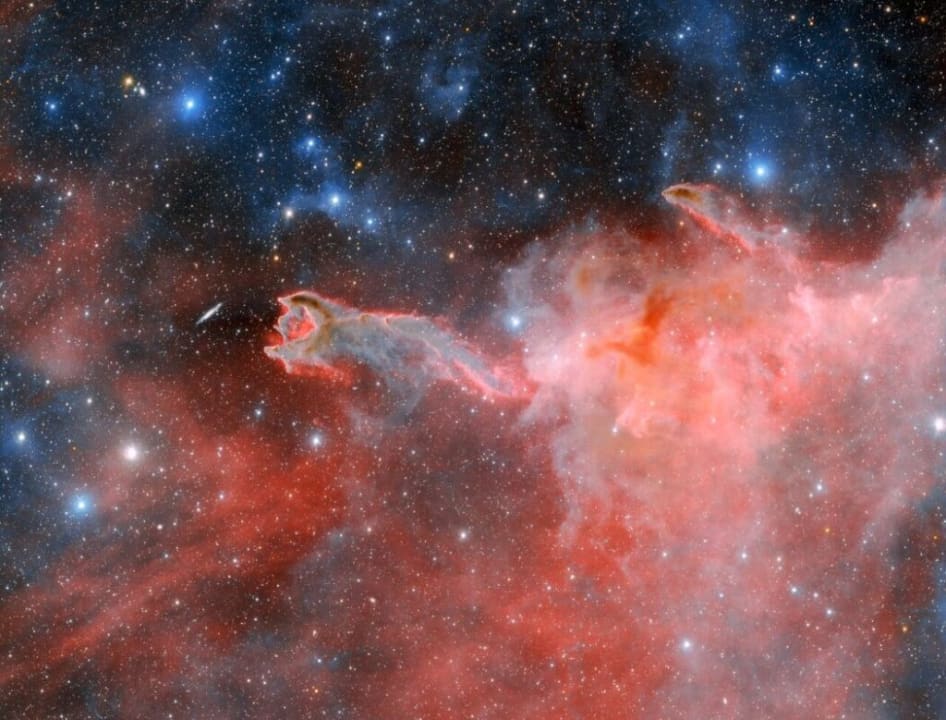
The CG 4 and other comet-like globules are mostly found within the Gum Nebula, a vast region of bright gas that hosts at least 31 of these structures, along with CG 4. It is believed that these globules are remnants of a supernova that occurred approximately one million years ago.
The observation of the Hand of God offers astronomers a unique opportunity to study the formation and evolution of these intriguing interstellar structures. Although similar ones have been sighted throughout the Milky Way, CG 4 stands out for its distinctive shape and its relative proximity to the spiral galaxy ESO 257-19, making it an object of great interest for astronomical research.
