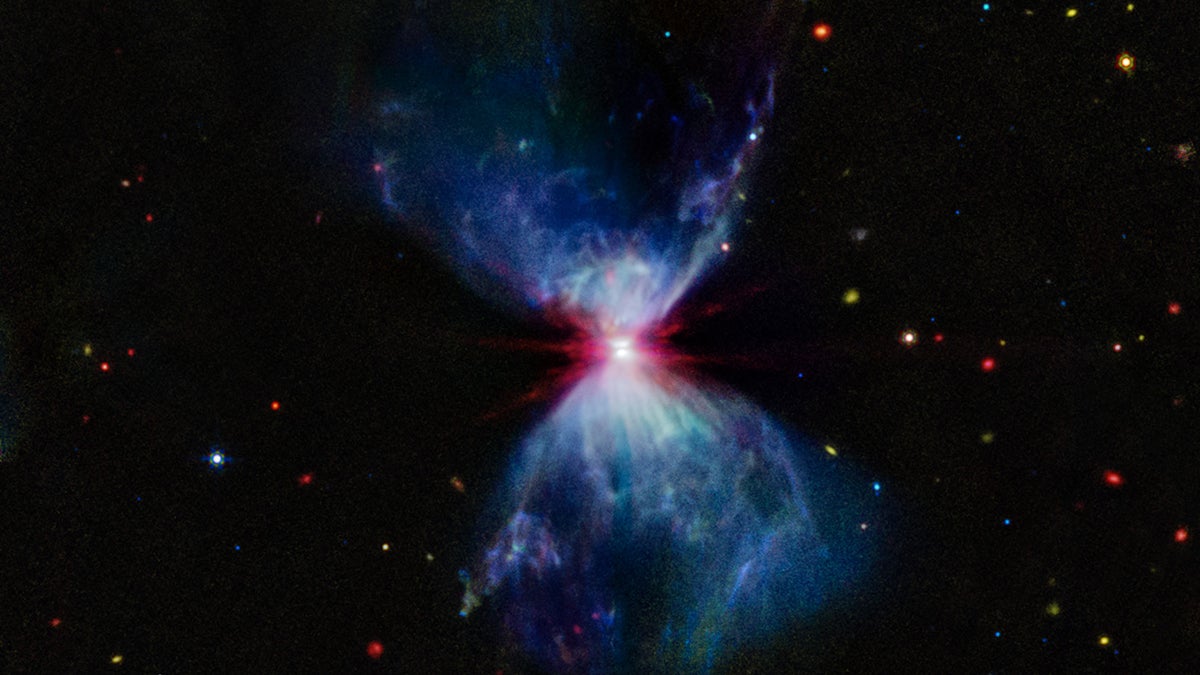
The James Webb Space Telescope from NASA has captured an impressive image of a hidden protostar in the dark molecular cloud L1527, which is in the process of formation. This new capture highlights the behavior of this young celestial object and shows the different concentrations of gas and dust that surround it.
The image, taken with the MIRI (Mid-Infrared Instrument) of the Webb, reveals a protostar growing in the neck of an hourglass-shaped structure, accumulating material from a thin protoplanetary disk, visible as a dark line.

With only 100,000 years, this protostar is still enveloped in its mother molecular cloud. Previously, the NIRCam (Near-Infrared Camera) of the Webb allowed to observe this region, showing the cloud and the protostar in vibrant and opaque colors. Both NIRCam and MIRI have revealed the effects of the outflow streams that are emitted in opposite directions along the rotation axis of the protostar. These outflow streams, which take the form of arc shocks, sculpt the hourglass structure within the molecular cloud, energizing the surrounding matter and creating a glow reminiscent of fireworks in a night sky.
Unlike NIRCam, which primarily shows the light reflected in the dust, MIRI offers a view of how these flows affect the denser dust and gases. The blue areas of the hourglass indicate the presence of polycyclic aromatic hydrocarbons, while the red areas represent the dense mantle of dust and gases surrounding the protostar. In addition, MIRI reveals a white region directly above and below the protostar, a mixture of hydrocarbons, ionized neon, and thick dust, which shows how the protostar propels this matter as it consumes material from its disk.
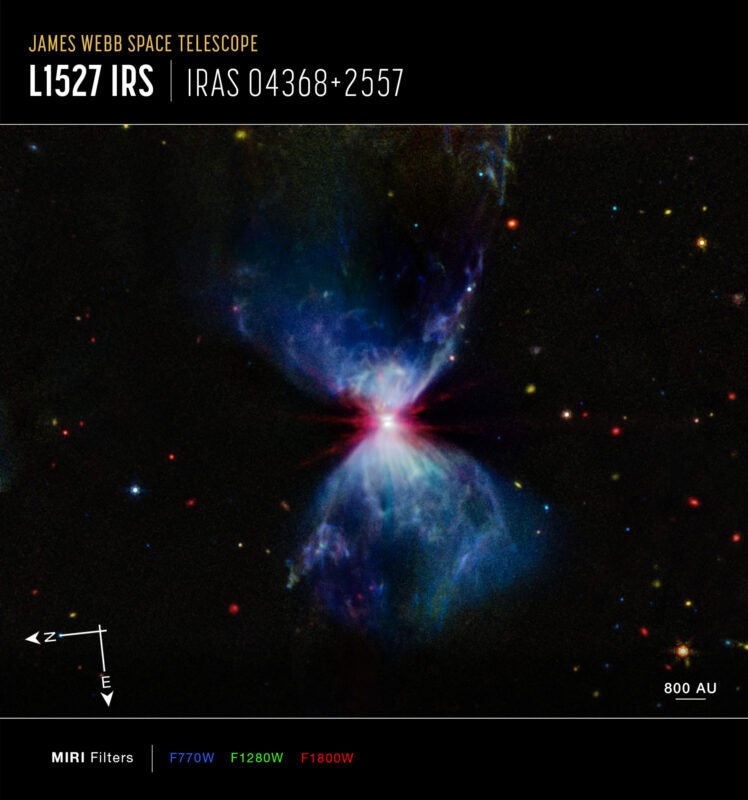
Over time, the protostar will continue to age and release energetic jets, consuming and pushing away much of the molecular cloud, causing many of the observed structures to begin to fade. Eventually, when it finishes accumulating mass, the star will become even more visible, even to visible light telescopes.
The combined analysis of near-infrared and mid-infrared images reveals the behavior of this system and how the central protostar is affecting the surrounding region. Other stars in the Taurus region, where L1527 is located, are forming in a similar way, which could alter other molecular clouds and affect the formation of new stars.
