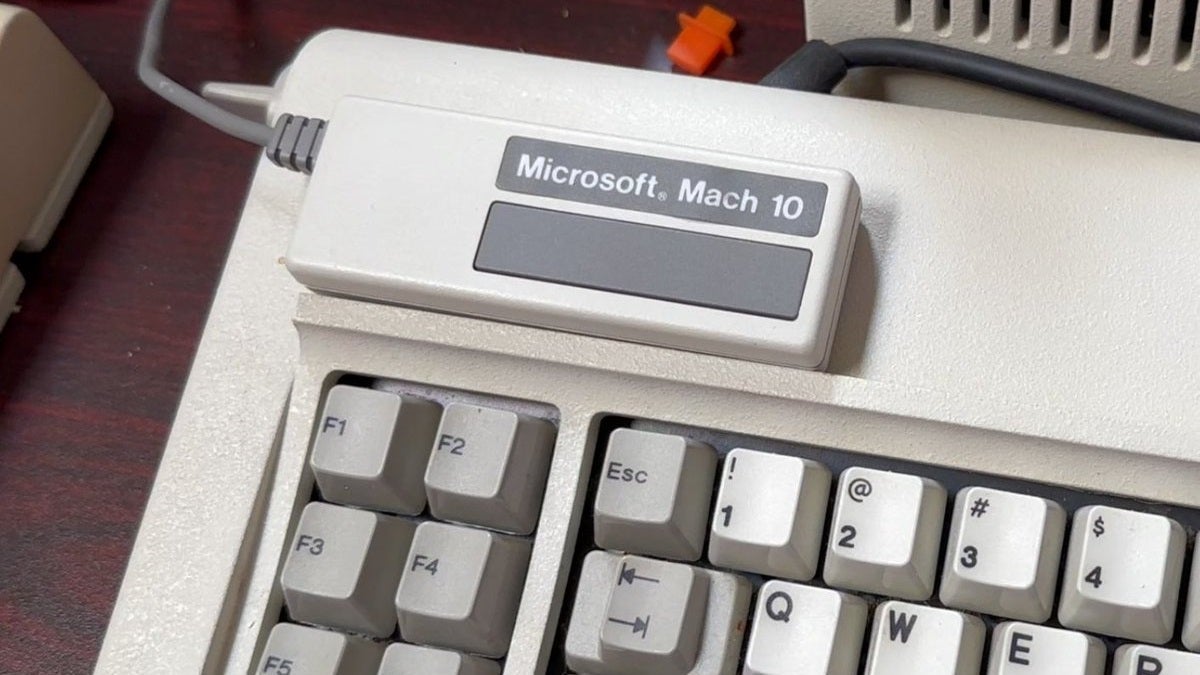
In the mid-1980s, it wasn’t even clear that the ubiquitous Windows operating system would last much longer, as Microsoft was working with IBM on an alternative to both Windows and the DOS it was based on: OS/2.
And although it ultimately did not manage to displace Windows in the market, OS/2 enjoyed a very good reputation among PC users. Despite this, a very specific version of OS/2 was, in fact, Microsoft’s least sold product of all time. We present to you OS/2 for Mach 20, of which a total of 11 copies were sold, of which eight were returned.
A hard-to-believe story in 2025
Let’s go back to the mid-1980s. At that time, computers were on their way to becoming something ubiquitous, but they had not yet reached that status.
We were still in a transition period, where many companies were computerizing their operations, but continued to operate with budgeting ideas that were firmly rooted in the dynamics of the 1960s offices.
Computers were very expensive, but they were also the future, so it was likely that one could convince the expense account managers of companies that this huge investment in computers was necessary for the business.
However, personal computer technology was advancing very rapidly in the late 1980s. In just a few years, we went from 4.77 MHz 8088 CPUs with an 8-bit bus to 33 MHz 386DX units with a 32-bit bus, and we transitioned from monochrome graphics to SVGA, with 256 bright colors.
All of this had a cost, and trying to convince the accountants that it was time to upgrade the computers in just a few years was a Herculean task. What if, instead, it were possible to upgrade the machine with an expansion card that offered most of the advantages of a new computer at a fraction of the cost? That could be much easier to sell.
That was, at least, the commercial promise of the very popular “Turbo cards,” including Microsoft’s Mach 10 hardware upgrade card. The Mach 10 was a card with a flat cable that connected to the CPU socket of the PC. The CPU was replaced by that connection, and the much faster 8086 CPU on the card, with its own local memory, took over.
Although you were still limited by the scarce capabilities of the 8-bit system bus and the slow storage, this really provided a significant acceleration in CPU-dependent tasks.
The Mach 10 was not especially popular (due, at least in part, to its high price), but Microsoft, perhaps encouraged by the great success of its previous CP/M card for the Apple II, decided to try again with the Mach 20. This card had more features, including the ability to expand memory by connecting a secondary card directly to the Mach 20 expansion board, which saved a valuable expansion slot on the motherboard.
The Mach 20 was not particularly popular either, but apparently it was popular enough for Microsoft to decide that it was worth launching a specific version of OS/2 for the Mach 20, and that specific version was supposedly the least sold Microsoft product of all time.
The concrete figure is basically a rumor at this point, but Raymond Chen writes: “One of my former colleagues spoke with the person who replaced him as the OS/2 technical support specialist for Mach 20. According to that person’s recollections […], a total of eleven copies of ‘OS/2 for Mach 20’ were sold, and eight of them were returned.” That leaves only three customers who bought a copy and did not return it. And the technical support specialist had personally spoken with two of them.
As funny as it may be to think of a version of an operating system that sold a mere 11 units, of which eight were returned, it is actually not surprising at all. The version in question required the extremely rare Mach 20 hardware, and OS/2 itself was not particularly well-known outside of the circle of die-hard enthusiasts; most of those who returned it probably bought it without really knowing what they were getting into.
That said, it is possible that the three who kept it were completely satisfied with the product, but we will probably never know.
