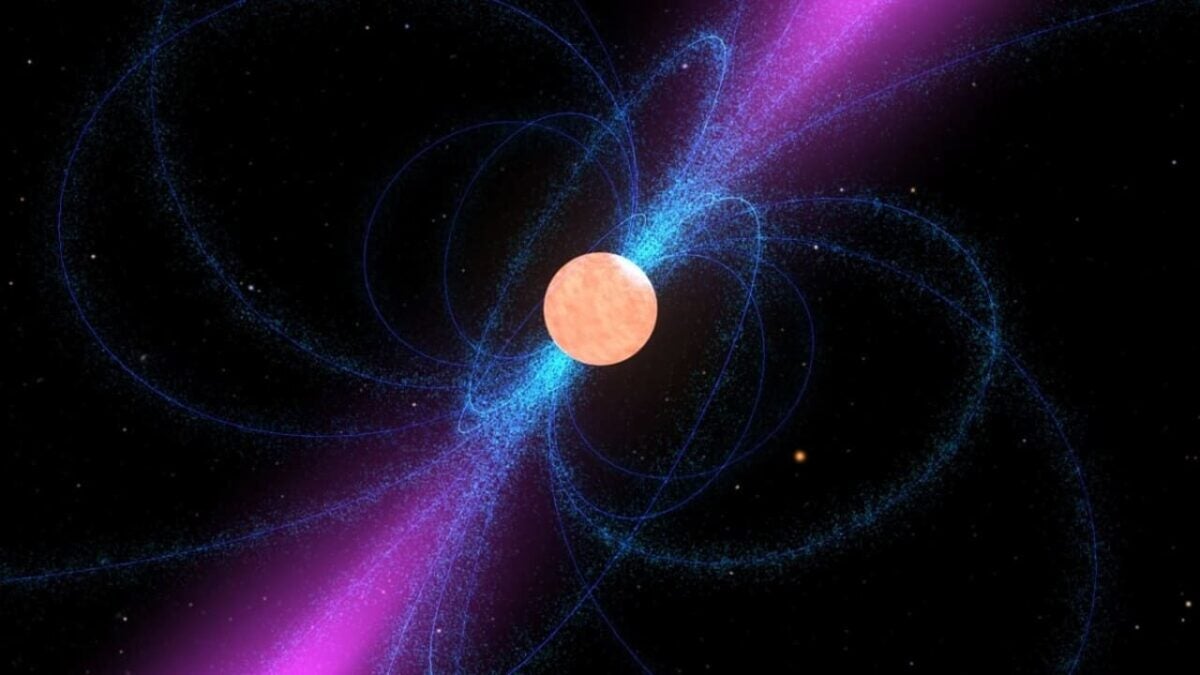
Astronomers have been observing pulsars for a long time, which are highly magnetized neutron stars that spin and emit energy signals, resembling beacons.

These repetitive radio signals are detected here on Earth as powerful and surprisingly regular bursts, at least until they inevitably slow down and die out.
Now, a team of researchers has discovered a different type of pulsar called a magnetar, which emits even more powerful bursts of radio waves that repeat every 22 minutes, an astonishingly long period for a celestial object of its kind.
In fact, as detailed by astronomers in a new study published in the journal Nature, this particular magnetar, nicknamed GPM J1839-10, has been emitting five-minute-long signals from a distance of 15,000 light-years since 1988, with an incredible degree of precision, down to a tenth of a millisecond.
No failure for 33 years
And it appears that it shows no signs of stopping, confounding our pre-existing notions about pulsars.
“This extraordinary object challenges our understanding of neutron stars and magnetars, which are some of the most exotic and extreme objects in the Universe,” said lead author Natasha Hurley-Walker, a radio astronomer from Curtin University (Australia), in a statement.
In other words, the magnetar should have died long ago, and its “radio emission should only have been visible for a few months or years, not 33 years and counting,” Hurley-Walker concluded.
“So when we try to solve one problem, we accidentally create another,” she wrote. “What are these mysterious sources of repetitive radio waves?”
Astronomers are now faced with an even greater enigma. What is J1839-10? Could it really be a magnetar despite its astonishing longevity?
The discovery could force us to reconsider what we know about the evolution of neutron stars. For now, Hurley-Walker and her team hope to detect more radio signals like this one.
“It was an incredible moment for me,” recalls Hurley-Walker, referring to the moment when she found evidence of the signal in the data recorded in 1988. “I was five years old when our telescopes first recorded pulses from this object, but nobody noticed, and it remained hidden in the data for 33 years.”
Back then, they didn’t realize it because they weren’t expecting to find anything like it. The Universe is fascinating… and our knowledge about it changes every day.
Some of the links added in the article are part of affiliate campaigns and may represent benefits for Softonic.
