The Grumman X-29 looks like a plane that a child assembled from a model kit without reading the instructions, hence the wings of the plane were, for the first time, placed in the opposite direction. Dear reader, innovation is not always necessary. This model can only be seen at the National Museum of the United States Air Force in Dayton (Ohio) or the NASA Armstrong Flight Research Center in Edwards (California), where there are prototypes of one of the strangest planes ever to come off the drawing board. For those who are not familiar with it, this plane (the […]
The Grumman X-29 looks like a plane that a child assembled from a model kit without reading the instructions, hence the wings of the plane were, for the first time, placed in the opposite direction. Dear reader, innovation is not always necessary.
Subscribe to the Softonic newsletter and get the latest in tech, gaming, entertainment and deals right in your inbox.
This model can only be seen at the National Museum of the United States Air Force in Dayton, Ohio, or the NASA Armstrong Flight Research Center in Edwards, California, where there are prototypes of one of the strangest aircraft that have ever come off the drawing board.
For those who don’t know it, this plane (the Grumman X-29 of the United States Air Force) was born during the 1980s and is a fighter whose main attraction is that it has reverse wings. Let’s tell its story.
When did the idea of inverted wings arise?
In the 1930s, aeronautical engineers experimented with all kinds of wings. There were box wings, tube wings, cantilever wings, rotating wings, and wings that looked like Venetian blinds. If you could imagine a wing, someone was building it. This, in general, is the best way to break with the established norms.
One proposal was to sweep the wings forward instead of backward. The idea was that such a wing would reverse the usual flow over it. While in a backward-swept wing the air flows from the root to the tips, in a forward-swept wing the air flows from the tips to the roots. This reduces drag, increases maneuverability, and allows for flying at a steeper angle of attack.
As explained in New Atlas, the concept was put into practice by Germany during World War II with the Junkers Ju 287 jet tactical bomber. It was later incorporated into the civil aircraft Hansa Jet HFB-320 in the 1960s, but in both cases, the wings were far from successful due to the tendency of the wings to be unstable because of excessive wing flexing.
How the technology for the final design of the X-29 was achieved in 1970
In the 1970s, DARPA, the U.S. Air Force, and NASA decided to revisit the concept thanks to the development of new carbon composites that promised to make forward-swept wings more rigid without adding too much weight.
The result was the X-29, which flew for the first time in 1984 and served as a testbed until 1992. Two prototypes were built and from the beginning they had a strange but familiar profile.
The strange wings were located far back on the fuselage and, instead of tail stabilizers, they had ailerons located in front of the wings. The familiarity was due to the fact that the designers saved money by basing the design on the fuselage of an F-5 Freedom Fighter with the landing gear of an F-15.
The X-29 had quite decent performance. Its General Electric F404-GE-400 engine produced a maximum of 16,000 pounds of thrust, giving it a top speed of Mach 1.5, an operational ceiling of 50,000 feet (15,000 m), and a range of about one hour of flight.
However, as expected, it was very unstable. And this instability made it very difficult to pilot.
Grumman’s response to the antisocial degree of aerodynamic instability of the X-29 was to install a state-of-the-art system that corrected the aircraft’s flight 40 times per second.
In many ways, the X-29 was a great success, as it provided American engineers with tons of data that would be used in subsequent aircraft designs. However, the wing design did not succeed and died with the X-29.
For those who don’t know them, they are the oldest and most distant probes built by humans that are still active. They are also the only probes that have left our solar system and ventured into the vast expanses of space. Unlike many other probes, these continue to function not thanks to solar energy, like the rest, but through nuclear energy. But at some point, their mission will end. And right now is a good time to remember that. The Voyagers began as planetary missions. Their goal was to carry out the so-called Grand Planetary Tour, that is, to visit […]
For those who are not familiar with them, they are the oldest and most distant probes built by humans that are still active. They are also the only probes that have left our solar system and ventured into the vast expanses of space.
Subscribe to the Softonic newsletter and get the latest in tech, gaming, entertainment and deals right in your inbox.
And unlike many other probes, these continue to function not thanks to solar energy, like the rest, but due to nuclear energy. But at some point, their mission will end. And right now is a good time to remember that.
The Voyagers began as planetary missions. Their objective was to carry out the so-called Grand Planetary Tour, that is, to visit the four outer planets of the solar system through a series of flybys. Jupiter, Saturn, Uranus, and Neptune were seen in a new light thanks to the robotic cameras of the probes and their numerous scientific instruments.
Everything we know about Uranus and Neptune is thanks to the Voyagers
The ice giants Uranus and Neptune, in particular, were studied for the first and only time in history by Voyager 2, while the successful observations of Jupiter and Saturn served as a basis for subsequent interplanetary missions to these worlds, such as Galileo, Juno, and Cassini-Huygens. Voyager 1, on the other hand, had as its main objective Titan, the largest moon of Saturn and one of the most intriguing satellites of the outer solar system.
Once the planetary journeys of the Voyagers were completed, it was possible to start a new phase of the mission. After their last planetary stops, both probes reached the escape velocity for the solar system, which allowed them to break free from the sun’s gravity.
Since 2012, in the case of Voyager 1, and since 2018, in the case of Voyager 2, they have become interstellar. We know this because after those dates, the probes’ sensors showed that the charged particles coming from the sun became less numerous and energetic than those detected in the galactic environment. It was a golden opportunity to study the boundaries of the solar system and the environment outside of it.
Voyager 1: the GOAT of space exploration. ?
At 47 years old and 15.4 billion miles away, it went silent due to a heater glitch. But NASA fixed it, and it’s back to sending data from interstellar space—powered by decaying plutonium.
Reaching such a distance is only possible with the right energy source. Many probes use solar panels, but if they get too far from the sun, they become useless (the farthest probe using them is Juno, which orbits around Jupiter).
The secret of the Voyagers lies in their atomic heart: both are equipped with three radioisotope thermoelectric generators, or RTGs, small power generators that can produce energy directly on board. Each RTG contains 24 spheres of plutonium-238 oxide with a total mass of 4.5 kilograms.
Plutonium-238 is an unstable isotope, which means it undergoes radioactive decay. The plutonium atoms in RTGs release alpha particles (composed of two protons and two neutrons) that collide with the RTG container and heat it. The heat is converted into electricity.
But over time, the plutonium on board depletes and the RTGs produce less and less energy. The Voyagers are slowly dying. The nuclear batteries have a maximum lifespan of 60 years.
In order to conserve the remaining energy of the probes, the mission team is gradually shutting down the various instruments of the probes that are still active.
There are four active instruments remaining, including a magnetometer, as well as other instruments used to study the galactic environment, with its cosmic rays and interstellar magnetic field. But these are in their final years. In the next decade, the 2030s, the batteries of both probes will run out forever.
Science fiction is a booming genre, especially thanks to streaming platforms that continue to invest in it. From the supremacy of Apple TV+ to the mainstream offerings of Netflix or Prime Video, new series and movies keep appearing that captivate fans of the genre. This fertile ground allows classic science fiction gems to find a good place within the platforms. From cult films like The Thing to gems that went unnoticed at the time like eXistenZ, new titles keep emerging that have […]
Science fiction is a booming genre, especially thanks to streaming platforms that continue to bet on it. From the supremacy of Apple TV+ to the mainstream offerings of Netflix or Prime Video, new series and movies keep appearing that captivate fans of the genre.
This breeding ground allows classic science fiction gems to carve out a good niche within the platforms. From cult films like The Thing to gems that went unnoticed at the time like eXistenZ, new titles keep emerging that have a new life thanks to streaming. And this is what’s happening with Curvature, a film that has sneaked into the most-watched list on Prime Video without anyone really expecting it.
Pure and uncompromising science fiction
Curvature is an independent science fiction thriller, directed by Diego Hallivis, which was made on a very low budget, considering what the genre is accustomed to. At the time, it did not generate many good reviews, but throughout its 88 minutes, it offers some surprises that are well worth it.
The story centers on Helen, played by Lyndsy Fonseca, a woman who tries to unravel the mysteries behind the unexpected death of her husband, a scientist involved in time travel research. During her search, Helen discovers that she has sent herself a message from the future, leading her to face temporal paradoxes while trying to prevent a greater disaster.
Curvature is about grief in futuristic times, combining time travel science fiction with a personal drama that anyone can relate to. The film combines flashbacks with very well-shot action scenes for its budget, and it is definitely worth a look.
AirPods have become one of the favorite Christmas gifts. With each generation, Apple has improved the sound quality, design, and connectivity, making these headphones a standard. This year, although we have seen the arrival of the new AirPods 4 and an update for the AirPods Max, the anticipated AirPods Pro 3 are not here yet. So, especially if we are considering AirPods for this Christmas, let’s see what we can expect from this next generation. The AirPods Pro 3 will arrive in the fall of 2025 The first and most important thing is to know when […]
AirPods have become one of the favorite Christmas gifts. With each generation, Apple has improved the sound quality, design, and connectivity, making these headphones a standard. This year, although we have seen the arrival of the new AirPods 4 and an update for the AirPods Max, the much-anticipated AirPods Pro 3 are still not here. So, especially if we are considering AirPods for this Christmas, let’s see what we can expect from this next generation.
The first and most important thing is to know when we will see the AirPods Pro 3. According to rumors, the launch of this new generation is scheduled for the fall of 2025. If we look at previous versions, Apple seems to prefer the months of September or October—along with the iPhones—for this type of presentation. The wait is, therefore, considerably long.
The design of the AirPods Pro 3 promises to be the first to change significantly since the introduction of the originals in 2019. Here we expect greater comfort, as well as a better fit. The latter translates into a better seal of the ear canal, which will improve sound quality and noise isolation.
The heart of this new generation will be the H3 chip, which will improve sound and noise cancellation. The jump from H1 to H2 brought cancellation that doubled the effectiveness and a much richer frequency range. With the H3, we can expect even more refinement in audio and new features like Transparency Mode.
Finally, rumors suggest that the AirPods Pro 3 will integrate new health capabilities. Apple is working, as far as we know, on sensors to accurately measure body temperature. This data can support more functions and monitoring of our health.
All in all, if we are considering upgrading our AirPods, we might wonder if we should wait until 2025. The answer will depend on our needs, but what is clear is that the AirPods Pro 3 seem to be designed to mark a before and after.
After three seasons filled with mystery and horror, From has dropped a bombshell that has left its followers shocked: the true nature of the cursed town and its sinister inhabitants. And, obviously, here come the spoilers. In the final episode of season 3, titled Revelation: Chapter 2, it is revealed that the nocturnal creatures terrorizing those trapped in the town are not just any monsters, but the former residents of the place, transformed after making a dark pact with a malevolent entity. The agreement promised them immortality in exchange for the sacrifice of their own children, an act that condemned their […]
After three seasons filled with mystery and horror, From has dropped a bombshell that has left its followers shocked: the true nature of the cursed town and its sinister inhabitants. And, evidently, here come the spoilers.
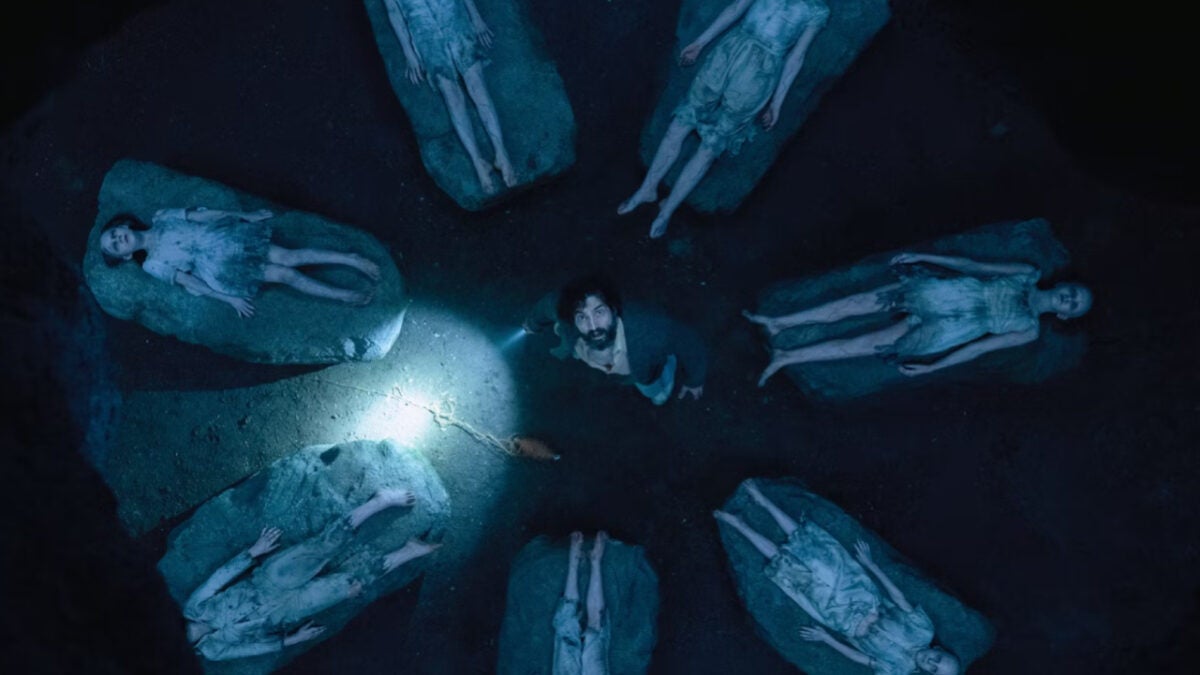
In the final episode of season 3, titled Revelation: Chapter 2, it is revealed that the nocturnal creatures terrorizing those trapped in the town are not just any monsters, but the former residents of the place, transformed after making a dark pact with an evil entity. The agreement promised them immortality in exchange for the sacrifice of their own children, an act that condemned their souls to an endless cycle of suffering and reincarnation.
Subscribe to the Softonic newsletter and get the latest in tech, gaming, entertainment and deals right in your inbox.
The key to this terrifying enigma lies with the murdered children, who try to guide characters like Tabitha and Jade to break the cycle. Through clues like the numbers on the bottles and a musical sequence, it is discovered that the sacrifices connect with the magical trees that allow teleportation. However, the ending doesn’t stop there: the appearance of the enigmatic Man in the Yellow Suit, who seems to be the entity behind the pact, changes the rules of the game. This being, capable of defying the laws of the place, causes an unexpected death and adds an even more disturbing layer to the story.
Although fans were expecting definitive answers, From has opted for an approach that resolves some mysteries while introducing new unknowns. With a fourth season confirmed for 2026 on Max, the debate and theories will continue to fuel the community as they wait to see how this nightmare unfolds in the upcoming episodes. Are we facing a new case of Lost? It seems not entirely… but it repeats some formulas that are too reminiscent of that series.
Despite being a box office success and the reviews not being entirely poor, Vaiana 2 is far from being the original 2016 movie. The sequel, as almost all critics point out, does not measure up in songs, story, or emotion. And although many have been surprised, the reason for this is very clear: it was initially going to be a series. In an interview, director David Derrick Jr explained that they were going to continue the world of Vaiana in a serialized fiction for Disney Plus, but eventually […]
Despite being a box office success and the reviews not being entirely poor, Moana 2 is far from being the original 2016 film. The sequel, as almost all critics point out, does not measure up in songs, story, or emotion. And although it has surprised many, the reason for this is very clear: it was initially going to be a series.
Subscribe to the Softonic newsletter and get the latest in tech, gaming, entertainment and deals right in your inbox.
In an interview, director David Derrick Jr explained that they were going to continue the world of Moana in a serialized fiction for Disney Plus, but they eventually changed plans… and both he and his team had to adapt. They explored more of Moana’s journey instead of focusing on other characters… but it’s noticeable that many things were lost along the way.
Director David Derrick Jr tells us that when ‘MOANA 2’ was a TV series, there was a greater focus on the crew members on the journey
The plot of Vaiana 2 takes place three years after the first movie. Vaiana and Maui, accompanied by a new and diverse crew, receive a call from their navigator ancestors that leads them to explore unknown and dangerous waters in Oceania. Although it features a soundtrack by award-winning artists like Opetaia Foaʻi, Mark Mancina, and Abigail Barlow, unfortunately, it does not reach the level of the previous one.
James Gunn has a perspective on the universe he is creating with DC Comics material that is very different from the Marvel Cinematic Universe. As the filmmaker explains, his main goal is to have very good scripts to gradually build his franchise and engage the audience. And the first test he has is with Creature Commandos. The animated series scheduled for December 5th has already been shown in dozens of images and presentation trailers. But we hadn’t been able to see the interaction between the characters well… until now. From […]
James Gunn has a very different perspective on the universe he is creating with DC Comics material compared to the Marvel Cinematic Universe. As the filmmaker explains, his main goal is to have very good scripts to gradually build his franchise and integrate the audience. And the first test of fire is with Creature Commandos.
Subscribe to the Softonic newsletter and get the latest in tech, gaming, entertainment and deals right in your inbox.
The animated series scheduled for December 5th has already been shown in dozens of images and presentation trailers. But we hadn’t been able to see the interaction between the characters well… until now. Max has released an exclusive clip of the series and it looks even better than many expected.
In a world where the darkest experiments have created monsters with extraordinary abilities, the Creature Commandos, a group of supernatural misfits, carry out covert missions for the government. Together, they face global threats while grappling with their own internal conflicts, trying to prove that even monsters can be heroes. Amidst action, horror, and dark humor, the series explores the limits of humanity in those whom society fears and rejects.
Autodesk’s CyberWeek launches December 2nd and runs through December 8th. The promotion will bring significant discounts that will allow us to access renowned design tools and software at highly attractive prices. From AutoCAD to Fusion 360, including specialized versions like AutoCAD IST or Revit LT Suite, now is the perfect time to renew our licenses or try new solutions.
The discounts available from December 2 to December 8, reach up to 25% on various tools. A wide range of options covers both general and specific needs in design and manufacturing, now accessible at more attractive prices.
The discounts apply to both new licenses and renewals, meaning we can enjoy the benefits regardless of our current software situation.
In this regard, CyberWeek not only offers more competitive prices but also allows us to explore solutions we might not have considered before. With Autodesk tools, we are assured of working with trusted, powerful products that have long been a standard in the industry.
AutoCAD and AutoCAD IST: Precision Design Wherever We Are
AutoCAD is the most recognized computer-aided design (CAD) tool on the market and a standard in multiple industries. It allows us to create precise 2D and 3D drawings with a level of detail that satisfies even the most demanding needs.
AutoCAD is not just a tool for architects or engineers; it is also indispensable for industrial designers, urban planners, and even entertainment professionals, such as those working in visual effects. Its versatility, combined with an interface optimized for different use cases and its ability to adapt to specific workflows, makes it an essential choice for those seeking efficiency and precision in their projects.
AutoCAD: A Reference in the Computer-Aided Design Market
With AutoCAD, we have access to a set of powerful tools designed to optimize design and collaboration:
2D and 3D Design Creation: We can work with complex geometries, set exact dimensions, and easily generate three-dimensional representations.
Automation of Repetitive Tasks: Features like block libraries allow us to reuse recurring elements, optimizing time in our projects while building our own catalog of personalized solutions.
Cloud Collaboration: Thanks to the integration with Autodesk Drive and BIM 360, we can access our projects from anywhere, share them with our team, and work in real-time, wherever we are.
Compatibility: AutoCAD works in the DWG format, which has become the industry standard, ensuring that our designs are accessible and editable on practically any platform. And if we need a specific solution, we can find the necessary tool to make the conversion.
AutoCAD IST: Industry Specialization
AutoCAD IST, in turn, takes the AutoCAD experience a step further, focusing on specific sectors like industry and telecommunications. This version includes customized tools for working with specific standards and simplifies tasks that are normally more complex in other CAD tools, such as designing electrical systems, wiring diagrams, or telecommunications infrastructure. With AutoCAD IST, we can save time and reduce errors by automating complex processes.
20% Discount for New Licenses or Renewals
During CyberWeek, both AutoCAD and AutoCAD IST are available with a 20% discount on annual subscriptions. This means we can access one of the most advanced tools on the market with significant savings. With Autodesk’s focus on current customers—rather than future ones—if we are already users, this promotion is an opportunity to renew our licenses at more competitive prices.
Revit LT Suite: Simplified Architecture
Revit LT Suite is a solution specifically designed for architects and designers who want to take advantage of Building Information Modeling (BIM) without the complexity of full versions.
This tool is ideal for those seeking an efficient and easy way to work on architectural projects. It allows us to design, document, and visualize projects intuitively, all while creating a 3D model that integrates all relevant information in a centralized manner.
Revit LT Suite not only facilitates the transition to BIM but also improves productivity and accuracy when bringing architectural projects to life. Among its standout features are the following:
Integrated 3D Modeling: Every element we design is automatically reflected in all project views. This means that if we update a door on the ground floor, its representation in sections, elevations, and construction plans is automatically updated.
Precise and Automated Documentation: With Revit LT Suite, we can generate all project documentation, from plans and sections to perspective views and schedules. All of this syncs with the main model, eliminating the need to manually update different elements.
Interoperability: The tool allows us to work in DWG and RVT formats, ensuring compatibility with other design software, both our own and third-party, and facilitating collaboration with multidisciplinary teams.
Visual Presentations: Revit LT Suite includes tools to generate rendered images and high-quality presentations, allowing us to communicate our ideas clearly and attractively.
Revit LT Suite is designed with simplicity and accessibility in mind, making it ideal for those who don’t need all the advanced functionalities of Revit but want to enjoy the benefits of BIM design.
During CyberWeek, Revit LT Suite offers a 25% discount on its annual subscription. These savings allow us to access a tool that transforms the way we work on architectural projects and facilitates collaboration with other professionals.
Fusion 360: Integrated Design and Manufacturing
Fusion 360 is much more than design software. It’s a platform that integrates design, engineering, and manufacturing into one solution, allowing us to manage highly complex projects from conception to production.
Whether we are developing prototypes, simulating mechanical parts, or creating designs for manufacturing, Fusion 360 offers the tools we need to work with precision and efficiency.
Fusion 360 stands out for its ability to unify multiple workflows in a single tool. Among its most notable features are:
Parametric and Freeform Design: It allows us to work with both strict geometries, using defined parameters, and organic and sculpted forms, which are ideal for creative projects.
Integrated Simulation: Before manufacturing a part, we can analyze its performance under different conditions, identify potential failures, and optimize the design for real-world use before creating the first prototype.
Product Lifecycle Management (PLM): Fusion 360 allows us to manage versions, collaborations, and revisions, ensuring all team members are always working with the latest version of the project.
Advanced Manufacturing Capabilities: From CNC milling to 3D printing, we can configure and optimize the entire manufacturing process directly within the tool.
Cloud Collaboration: With cloud integration, we can share projects, receive real-time feedback, and work simultaneously with other users, no matter where we are.
Fusion 360 is a solution that covers the entire product lifecycle, making it an ideal choice for engineers, industrial designers, and manufacturers who need a comprehensive tool.
25% Discount to Upgrade or Explore a New Way of Working
During CyberWeek, Fusion 360 is available with a 25% discount on annual subscriptions, offering a unique opportunity for those looking to enhance their workflow and optimize every stage of design and manufacturing.
AutoCAD LT: A Lightweight Option with Great Potential
AutoCAD LT is a more accessible alternative to the full version of AutoCAD, designed specifically for those who need to work exclusively with 2D drawings. Although lighter in features, it maintains the quality, precision, and reliability characteristic of Autodesk, making it an ideal choice for students, freelancers, and small businesses.
AutoCAD LT provides a simple yet powerful experience with tools designed to simplify our 2D workflow. Its main features include:
Intuitive Design Tools: AutoCAD LT features a set of tools that allow us to create, edit, and document designs efficiently.
Full DWG Compatibility: We can share and receive files without worries, ensuring our work is accessible to any collaborator.
Cloud Integration: With Autodesk Drive, we can save our projects in the cloud and access them from any device.
Automatic Updates: As a subscription-based product, we always have access to the latest version of the software, ensuring we work with the most up-to-date tools.
AutoCAD LT is ideal for projects that don’t require 3D modeling, offering a simplified yet effective solution for tackling design and documentation tasks.
25% Off for Our Annual Subscription
During CyberWeek, AutoCAD LT is available with a 25% discount on its annual plan, making it an even more attractive option for those seeking quality software at a reduced price. This discount allows us to access a tool that, while lighter than the full version, offers great power and versatility.
How to Take Advantage of These Discounts
Enjoying the CyberWeek discounts from Autodesk is simple, but we must act quickly, as they will only be available for one week: from December 2 to December 8. To access these special prices, we can:
Visit Autodesk’s Official Website: The promotions section contains all the details and purchasing options.
Speak with a Sales Representative: If we need more information or have specific questions, Autodesk’s team is available to assist.
Explore Subscription Options: Discounts apply to annual subscriptions, ensuring we get the best price for 12 months.
Additionally, if we are current Autodesk users, we can confirm that the discounts also apply to renewals and license upgrades.
Autodesk’s CyberWeek is the perfect opportunity to access design and manufacturing tools with significant discounts. Whether we need the versatility of AutoCAD, the specialization of Revit LT Suite, or the advanced integration of Fusion 360, there is an option for every need and budget.
With discounts of up to 25% on some of the industry’s most important tools, this is the time to make strategic decisions to improve our workflow.
For years, the world of music was something very simple: you took a song, covered it your way with your friends, released an album, and, with luck, managed to become a social phenomenon. Nowadays, however, things have changed, trends are not the same, and you don’t even need people to play with you or, in fact, for them to be real at all. The phenomenon of virtual bands seems to be on the rise, but it has actually been with us since the late 50s. Pay attention to the path we’ve taken since then, because it’s spectacular. […]
For years, the world of music was something very simple: you took a song, covered it your way with your friends, released an album and, with luck, managed to become a social phenomenon. Nowadays, however, things have changed; trends are not the same, and you don’t even need to have people playing with you or, in fact, for them to be real at all. The phenomenon of virtual bands seems to be on the rise, but it has actually been with us since the late 50s. Pay attention to the path we’ve taken since then, because it’s spectacular.
It all started in 1958, when singer David Seville modified his own voice in the song Witch Doctor to make it sound “chipmunk-like” with very high pitches and a faster speed than usual. It was a huge success, and thus, the trio that first accompanied him on stage and later flew on its own: Alvin and the Chipmunks. Although you may only know them from the film adaptations, the truth is that from the end of that decade until now, they have released more than fifty albums, each time of much more questionable quality.
Alvin and the Chipmunks ended up being a television series, had several video games, comics, and even went on four tours across the United States from 1984 to 2015. And, indeed, they have more Grammys than many artists. Seeing the situation, there were quite a few who jumped on the bandwagon to make “chipmunk” songs, trying to pursue a market where there weren’t that many people.
An example was the Nutty Squirrels, who also had a television series (even before Alvin and the Chipmunks) and released their last album in 1964. The album included a cover of, among other things, A Hard Day’s Night by The Beatles. Quite something. The world of singing mascots was put on hold for a moment until someone thought, “Hey, what if instead of squirrels, there are many more animals?”
From comic to reality
Said and done. In 1968, the Banana Splits were born in a Hanna-Barbera television series with their name: they were four animals dressed in hilarious costumes. And no, they weren’t just cartoons: they were also people dressed in plush suits playing songs. They even released several albums, although they were never famous enough to go on tour. However, very recently they had a reboot as a horror movie. Hey, you never know where success lies.
It was during this time that virtual bands finally had their moment of glory, emerging from the least musical medium possible: comics. The Archies (formed in the animated series that adapted the Archie comics) tried to adapt the success of The Monkees to animation, and they succeeded. In fact, their influence is so significant that even in 2023 there was an Indian movie for Netflix based on them. Alongside them, another group based on a comic from the same publisher: Josie and the Pussycats.
This is a curious case, because from the nonexistent band that played in the cartoon series, a real band was formed that released several albums, had a movie in 2001, and went on several tours. From a virtual band, a real band was born, something that Marvel tried to replicate with Jubilee (unsuccessfully). As fake music bands were becoming a profitable business, dozens of cheap TV series with this idea started to emerge, from Jabberjaw (whose protagonist was a shark) to the Cattanooga Cats (four cats playing guitar, bass, drums, and vocals) or Jem and the Holograms, among many others. And of course, the market became oversaturated.
They have become aggressive
When the industry calmed down, in 1998 perhaps the epitome of virtual bands was born: Gorillaz, a group whose real face was unknown. Its members were animated characters, their music videos pure fantasies that mixed anime with the late 90s aesthetic, their lore was more than well-formed… and they even ended up touring where the real band played completely in the dark behind a giant screen showing the videos that had made them famous. At least until 2005, when they came out as a real band… and the “Gorillaz-mania” subsided a bit. To this day, they still continue to perform concerts, release albums, and were even about to shoot a movie with Netflix (which ended up being canceled). Quite something.
With modernity and the Internet, this phenomenon has increased. There are idols that don’t exist and fill stadiums (like Hatsune Miku, for instance), groups that exist in the reality of games like League of Legends, or even singers that only sound thanks to artificial intelligence. And it’s going further. We have left behind the singing chipmunks and anime music videos to focus on cybernetic figures that seem taken from a cyberpunk fantasy in which, ultimately, we move. Will the day come when no one needs to pick up a guitar and the work on tours is just pressing “play” on a video? Hopefully, we won’t see it. With even more luck, we’ll return to the era of people dressed as animals playing the guitar.
Since Elon Musk left the OpenAI project, where he was not only one of the first people involved but also one of its biggest investors in the early years. Back then, Elon Musk trusted in the human and good work of AI and OpenAI. For the past year, everything has been lawsuits and complaints against those who were his colleagues and partners. The lawyers of the tech billionaire Elon Musk have requested a preliminary injunction against OpenAI, several of its co-founders, and its investor and close collaborator, Microsoft, to prevent OpenAI and other named defendants from participating in […]
Since Elon Musk left the OpenAI project, where he was not only one of the first people involved but also one of its biggest investors in the early years. At that time, Elon Musk trusted in the human and good work of AI and OpenAI. For the past year, it’s been all lawsuits and complaints for those who were his colleagues and partners.
Subscribe to the Softonic newsletter and get the latest in tech, gaming, entertainment and deals right in your inbox.
The lawyers of tech billionaire Elon Musk have requesteda preliminary injunction against OpenAI, several of its co-founders, and its investor and close collaborator, Microsoft, to prevent OpenAI and other named defendants from engaging in what Musk’s lawyer claims is anticompetitive behavior.
The request for a precautionary measure, filed late Friday in the U.S. District Court for the Northern District of California, accuses OpenAI, its CEO Sam Altman, its president Greg Brockman, Microsoft, LinkedIn co-founder and former OpenAI board member Reid Hoffman, and former OpenAI board member and Microsoft vice president Dee Templeton of various illicit activities, and seeks to stop them.
Elon Musk files for injunction to halt OpenAI’s transition to a for-profit https://t.co/WMoN08EdZ0
The accusations included in the lawsuit, as we have read, are:
Dissuade investors from backing OpenAI rivals like Musk’s own AI company, xAI.
Benefit from “competitively sensitive information improperly obtained” through OpenAI’s connections with Microsoft.
Convert OpenAI’s governance structure into a for-profit company and “transfer any material assets, including intellectual property owned, possessed, or controlled by OpenAI, Inc., its subsidiaries, or affiliates.”
Make OpenAI do business with organizations in which any defendant has a “material financial interest.”
Musk’s lawyers claim that “irreparable harm” will occur if the injunction is not granted.
“The plaintiffs and the public need a pause,” they wrote in the filing. “A court order to preserve what remains of OpenAI’s non-profit character, free from self-dealing, is the only appropriate remedy.” Otherwise, the OpenAI promised to Musk and the public will have disappeared by the time the court gets to the bottom of the matter.
The motion is the latest salvo in Musk’s legal battle against OpenAI, which fundamentally accuses the company of abandoning its original non-profit mission to make the fruits of its AI research available to everyone. Musk withdrew the lawsuit in July, but revived it later this summer. Earlier this month, an amended lawsuit included new defendants, including Microsoft, Hoffman, and Templeton, and two new plaintiffs: Shivon Zilis, a Neuralink executive and former OpenAI board member, and xAI.
Musk has claimed in previous lawsuits that he has been defrauded of more than 44 million dollars that he says he donated to OpenAI taking advantage of his “well-known concern for existential damages” of AI. Musk, one of the co-founders of OpenAI, left the company in 2018 due to disagreements about its direction.
History of OpenAI, from 2015 to 2024
OpenAI was launched in 2015 as a non-profit organization and, in 2019, it became a capped-profit where the non-profit organization became the governing entity of a for-profit subsidiary. The company is in the process of becoming a fully for-profit corporation, which reportedly would allow OpenAI to maintain its non-profit status as a separate entity.
Elon Musk created his response to OpenAI, xAI, last year. Shortly after, the company launched Grok, an artificial intelligence model that now powers a series of features on Musk’s social network, X (formerly known as Twitter). xAI also offers an API that allows customers to integrate Grok into third-party applications, platforms, and services.
In the request for a precautionary measure, Musk’s lawyers argue that OpenAI is depriving xAI of capital by obtaining promises from investors not to finance it or its competitors. In October, the Financial Times reported that OpenAI demanded investors in its latest funding round to also refrain from financing any of OpenAI’s rivals, including xAI.
Musk’s petition also alleges that Microsoft and OpenAI continue to illegally share proprietary information and resources, and that several of the defendants, including Altman, are conducting business on their own that harms competition in the market.
In a statement sent by email, a spokesperson for OpenAI said: “Elon’s fourth attempt, which once again recycles the same unfounded complaints, remains completely without merit.” The company had already tried to dismiss Musk’s lawsuit, calling it “bluster” and unfounded. We’ll see how all this ends now that Elon Musk is Donald Trump’s right-hand man.