OpenAI just rolled out something called Deployment Simulation ahead of the GPT-5 family launch. It’s a pre-release testing method meant to answer a pretty practical question: once a model is actually out in the world, how often is it likely to mess up?
The setup is different from the usual synthetic-prompt testing. OpenAI takes real, anonymized chats from an older model, replays them, and has the unreleased model write the next reply. According to the company, that approach got the direction of error trends right 92% of the time.
The idea is also supposed to cut down on the distortion you get when a model can, in effect, tell it’s being evaluated. Using de-identified conversation logs means the test is built around the kind of messy, unpredictable prompts people really type. OpenAI says that helped surface issues it hadn’t seen before, including something it calls “calculator hacking,” and shifted the emphasis toward how often failures are likely to happen in real use, not just whether a failure can happen in theory.
If you pay attention to AI safety, this one’s worth watching.
OpenAI is clear about the limits, too. Deployment Simulation isn’t meant to replace red-teaming or targeted evaluations, and the company says it should sit alongside both. Rare failures can still slip through. So can new attack techniques and odd behavior that doesn’t show up often enough to get caught this way. OpenAI researchers also ran the method on the public WildChat dataset so outside auditors would have a version they could use without private logs, though OpenAI says it’s probably less accurate than the internal-data version, especially as pressure keeps building from the US National Institute of Standards and Technology (NIST), new European Union rules, and safety institutes in other countries.
The full research paper is up on OpenAI’s website.
The Information reports that OpenAI brought in about $5.7 billion in revenue in Q1 2026, while burning through roughly $3.7 billion in cash. Both numbers were about three times what they were a year earlier.
That suggests demand is still rising fast. But computing costs are climbing almost in step with revenue, which makes the usual investor dream of widening margins harder to see.
Even so, The Information says OpenAI finished the quarter with more than $73 billion in cash and marketable securities, up from around $40 billion in December. Most of that jump, the report says, came from fundraising rather than from the underlying business.
The company has also told investors, per The Information, that it doesn’t expect to turn profitable until the end of the decade. The reason is straightforward enough: OpenAI plans to keep pouring tens of billions of dollars into infrastructure, model development, and the support systems around both.
Its latest funding round reportedly put OpenAI’s valuation at about $852 billion. That comes ahead of a confidential U.S. IPO filing that could land as soon as September 2026 and could value the company at as much as $1 trillion.
If you follow the AI business, this report is worth your time. The Information says OpenAI’s 2025 results showed a $39 billion net loss, or closer to $8 billion if you strip out a one-time non-cash charge tied to a structural conversion, on about $34 billion in total spending.
That spending total reportedly included roughly $19 billion in R&D. Add in competition from Anthropic, slower ChatGPT growth, and the possibility of model price cuts, and the pressure only builds.
The reported figures are in The Information’s coverage.
MP1st reports that CD Projekt may have another Witcher game in development, this time an unannounced free-to-play co-op action RPG for PC and mobile.
The report says players would create their own witcher in the year 1230, back when Geralt was still young, and then pick up monster contracts across a variety of environments. Combat is said to be skill-based, with school-specific abilities, Signs, and potion brewing all part of the mix.
MP1st also says this isn’t Project Sirius, the rebooted and larger-scale Witcher game in development for PC and consoles, which is set to include both single-player and multiplayer elements. It’s supposedly a separate project entirely.
The Witcher might be getting a mobile RPG. 🔥
Report suggests CD Projekt Red is working on a co-op, free-to-play Witcher RPG for mobile and PC.
◾Reportedly a co-op action RPG with multiplayer focus ◾Expected to be free-to-play, marking a big shift for the franchise ◾Likely… pic.twitter.com/39rY4eyuvO
No studio has been tied to the project yet. Still, it’s not hard to see why some people keep bringing up Scopely, especially after its IP deal with CD Projekt and those Scopely job listings for a “AAA action RPG” on PC and mobile, even if none of that proves anything by itself.
For now, this is still just a rumor. CD Projekt Red hasn’t announced the game, and on its Q1 2026 earnings call, the company only said that its Scopely project remains in early development and is “definitely not” coming out in 2026.
DSX, a PC app on Steam, just added something wireless haptics and adaptive triggers over Bluetooth in a new beta: wireless haptics and adaptive triggers over Bluetooth. So if you use Sony’s PlayStation 5 controller on PC, you can finally get its best features without keeping a USB-C cable plugged in.
Sony still doesn’t officially support this on PC. DSX apparently gets around that by making your computer think it’s connected to a wired DualSense, then sending the haptics and trigger data over Bluetooth anyway. Until now, the options were pretty limited. Stay plugged in, or mess with DIY fixes like a Raspberry Pi Pico adapter.
DSX PC App Beta Adds Haptic Support, Bluetooth Audio to Sony DualSense Controllers Connected Wirelessly. https://t.co/DIexK4QhCQ
The timing matters, too. Sony keeps bringing more first-party games to PC, and a lot of those ports make heavy use of DualSense feedback. Valve says daily controller use on Steam has tripled since 2018. PlayStation controllers now account for 26% of all controller gaming sessions on the platform, according to Valve.
So far, early impressions from Digital Foundry and PC Gamer have been positive. There are still a few open questions, though, especially around accessibility benefits and whether reliable unofficial support like this could shape how developers think about advanced controller features on PC.
If you use a DualSense on PC, this beta is probably worth trying. You can get DSX on Steam for PC.
Sensor Tower’s latest data on mobile chatbot apps points to two things at once. ChatGPT still has the biggest reach by far. Claude, though, is doing a better job turning users into paying subscribers.
In the US mobile market, Claude brought in $2.76 in revenue per user, compared with $1.74 for ChatGPT, per Sensor Tower. That’s a big jump from September 2025, when Claude was still under $0.50. About 13% of Claude users now subscribe, while ChatGPT sits closer to 8% across iOS and mobile, Sensor Tower says.
ChatGPT’s share of the market also slipped below 50% in March 2026 and was down to 46.4% by late May, according to Sensor Tower. Two years earlier, it was at 81%. Over that same stretch, Google’s Gemini reached 27.7%, and Claude climbed to 10.3%, Sensor Tower says.
ChatGPT just crossed 1.1 BILLION monthly users, making it the biggest AI assistant by far.
Claude’s $20 starting price seems to help, per Sensor Tower, while cheaper ChatGPT and Gemini plans pull their average revenue down. Sensor Tower also says OpenAI’s US Department of Defense deal lined up with a rise in ChatGPT uninstalls. Claude, meanwhile, picked up share after Anthropic passed on a similar deal.
ChatGPT still has the edge on retention, at 86% versus 73.7% for Claude, according to Sensor Tower. Consumer spending is also on track to hit $4.25 billion in H1 2026, up from $1.83 billion a year earlier, Sensor Tower says. That’s happening as OpenAI weighs price cuts, Google drops Gemini to $5, and Apple gets ready for bigger on-device Siri upgrades.
If you follow AI apps, keep an eye on this one. ChatGPT is ahead on scale, but Claude is showing that a smaller user base can bring in more money.
You can download ChatGPT, Claude, and Gemini on iOS and Android.
Former Naughty Dog artist Del Walker weighed in after Summer Game Fest, saying people shouldn’t treat Intergalactic: The Heretic Prophet being absent from the show as some kind of warning sign. His point was pretty straightforward: putting together a showcase trailer can pull developers away from the actual game for months.
That can mean artists, animators, engineers, cinematic teams, motion-capture staff, and production support all getting diverted just to build something for a presentation. Seen that way, the choice not to show Intergalactic: The Heretic Prophet may have been the better call for development, not evidence that something’s gone wrong or, as some posts online framed it, “the dog’s fault.”
Fair enough.
Intergalactic: The Heretic Prophet was announced at The Game Awards in December 2024 with a cinematic trailer, and it didn’t take long to become one of Sony’s most anticipated exclusives. It’s also Naughty Dog’s first new IP since The Last of Us in 2013: a PlayStation 5 action-adventure set thousands of years in the future, starring bounty hunter Jordan A. Mun, played by Tati Gabrielle.
If you’re waiting on Naughty Dog’s next big single-player game, this quiet stretch reads more like a deliberate decision than a reason to panic. Especially after The Last of Us Online was canceled and resources were moved over to Intergalactic: The Heretic Prophet.
Still, the reaction hasn’t been unanimous, and plenty of fans are still saying, “let them cook.”
Intergalactic: The Heretic Prophet is currently in development for PlayStation 5. There’s still no release date, though unconfirmed industry chatter says it could show up sometime around mid-2027.
Raul Siqueira and Jeff Adams say this version of Lara Croft is older , more confident, and fully in her prime. The Survivor games still count, and they still matter, but they now seem to sit as one chapter in Lara’s past rather than the full definition of who she is.
RUMOR: Tomb Raider: Legacy of Atlantis is claimed to be delayed till February 2027🚀
✅Announced at The Game Awards 2025 ✅Officially coming sometime in 2026 ✅Announced alongside Catalyst ✅Catalyst is a new TR game coming 2027 ✅No further trailers since TGA ✅An official post… pic.twitter.com/fjS3izup6S
Crystal Dynamics is also going back to the ideas, places, and visual touchstones of the 1996 original. Just not as a scene-by-scene remake.
On the gameplay front, Legacy of Atlantis keeps the trilogy’s big cinematic moments, but puts more weight back on exploration and puzzle-solving. Legacy of Atlantis also brings in a wrist-mounted grappling hook, a Focus ability that slows combat, and Lara Croft’s trademark dual pistols.
The studio says the T-Rex encounter has been redesigned to feel tenser and bigger in scale. Lara Croft is now voiced by Alix Wilton Regan, taking over from Camilla Luddington, and Legacy of Atlantis is being built in Unreal Engine 5 with Flying Wild Hog helping on development.
If you liked the Survivor games and kept wishing they leaned a little harder into that older Tomb Raider feel, this will probably sound promising. Legacy of Atlantis also sits inside a wider franchise push that includes Tomb Raider: Catalyst and a live-action Amazon Prime Video series.
For now, Legacy of Atlantis is aiming for February 2027, though reports still split on the exact date. Some point to February 12. Others say February 27. Either way, Legacy of Atlantis is set for PS5, Xbox Series X|S, Switch 2, and PC.
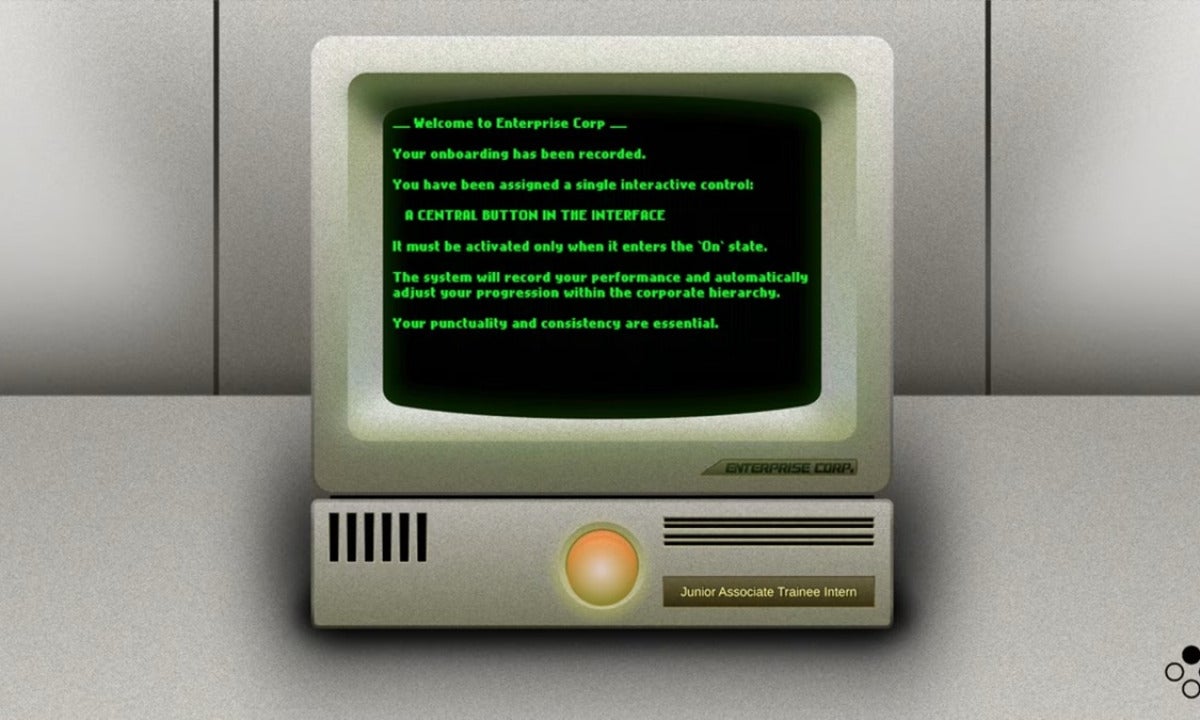
The Nintendo eShop listing says June 18, 2026 Just Press the Button hits Nintendo Switch, and it’s coming as a console exclusive. At the center of it is a very simple premise: you press a button when the company tells you to.
Spanish studio Sonomio Games is both developing and publishing it. In Just Press the Button, you play an employee at Enterprise Corp. What looks like a basic office job turns into a single-player story about promotions, workplace hierarchy, ambition, obedience, conformity, and what success actually costs.
And the more faithfully you do what you’re told, the game leans on that bare-bones loop to dig into monotony, labor, and power inside a rigid corporate system.
If you like experimental narrative games and shorter interactive experiences, the $2.99 launch price listed on the Nintendo eShop makes this one pretty easy to suggest. It could end up being a hidden gem, or at the very least an interesting little experiment.
One thing to watch for if you’re searching for it: some early store listings incorrectly named Sweet Dreams as the developer. The actual studio behind it is Sonomio Games, founded by Verónica Rodríguez and Antonio Carlón.
So far, Just Press the Button has mostly slipped by unnoticed. There’s been very little media coverage, and barely any major reviews, previews, or interviews.
You’ll be able to download Just Press the Button from the Nintendo eShop on Nintendo Switch starting June 18, 2026.
One of the challenges of layout design in Adobe InDesign is making sure that the text fits in the spaces. The simple act of adding one extra word can throw everything off and require rethinking the design. In its latest version, InDesign has launched Rewrite, a new artificial intelligence feature designed to solve this problem. With this tool, we can expand, condense, or modify the tone of a text to fit the available spaces. Next, we will see how it works step by step. What is Rewrite and what for […]
One of the challenges of layout design in Adobe InDesign is making sure that the text fits in the spaces. The mere act of adding one extra word can throw everything off and require rethinking the design.
In its latest version, InDesign has launched Rewrite, a new artificial intelligence feature designed to solve this problem. With this tool, we will be able to expand, condense, or modify the tone of a text to fit the available spaces we have. Next, we will see how it works step by step.
Generative artificial intelligence has also arrived at InDesign, specifically to help us with texts. Rewrite helps us analyze the content and the space of the text box to make everything fit better in your designs. Thus, instead of editing word by word, we can shorten very long texts, expand them, change the tone, or generate other variants that fit better in the layout.
Changing the tone of a text can be useful for certain situations; in some cases, you may need a more professional approach, or perhaps the complete opposite. In the end, you can generate different versions that maintain the essential information but change how it is communicated.
How to use Rewrite in InDesign
To begin, open your project in InDesign and select any text you want to modify. You can also place the cursor over a text frame to select the entire story.
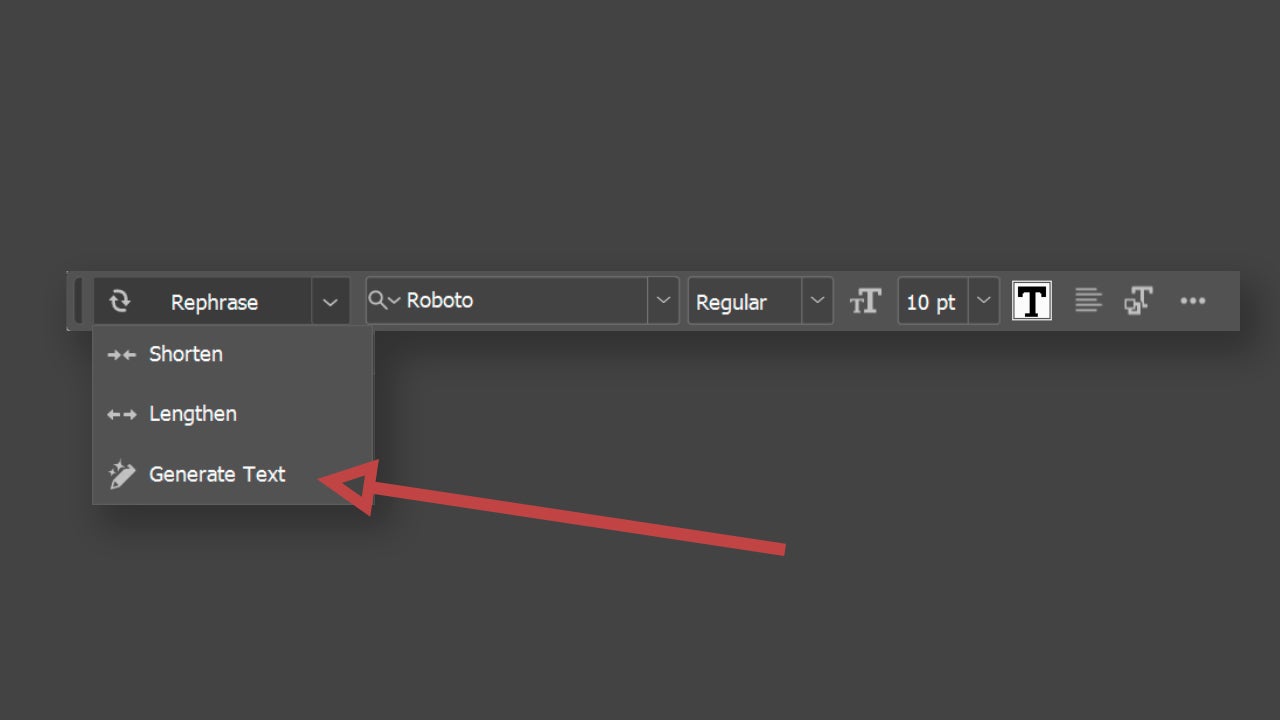
When you select the text, a floating contextual bar will appear. If you don’t see it, go to Window and click on Contextual Task Bar to make it appear. In this floating bar, select GenerateText; by doing so, you will also open the Generate panel.
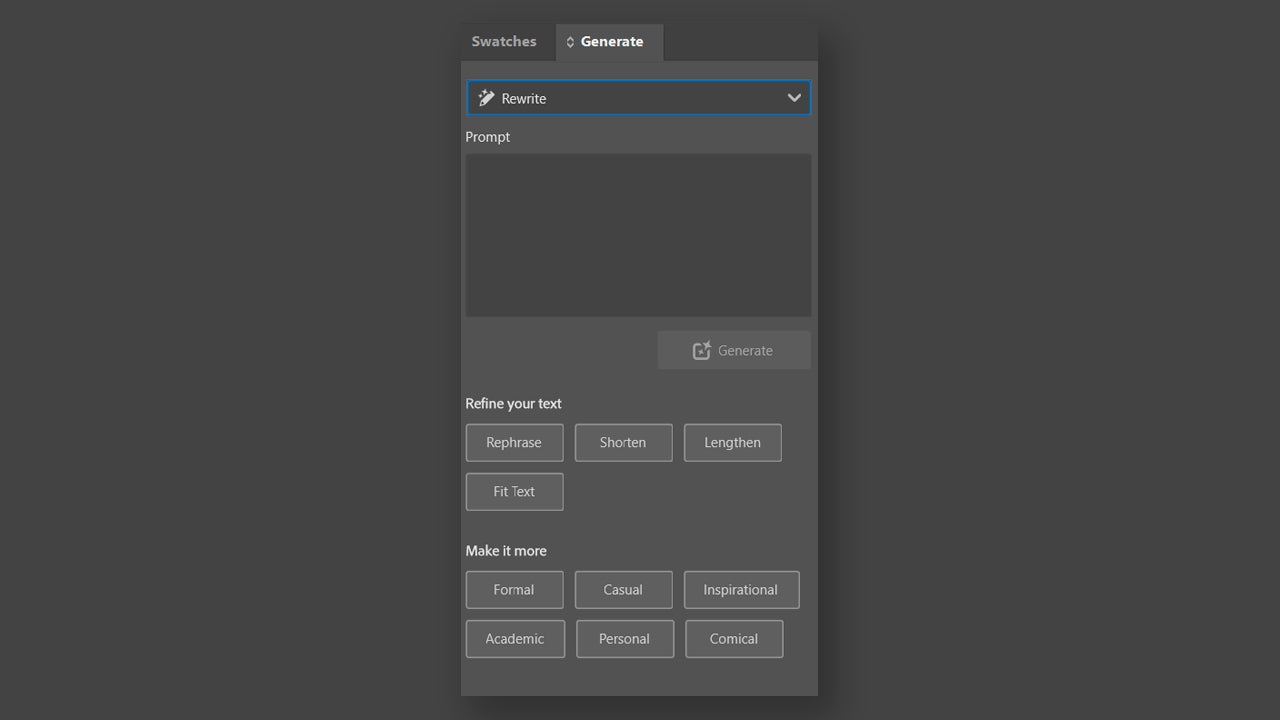
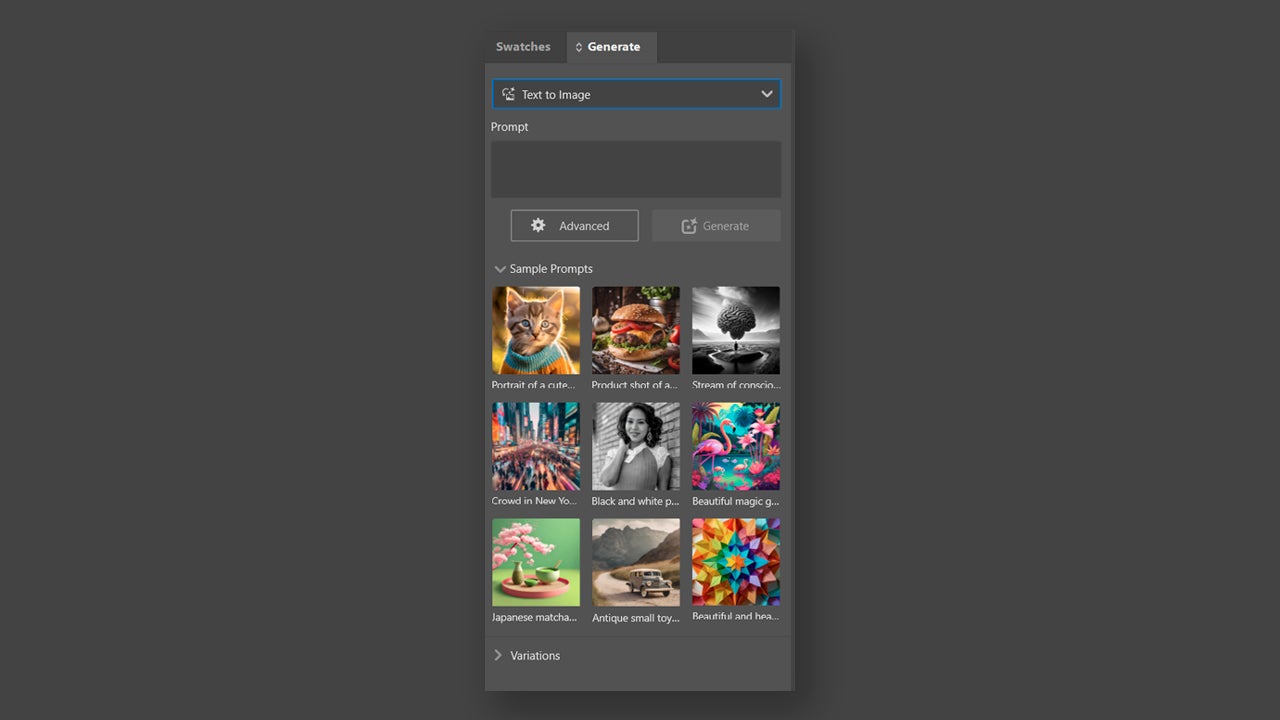
There are other ways to access Generate. To start, you can activate the option by going to a text box, right-clicking, and selecting the Generate Text option. On the other hand, you can make the Generate panel appear by going to Window > Generate. From this panel, you have several options, but we will focus now on Rewrite. Below Rewrite, you will see a text box where you will need to write your prompt. Simply describe therehow you want the selected text to be modified and click on Generate.
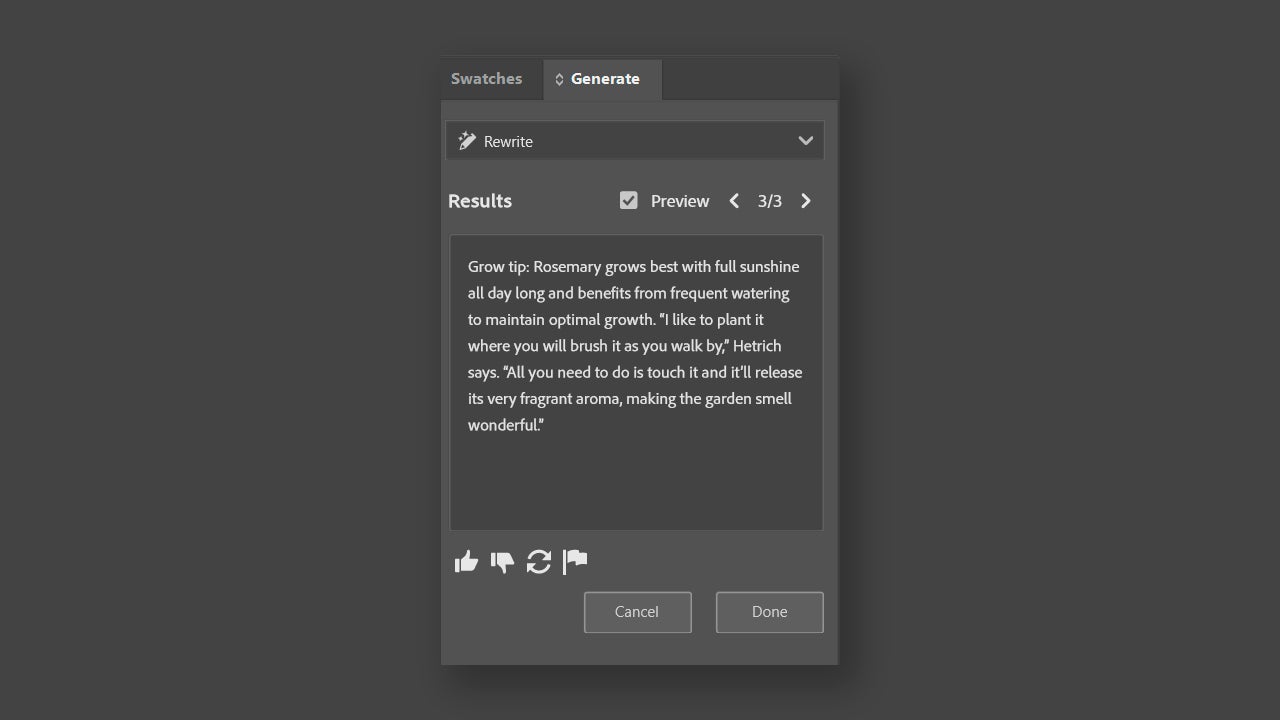
When I finish processing your request, you will see how the text is automatically replaced in your layout while respecting the paragraph style you have applied. As a detail, keep in mind that the language of the generated text will match the language you used to write the prompt.
You can also see other variations of the text in Results (through the Generate panel) in case the one you see doesn’t fully convince you. Choose one of the three alternatives and select Done to finish. Below you will see other symbols that will help you confirm that the result is good (thumbs up), that it is bad (thumbs down), or to try again (retry symbol).
If you want, you can modify the text with a series of predefined shortcuts, such as Rephrase, Shorten, Lengthen, or Fit Text, for example. These “buttons” will help you perform very specific actions in a short amount of time.
If you want to improve the results of this function, you must consider the length of the text to be modified and ensure that it does not exceed 1500 words. On the other hand, do not lose sight of the cost of generations made with AI. Although the Rewrite and related options are free for InDesign users, the Fit Text function does consume a credit per generation.
Images also receive updates
In addition to Rewrite, InDesign also includes a series of improvements in images. Within the Generate panel, there is also the option of Text to Image. Just like in Photoshop, within InDesign we will be able to generate images from a prompt.
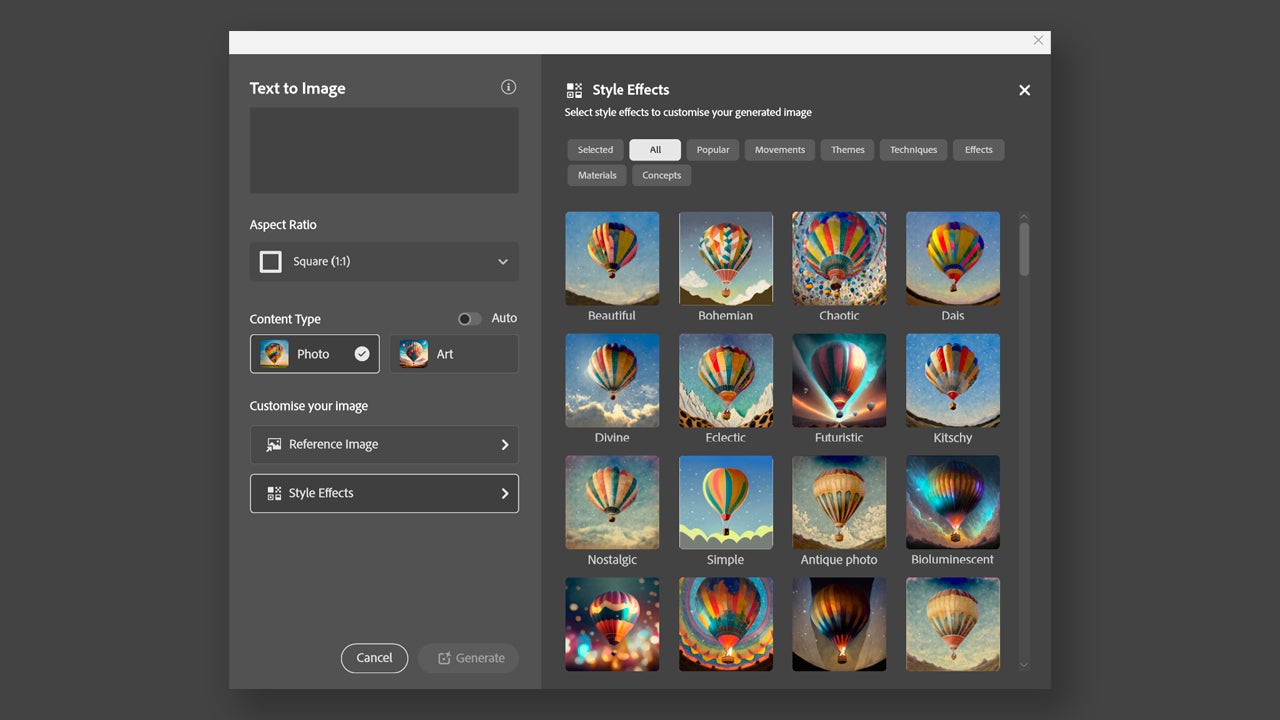
This can help you create images that serve as provisional while you wait for the final ones. Just like lorem ipsum, this way you can visualize how your almost final layout would look. If you click on the Advanced option, you will be able to access a new panel with more options that will help you create more detailed images.
There you can choose artistic styles, the aspect ratio, and even upload a reference image so that the generated output closely resembles the final image.
Eight in ten. That’s the share of surveyed IT professionals whose organization handled a browser-related security incident in the past twelve months. Half describe the damage as moderate or severe, which in IT speak usually translates to someone calling their boss on a Sunday.
The interesting part isn’t the headline percentage. It’s the profile of the companies hit hardest: BYOD policies, heavy SaaS use, remote-first teams. In other words, a normal 2026 company.
“Hackers don’t hack anymore. They just log in.”
That’s the line from NordLayer’s Andrius Buinovskis, and it does most of the work this report needs to do. Infostealer malware harvested around 1.8 million credentials and a staggering 68.8 billion cookies across 2025 alone. Once those are out, a login looks like any other login. Nothing trips. Nothing alarms.
You don’t need a Hollywood breach. You need a stolen cookie.
Your work is in the browser. Almost all of it.
NordLayer’s team analyzed 504 of the highest-rated work applications across 51 categories on Gartner Peer Insights. Every one of them was reachable from a browser. Nearly 79% were browser only: no installable client, no desktop fallback. Open a tab, you’re in.
That’s the new perimeter. It’s also why a single endpoint antivirus, by itself, isn’t really enough anymore.
Confidence is high. Coverage is patchier than people think.
Here’s the contradiction the report keeps circling back to. 73% of IT pros say their organization is well prepared. Yet when you ask which specific browser controls they’ve actually deployed, the picture changes. DLP tools lead at just 53%. Everything else trails below that.
The concern is genuine. 98% of respondents say their org is worried about web-based threats. 81% expect attacks to grow more elaborate. 73% expect more of them. The will is there. The tooling hasn’t caught up.
Three things the report tells you to actually do
Buinovskis groups his advice into three priorities, and they read more like guardrails than silver bullets:
See what’s running. Get visibility into the SaaS in use, the extensions installed, and the sites people visit. Without that, shadow IT does whatever it wants.
Block at the source. DNS filtering and DLP take a lot of weight off the user. Especially useful for teams handling financial or personal data.
Stop assuming trust. Zero trust at the browser level means employees only reach the resources they actually need, and an attacker with a valid cookie still hits a wall.
We’ve barely scratched the surface here. The full Why Browser Security Can’t Wait: Web-based Threats Report 2026, methodology and all, lives at: https://nordlayer.com/browser-research-report/
If browser security sits anywhere on your roadmap for the next two quarters, you’ll save yourself the trouble of doing the math.