Nintendo has decided that Fire Emblem is one of its flagship franchises. Although for many years it hasn’t sold as much as some of its other big franchises, like Super Mario or The Legend of Zelda, it has always tried to make room for at least one title per generation. And while on handhelds it really took off on the Nintendo 3DS, on home consoles it wasn’t until Three Houses that it did.

The latest entry in the franchise managed to win over a wider audience thanks to its mix of visual novel, date sim and strategy game. But the more classic players wanted a bit more bite from the game: Three Houses fell short when it came to the game’s strategic depth. And now Fire Emblem: Fortune’s Weave seems to want to fix that. Not by going back to repeat the Three Houses formula, but by taking the best of the old and new formulas to make a more refined version.
An evolution of Three Houses
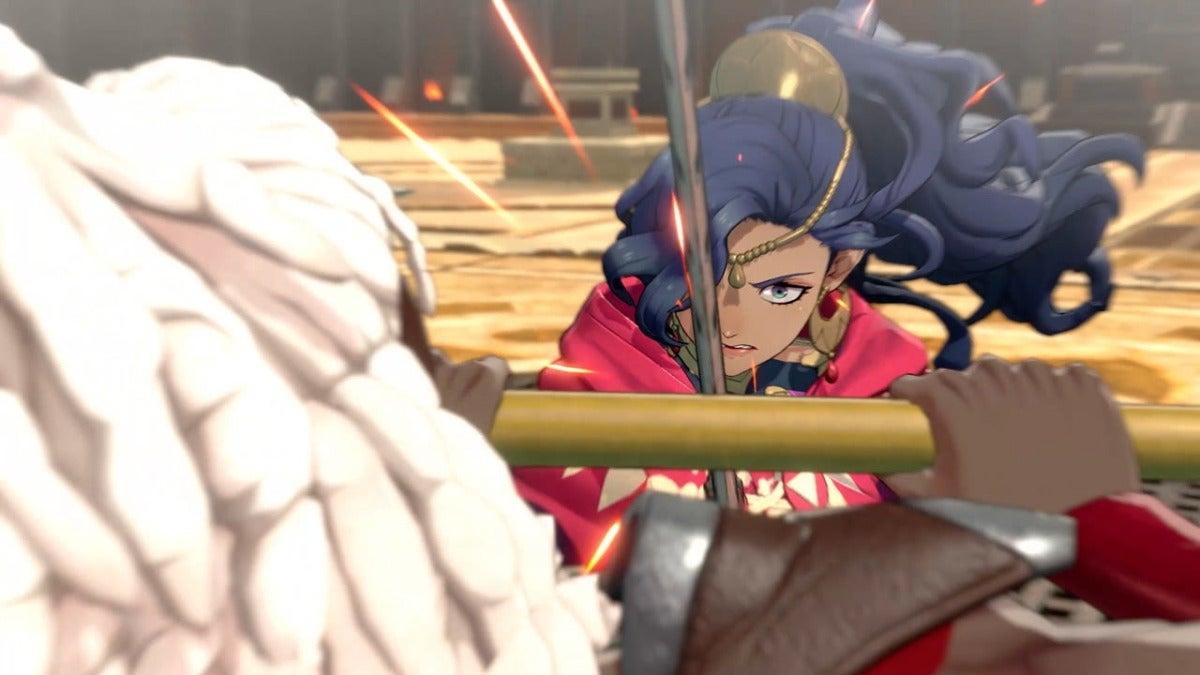
Set in the same world as Three Houses, everything takes place in the empire of Dagda. An empire that spans an entire continent and encompasses three nations: Samaris, Damascar and Brezarant. The Dagdian empire hosts a gladiatorial event every six months known as the Heroic Games and that’s where the story begins. We’ll choose one of the game’s four characters to take part in them so that the emperor, by winning, grants us our greatest desire.
With this premise, which only lasts through the first act, Fortune’s Weave begins. It otherwise closely resembles Three Houses. We’ll have to choose one of the protagonists and follow their story, facing the other three until reaching its conclusion. The twist is that in this installment it’s much easier to switch between different routes, being able to change between them from the start menu much more easily.
What’s more, the game will let us skip some complete acts once we’ve finished them on other routes. Since some of them are very similar, it’s meant to avoid the repetition and fatigue that a game that can easily run 60 to 80 hours can cause. To do that, to prevent our units from ending up underleveled, a more JRPG-like system has been added where we can have quick battles to level up our characters.
A classic edge
In everything else it’s exactly what we’d expect from a Fire Emblem after Three Houses. Recruiting characters, getting to know them and showering them with gifts is an important part of the game. But past the halfway point of the game its difficulty increases noticeably. And tactics start to become much more important.
That’s where you can tell how they’ve wanted to embrace the more classic players too. The ones who’ve been playing since the SNES and were missing a bit more depth and difficulty in the game. Although it’s still possible to play without permanent death, easing much of the tension, and with a rewind function having been added, reducing tension for those less versed in strategy, this last part tightens the screws for those who want a more intense Fire Emblem.
The only problem is that you have to get there. And that means getting through several dozen hours of gameplay that, while interesting, can start to drag. Which shows they still haven’t quite finished finding the exact blend in the formula.
Even so, Fire Emblem seems to be cementing its place with Fortune’s Weave as one of Nintendo’s great franchises. Having given it their all and rather than just trying to repeat Three Houses’ success, Nintendo have shown that they intend to keep pushing the series further. Which gives us hope that we’ll keep seeing this particular franchise evolve in entries to come.