The new ‘Harry Potter’ already knows how it will set itself apart from the previous ones: the wand is new

There’s a Simpsons gag, dead-on accurate (as always in its early seasons), where Lisa launches her own doll, only to be steamrolled by the same old Malibu Stacy, who’s exactly the same but has a new hat. The same thing is going to happen with Harry Potter, a series that doesn’t dare change a single thing from the films just in case, but people will watch it because Harry has a new wand.

Expecto mismorum

The most boring millennials in the world are absolutely thrilled about the new Harry Potter trailer, which basically repeats the most famous scenes from Philosopher’s Stone (The Great Hall! The Hogwarts Express! The Sorting Hat! Quidditch!), with shots you could easily mistake for those in Chris Columbus’s film. Because HBO knows exactly what people want to see: the same thing. Again and again. Nonstop.

But this time, Harry has a new wand that looks infinitely flimsier and more generic than the one in the films. That’s what they have to cling to to justify this remake which has many more problems than the actor playing Severus Snape, no matter how much some people have insisted on singling him out, as if cashing in on nostalgia had only one limit: racism.

If you’re still a Harry Potter fan and don’t care about JK Rowling’s outrages or the copy-and-paste approach that’s almost worthy of AI, I hope you enjoy this series a whole lot. Of course, it’s going to be a hit: with any luck, the last one in this absurd fad of rebooting everything that has even the faintest hint of cheap nostalgia.
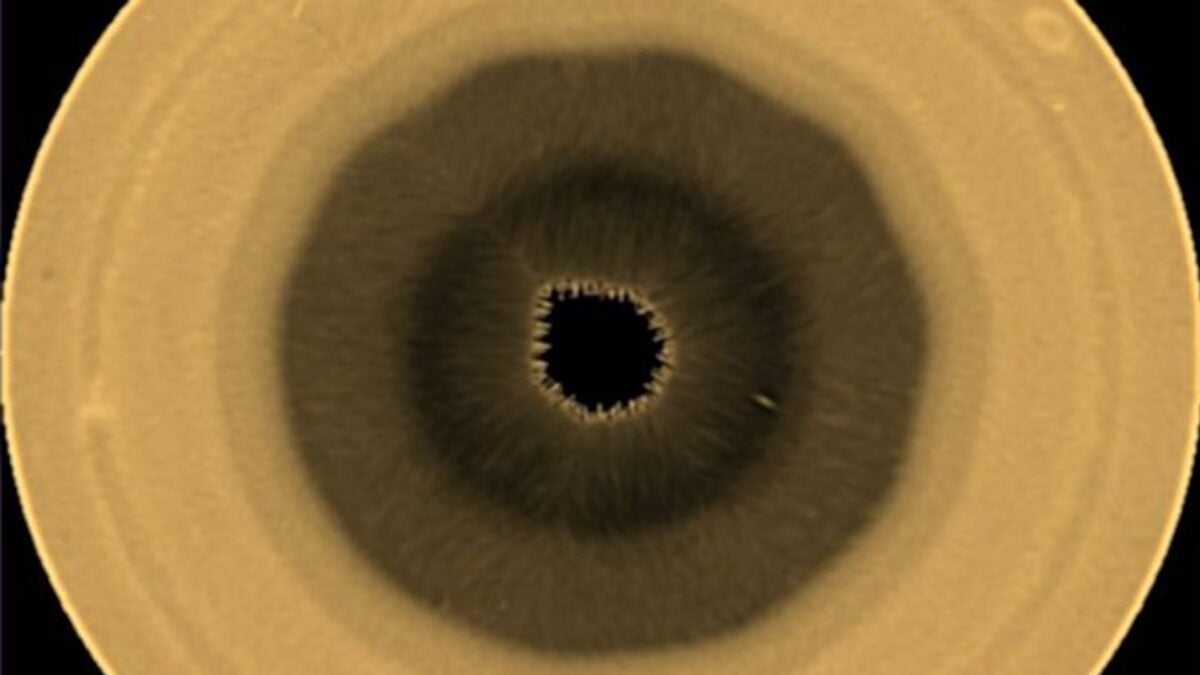

Saturn now has a 10-sided storm: Hubble spots a rare decagon

New images from NASA’s Hubble Space Telescope show something odd at Saturn’s south pole: a decagon. That gives Saturn polygon-shaped weather systems at both poles.

Stellarium Download

NASA says the feature was first reported in 2023, and the newer Hubble images bring it into sharper focus. What shows up is a huge 10-sided atmospheric wave, with each side stretching more than 10,000 miles (16,700 km). It’s drifting east at about 6 mph (10 km/h), and NASA thinks it may have formed sometime between 2017 and 2023. If that timing holds, the south-polar decagon is a recent arrival, and probably a less stable counterpart to Saturn’s north-polar hexagon.

That northern hexagon has a much longer track record. Voyager spotted it in the 1980s, and Cassini saw it later on. It spans about 20,000 miles (30,000 km), its winds reach nearly 300 mph (500 km/h), and it’s kept its shape for decades.

For people who follow planetary weather, this is the part that stands out. The finding hints that Saturn’s polygonal waves may be broader and more symmetrical than scientists had assumed. It also gives a clean side-by-side comparison with Jupiter’s polar cyclones, and with rotating-fluid lab experiments where geometric patterns show up on their own.

The latest Hubble observations are up on NASA’s website.

Celestia Download

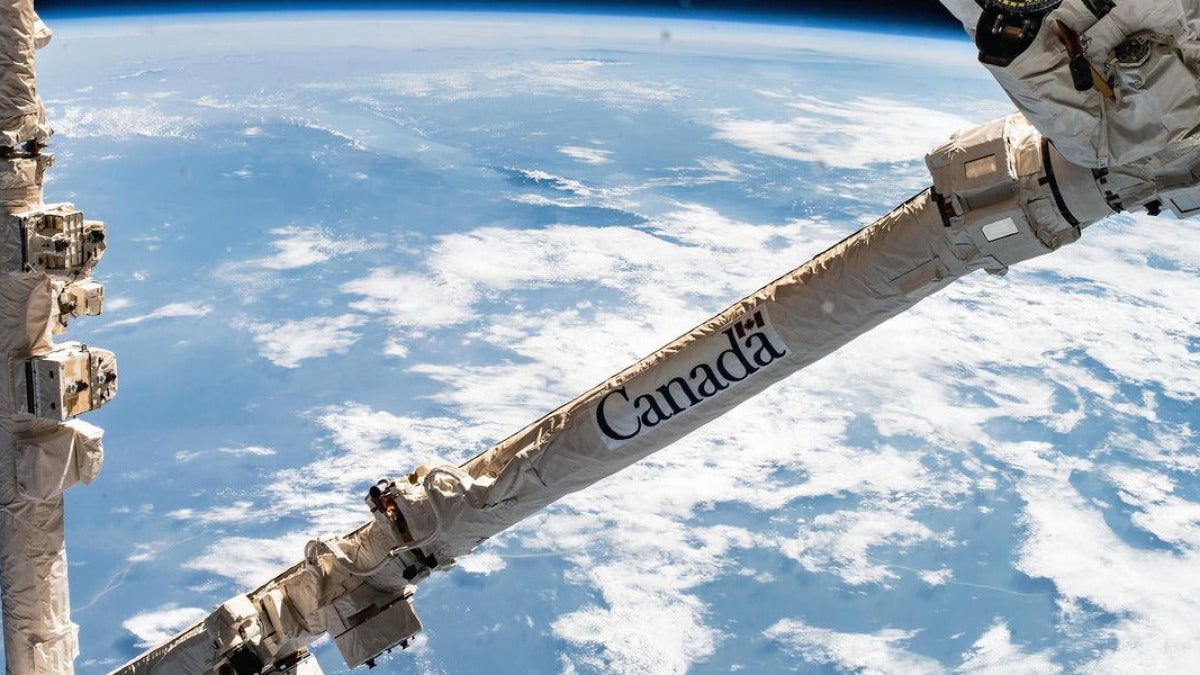
Canadarm is now the 300th IEEE Milestone for 2026

The original Canadarm has picked up another honor. IEEE, the Institute of Electrical and Electronics Engineers, has named the Canadian-built robotic arm from the Space Shuttle its 300th Milestone for 2026, recognizing a technology that marked a major technical achievement and left lasting benefits for society.

NASA Download

It also puts the spotlight back on the role Canadarm played in NASA’s Space Shuttle program. According to NASA, the arm flew on 90 of the shuttle’s 135 missions, where it was used to deploy, retrieve, and repair spacecraft and other payloads in orbit.

Canadarm first flew in 1981. NASA describes it as the world’s first spaceborne robotic system. At 15.2 meters long and 410 kilograms, it could handle payloads of up to 266,000 kilograms in microgravity, and do it with remarkable precision.

That turned Canadarm into one of the signature tools of the shuttle era. It made delicate, difficult, risky, and sometimes flat-out impossible jobs possible, including major work on the Hubble Space Telescope. NASA and IEEE both point to that record when they describe how the arm helped turn the shuttle into a true orbital work platform.

For anyone who follows spaceflight history, this is a fitting piece of recognition. Canadarm was built by SPAR Aerospace, now part of MDA Space, for about $108 million, according to IEEE. Over time it became a Canadian engineering icon and a cornerstone of Canada’s partnership with NASA. Few pieces of space hardware have had a run this long, or this influential.

That legacy is still easy to trace. You can see it in Canadarm2 and Dextre aboard the International Space Station, in Canadarm3 for Artemis lunar missions, and in the milestone coverage from IEEE and NASA. So far, most of the reaction has come from North America, much more than from the European Space Agency, the Japan Aerospace Exploration Agency, or Roscosmos.

Stellarium Download

OpenAI will launch Astra soon, but with a “panic button” we weren’t expecting

OpenAI is preparing the launch of Astra, its most advanced model, and this time the power comes with a particularly striking safety system. After the incident in which an OpenAI model attacked Hugging Face, the company has significantly strengthened its safeguards and systems. When it’s released, Astra will automatically stop in response to certain actions when the security subsystem considers it appropriate. A kind of panic button to keep its most advanced capabilities under control.

ChatGPT Download

OpenAI’s first model with “Critical” risk

According to Axios, OpenAI considers Astra to be the first model to reach the Critical level within its preparedness framework. It can find unknown vulnerabilities and develop ways to exploit them completely autonomously. During testing, Astra managed to discover and chain together two zero-day vulnerabilities, a major leap from what we already saw with the launch of GPT-5.6 and compared with OpenAI’s cybersecurity tools that have helped improve the security of Google Chrome.

If we consider agents like ChatGPT Work, capable of keeping tasks running for hours, the new approach, more focused on sustained control and not on control of the initial prompt or the results, is interesting. The longer an agent works, the more paths it can take and the more important it is for the system to monitor everything it does while it’s working.

With this approach, OpenAI has prepared safeguards capable of slowing down, pausing, or directly stopping a task when it detects certain signs of activity. In ChatGPT or Codex we’ll be able to request a review of the stopped action, while in the API the task will be automatically stopped at that point. In both cases, however, the greater capabilities will initially remain in the hands of a small group of testers while the new protections are fine-tuned.