Today we have not come to talk about all the controversy that arose from the release of Stellar Blade, since we dedicated a whole article to that chapter talking about everything that happened. If you don’t know what happened, we recommend you go here first and then come back for the analysis.
Having said that, it’s time to review with dedication and affection one of the most anticipated games of the year and one of the few exclusive games that Sony has for this 2024. For these reasons, all eyes were on Stellar Blade, a title created and developed by SHIFT UP Corporation in collaboration with PlayStation.

After a week of playing and testing my reflexes in a quite demanding game, with powerful graphics and a story that ends up hooking you, it’s time to give my opinion as an analyst about Stellar Blade, a game that became famous for secondary issues and that, due to the noise, has not had the weight it should have as a video game.
A story that can captivate if you let yourself go
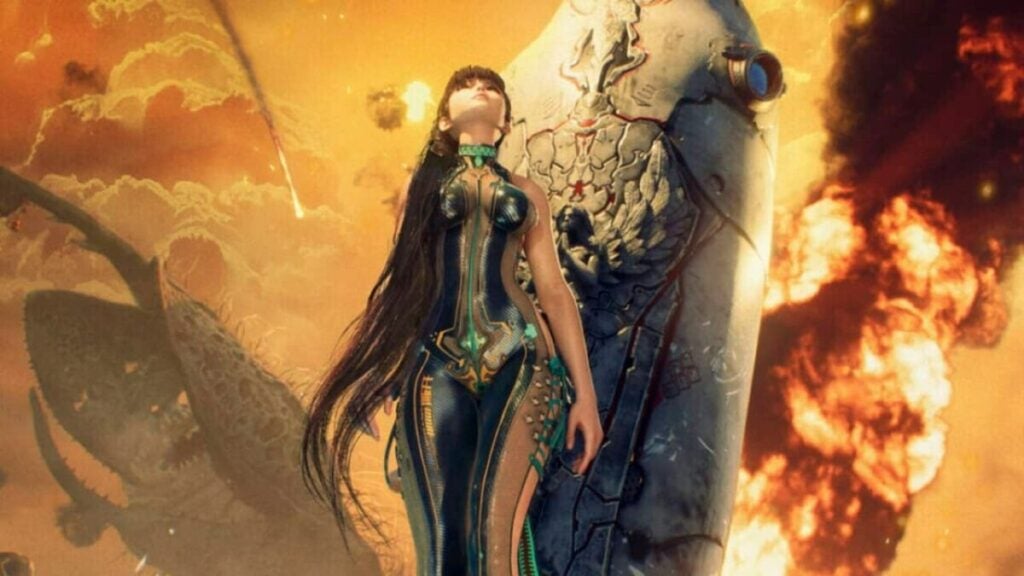
Stellar Blade follows Eve, a soldier from the Airborne Squad 7 regiment, who is sent to Earth to eradicate an invasion of strange aliens called Naytibas.
While Eve fights against these giant monsters in the hope of saving humanity from annihilation, she uncovers a conspiracy about the true origin of the Naytibas.
And it turns out that things are not exactly what they seem, and soon, Eve is flying from zone to zone, wielding her sword like a skateboard, and taking a little trip to space to uncover the truth behind it all: the Naytibas, the last remnants of humanity, the other members of the Air Squadron, even herself.
This is a tangled narrative that, although predictable, has some moments of introspection along with the kind of high-octane action that can be seen in other types of games.
A world that reflects the last days of humanity
The world of video games is captivating. There is a main area, Xion, that has those stereotypical and cool vibes of “last human outpost”: empty streets, ruined houses, buildings made of cargo containers, abandoned belongings like books and guitars.
This is the place where most missions begin and end, and where a large part of the characterization takes place, as many of the NPCs you interact with live here. Unfortunately, almost all of the characters are one-dimensional.
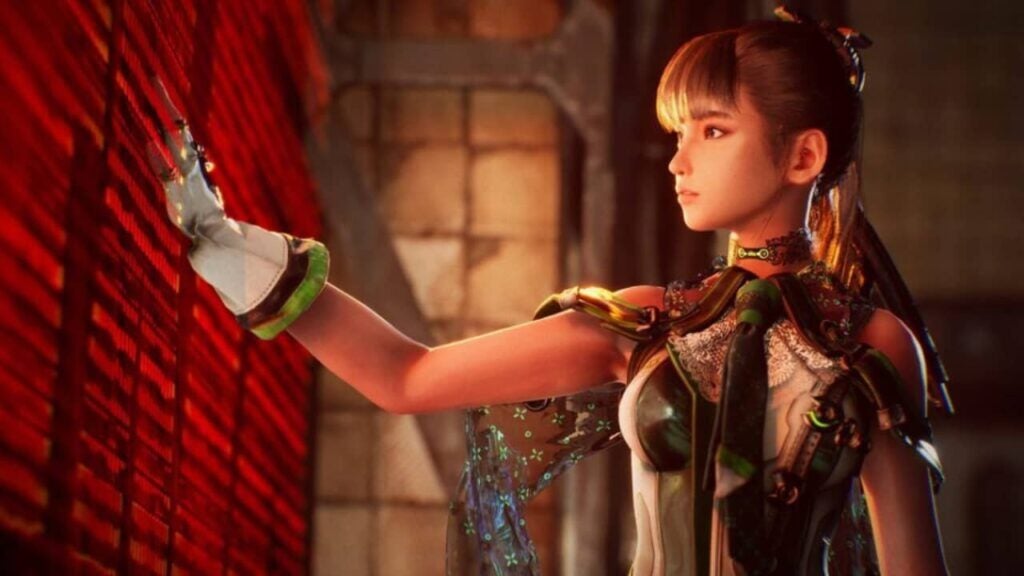
There is no urgency in delivering the lines, which turns crucial scenarios into superficiality. Stellar Blade is truly beautiful, especially due to the character models and the details of the environment, but since the characters are more 2D than 3D (metaphorically speaking), the interactions with them feel flat and lifeless, despite the emotional weight of the texts.
Outside of Xion, there are several open areas that you can explore, each dedicated to a different natural element: grass, earth, stone, water. These open areas are huge and are full of enemies to fight, places to see, items to collect, and secondary objectives to complete.
It’s easy to get lost in these places, and I don’t mean that in a negative way. Of course, you can get lost literally. Many of the areas intertwine with each other, with paths that bend over and under others, making navigation a torment. But with so much to do and see in Stellar Blade, you won’t mind getting lost often.
Probably, if you do it, you will come across an optional boss, an impressive suit, a beautiful view, or that object in the depths of the ocean to finally complete that damn side mission. Sorry, that was a projection. What I mean is that Stellar Blade is packed with things. Exploring every corner here is exciting because everything is beneficial in one way or another.
A challenging and very fun fight
Stellar Blade has been compared to many games: Bayonetta, DmC: Devil May Cry, Nier: Automata, Sekiro: Shadows Die Twice. All those comparisons are accurate, as Shift Up’s action game resembles other action games.
However, although it takes many ideas from Nier and Sekiro, I think its attitude is closer to that of Devil May Cry. Eve has style, like Dante. She may not be arrogant or boastful, but she is very aware of her abilities and experience. And like Dante, Eve doesn’t beat around the bush. However, it’s not all about appearances, as Eve’s combat mechanics are similar to Dante’s throughout the Devil May Cry franchise.
There are many attacks to learn, each one more impressive than the previous one. By combining light and heavy attacks, you can chain combos that become progressively more complex while Eve flips and spins while wielding her sword like a gymnastics dancer.
Eve also has the functions of dodging and blocking, which allow you to evade attacks, block incoming damage, and deflect blows to make your way to lethal executions.
Facing the wide variety of enemies in the game is exciting and pure fun. Everything fits perfectly and when you unlock its entire arsenal, Eve becomes a killing machine.
A game that is worth it, despite everything that has been said
Despite everything, I had a lot of fun with Stellar Blade. It’s a game of dichotomies, fun and frustrating at the same time, but in this type of intermediate stagnation it finds a way to tell a captivating story about transhumanism in the end of the world and how even robots feel things.
The platforms can be unstable and sometimes it can be difficult to control Eve, but the elegant action compensates for the more tedious elements. It’s not perfect, but at its best moments, Stellar Blade remains quite stellar.
