For years it seemed like Silent Hill was a dead franchise. After Konami canceled Silent Hills and parted ways with Hideo Kojima after P.T., we spent nine years without hearing a word about the franchise until 2023, when they resurrected it with Silent Hill: Ascension. And while both Ascension and Silent Hill: The Short Message weren’t exactly the two best calling cards for bringing the franchise back to life, they haven’t missed a beat since then.
Silent Hill 2 Remake, against all odds, did justice to one of the most iconic games in the history of horror video games and one that, in many people’s eyes, was impossible to remake. Silent Hill f was a new direction for the franchise that, while it proved divisive, showed that there are no obvious red lines for it and that it’s possible to do things different from the path laid out by Silent Hill 2 without losing the identity of the series. And Silent Hill: Townfall shows that Silent Hill f was not only right, but that it’s also possible to do different things, too, from what that Japan-inflected version of this legendary franchise was doing.

Screens that shape the world
Silent Hill: Townfall is a game created by Screen Burn Interactive, a Scottish studio known for its indie games like Stories Untold and Observation. These games, much smaller and more distinctive, are based mainly on one specific aspect: their interfaces. Built around interacting with screens of all kinds, they center their horror on what they suggest and on how, in interacting with the screens and not directly with what’s happening in reality, the possibility of horror arises. Something this new Silent Hill has inherited, at least in part.
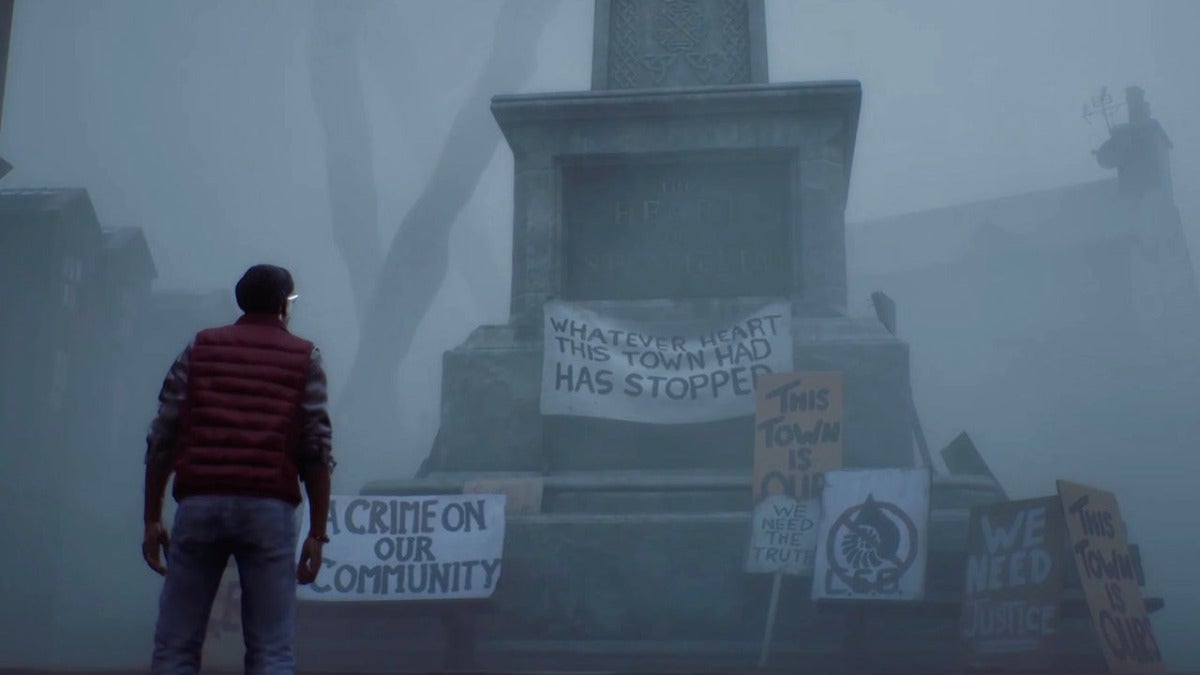
In Silent Hill: Townfall, you play as Simon Ordell, a young man who in 1996 returns to the town of St. Amelia in Scotland trying to uncover his connection to the town. Though along the way he will also discover that this town has suffered terribly because of its relationship with the capitalist exploitation of its natural resources, which will have a great deal to do with his life.
To move between reality and Silent Hill’s reality he will have one important element: a portable television that lets him communicate with other people who are trapped on the other side and uncover important clues about his past and the town. Besides something even more important. Because this TV will let him detect the position of the enemies around him. With one catch. As long as he’s looking at it he’ll lose part of his perspective on his surroundings.
Silent Hill can be many things
Silent Hill: Townfall is played entirely in first person and this shapes the whole game. Looking at the television will make us lose sight of our surroundings, fighting hand-to-hand will be a horrible decision and in general fighting enemies is always a worse decision than trying to move forward stealthily. Especially when our visibility of the situation is rather limited. And when there is also an invincible enemy we won’t be able to defeat and from which we’ll have to flee whenever possible.
Heavily inspired by the first three Resident Evils, Alien: Isolation, and Silent Hill: The Short Message, these encounters force us to play with the environment and make sure we’re especially stealthy and careful when moving forward. Something that changes the classic Silent Hill style, but gives the whole thing its own personality.
In that sense, the game feels less like Silent Hill 2 and its lineage, which 3 and 4 continue, and more like its own thing. Centered on stealth and placing more emphasis on more elaborate and cerebral puzzles, it shifts the focus toward a much more grounded horror and with more emphasis on more everyday aspects that fit better in the present. This may disappoint some fans who expect something more timeless or something more akin to the classics, but which fits the series like a glove.
This makes Silent Hill: Townfall, together with Silent Hill f, a perfect example of what the franchise should aspire to: not to imitate past successes, but to capture their atmosphere and tone and do something of its own with that. To create games that feel like Silent Hill, not games that imitate a previous Silent Hill. And in that, Silent Hill: Townfall is excellent.
