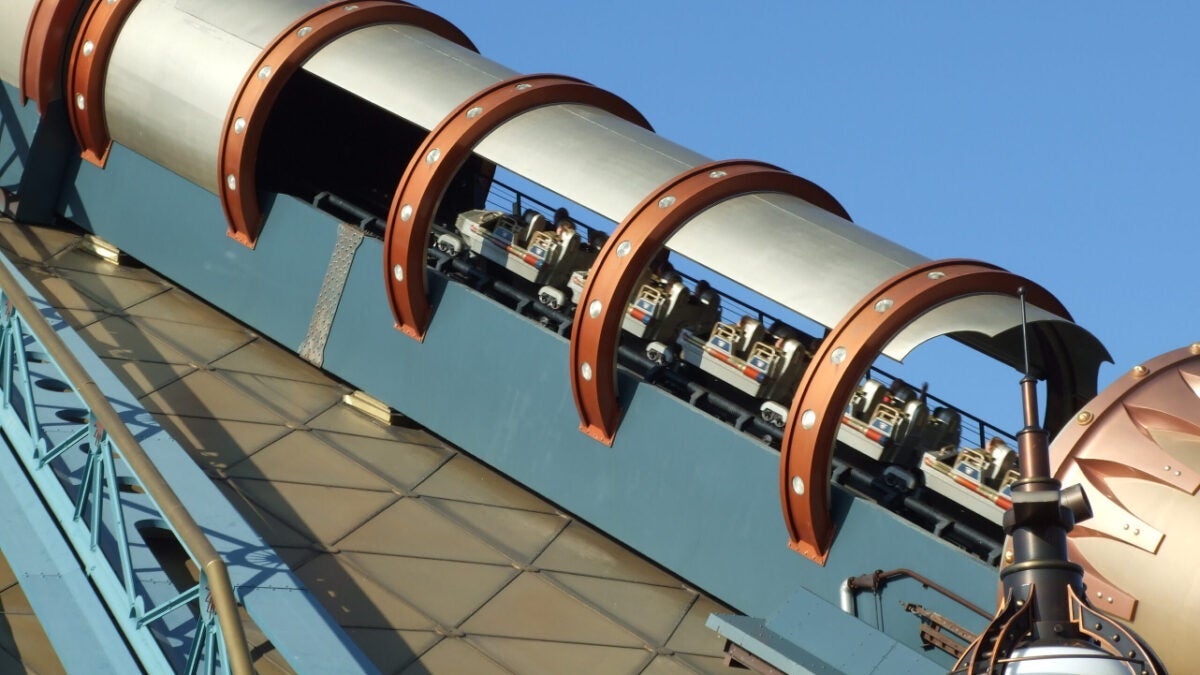
For a long time, the golden vacations in Europe (at least for families with children) have been going to Disneyland Paris, a park that opened on April 12, 1992 with the name Euro Disney and that was on the verge of closing many more times than most people believe. However, there was one attraction, almost alone, that managed to get it out of absolute bankruptcy. It was innovative, incredible, and original. Its reward was to be replaced. That’s how things are in amusement parks.

Oh la la! The Disney!
Do you remember that episode of The Simpsons where an employee of Itchy & Scratchy Land is completely alone and says ‘We’re open?’ It wasn’t far from reality: in 1994, only two years after its opening, there were already rumors that the park was going to close due to bankruptcy, and even Disney was considering leaving it in the hands of the banks that were investing to save it from disaster.
During its opening month, the park and hotels were expecting 60,000 visitors, but only 25,000 showed up, resulting in a loss of 300 million francs at the time (equivalent to about 87 million euros today, accounting for inflation). By 1994, the debt had already reached 3 billion. The management had no idea how to reverse the situation until they decided to fulfill one of the engineers’ initial dreams: the Parisian Space Mountain.
Originally, in the concept of Euro Disney, the designers wanted to create a gigantic tribute to Jules Verne and his novels with a large pyramid in which there would be a version of the Nautilus (from 20,000 Leagues Under the Sea), a roller coaster based on Journey to the Center of the Earth, and of course, a Space Mountain that would remind us of one of the most influential works in the history of science fiction: From the Earth to the Moon.
Julio Verne, Disney princess
It’s hard to imagine, nowadays, that Disney decided to open an attraction that didn’t have any of its characters as the protagonist, but Tim Delaney had the insight to see that if George Méliès could revolutionize cinema based on that story for his masterpiece, A Trip to the Moon, he could also do it with Disneyland Paris.
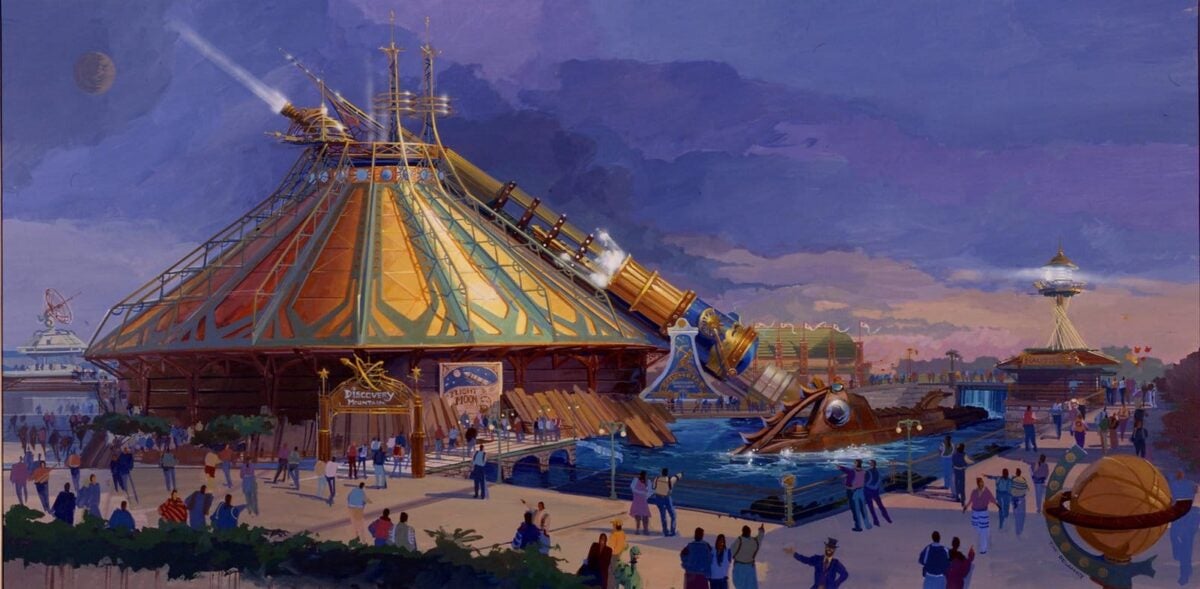
From the Earth to the Moon cost 89.7 million dollars, but it was money well spent: at that time, it became the tallest and fastest Space Mountain among all Disney parks, and it allowed the launch to be seen from the outside with smoke, making those still in line want to ride it. It reached speeds of up to 71 kilometers per hour, offered three different loops, and broke all the molds by offering a soundtrack that suited what was happening at each moment, composed by Steve Bramson.
In fact, it worked so well and was so innovative that the rest of roller coasters around the world started to copy it. The attraction itself was spectacular and the ride was magical, including a representation of Jules Verne and even the smiling moon. It was such a success that, for the first time, Disneyland made profits in 1995 and attendance increased from 8.8 million people per year to 10.7 million. They were saved. And all thanks to Jules Verne, who would have thought?
From the moon to crashing into Earth
Julio Verne’s dream lasted ten years at Disneyland Paris, until in 2005 they removed all references to the writer to create Space Mountain: Mission 2, which changed the happy moon for a supernova and took visitors to the far reaches of space. But it wasn’t as well received: the public wanted the classic version back, including the soundtrack, which was replaced here by one by Michael Giacchino.
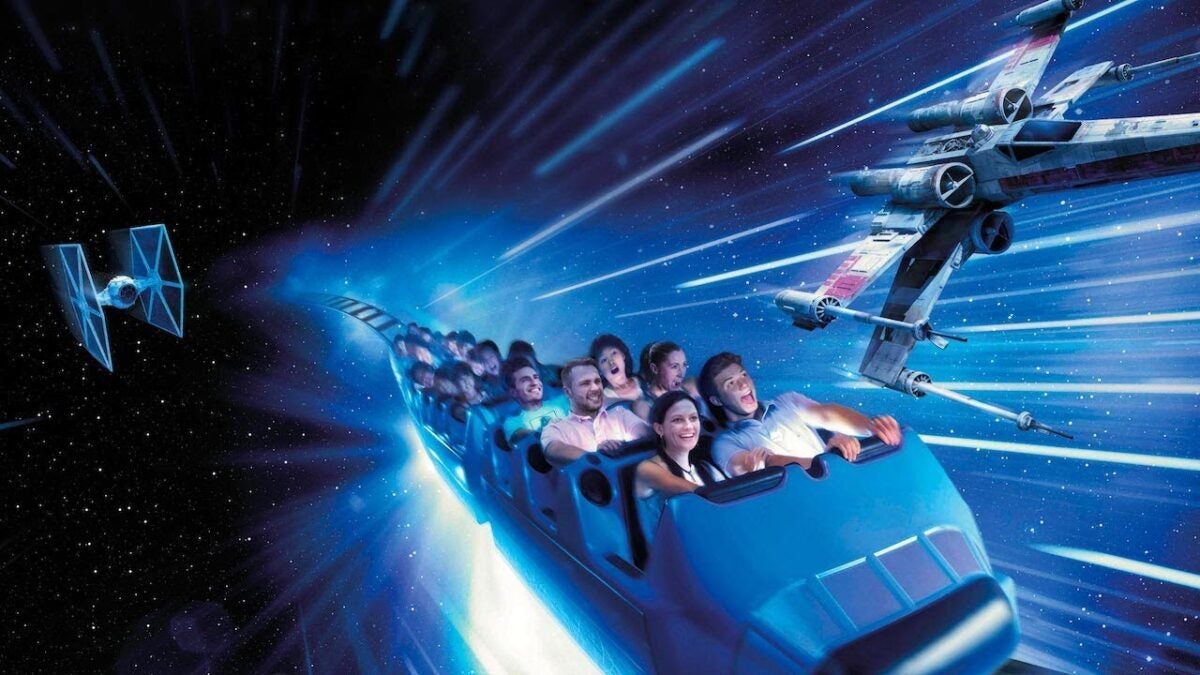
In 2017, the Victorian theme was finally discarded with its remodeling as Star Wars: Hyperspace Mountain, gaining strength with its franchises. The soundtrack became a remix of John Williams’ themes, the planets and supernovas were now Star Wars ships, and Jules Verne was replaced by… Admiral Ackbar. There are no plans to bring back From the Earth to the Moon despite having saved the entire park. Sadly, times are changing.