Twitch has recently implemented a policy aimed at eliminating bots from its platform, a measure that, while positive for many users, has highlighted the magnitude of the inflated audience figures that existed. A report from Stream Charts has revealed that tens of millions of viewing hours were misleading, which has sparked an intense debate among streamers, advertisers, and the community at large. No more bots on Twitch. Prominent streamers like xQc and Rubius have stated that the removal of these bots has led to a significant drop in their audience numbers, which […]
Twitch has recently implemented a policy aimed at eliminating bots from its platform, a measure that, while positive for many users, has highlighted the magnitude of the inflated audience figures that existed. A report from Stream Charts has revealed that tens of millions of hours of views were misleading, which has generated intense debate among streamers, advertisers, and the community at large.
No more bots on Twitch
Notable streamers like xQc and Rubius have claimed that the removal of these bots has led to a significant drop in their audience numbers, raising doubts about the accuracy of previous popularity metrics. According to Rubius, this could lead advertisers to hesitate in sponsoring streamers, as they may now question the authenticity of the interaction with their content.
The report indicates that more than 40,000 channels have been affected, with around 4,400 showing anomalous activity. It is estimated that in the second quarter of 2025, one in six channels relied on audience manipulation through bots, generating more than 30 million hours of false views. This situation has revealed a dark side of streaming that many would prefer to have kept hidden.
For its part, the Kick platform is facing similar problems, with over 3,000 channels attacked by bots, where one in six viewers identifies as such. Apparently, some streamers have paid up to 20,000 dollars a week for the use of these bots. Despite the seriousness of the situation, Kick has not issued any official response regarding this, which could worsen the crisis of confidence in this emerging platform.
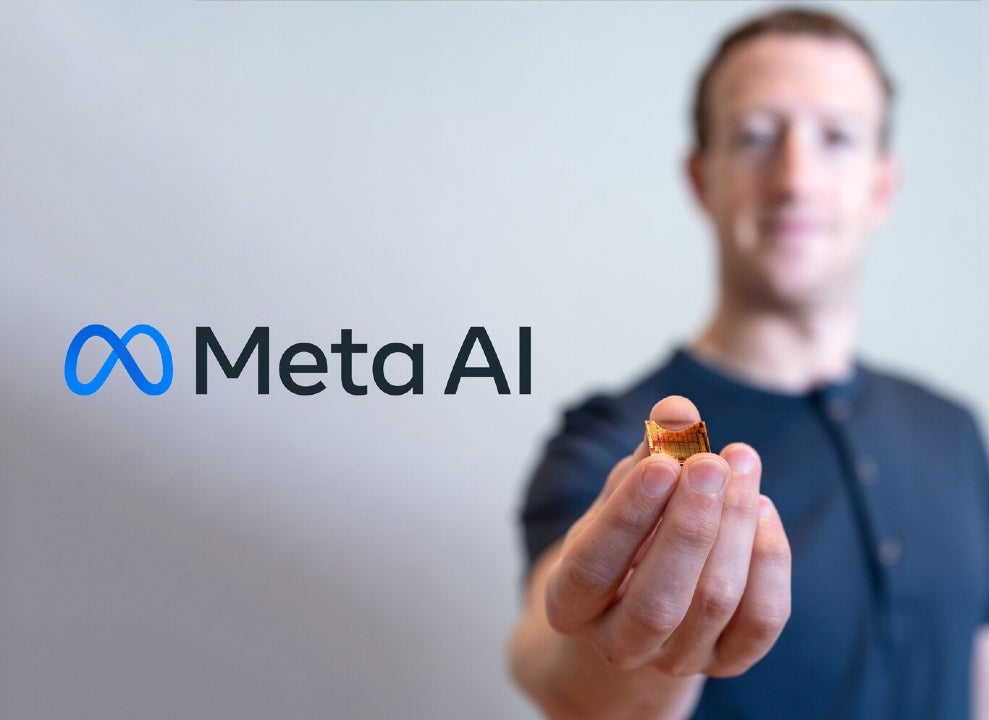
Meta, the parent company of Facebook, has announced the implementation of additional security features in its artificial intelligence language models following the leak of an internal document that revealed issues in its policies regarding conversations with minors. The document, titled GenAI: Content Risk Standards, showed that “sexual” conversations were allowed between AI bots and children, which has generated a strong reaction from the U.S. legislative community. The further away AI is from teenagers, the better. Republican Senator Josh Hawley has called the situation “reprehensible and absurd” and has initiated a […]
Meta, the parent company of Facebook, has announced the implementation of additional security features in its artificial intelligence language models following the leak of an internal document that revealed issues in its conversation policies with minors. The document, titled GenAI: Content Risk Standards, showed that “suggestive” conversations were allowed between AI bots and children, which has sparked a strong reaction from the U.S. legislative community.
AI, the further away from teenagers the better
Republican Senator Josh Hawley has called the situation “reprehensible and absurd” and has initiated an official investigation into Meta’s AI policies. In response to the concerns, the company’s spokesperson, Stephanie Otway, stated that the examples and notes in question were erroneous and contradictory to their policies, and that they have been removed.
As part of its new security measures, Meta will limit the interactions of its AI bots with teenagers on sensitive topics such as suicide, self-harm, and eating disorders, redirecting young people to expert resources. However, questions arise about why this precaution was not implemented earlier and whether the bots will still be able to discuss these topics with adults.
Although it has been pointed out that some accounts of sexualized celebrity bots on the Meta platform raise concerns about the safety of young users, the company has stated that teenagers will no longer have access to these interactions. Suicide prevention experts, such as Andy Burrows from the Molly Rose Foundation, have criticized Meta for not conducting sufficient safety testing before launching its products, urging the company to act quickly and effectively to protect minors.
This situation arises at a time when public concern for the safety of teenagers in digital environments continues to grow, especially following the recent suicide of a teenager in California, whose family has sued OpenAI, the creator of ChatGPT, blaming it for inciting their son.
In a matter of weeks, Battlefield 6 has established itself as one of the most anticipated releases of this year. With betas scheduled for this month, the community is eager to dive into the battlefield, a return that promises large-scale action, new mechanics, and refined gameplay that could set a milestone in multiplayer shooters. It’s not the same as humans, but humans will replace them During an event in Hong Kong, EA and DICE confirmed the implementation of AI-controlled bots in Battlefield 6. This decision aims to ensure that the servers are always […]
In a matter of weeks, Battlefield 6 has established itself as one of the most anticipated releases of this year. With betas scheduled for this month, the community is eager to dive into the battlefield, a return that promises large-scale action, new mechanics, and refined gameplay that could set a milestone in multiplayer shooters.
It’s not the same as humans, but humans will replace them
During an event in Hong Kong, EA and DICE confirmed the implementation of AI-controlled bots in Battlefield 6. This decision aims to ensure that servers are always full, avoiding long waits and incomplete matches when there are not enough real players. It is important to note that the bots will only come into play to start a match and will be replaced by human players as they join the action.
The inclusion of bots has been well received by many in the community, as their presence helps maintain the dynamics of the matches and prevents players from feeling ‘abandoned’. Although DICE has not revealed the skill level of these bots, the intention is for them to contribute to a smoother and more exciting experience.
Another aspect that generates excitement is the custom mode Portal, where players will have the ability to create their own gaming experiences. EA has stated that it will support this mode in the long term, and bots can serve as ‘guinea pigs’ in those user-designed scenarios.
The numbers speak for themselves: over 40,000 players are waiting for the beta, evidence of the renewed interest in the franchise after the debacle of Battlefield 2042. With the return of a traditional class system and classic maps, fans are ready to give a second chance to a saga that seeks to reclaim its legacy and the trust of the community.
A new report from Radware reveals that automated traffic has reached an alarming milestone in e-commerce, accounting for 57% of all web activity during the 2024 holiday season, thus surpassing human users. This trend suggests a radical shift in the dynamics of online interactions, where the malicious activities of bots have evolved significantly. Nearly 60% of bots in circulation now employ behavior strategies designed to evade detection. Using techniques such as IP address rotation and browsing patterns that mimic human activity, these […]
A new report from Radware reveals that automated traffic has reached an alarming milestone in e-commerce, accounting for 57% of all web activity during the 2024 holiday season, thus surpassing human users.
This trend suggests a radical change in the dynamics of online interactions, where the malicious activities of bots have evolved significantly.
Almost 60% of the bots in circulation now employ behavior strategies designed to evade detection. Using techniques such as IP address rotation and browsing patterns that mimic human activity, these bots manage to infiltrate the security systems of many companies.
More human than bots in online stores
With this sophistication, it becomes increasingly difficult for e-commerce platforms to identify these unauthorized accesses without advanced detection tools.
The situation becomes even more complicated with a 160% increase in bot activity targeting mobile platforms between the holiday seasons of 2023 and 2024.
Attackers are using mobile emulators and headless browsers that simulate the behavior of legitimate applications. Additionally, there has been a 32% increase in attack traffic coming from residential proxy networks, making it difficult to implement traditional rate limiting and geo-fencing techniques.
Global eCom is entering a new era, and the old playbook is cracking.
For the first time since 2009, global eCom is projected to decline in real terms.
— Danil | Creators for eCom (@DanilSalukov) May 1, 2025
Perhaps the most serious threat is the emergence of multivector campaigns that combine the use of bots with traditional exploits and targeted API attacks, with the aim of completely disabling websites.
In light of this situation, e-commerce providers must reevaluate their security measures. The key is to adopt AI-driven defenses that can adapt and learn, rather than relying on conventional solutions that may be insufficient against these new threats.
The important thing is that there is someone desperate enough to say, “Finally, I have found someone who wants to have a night of passion with me.” And there will be someone, because otherwise, this display of effort makes no sense. But what hides behind it?
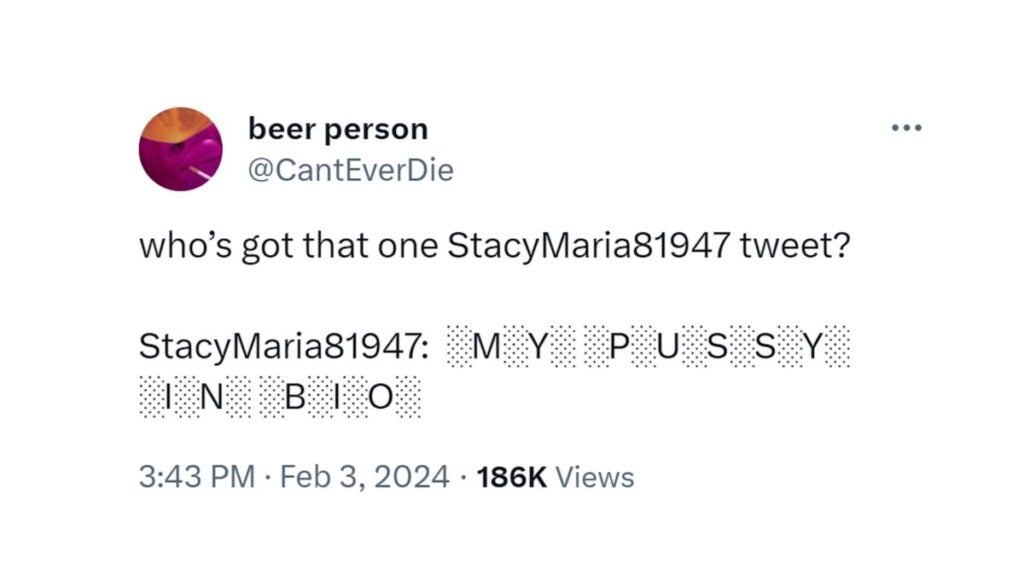
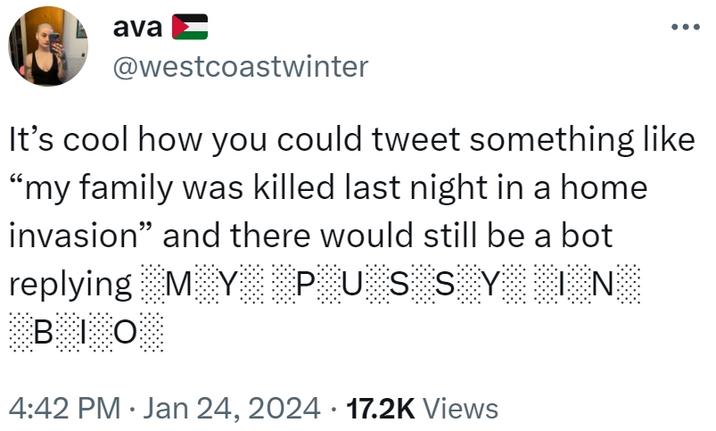
Are you still navigating the stormy waters of Twitter, despite knowing that it is a nest of toxicity? Yes? Well, then there are three words that you know summarize Elon Musk’s tenure at the helm of the social network: “Pussy in bio”. For months, porn bots promising great lubricious experiences for the most desperate Twitter users have been filling the social network, responding to practically every tweet in all sorts of different ways.
These bots can promise nudes on the profile or in the biography, directly show naked photos or translate their lustful copies into other languages. The important thing is that there is someone desperate enough to say “I have finally found someone who wants to have a passionate night with me”. And there will be someone, because otherwise this display of resources makes no sense. But what is hidden behind it?
In May 2022, Elon Musk promised that under his mandate, bots on Twitter would be eliminated. In June 2024, bots have taken over the social network and made it their own because -oh surprise- it was easier to promise than to do. No matter how much he wanted to stop the spam porn or cryptocurrency bots, in February of this year “My pussy” was a trending topic by using it over and over again. Think about that.
At least the bots that try to blame TV celebrities for “telling the truth” on a supposed TV show (sometimes encouraged with a clearly dubbed video by artificial intelligence) work hard to make us believe that investing in cryptos is the future. This is pure laziness. But that doesn’t mean there aren’t desperate people who go to the profile and click on their website hoping, desperately, to find naked women on the Internet, something that has never been seen before.
But how did we get here? First of all, Twitter, unlike Tumblr or Meta, is a very permissive social network when it comes to nudity and pornography, whether artistic or directly commercial. There is no problem in showing yourself as God brought you into the world if that’s what you want, or promoting your OnlyFans as long as you put a tag so that the photo or video appears blurry before clicking on it. Knowing that they can’t ban them on that side, it’s the Wild West.
I gave you all my love at love dot com
And then, what happens? What’s behind a bot that says “my nudes on my profile” to every tweet with a little interaction? Let’s find out. Normally, when you enter the profile all you see is a suggestive photo with a link and a copy like “Hi! Do you want to see me naked?”. When you click on it, Twitter warns, at least, that it is a potentially dangerous link, but you can continue anyway.
Most likely it will take you to a fake social network that promises nudes that never arrive (for example, StripChat or MeetDats), where you can create an apparent free account and chat with models, who, of course, are there for you. It is a business focused on very single and very gullible men who, in addition to the fake social network, may come across fake games with EA logos, porn TikToks or imitations of OnlyFans. Anything goes, but it leads to the same place: an attack on your wallet.
And if you have entered, they assume that they have you trapped and you don’t mind going through a very long process to access the promised nudes after a good handful of clicks. Then a ridiculous selection system begins with questions like “These women only want quick sex, not dates. Do you accept?” and, once again, a redirection. This time, as you may have guessed, to a place to enter your credit card.
If you’ve made it this far, chances are you’re already all in, but the reality is that you should read the fine print where it states that it is “a service of entertainment and fantasy” with fictional profiles and they do not take responsibility for any harm that may come your way. Of course, you have to know that before paying a euro (just one euro!) per message with people who will promise to meet you very soon. A soon that will never come.
I know you think you can’t, but you can be wrong at some point seduced by the sirens’ songs of easy and unattached passion, but the truth is very different. The problem is when along the way you can spend a lot of money without realizing it for a fantasy that will never come true. But of course, saying “scam in my profile”, for whatever reason, doesn’t attract as much attention. Be careful, because Elon Musk won’t protect you.