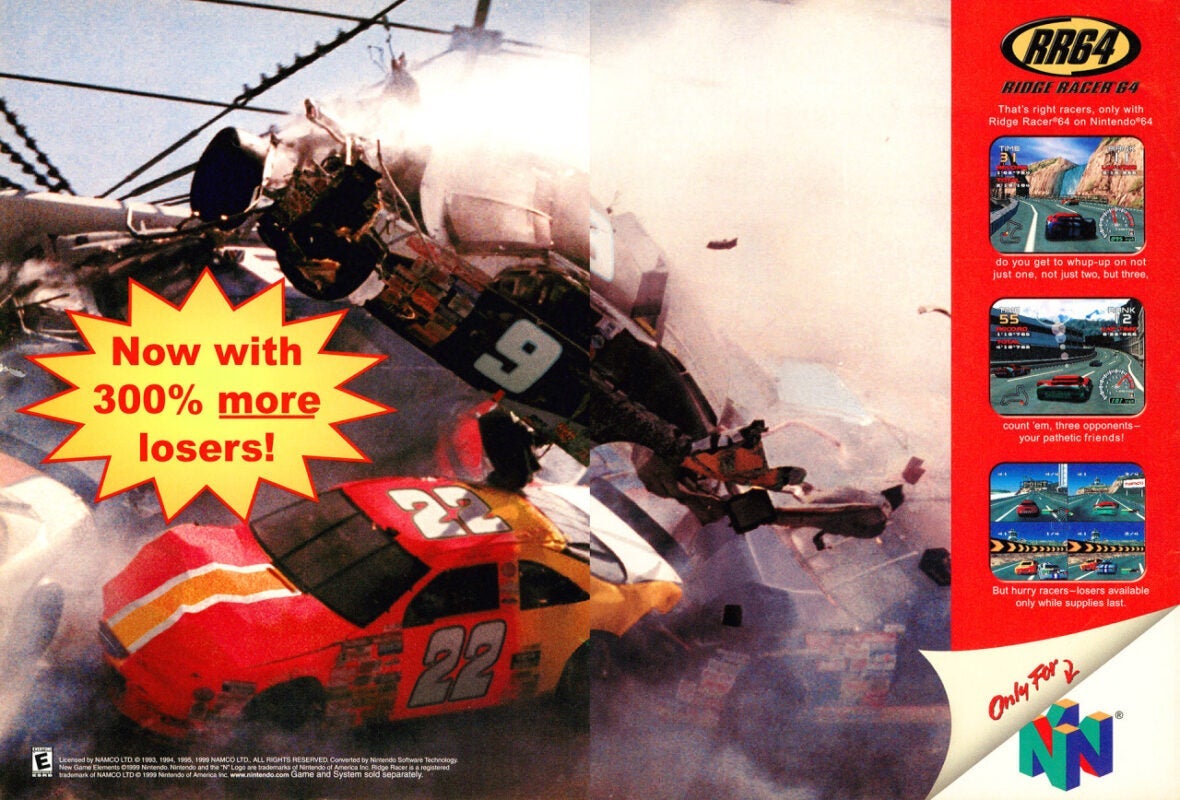
Reiko Nagase has confirmed the return of Ridge Racer 64 for Nintendo Switch Online subscribers and its Expansion Pack. This title, released in the year 2000, marked the debut of the renowned franchise on Nintendo consoles and has remained in collective memory thanks to its innovative gameplay and impressive use of the Nintendo 64 hardware. Ridge Racer 64 stood out for combining arcade sensations with a smooth game design, offering players a unique racing experience. It featured eight tracks and 32 vehicles, each designed to maximize the […]
Reiko Nagase has confirmed the return of Ridge Racer 64 for Nintendo Switch Online subscribers and its Expansion Pack. This title, released in the year 2000, marked the debut of the famous franchise on Nintendo consoles and has remained in the collective memory thanks to its innovative gameplay and impressive use of the Nintendo 64 hardware.
Ridge Racer 64 stood out for combining arcade sensations with a smooth game design, offering players a unique racing experience. It featured eight tracks and 32 vehicles, each designed to maximize enjoyment on the asphalt and circuits. Among its game modes are Quick Play, Grand Prix, Car Attack, and Time Attack, in addition to a multiplayer mode that allowed up to four players to compete at the same time, an appeal that remains in its adaptation to Switch.
The reason for its triumph: the incredible atmosphere
However, what truly elevated Ridge Racer 64 were its visual aspects and its soundtrack, composed by Keith Arem, which added to the techno atmosphere characteristic of the turn of the millennium. The music not only complemented the gameplay but also enhanced the sense of speed, a distinctive hallmark that has remained in the franchise.
With the franchise currently under the wing of Bandai Namco, there are hopes within the community that a new Ridge Racer will be developed to compete with the iconic Mario Kart on future consoles. However, to offer an innovative and enticing experience that attracts both new players and veterans, they will need to demonstrate the power of the new hardware. The return of Ridge Racer 64 is an exciting gift for driving enthusiasts, reaffirming its legacy in the history of video games.
Pac-man was a bombshell since its release, on May 22, 1980, which came to unseat Space Invaders in the world of arcade games. Logically, a sequel had to arrive soon, right? Well, it wasn’t that easy.
As much as we now argue between open worlds full of secrets with our favoritism for ‘GTA‘ or ‘Zelda‘, talk about FPS and indie games as if two hundred new titles are released every week, we must remember that forty years ago the world of video games belonged to a yellow ball eating pills and being chased by ghosts: ‘Pac-man’ was a bomb since its release, on May 22, 1980 that came to unseat ‘Space Invaders’ in the world of arcades. Logically a sequel had to come soon, didn’t it? Well, it wasn’t that easy.
Traditional video game returns with renewed energy
Waka waka waka waka
A book could be written with all the shameless plagiarism of the classic Pac-Man (‘Lock’n’chase’, ‘Piranha’, ‘Gobble a ghost’ or ‘Jelly monsters’, among hundreds of others). In fact, it is one of the first cases in which the intellectual property of video gameswent to trial, with Namco winning several of them. In this scenario in which there was no month without a ‘Pac-man’ substitute, it is easier to understand all the trouble the developer went through to get a sequel that didn’t taste, simply, like another cheap copy.
Paradoxically, the story of ‘Ms. Pac-man’ begins with a plagiarism by Namco. Pac-man‘ begins with a plagiarism by Namco, but not of Pac-Man, but of ‘Missile Command’, a game that six MIT students (through their company, General Computer Corp, or GCC) were able to improve by reverse engineering: ‘Super Missile Attack’ was a success… until Atari sued them for 15 million dollars.
If now 15 million is a barbarity, imagine in 1981. Luckily for GCC, Atari was able to accept that they could do more good than harm, dropped the lawsuit and made them work for them by paying them $50,000 a month for two years in exchange for them to stop making expansions of Atari’s intellectual properties and instead make new games for the company. The first thing they did? Effectively, the ‘Pac-man’ expansion. Well, sort of: ‘Crazy Otto’, from which they created three of the most sought-after arcade games of all time.
If not this one, it will be Otto
Crazy Otto’ was basically ‘Pac-man’ but with new levels (and differentiation between mazes), sound and music, flashier graphics, faster speed and better enemy AI. First, Namco rejected it because they had specifically agreed that they could not use the IPs as they pleased, but then they started to think: What if it was a sequel to ‘Pac-man’ changing the walking gentleman (Otto) for the already mascot of the company?
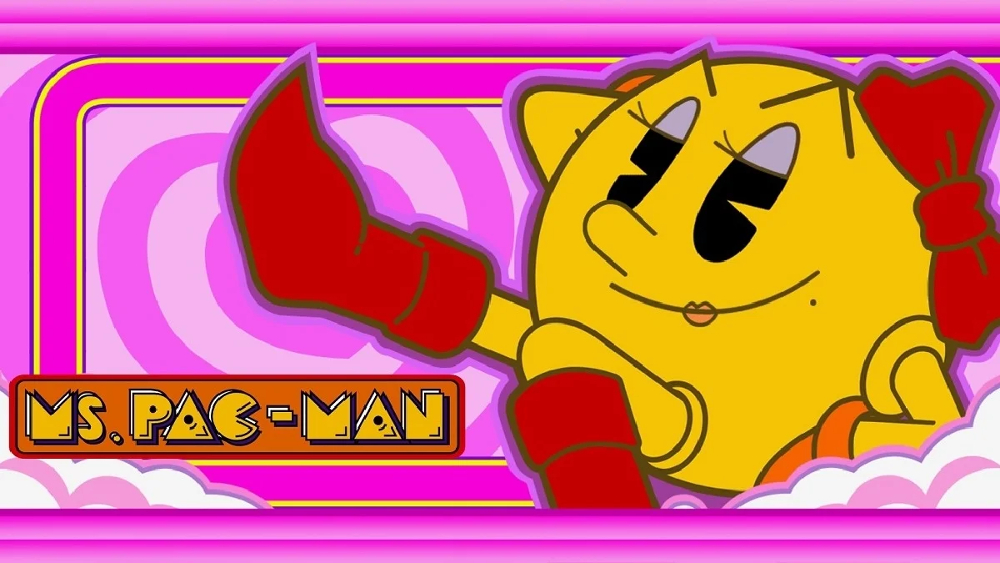
Namco (well, Midway, its US distributor) bought the rights from GCC and decided that, this time, it would be called ‘Super Pac-man’, to make it clear that it was the return of the king of video games. However, there were some sequences between the screens of ‘Crazy Otto’ introducing his female counterpart and it gave them a little idea, which, added to the fact that ‘Pac-man’ introduced millions of women in a world dominated by men in the arcade, how could they not create the female version of Pac-Man? They modified the original icon by adding eyes with eyelashes, a bow, a mole and red hair. That was it. Pac-Woman was born.
Well, Pac-Woman was short-lived, because they quickly changed her name to a more sonorous – and confusing – ‘Miss Pac-man’. In less than 24 hours, a filmmaker realized that on one of the screens, a stork was giving the couple a baby, and that could lead to thoughts of illegitimate pac-children. Not the plan. The character was renamed ‘Mrs. Pac-man’ and, finally, ‘Ms. Pac-man’. Pac-man’. Almost nothing. Then they received the notes from Japan sent by Masaya Nakamura, president of Namco: “Remove her hair immediately”.
Feminist icon?
The game appeared at the beginning of 1982 and was ported to all the consoles of an era, demonstrating, once again, that the ‘Pac-man’ saga was here to stay. Although the change of the character was minimal, it was the starting signal for a whole world of characters that has lasted until our days and a fireproof saga that has even appeared in ‘Super Smash Bros’ and ‘Mario Kart 8’, through aMiibo.
Only in 1982 four more official games were released (‘Super Pac-man’, ‘Pac-man Plus’, ‘Pac-man & Ms. Pac-man’ and ‘Baby Pac-man’) before its fame faded away completely in 1987 (with a late revival years later, of course, like all 80’s nostalgia). We may not see it as much as we once did, but it will always go down in history as the first serious attempt by video games to reach out to a female audience. Luckily, things have changed radically… Or so we want to believe as we watch those arcades full of yellow balls in suggestive poses and doing waka-waka.