Rob Bottin, at just 22 years old, was responsible for the innovative special effects of The Thing, directed by John Carpenter, creating one of the most iconic creatures in science fiction cinema. His extreme commitment to the project led Bottin to work long hours, even living in the studio. This physical and mental effort took a toll on him, resulting in double pneumonia and recurring nightmares that plagued his rest. Special effects too grotesque for a human When The Thing premiered in 1982, it was met with lukewarm reviews and comments about its violence in a […]
Rob Bottin, at just 22 years old, was responsible for the innovative special effects of The Thing, directed by John Carpenter, creating one of the most iconic creatures in science fiction cinema. His extreme commitment to the project led Bottin to work long hours, even living in the studio. This physical and mental effort took a toll on him, resulting in double pneumonia and recurring nightmares that haunted his rest.
Some too grotesque special effects for a human
When The Thing premiered in 1982, it was met with lukewarm reviews and comments about its violence during a summer dominated by E.T. and a prevailing conservative morality. Many critics considered the film’s grotesque mutations unnecessary, relegating Bottin’s work to a mere curiosity of the moment. However, what they did not recognize was the verisimilitude and ingenuity behind each transformation, achieved through makeup, latex, and animatronics techniques, without the use of CGI.
Despite its harsh initial reception, today The Thing is hailed as a masterpiece, influencing decades of genre cinema. Bottin’s effects, which include the famous creature with fluid morphology and the ability to infiltrate other bodies, have become essential references in the history of cinematic horror. The film has been reclaimed not only for its innovative practical art but also for Bottin’s ability to merge the grotesque with the fascinating.
With more than 40 years since its premiere, the legacy of Bottin’s work endures, reminding us not only of his creative genius, but also the high personal cost that had to be paid to bring those unforgettable moments of modern horror cinema to life. Without his unwavering dedication, many of the iconic images we enjoy today simply would not exist.
He, at first, was very clear: no interest in writing for children.
Not all stories about the origin of mythical things have to be mythical, laborious and teach a lesson about effort. Sometimes they just happen. I’d like to tell you that RL Stine was a young idealist with a dream of making local kids shudder, boys, shudder when he created ‘Nightmares,’ his 62-book saga that later expanded into hundreds of other novels, movies, video games and, of course, TV series. But it’s not the truth.
Robert Lawrence Stine was 49 years old and had a career forged from choose-your-own-adventure books, humor magazines and the ‘Street of Terror’ saga when, in 1992, Joan Waricha, the co-founder of Parachute Press, asked him to make a personal dream come true. The woman realized that there was no horror literature for children between the ages of 7 and 11: who better than Stine to take charge?
He, at first, was very clear: no interest in writing for children. He was doing well without the need to demean himself in this way, so he passed on the subject. His wife and publishers kept insisting but Stine kept refusing (what a financial genius, eh?) until one day, just to shut them up, he finally said yes and signed a six-book contract.
Of these, the first, ‘Welcome to the House of Death’, even now Stine himself thinks it is too terrifying for children, especially compared to the sacker he was later, with deplorable books like ‘Monster’s Blood IV’ or ‘The Lost Legend’. Stine started releasing a monthly book and Nightmaremania made him lots and lots of money. Millions and millions from a saga that he intended to abandon without even starting to write.
Time has passed, Stine is 79 years old… And he’s still writing ‘Nightmares’. Specifically, he’s now with a collection titled SlappyWorld, plus he has time to do new ‘Street of Terror’ novels. And at this point, it doesn’t look like Jovial Bob Stine, as he was originally known, is going to change his modus operandi. Fortunately.
RL Stine made gold with books, the series, spin-offs like “In search of your own nightmare”, board games and all kinds of merchandising. And meanwhile, at Scholastic they kept thinking about the easiest way to further capitalize on the success.
Perhaps nothing encapsulates better what the 90s were like than ‘Goosebumps’, both the original saga of 62 books (of which only 60 were published in Spain) and the TV series that tried to terrify a whole generation in ‘Club Megatrix’ with its well-known “Temblad, muchachos, temblad, qué miedo váis a pasar”(Tremble, boys, tremble, you’re going to be scared).
1995 and 1996 were a real “Nightmaremania”, especially in the United States (although watch out for the publication of the magazine ‘Goosebumps’ in Spain and other acts of dubious legality). RL Stine was making gold with the books, the series, spin-offs such as ‘It’s Only a Nightmare!’, board games and all kinds of merchandising. And meanwhile, Scholastic couldn’t stop thinking about the easiest way to capitalize even more on the success. They succeeded, of course. And they succeeded.
Before ‘Goosebumps’, Stine was already known in the publishing world: he wrote quickly and efficiently, and his ‘Fear Street’ novels were a success. Perhaps that is why he was asked to transform adolescent terror into children’s fears with a collection that he hesitated to write, but ended up making him world famous: even now new novels of the saga are still coming out, although without repeating the crazy success of yesteryear, of course. In July 1992, ‘Welcome to Dead House’ and ‘Stay Out Of The Basement’ were published to general indifference. Three years later, a series that would run to 74 episodes premiered.
‘Goosebumps’ not only adapted 48 books from the original saga: it also brought to television short stories and a couple of books from the consequent series, ‘Goosebumps 2000’. There were even three episodes, dubbed ‘Chillogy’, which were completely new stories. In fact, there RL Stine wasn’t even credited as a screenwriter. And it was strange, because his name was on everything from novels he clearly hadn’t written to the ultimate shameless cash grab for 90’s kids: ‘Goosebumps presents’.
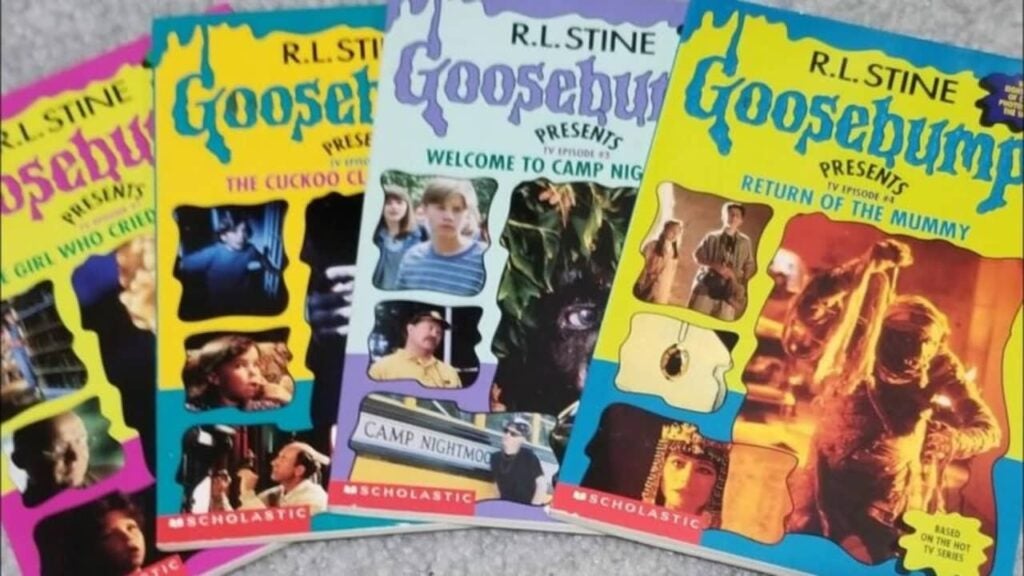
Each episode of ‘Goosebumps’ was based on an original book of about 120 pages. But Scholastic thought they could still make a few dollars more by releasing smaller books based on the TV episodes, in which RL Stine would only put his name on the cover, but not write a single word. The first experiment, in February 1996, was a small 57-page book based on ‘The Girl Who Cried Monster’. And the ticket machine took another turn.
Nearly twenty
One could believe that nobody would fall for such an obvious deception, but the truth is that 18 books were published between February 1996 and February 1998 by different authors, such as Carol Ellis (expert in writing books on demand for sagas like ‘Cheerleaders’ or ‘Zona Límite’), Megan Stine (not related to RL Stine and who ended up making a name for herself writing biographies for children) or Francine Hughes (who had just adapted ‘Space Jam’ and ‘Beethoven 2’ into novels). All in all, a complete fiasco.
You may be thinking about why these books existed. And, on reflection, it makes sense: it was a time without streaming, when there were almost no VHS releases of TV episodes. If you had really liked an episode, you had to hurry up and record it or wait for it to be rebroadcast. These books, which contained full-color pictures, were a way to keep it alive in your memory. In the golden age of novelizations of any kind no one thought it was a rarity. Ah, the good part was that, since they were made from scripts and not the final episodes, you could see (well, read) some unpublished scenes. That’s something.
‘Nightmares’ currently has more than two hundred novels that have made RL Stine a millionaire. Of course, it doesn’t seem that on this book day many are going to go out to the Retiro expecting to find the literary adaptations of the television adaptations of these novels for children. But at least you know they exist: not everyone does!