Clint Hocking is the director of Far Cry 2 and was the director of the upcoming Assassin’s Creed, Assassin’s Creed Hexe, until a few weeks ago. And now he is in the news because he made some statements about the use of AI in video game development. Specifically, how he believes that AI sucks when it comes to doing any kind of work, creative or not. AI is not very liked by Edge Magazine, which in this month’s issue has published a long report on the rise of AI in video game development. For this, it has included, among others, […]
Clint Hocking is the director of Far Cry 2 and was serving as the director of the upcoming Assassin’s Creed, Assassin’s Creed Hexe, until a few weeks ago. And now he is in the news because he made some statements about the use of AI in video game development. Specifically, how he believes that AI sucks when it comes to doing any kind of work, creative or not.
AI is not very popular
Edge Magazine, in this month’s issue, has published a lengthy report on the rise of AI in video game development. For this, it has included, among others, Hocking, who commented on his experience regarding this. “It was brutal. ChatGPT sucks. It doesn’t know how to program. Everything was broken,” the director stated about his experience using AI tools. He affirmed that “it was mostly me trying to debug code without knowing how to program code,” acknowledging that “in a way, I have learned to program despite ChatGPT.”
This seems to align with Ubisoft’s recent experience with AI. The company has been working on the possibility of introducing generative technologies into its process, but it seems that it hasn’t worked. People within the company have even claimed that they don’t use AI because “the results are crap,” suggesting that the idea at Ubisoft is that AI is far from delivering optimal results for making video games. If it ever becomes capable of doing so.
That doesn’t mean that all video game companies agree. Many other studios, like Larian, developers of the acclaimed Baldur’s Gate 3, are looking for ways to integrate it into their workflow. So it seems that we are going to encounter a lot of news of this kind in the future. Even if no one seems to find real useful applications for AI.
What is the first video game in history? Many will consider it to be Pong, from 1972. Others might say a version of Tic-Tac-Toe called OXO that was made at the University of Cambridge in 1952, which didn’t have moving graphics but did have interaction with the player (the computer that ran it, by the way, took up an entire room, and its controller was… a rotary dial telephone). Or perhaps Tennis for Two, a kind of side-view tennis game that was understood as simple entertainment and never had a commercial vision. In fact, after […]
What is the first video game in history? Many would consider it to be Pong, from 1972. Others might say a version of Tic-Tac-Toe called OXO that was made at the University of Cambridge in 1952, which did not have moving graphics but did have interaction with the player (the computer that ran it, by the way, occupied an entire room, and its controller was… a rotary dial telephone). Or perhaps Tennis for Two, a kind of side-view tennis game that was understood as simple entertainment and never had a commercial vision. In fact, after 1959 it was dismantled to use its components in other projects.
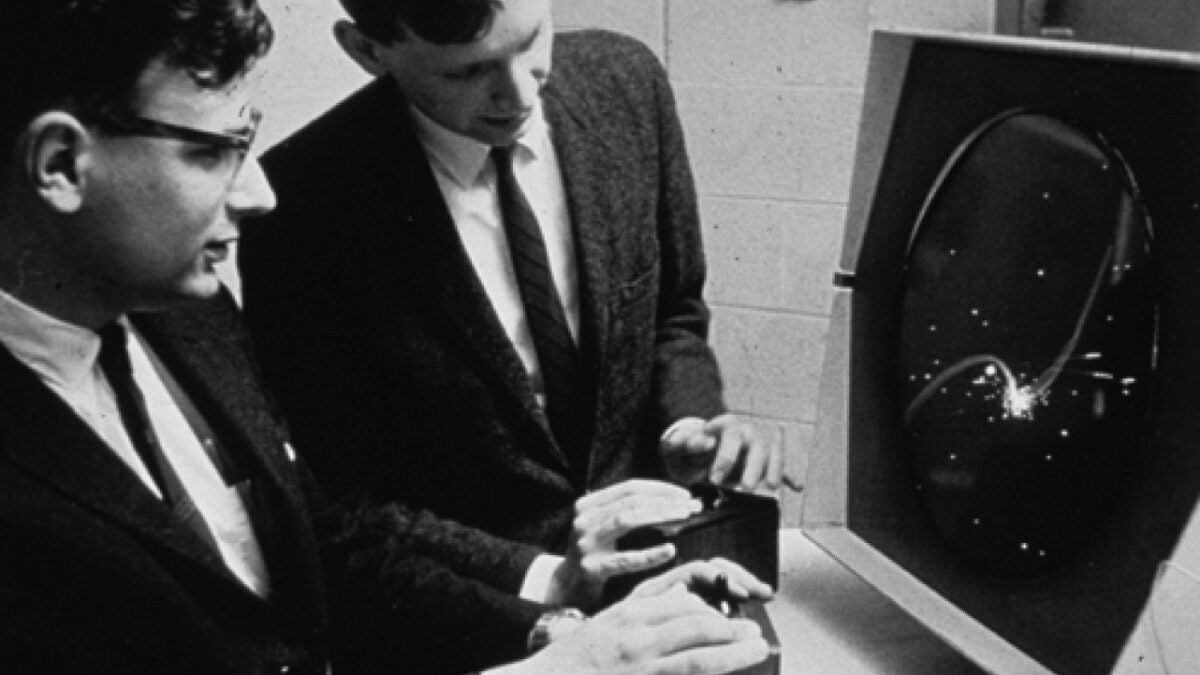
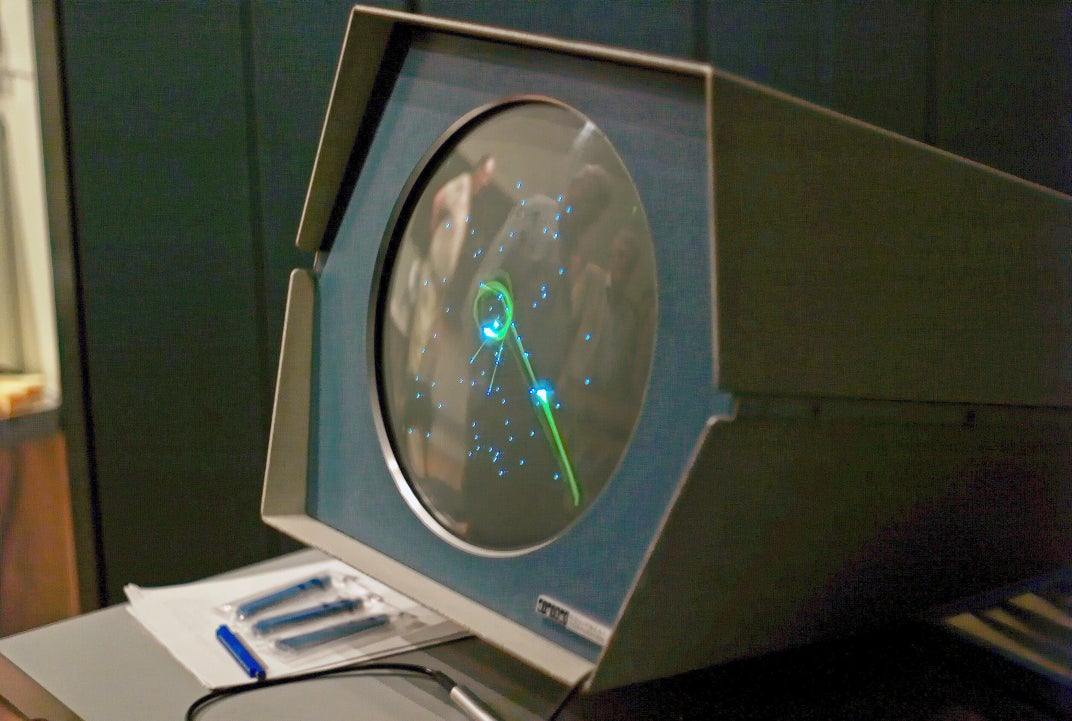
All are valid in one way or another, but it can be said that the first video game, as we know it, was born in 1962: a space battle between ships called SpaceWar! which was not only the first contact for many with programming, but also… the first creative commons game in history, which was tweaked, improved, and re-released across several universities until it had dozens of versions throughout the United States.
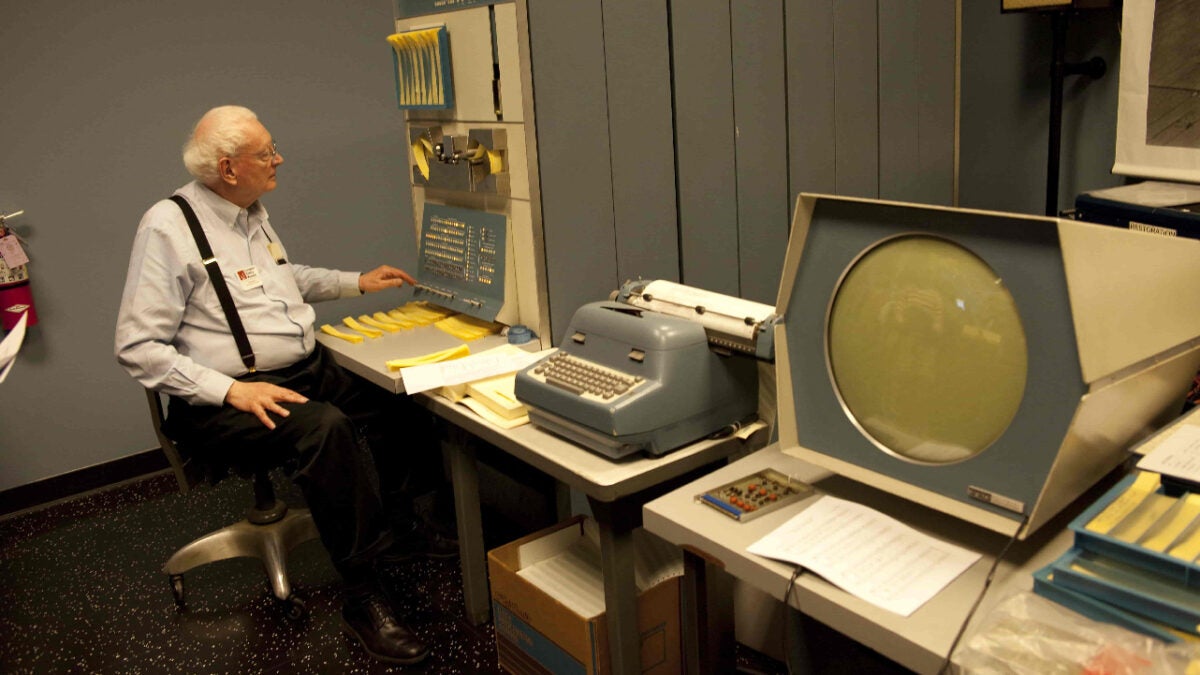
There are two places where this story begins. The first, in the offices of Digital Equipment Corporation, a company that in 1959 was just two years old and had been able to create a revolutionary minicomputer, the PDP-1, which cost $120,000 (a little over a million today, considering inflation) and weighed exactly what you are thinking when you hear the word “mini”: 730 kilos of nothing. But of course, it had to house its amazing 9.2 Kb of power somewhere!
Only 53 units of the PDP-1 were made. One of them, in 1961, ended up being donated to MIT (the university of Massachusetts known worldwide as one of the most cutting-edge in the world), where it became the favorite toy of an entire community of hackers. Yes, although now the word has negative connotations, back then it referred to people eager to write code, learn to program, and use the then-novel computers of tomorrow. And if they could have fun along the way, all the better.
It is there where we find the second place that begins the story, the Tech Model Railroad Club. Yes, exactly: a club where they made scale models of trains and locomotives. And the members were divided into two: those who wanted to enjoy the realism of the models and those who wanted to use computing to ensure that the trains ran correctly on the tracks. Gradually, these evolved into the world’s first computer programmers. And it wasn’t easy.
Let the Space War Begin!
When talking about the PDP-1, you might think of a computer like the one you have near you right now: a screen, a keyboard, a mouse… Well, not exactly. The first prototype of a mouse was created in 1964 and the first keyboard in 1973. Those gigantic structures were operated with all kinds of plugs and buttons… and from there they could program things that now seem basic to us, like word processors, but which were incredibly novel at the time. They were even able to reproduce Bach’s fugues, Mozart’s songs, Beethoven’s Symphony No. 9, or even the Ode to Joy! Yes, now we have Spotify, mp3, and wav, but imagine doing that with less than 10 kb of memory and no guide on how to achieve it.
In this situation of limitless creativity, we find a group of kids, the Hingham Institute, who wanted to create the first “computer toy” or, as we know it now, video game. In fact, they believed that was the highest aspiration a computer could achieve. Being fans of space opera thanks to novels like The Secret Planet or The Skylark of Space by E. E. Smith, they decided to pursue their dreams: two ships in space shooting at each other. Sounds easy, right? Now imagine being the first to do it in 1962, without being able to Google “how to program an easy video game” or ask ChatGPT.
Steve Russell became the project leader, a legendary student who didn’t even finish his studies at Dartmouth because he was quickly hired as a professor. And it didn’t take him five years to program it, like current games: in just two months he had written the 2000 lines of code necessary for it to work. Not bad considering he could only use the computer when no one else was using it. That is, in the early hours, when the rest of the university was asleep.
His prototype wasn’t the best in the world, and he was aware of it. Once he finished it, it was time for the other students to add rhythm, dynamism, and what we now know as mods. The code was completely open for anyone to modify and make their own version: one created a multiplayer mode, another altered gravity, yet another allowed the player to flee… And there was even someone who found the ultimate key: a scoring system to compete, continuously try to improve… And make the queue of people waiting to try it at the demonstrations move faster. In short, a classic arcade game.
You can imagine the heightened creativity of twenty-year-olds who have just discovered their vocation (and, incidentally, video games for the first time). SpaceWar! quickly became a hit around universities, especially because the PDP-1 was included as a program in every unit sold since then. Of course, no one made a penny, although it would have been a success. Gradually, students were playing, enjoying, learning, and forming the world’s first group of video game fans. Both playing them and making them. And among them were some of the people who would create the industry just a few years later. And it all started with a computer that didn’t even have a keyboard. Well, minicomputer.