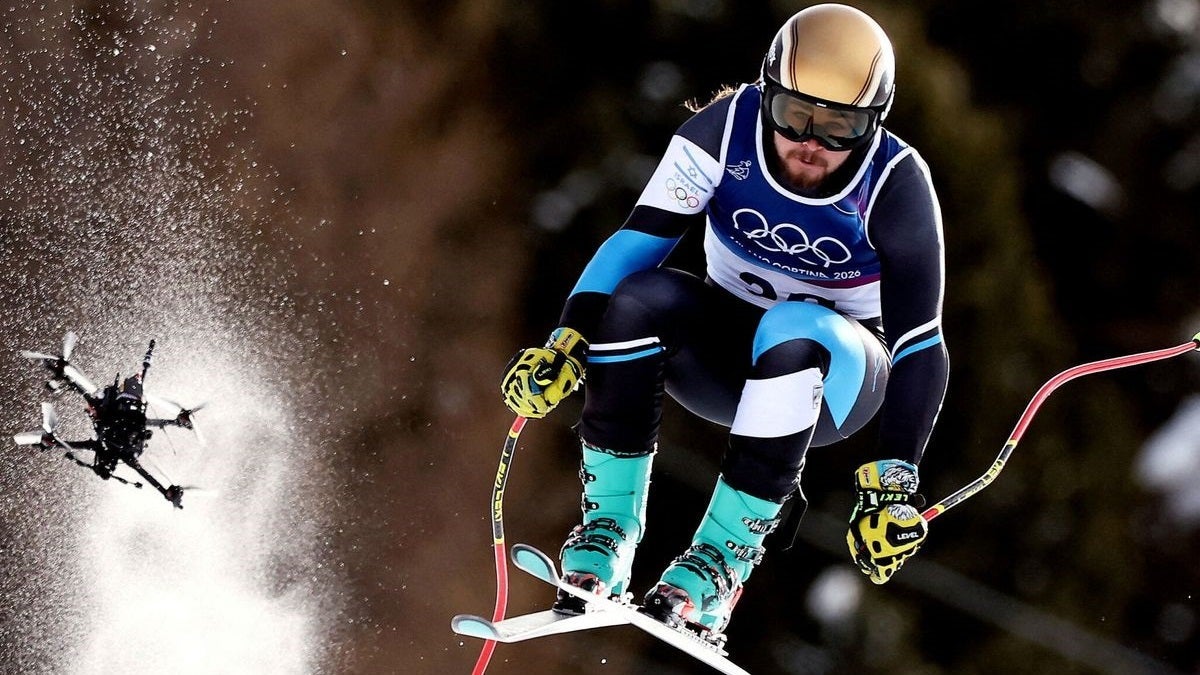
FPV drones (First Person View) have arrived in sports broadcasts with an impressive impact, capable of reaching speeds of up to 100 km/h and offering innovative visual perspectives in disciplines such as alpine skiing and cycling.
Olympic Broadcasting Services (OBS), responsible for the television signal of the Olympic and Paralympic Games, began using this technology at the Beijing 2022 Games, and its use has notably expanded for the upcoming Paris 2024 and Milano-Cortina 2026 Games.
For Milano-Cortina, OBS has designed drones specifically for the transmission of sporting events, lightweight devices weighing 243 grams that incorporate advanced COFDM transmission technology, allowing for high-definition video.
A technology that has revolutionized the way sports events are broadcast
In total, 25 drones have been deployed, operated by specialized teams that work in perfect synchronization to ensure accuracy in the flights. This development marks the first time that drones will be used en masse in the Winter Games, allowing spectators to follow athletes through fast and complex descents.
The arrival of FPV drones has transformed the way sports are presented to the public. Previously, coverage relied on quick cuts between fixed cameras; now, drones allow for smooth and continuous tracking of athletes, ushering in a new era of immersion and appreciation for the sport.
Viewers can experience the rapid speeds achieved by the competitors, opening up a range of visual possibilities that seem straight out of a video game.
Despite these advancements, drone technology still faces challenges, especially regarding safety. An incident in 2015 raised concerns about their use in sporting events, although new lightweight models have been designed to mitigate risks. However, recent reports suggest that there is still room for improvement in technological safety issues.