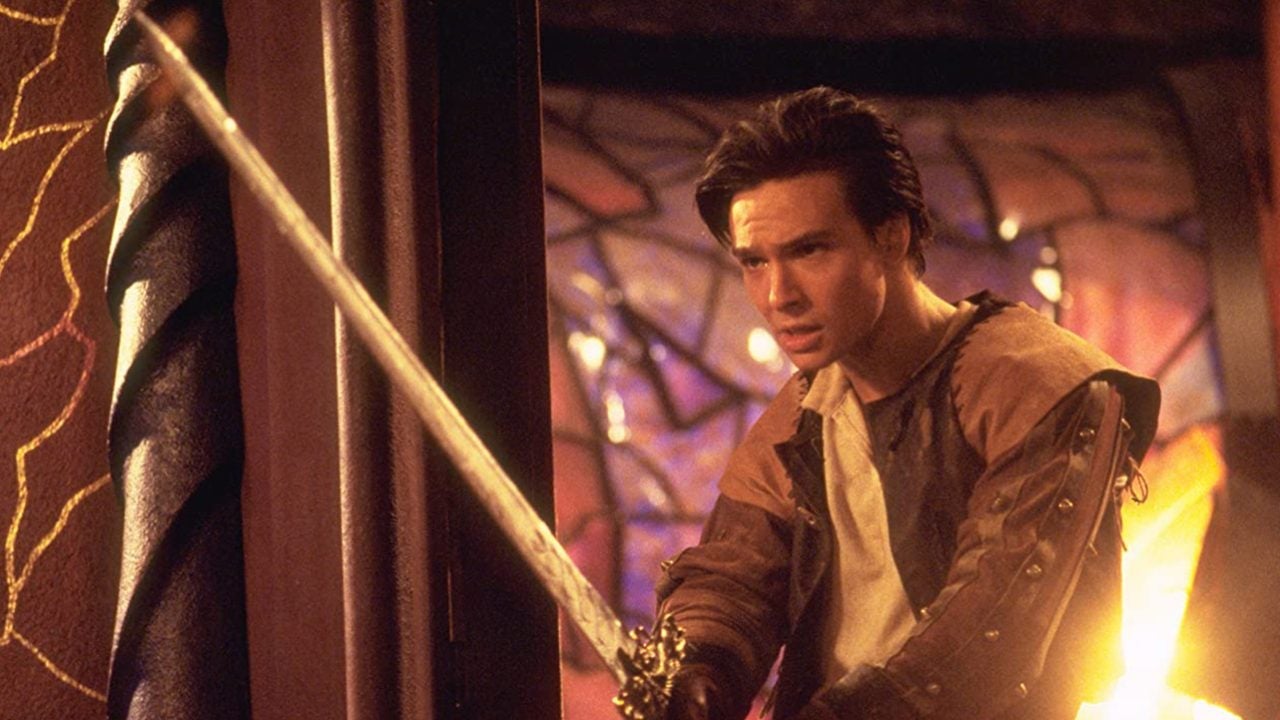
It took almost 50 years for Dungeons & Dragons, the most famous role-playing game of all time, to have an adaptation that lived up to its legacy: Honor Among Thieves was fun, adventurous, playful, and unique, while still embracing the medieval fantasy with magic and giant swords that players are accustomed to. However, getting to this point has involved a universe of bad adaptations, misunderstood versions, iconic (but failed) cartoons, and people who consider themselves fans but definitely do not understand the game. One of these people was Courtney Solomon, an old-school gamer who wanted to make the definitive movie. It did not turn out well.
A hellish world
In the early 2000s, Dungeons & Dragons was practically forgotten, beyond the groups that continued to gather to roll dice for hours. Just fifteen years earlier, the animated series from the mid-80s helped make all the kids want to try it (and, by extension, learn math), but the fear of the unknown caused by the Satanic Panic buried all its chances of becoming something mainstream, settling for being an unavoidable piece for all pop culture enthusiasts that had forever transformed the way stories are told. I wish everyone could say something remotely similar.
But then came Courtney Solomon, a 21-year-old who started his own company in 1992, Sweetpea Entertainment, to buy the rights to the franchise and make his dream project: an adventure on par with those he created with his friends. Solomon believed he had experience, after all: his mother was a production coordinator on television series, which apparently gave him credibility, so he only had to travel around the world looking for funding for his masterpiece. Considering that the parent company had been receiving sighs and rejections from all kinds of film producers for a decade, they wished him good luck, sold him the rights (after a long pitch), and went on their way.
Solomon was not going to settle for less than a 100 million dollar movie directed by Francis Ford Coppola, James Cameron, or Renny Harlin, who at one time or another were attached to the project. The original script featured a rogue as the protagonist and included up to 14 monsters in a final battle filled with special effects. In fact, in 1995 they even secured a final director, Stan Winston, a special effects expert from movies like Jurassic Park, Aliens, Predator, or Edward Scissorhands. Big words. So, if everything was tied up and well tied… can anyone tell me what the hell happened?
The usual in Hollywood: several fantasy movies crashed at the box office at the same time, and the producers stopped trusting Dungeons & Dragons, gradually pulling their money from the production. The movie became a television series for a time, and later a direct-to-video film that, far from the 100 million dollars Solomon wanted, managed to get a budget of 3.5 million. And thank you. Solomon himself, in light of his failure, appointed himself as director and shot a test scene in Los Angeles so powerful that it managed to raise investor interest again to 35 million. With this, something more than decent could have been made! Spoiler: he rolled the dice and got a failure.
The result was a solemn bad movie that barely has anything in common with the original game. Fans ended up angry with Solomon, Wizards of the Coast didn’t know where to hide and at the box office, it barely made 33 million amidst the fury of film critics. To everyone’s surprise, it was enough to produce two more direct-to-video movies in 2005 and 2012, without Solomon in sight (only as a producer). The director would end up becoming a name in Hollywood’s low-budget cinema thanks to his production work on films like The Strangers. Hey, no one knew how to get a lot out of very little like he did. He just needed to make it interesting!
As we all now know, thanks to the rise of Twitch and shows like Critical Role, Dungeons & Dragons returned to popular culture in the honored place it deserved from the beginning. And no one ever spoke of this abomination again. Happy ending for everyone.
