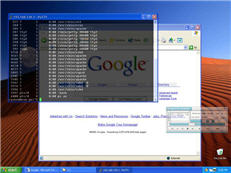
Vista-style transparency for nothing

vitrite.jpgOne of the most hyped features of Vista is its new transparent windows, courtesy of the Aero graphics engine. This is a useful option if you’ve got lots of windows open on a crowded screen and more to the point, it looks good. However, if like many others you’re still not convinced Vista is worth upgrading to, you can still have this classy little feature courtesy of Vitrite.

Vitrite is a tiny app that allows you to manually adjust the level of transparency for almost any visible window. When executed, Vitrite minimizes to the system tray in the lower right corner of the screen. If you wish to make a window transparent, you simply click on the window and press ‘Ctrl Shift’ plus any number on your keyboard depending how transparent you want to make it with one being the most transparent setting. So no more flicking between tabs or scrolling through your toolbar to see what you’ve got open – you can see everything at a glance. Obviously, be careful that you don’t pile too many windows on top of each other or else everything will start to look incomprehensible.

Note as well that Vitrite also offers the option to toggle the ‘always on top’ feature. Again, just press ‘Ctrl Shift’ with the ‘+’ key to make the active window float on top of the other windows. So there you have it – one of Vista’s most attractive features for nothing!
Get hold of codecs with afreeCodecVT

1132370366.pngAnybody who’s watched AVI movies has had to use a codec, yet few people really understand what they are or how they work. To make things clear, codecs encode (and decode) your media file so that your media player can read it. AfreeCodecVT will avoid all the hassle by helping you choose the right codec according to the media file you have and will provide all sorts of information on all the codecs that exist out there.
A simple one-stop interface makes afreeCodecVT a reliable and easy to use gateway for the codec hungry crowd. AfreeCodecVT is first and foremost a huge database with every imaginable resource on codecs and the ways they’re used. The codec wizard will answer your doubts and the codec search will link you to the regularly updated codec library from the afreeCodecVT website. There’s a good chance the one you need is among the ones most downloaded by other users.

Continue reading “Get hold of codecs with afreeCodecVT”

Use your PC for non-techie hobbies

origami.gifIt seems that nowadays we’re all somehow obliged to enjoy geek hobbies, such as playing videogames, surfing the net or retouching digital pictures. What happened to all those good old hobbies people used to have? Not so long ago, children traded football cards while their parents collected stamps, cooked new cake recipes for dessert or knitted warm sweaters for all the family.

Society has definitely turned hi-tech but traditional hobbies are still a very valid option for those who want to make the most of their spare time –preferably not in front of a screen. In any case, there’s always a way to combine both technological and more conventional hobbies.

Regarding software, for example, you can find apps that help you organize your favorite cooking recipes or manage almost any type of collection, from the classical coins and stamps anthology to collections of books, movies or even wines. If you like reading comics, your PC allows you to enjoy a wide variety of daily comic strips right on your desktop.

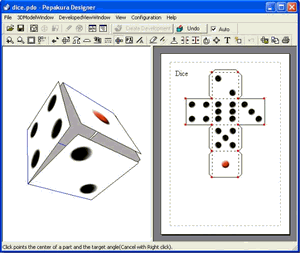
Finally, there are also software applications dedicated to less common hobbies like origami (the art of making paper figures) or even to really traditional activities like cross-stitching.

WMDC – ActiveSync for Vista

windows-mobile-2.pngAnyone out there who uses a Windows Mobile device (Pocket PC or Smartphone) will be familiar with Microsoft’s ActiveSync software. Ugly, irritating and very user-unfriendly, ActiveSync has been causing problems for users for years. Perhaps that’s why MS have finally decided to lay it to rest and replace it with the brand new (and, yet again, snappily titled!) Windows Mobile Device Center (WMDC).

There’s no doubt that the new tool offers some serious improvements on ActiveSync’s design and performance. Now adopting a fully-integrated GUI, the WMDC finally feels like a native part of the OS rather than just an add-on. Features for handling music and images are finally introduced and look pretty good (the photo-tagging option is a nice touch). Aslo improved are connection stability, file browsing and setup, making WMDC a much more complete and reliable solution than ActiveSync ever was.

That’s not to say, however, that WMDC is flawless. There are numerous problems with the new program, including some which will definitely prove to be deal-breakers for some users. For example, PocketPC2000 and PocketPC2002 devices are simply not supported by WMDC. The reasoning behind this decision seems somewhat dismissive of users who might own these older devices (Jason Langridge: “[If you’ve got a 6 year-old device]… I’d doubt you’d be running the latest version of Windows”). Bizarrely, WMDC can sync with Outlook 2007 but not with Vista’s new built-in ‘Mail’ or ‘Cal’ applications.
Continue reading “WMDC – ActiveSync for Vista”

Create your own Icy Tower character

Harold the Homeboy has become something of a cult hero in gaming circles now following the success of Icy Tower. However, due to the addictive nature of the game you end up spending so much time with the little dude that it’s possible to become sick of the sight of him (especially if you want to be as good as the player in this video).

[youtube]lMqq07EZwDk[/youtube]

The good news is it’s possible to give Harold a makeover using the built-in templates files. Enter the “\icy tower\characters\template” folder in Windows Explorer and click on the paintbrush icon to open a sprite version of the character. Press Ctrl + E to open up the sprites for editing Use the editor to tweak the character’s design, ensuring that every part of every sprite is the same colour. Make sure you don’t go out of Harold’s green outline (though you can change the colour of this outline). Now save the image and play the game with the template character selected.

Excel plugins vulnerable to attack

ExcelIf you’ve installed any Excel plugins such as Excel Calendar Template, then be warned that Microsoft have identified a new vulnerability in Excel that could allow hackers to take control of your machine. As usual however, the company will not put a date on a fix but say they are ‘working on it’.
The vulnerability affects all Excel versions after Office 2000 including Office 2004 for Mac. The vulnerability is exploited when hackers run a code by inserting a series of special characters inside any Excel file. The exploit can then be used to take over the rest of your machine. What’s worse, whilst Microsoft currently believe it is limited to Excel, its possible that it could affect other Office components such as Word, Outlook and Powerpoint.

Microsoft has recently employed a policy called “Patch Tuesday” where it issues fixes on a monthly basis rather than fixing problems on an as-they-happen basis. However, maybe the seriousness of this hole may prompt it into reverting back to its old ad-hoc system.

Edit tracks with FL Studio

Since its first release in 1998 Fruity Loops has done much more than changing its name to FL Studio. From a good midi pattern sequencer it has evolved into a powerful music editing studio for your PC. We’ve therefore decided to cover the features in this latest release.
fl5.jpg
Let’s first take a look at the interface. Users familiar with FL Studio will instantly recognize the dark green tone and rounded windows of past versions. However, the structure of the program can be difficult for a first-time user to grasp. The browser window on the left is your resource for any file you will need, from presets to projects and scores. Clicking on an item will open up a drop down selection of specific elements. This library can be filled with more of your own loops and samples and carries an impressive amount of plug-ins like DirectWave, EQUO or Fruity Squeeze. FLStudio has a smart search function to quickly find any track, tool or effect.

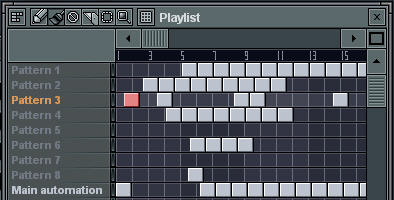
To edit your tracks you can use the original pattern window, which contains all the instruments you have selected. You will have to create the pattern desired for each instrument. You can also use the playlist window, divided into patterns at the top and audio tracks at the bottom. The playlist view features a handy paintbrush tool to color in your pattern. You can also decide to edit your tracks with the piano roll view, quite handy if you have a midi keyboard plugged in. Continue reading “Edit tracks with FL Studio”

Flickr restrictions imposed

flickr-gamma-logo.pngWhile we still maintain that Flickr is probably the best way to handle your photos online, the service is starting to annoy people as Yahoo! tightens its grip on the Web-based app. If you’ve managed to build up more than 3,000 contacts or 75 tags using the program then prepare to be disappointed – you’re no longer welcome.

According to Flickr’s owner, Yahoo!: “In our ongoing efforts to make Flickr better, we’re introducing two additional limits: the new maximum number of contacts is 3,000 contacts (good luck with that), and each photo on Flickr can have a maximum of 75 tags. We love your freedom, but, in this particular case, limiting these things will actually improve the system performance, making pages load faster across the site for everyone and cut out some unwelcome spammy behaviors. Both of these new limits apply equally to free and pro account members.”

While we can appreciate the case for reducing spam and increasing download times, it seems that the company is penalizing Flickr’s hardcore users just for the fact they’re enjoying the site and the community it has to offer. Instead of applying restrictions to the user perhaps Yahoo! could improve its file sharing system to allow everyone to share their photos without worrying about limits.

eMule vs Limewire

Today we’re going to take a look at eMule and Limewire, two of the biggest free P2P filesharing programs around. We will compare them according to a certain amount of factors like version, network, downloading process, search function and extra features.

emule2.jpgFirst of all, let us remind you that both programs are at very different levels of development. While eMule is known to be one of the most popular P2P applications, it is still only at version 0.47c. Limewire is now 4.12 and offers a PRO (but not free) version with advanced features. However there are loads of moded versions of eMule, like MorphXT, Plus or Xtreme with different skins or performance enhancements.

Concerning networks, eMule and Limewire are in two different ball parks. eMule connects to the eDonkey and Kad networks while Limewire connects to Gnutella. These are probably the most popular around, and yield excellent results, whatever you may be looking for. When setting up Limewire, if your router is UPnP enabled it will automatically forward a port for you. This is because Limewire supports UPnP port mapping. With eMule you will have to choose and forward a port yourself.

Continue reading “eMule vs Limewire”

Play DivX movies on your Pocket PC

divx-logo-2.pngPortable video is fast becoming the most popular secondary use for Pocket PCs, so making sure you have the right media player is now a priority for many PPC device owners. The Core Pocket Media Player is an open-source video and audio player compatible with all the most popular codecs and multimedia file types.

TCPMP is easy to use, very stable and loaded with a variety of features. The program’s main screen is reminiscent of similar programs on your desktop computer, with options to change aspect ratio, zoom and volume as well as more advanced controls such as video speed (10% – 200%), video driver, audio preamp and more.

One issue with playing video files on a Pocket PC, irrespective of which program you use to play them, is that there will be some lag or jumps from time to time. While some of the top end Pocket PCs now have processors and system memory that should be able to cope with playing quality video, the fact remains that the majority of devices, while technically capable of playing video, are not really designed for that purpose. Compare the playback quality on your Pocket PC with a purpose-built portable media player and you’ll see the difference. TCPMP’s settings are therefore an essential feature of the program, allowing you to play around with different levels of quality and performance to help you guarantee the best possible multimedia experience.

In all, The Core Pocket Media Player is a free, open source multimedia player which I’d recommend to anyone who wants to watch video on their Pocket PC. That said, if portable video is your heart’s desire, it would definitely be worth investing in a device built specifically for video playback which will provide much better overall quality.