Let’s collectively pretend to be in shock with this news: it turns out that the arrival of Donald Trump to power (not yet fully effective, but very close) has led to an almost immediate rollback of rights and the censorship of books, oppressing the weakest. To be more specific, and hiding it as “protection of childhood,” censorship has begun in the school districts of Tennessee, which will soon be left without manga to read in their libraries. Yes. Without manga. Little tolerance. Obviously, we can all agree that there can’t be hentai manga in student libraries […]
Let’s collectively pretend to be in shock with this news: it turns out that the arrival of Donald Trump to power (not yet fully effective, but very close) has led to an almost immediate rollback of rights and the censorship of books, oppressing the most vulnerable. To be more specific, and hiding it as “protection of children,” censorship has begun in the school districts of Tennessee, which will soon be left without manga to read in their libraries. Yes. Without manga.
Obviously, we can all agree that there cannot be hentai manga in student libraries in any country in the world, but under the pretext of banning any material that contains “nudity, shows sexual excitement, sexual conduct, excessive violence or sadomasochistic abuse” in schools, titles like Attack on Titan, Akira, My Hero Academia, Hunter X Hunter, Fire Force, or Jojo’s Bizarre Adventure, among many other titles, have been removed from the shelves, taking us back to past times we thought were long gone.
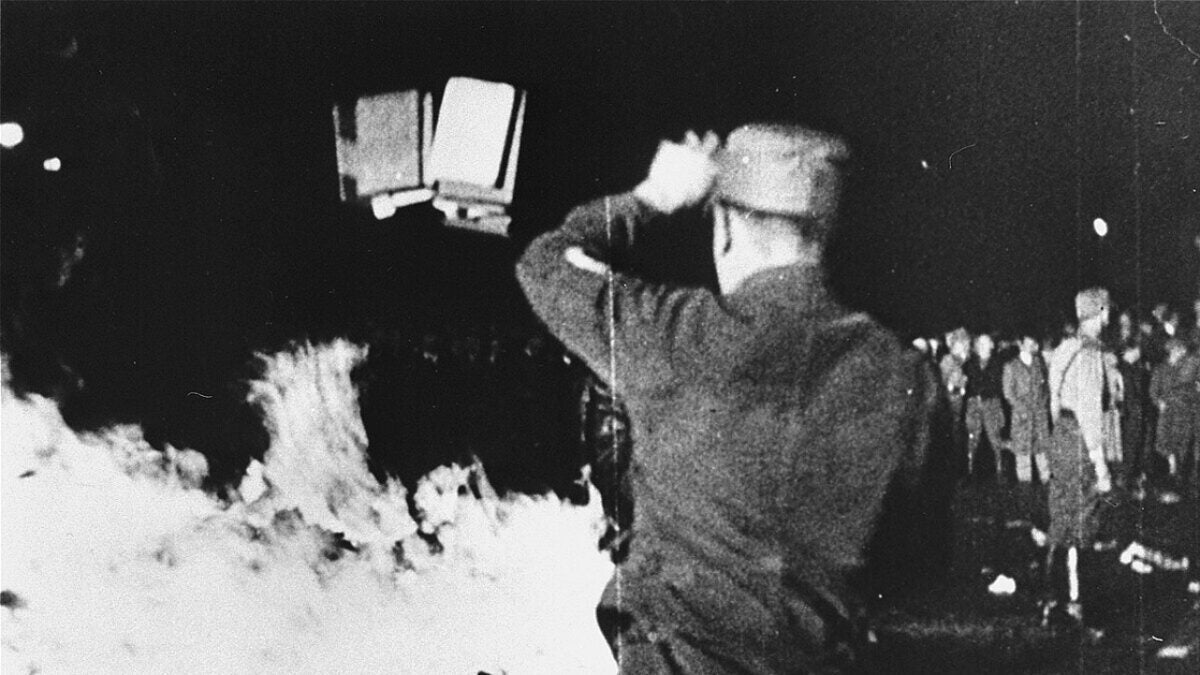
And in their attempt to ban “pornographic books,” classics like Wicked, The Perks of Being a Wallflower, or Tower of Dawn, a novel from the Throne of Glass series, have also been removed from the shelves. And we can add up to 150 titles that have absurdly been thrown into the fire without reason due to fear of the unknown. And if all this reminds you of 1930s Germany more than it should, perhaps it’s time to consider why.
This new installment of the Square saga is giving people something to talk about because it promises to be a game for adults in which we will find drugs, scenes of torture, sex, prostitution, and hate crimes.
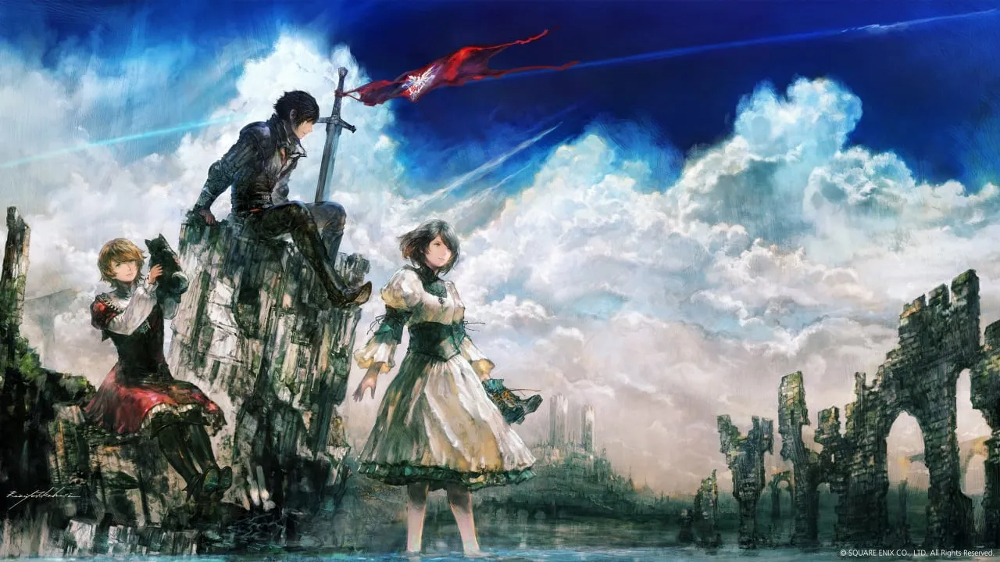
There’s a month and a half to go until the release of ‘Final Fantasy XVI’ and, apart from repeating the cycle of every Final Fantasy (fans saying that the previous one was the good one and this one isn’t), this new instalment of Square’s saga is really getting people talking because it promises to be a game for adults in which we’ll find drugs, torture scenes, sex, prostitution and hate crimes. It’s like a crossover between Final Fantasy and ‘GTA‘. However, there is one country that has gone beyond “for adults”: it has erased it from existence.
According to ESRB, the US rating system, the voices saying it’s too edgy aren’t lying: there will be moaning in a hotel room, dialogue like “I’d be happy to show you… if you can afford it”, half-exposed asses and breasts, and words like “fuck” and “shit”. OK, yes, we don’t think it’s anything to shout about either, but it was enough to give it an M rating, i.e. recommending that children under 17 stay away from it. PEGI, for its part, has also rated it for 18+.
Of course, the essentials of the game are still there: orcs, magic, swords, fireballs, that sort of thing. After all, it’s still ‘Final Fantasy‘, even if there are suddenly scenes written by a fifteen year old. However, in Saudi Arabia, the company in charge of rating the game has refused to do so and, consequently, the game will not be released and will remain unreleased in the country.
The reason is that Square has steadfastly refused to censor the game and make the necessary modifications to make it look good, so the hardcore fans out there may already be preparing “alternative ways” to get it. Wink, wink. The ratings body hasn’t said exactly what it is that’s been bothering them, but rumour has it that it’s a homosexual couple. Frankly, good for Square. There’s money to be made that isn’t worth stooping for.
This is not the first game to be censored in Saudi Arabia, which has a long tradition of banning experiences for the most bizarre reasons. For example, ‘The last of us II’ had a homosexual couple, ‘Dead rising 2’ had gambling and nudity, ‘God of war’ had religious and sexual content and ‘Spec Ops: The Line’ had a fictional representation of Dubai. There are many others, including ‘Roblox‘ or ‘Injustice: Gods Among Us’, and ‘Final Fantasy XVI’ is just one more on the list.
Not least because Saudi Arabian laws apparently don’t follow censorship enforcement and games end up appearing in shops without anything happening, so fans of Japanese RPGs in the country will probably be able to get their hands on it anyway. The censorship issue is a curious one: for example, no games were banned in Afghanistan between 2001 and 2021, except for one, with the idea of protecting the younger generation from a bad influence. You’re thinking of ‘Manhunt 2’ or ‘Carmageddon’, right? Well, it was PlayerUnknown’s Battlegrounds. What you have to see.
In Germany, Clever & Smart came to have not only two unpublished comics in Spain, but also three censored and redrawed pages of an adventure carried out in honor of the German country.
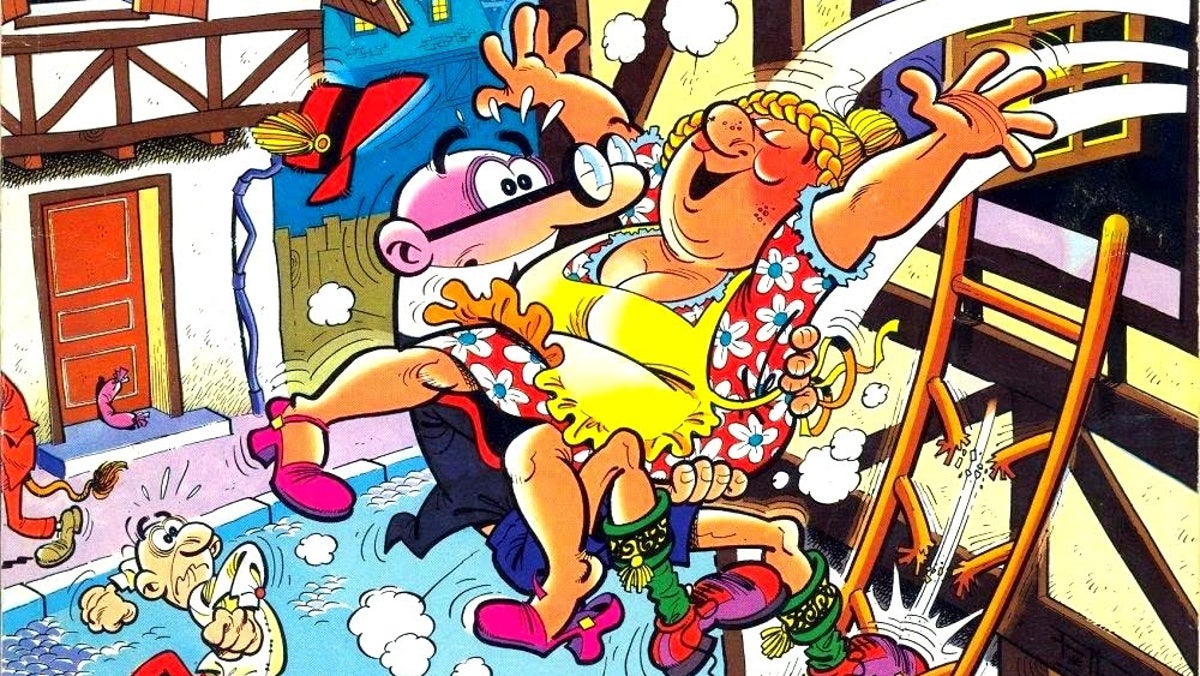
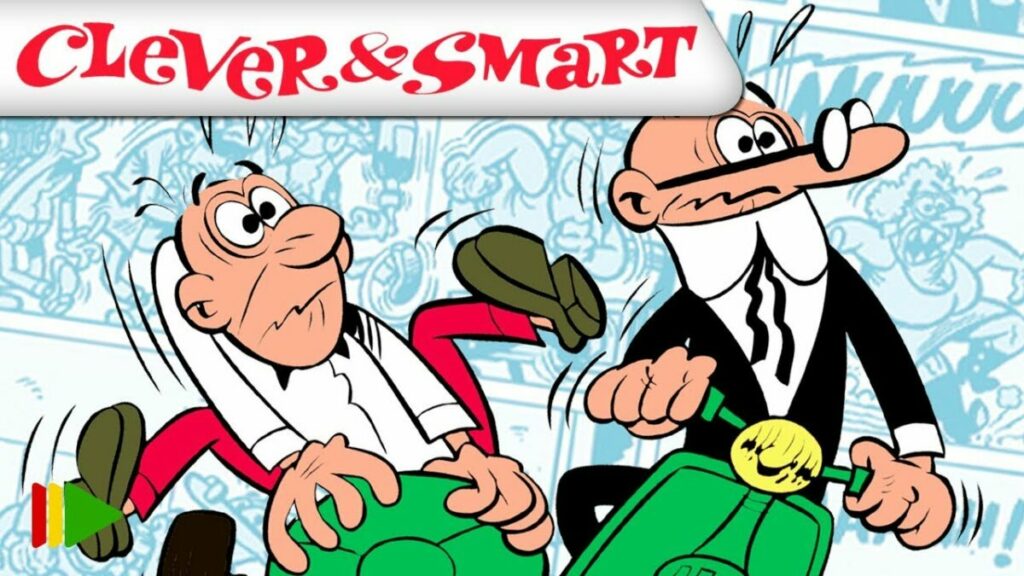
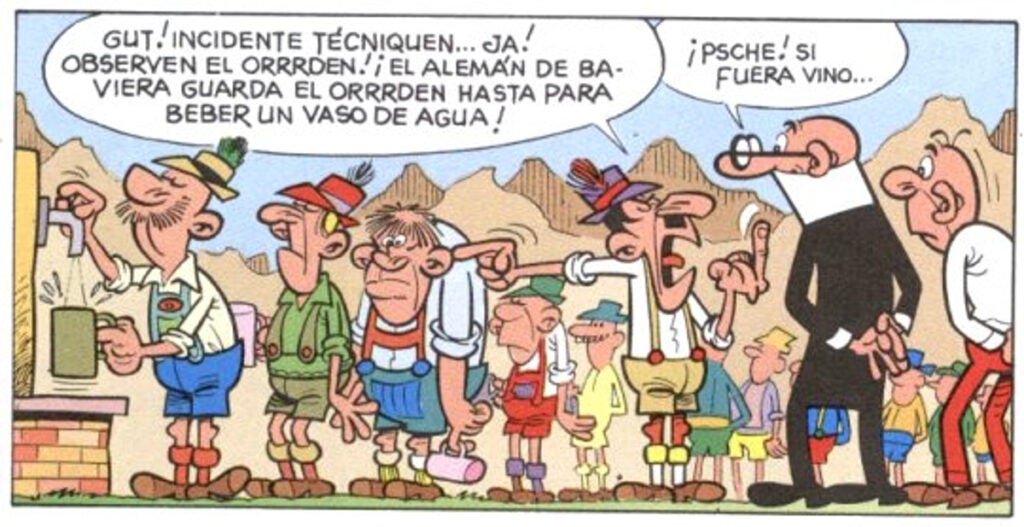
When we talk about the “Spain brand” we often forget one of the products that is most recognized beyond our borders. Although it may seem strange to us because it is still something very “caní”, Mortadelo and Filemón have been a huge success around the world. But maybe nowhere as much as in Germany, where Clever & Smart (the translation of those places) came to have not only two unpublished comics in Spain, but three censored and redrawn pages of an adventure made in honor of the German country. Don’t run, no, you fool, I’m going to give you censorship!
Landing in Germany
The year 1972. Ibáñez had just finished the twelfth long comic book of the TIA agents, ‘Gatolandia 76’, when his cartoons began to land in a Germany still divided by the Berlin Wall. Clever and Smart were still working for the TIA (which instead of ‘Aeronautical Investigation Technicians’ would now be ‘Trans-Internationaler Agentering’), but instead of fighting against GRANDMOTHER they were fighting against the OMA (‘Organisation Militanter Agenten’, it should be said that ‘Oma’ means ‘Grandmother’ in German). The name of the Super was changed to Mr. L.
Small changes that did not prevent Ibáñez from signing Mortadelo comics and comics in Germany. So much so that he even created a character that resembled his German publisher’s secretary, the later ignored Irma. Later, the agents would be known as Flip & Flap. Flip and Flap worked, paradoxically, for the OMA (“Organisation für Meister-Agenten”) and the Super was called “Mr. Knacks”.
The last way Mortadelo and Filemón would be known in Germany was as Fred and Jeff, the name given to the VHS edition of the short films by Estudio Vara. The thing is that Ibáñez was so grateful to Germany that between 1981 and 1982 he would serialize in Mortadelo magazine a story that would have our agents going around Bavaria or Berlin: In Germany. But the h0menage came out regular.
Apocrypha and censorship
The trip to Germany in question is in search of The Rat and The Pachyderm, two jewel thieves who have stolen Queen Elizabeth II’s jewels (“Her Majesty, the Queen, will have to attend the opening ceremony of the Parliament with a beret because of the theft of her crown and other jewels that blah… blah…”). And of course, to avoid problems between the two sides, all references to East Berlin were deleted in the German country.
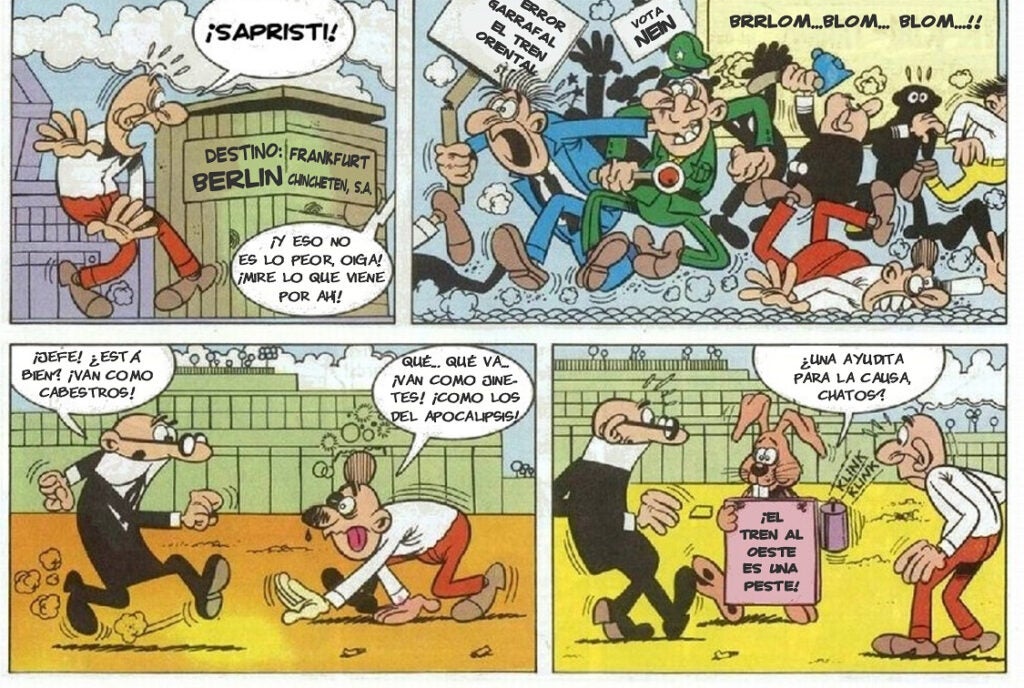
In the first censored page (and translated thanks to the Unofficial Page of Mortadelo and Filemón), Filemón discovers that they have arrived in East Berlin and end up knocking out a policeman who asks them for their papers. This could not be allowed in Germany, so what they discover instead is that they have arrived in Frankfurt, where there is a demonstration around the train. Finally, a rabbit appears with the slogan “The train to the West is a pest!” and asking them for a donation. The drawing tries to imitate Ibáñez’s, but it is between a copycat and forced. It doesn’t succeed.
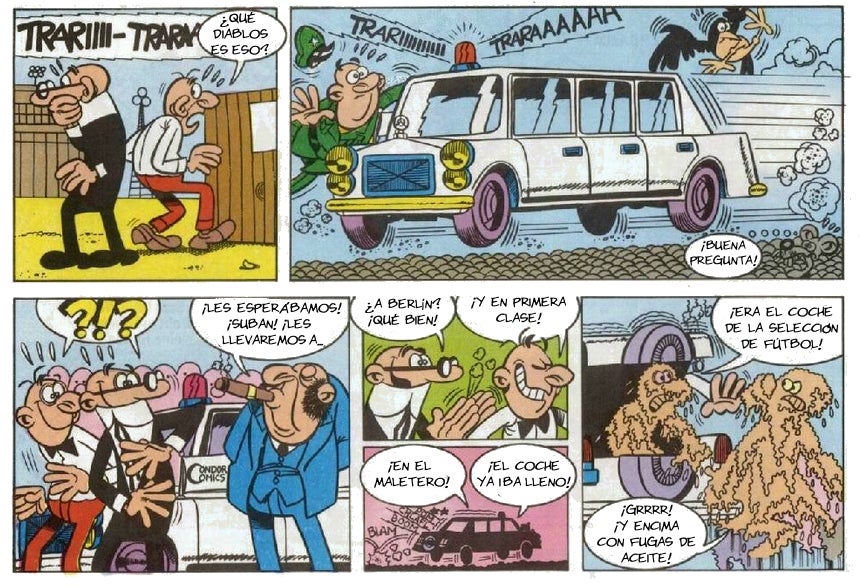
The second one is completely original, and it is worth reading to understand how difficult it is to make a good Mortadelo comic book. In the original, the agents try to cross the Berlin Wall from underneath but end up unblocking a pipe: the bad smell makes them pass through, leaving everyone disgusted. However, in the German version they doubt whether they are in Frankfurt or New York because there are “too many vandals on the loose” and end up arriving in Berlin in the trunk of the soccer coach’s car, which was leaking oil (justifying that they were muddy to continue the story).
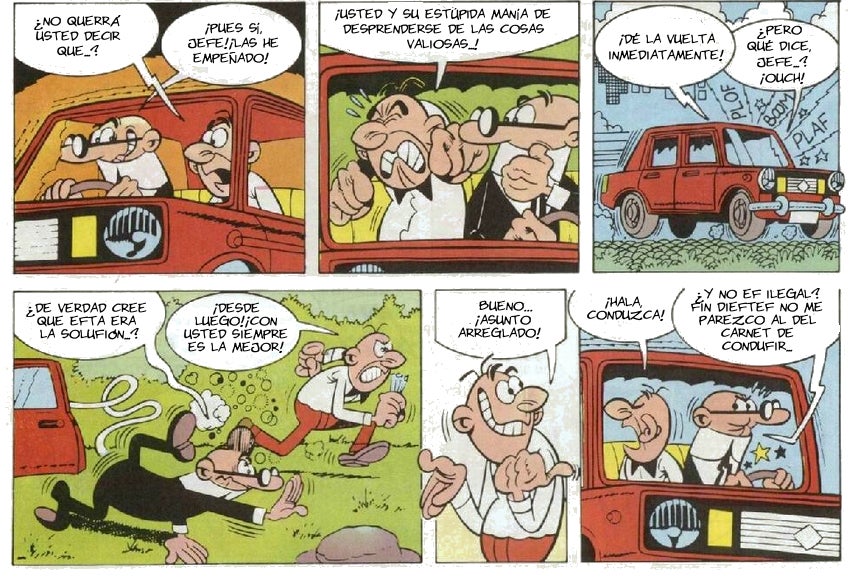
The third and most flagrant replaces a gigantic and hilarious cartoon in which the agents sneak into East Germany and everybody shoots at them (“Headquarters? Yes, send six fighter-bombers! And prepare the surface-to-surface missiles!”) with six in which Mortadelo acknowledged having pawned the crown jewels and turned around to get them back (“Well… matter settled!”). A masterpiece of absent-mindedness and the most profound ridicule.
Unpublished comics
In the 80’s, Ibáñez’s fame was such in Germany that 280 new strips of 13 Rue del Percebe were created, long comics by Botones Sacarino with stellar appearances by Mortadelo and Filemón (in one of which they get to meet Ronald Reagan while they prevent Tete Cohete from blowing up the Statue of Liberty and in another, for example, they use Professor Bacterio’s inventions in the writing of El aullido vespertino (The Evening Howl).
And, of course, there were also two completely unpublished Mortadelo and Filemón stories: ‘Nur kein Gehetze, wir haben Arbeitsplätze’ (translated by the TIA forum as ‘¡Que no cunda el pánico! Tenemos trabajo!’) came out at a time of very high unemployment in Germany, and shows the two agents testing methods to reduce it. In fact, its cover announced “Have you also been left on the street and without a job? Mortadelo and Filemón will give you some advice”. Just the people you want to get job advice from.
The second, ‘Vom Affen gelaust und losgesaust’ (translated by the TIA forum as ‘Monos con garrapatas… y huidas por patas!’) has a more Spanish line but is clearly not drawn by Ibáñez. In the story, both agents were fighting a poacher. These are mere curiosities that deserve to go down in the history of Spanish comics. Or German. European in any case! Don’t run, no, I’m going to give you apocryphal!