Huawei’s ambitious foray into artificial intelligence infrastructure, the CloudMatrix 384, is turning heads in the tech community.
Equipped with 384 Ascend 910C chips, the new system has reportedly outperformed Nvidia’s H800 chip when running the DeepSeek R1 model, which consists of 671 billion parameters.
This claim comes from a newly published technical paper in collaboration with the Chinese AI startup SiliconFlow, suggesting that Huawei’s approach may have tackled key performance metrics where Nvidia has traditionally dominated.
New AI Infrastructure from Huawei Promises High Power but at a High Energy Cost
The CloudMatrix 384 stands as a testament to Huawei’s brute-force approach to AI capabilities, especially notable given the company’s restrictions on accessing cutting-edge chip production.
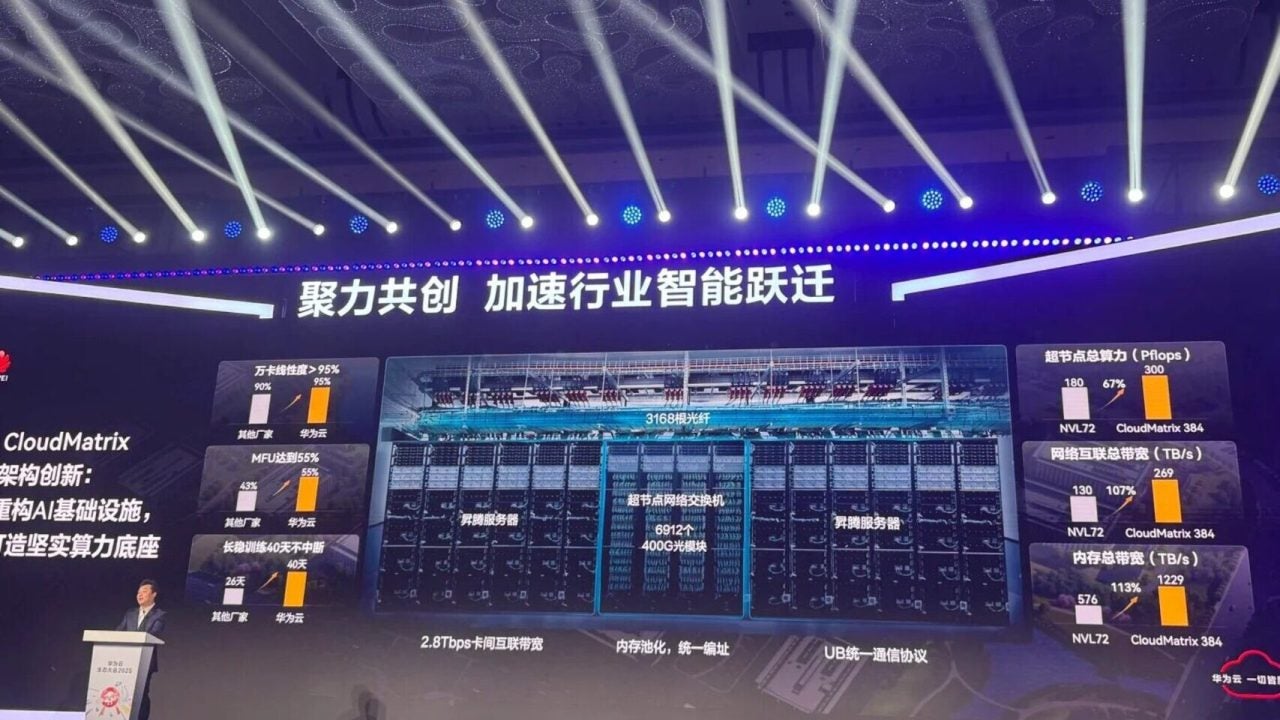
This rack-scale system features a combination of 384 dual-chiplet HiSilicon Ascend 910C neural processing units (NPUs) and 192 central processing units (CPUs), spread across 16 server racks interconnected with optical connections for enhanced speed.
Despite its high computational output, reaching an impressive 300 PFLOPs of BF16 compute, the CloudMatrix has a significant drawback: energy consumption. The system reportedly consumes four times more energy than Nvidia’s GB200 NVL72, racking up a total of 559 kW compared to the NVL72’s 145 kW, which raises questions about operational efficiency.
Notably, Chinese firms are unable to access Nvidia-powered AI clusters, which makes the relevance of direct performance comparisons with Nvidia somewhat diminished in that market. Furthermore, the recent drop in electricity costs in China by nearly 40% over the last three years may make the CloudMatrix’s energy consumption less of a hindrance to prospective customers.
Nvidia CEO Jensen Huang has maintained that his company remains a generation ahead in technology, acknowledging that while Huawei’s advancements are notable, scalability remains a challenge.
“AI is a parallel problem”, he stated, emphasizing the need for robust systems to compete effectively. Still, the CloudMatrix presents a viable option for Chinese enterprises aiming for high-performance AI solutions amid geopolitical restrictions.