It has been 23 years since Microsoft acquired Rare for 375 million dollars, an investment aimed at acquiring iconic franchises like Conker’s Bad Fur Day and Perfect Dark. However, a recent comment from Chris Seavor, creator of Conker, revealed that some of the Microsoft executives who made this decision were not fully informed about the video game industry. During a visit to Rare’s offices, one of them expressed his joy at seeing a series of Donkey Kong posters, exclaiming, “This is great! We own Donkey Kong, right?” No […]
It has been 23 years since Microsoft acquired Rare for $375 million, an investment aimed at acquiring iconic franchises like Conker’s Bad Fur Day and Perfect Dark. However, a recent comment from Chris Seavor, creator of Conker, revealed that some of the Microsoft executives who made this decision were not fully informed about the video game industry. During a visit to Rare’s offices, one of them expressed his excitement upon seeing a series of Donkey Kong posters, exclaiming: “This is awesome! We own Donkey Kong, right?”.
They were not the owners of Donkey Kong
This misunderstanding surprised Seavor, who had to correct the executives about the ownership of the iconic franchise. Although Rare developed successful titles of Donkey Kong, such as Donkey Kong Country, the rights to the license have always belonged to Nintendo, which had allowed Rare the opportunity to work with the character. This highlights the disconnect that can sometimes exist between executives of large corporations and the specific environment of their acquisitions.
The confusion, although surprising, is not entirely unusual in such a dynamic sector that is often unexplored by those who are not fans of the world of video games. Microsoft, by investing in Rare, sought to strengthen its catalog during a time when it was competing with other platforms and needed franchises that would attract a broader player base. Despite the mistake, Rare proved its worth by generating memorable titles that left a mark in the history of gaming.
As of today, Donkey Kong remains one of the most beloved franchises among players and is an integral part of Nintendo’s strategy, which has also explored its potential in cinema.
In the vast history of video games, many titles have left their mark on the collective memory of players. One of these classics is Snake Rattle ‘n Roll, developed by Rare, creators of Donkey Kong, for the NES. This game is characterized by its peculiarity and difficulty, where players control charismatic snakes that traverse isometric levels filled with colorful challenges. However, one of the most memorable elements is the inclusion of a surreal enemy: a giant foot that descends from the sky to crush the snakes for no apparent reason. A classic of English humor in the […]
In the vast history of video games, many titles have left their mark on the collective memory of players. One of these classics is Snake Rattle ‘n Roll, developed by Rare, creators of Donkey Kong, for the NES. This game is characterized by its peculiarity and difficulty, where players control charismatic snakes that traverse isometric levels filled with colorful challenges. However, one of the most memorable elements is the inclusion of a surreal enemy: a giant foot that descends from the sky to crush the snakes for no apparent reason.
A classic of English humor in video games
What many might have considered an absurd joke reveals itself over time as a tribute to Monty Python’s Flying Circus, the iconic British show known for its surreal humor. In the show’s introduction, a similar foot crushes everything at the end of a sequence of absurd images. However, in the 80s and 90s, British humor had a limited presence on Spanish television, which may have led many NES players to overlook this cultural nod.
Rare, known for its distinctive sense of humor and innovative approach to video game design, has influenced numerous titles over the decades, managing to create connections with its audience through cultural references. This inclination for humor is present not only in Snake Rattle ‘n Roll but in many other projects of the company.
Additionally, it is interesting to remember that Rare tried to enter the handheld console market with the Playboy, a color device that aimed to compete with Nintendo’s popular Game Boy. Despite its efforts, this console did not achieve the expected impact, but it reflects the studio’s ambition to diversify its legacy in the video game industry.
Throughout the life of the original Nintendo, there were a good handful of games that indeed had the famous quality seal that simply ensured… that they were licensed. Although for years many confused it with a real quality seal (as if it were a selection of greatest hits), the truth is that it had nothing to do with that. However, when a title came without that distinction, it was time to start worrying. Great myths of the history of bad games, such as Bible Adventures or Action 52, were released without any kind of license, the excuse […]
Throughout the life of the original Nintendo, there were a good handful of games that, indeed, had the famous quality seal that simply ensured… that they were licensed. Although, for years, many confused it with a real quality seal (as if it were a selection of greatest hits), the truth is that it had nothing to do with it. However, when a title came without that distinction, it was time to start worrying.
Great myths of the history of bad games, such as Bible Adventures or Action 52, were released without any kind of license, the excuse that several publishers used to sneak in shoddy games with nudity (Bubble Bath Babes, Peek-a-boo poker), fake ports, or decidedly poor titles. The real taboo nonsense of NES is in this infamous list of unlicensed games, yes, but for a time, Nintendo tried to convince us that they could also walk the tightrope of morality.
We drew lots
Since 1987, a newly formed Rare was exclusively dedicated to making games for NES, basic but necessary adaptations in the entire catalog, such as Wheel of Fortune, WWF Wrestlemania, or Marble Madness. To give you an idea of the production level, in 1989 they made 16 titles for the console, more than one a month. Such was the quality, of course: it would still be years before their Battletoads, Donkey Kong Country, Goldeneye 007, or Banjo-Kazooie, and in those early days they were taking the opportunity to make some money to keep the studio afloat.
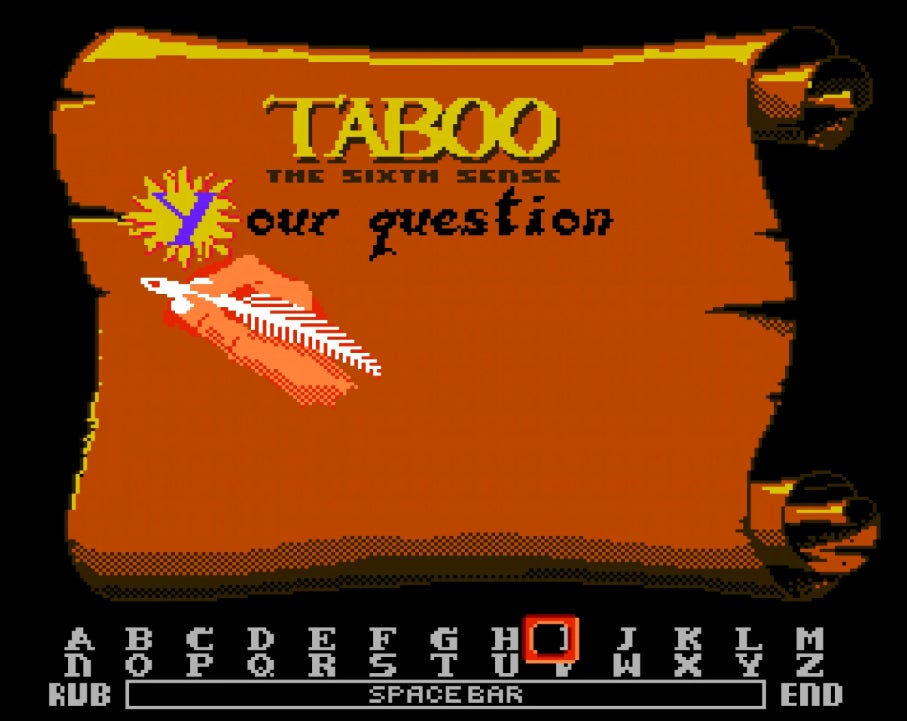
From time to time, they were tasked with creating an original game. This is what happened in 1988, when Tradewest, a distributor that had gained some traction with Ikari Warriors for arcade and the NES adaptation of Double Dragon, decided it was time to exploit the then-burgeoning American tarot trend with a game that promised strong emotions thanks to a title that at the time captivated every teenager looking for new gaming experiences that crossed their path. Taboo: The Sixth Sense was released in April 1989 in the United States, but no one expected what was hidden inside.
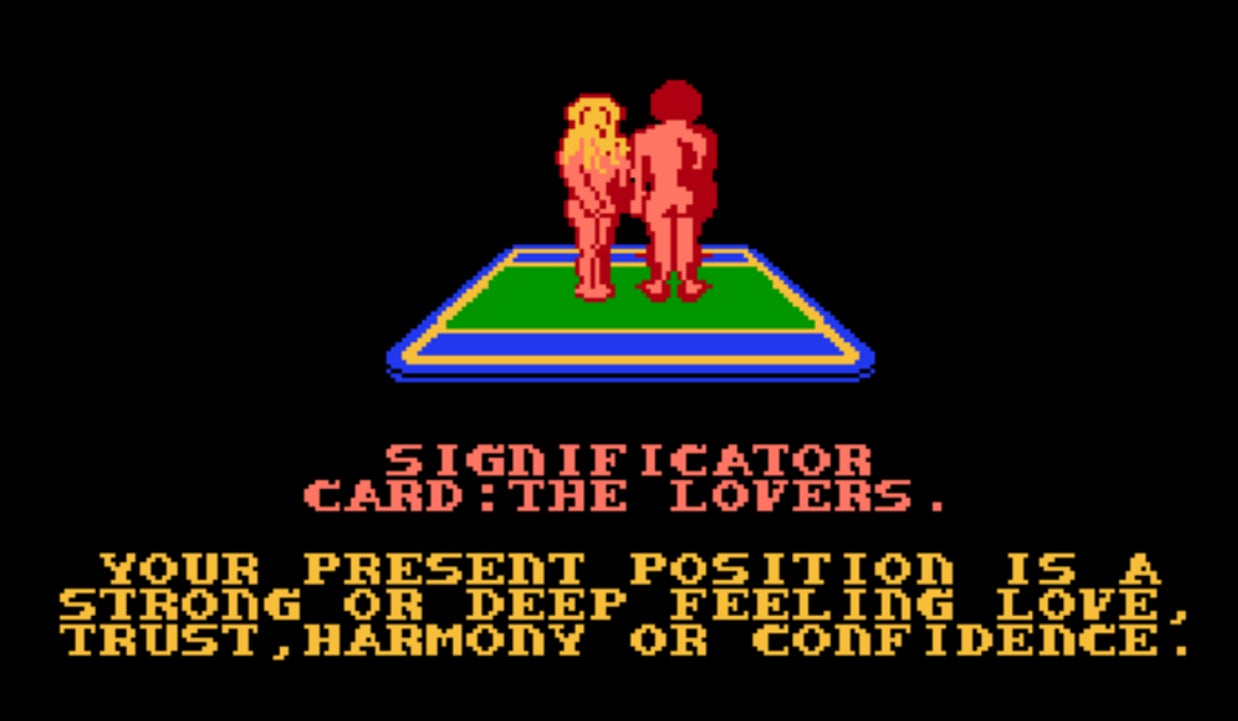
And the thing is, Taboo was marketed as a party game for kids and adults, but it was actually… a tarot card reading simulator. Just like that. When you turned it on, the screen asked for the player’s name, date of birth, and gender, requested them to ask something, shuffled the cards, and generated a tarot reading. In case you were not amazed enough, it had one more twist: afterwards, players would choose a state from the country and it would generate numbers for the lottery. If someone won, of course, it has never been known. But Taboo, within its simplicity, hid several secrets inside.
What you were waiting to see: Pornographic Nudes!
One of Nintendo’s maxims -especially in this early period- is that games should not have nudity or religious iconography. However, Taboo somehow managed to get away with both. Particularly, in a couple of cards you could see a woman without a shirt and a couple from behind showing their buttocks. It required a bit of imagination between pixels, but clearly Rare achieved the impossible: getting Nintendo to overlook this flagrant violation of its rules and eventually license it.
Shortly after its release, Taboo also earned an urban legend that follows it to this day. It was said that some kids, trying their luck, received the unmistakable message on screen that they were about to die… And they did shortly after, which led to the game being immediately pulled from stores. Of course, it’s all a lie: the game’s “prophecies” would never indicate anyone’s death, and the title, although it caused some controversy due to its adult content, was not well-known enough to be sanctioned by the U.S. Congress and banned from sale. Even before the Internet, there were fake news.
The most curious thing about Taboo, in the end, is its mere existence: A tarot game that is not played and is completely random, from Rare and released only in the United States in the late 80s? NES may have had more taboo games, but certainly few as strange as this one. Is it time for a reboot for Switch 2? With online stores, you never know.
The next Nintendo Switch Online game is a cult classic from the extinct Rare, which even if it is not so remembered today, in its day it was a bomb
Nintendo works slowly, but it never stops working. The catalog of games offered by Nintendo Switch Online has been steadily growing month by month, albeit at a very slow pace, yet it has never stopped doing so. There are better ways to do it. They could make a more impactful move by choosing to do so. But we can’t deny that, in its own way, it hasn’t abandoned the idea it presented us with this particular service.
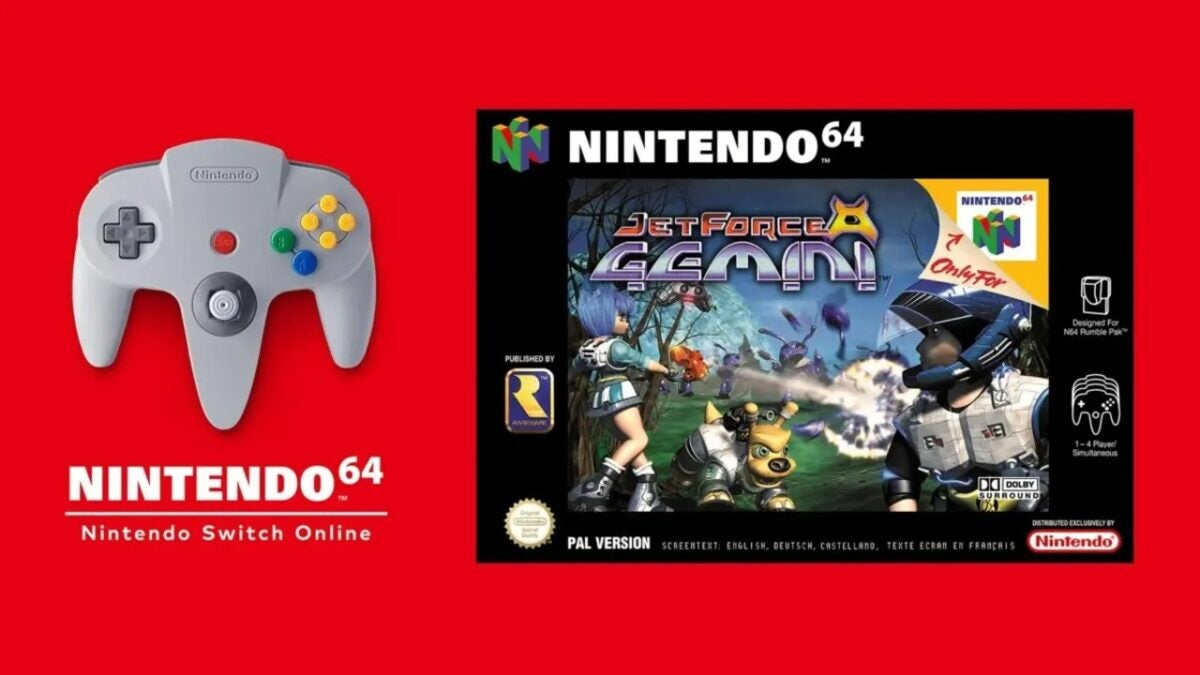
Today, Nintendo has announced that the next title coming to the Nintendo 64 app will be none other than Jet Force Gemini. A third-person shooter developed and published by Rare in 1999, which not only received excellent reviews but was also considered one of the best video games of the console at that time.
In Jet Force Gemini, players controlled the eponymous team of heroes who traveled through space to confront the invading hordes of Mizar, an insectoid who enslaved an entire alien race. With a blend of third-person shooter, shoot ’em up elements, and action-adventure in 3D environments heavily influenced by arcade games, Super Metroid, and Super Mario 64, the game was revolutionary for its time and the console. This uniqueness endeared it to many players, partly due to the ability to play cooperatively and competitively with up to four players—a rarity back then, outside a few titles.
Jet Force Gemini will arrive with the upcoming Expansion Pack for Nintendo Switch Online in December. Meanwhile, in Japan, they’ll have to wait a little less, as it’s set to be released on November 30th alongside Goldeneye 007, a game that’s already available in the rest of the world on the service.