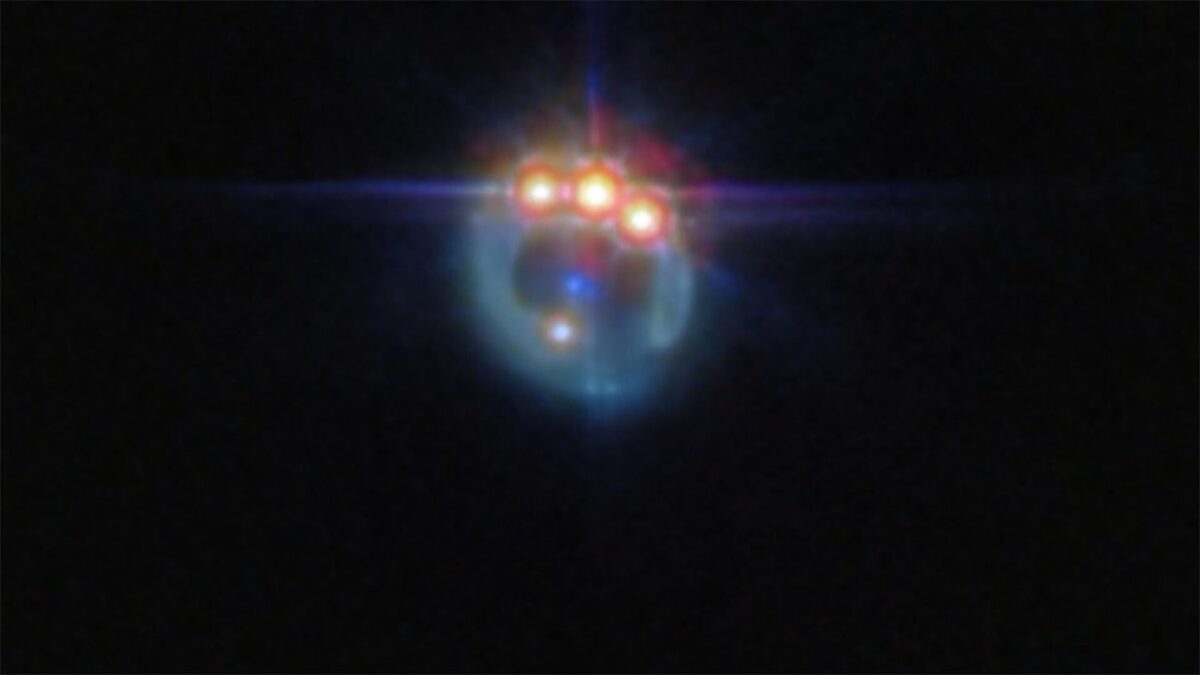
The James Webb Space Telescope has captured a bright “ring of jewels” created by a cosmic phenomenon called gravitational lensing. This new image shows a distant quasar known as RX J1131-1231, located about 6 billion light-years away from Earth. The powerful gravitational field of a nearby elliptical galaxy distorts the light from the quasar, creating a bright arc and duplicated views of the object, resulting in a visual effect that resembles a ring of gemstones.

Quasars feed on large amounts of gas and dust that fall into a galaxy’s supermassive black hole, causing the region to shine brightly. The European Space Agency (ESA) explained that the effects of gravitational lenses, produced when a massive object bends the light from a more-distant source, allow astronomers to study regions near distant quasar black holes.
“Measurements of the X-ray emission from quasars can provide an indication of how quickly the central black hole is spinning, and this gives researchers important clues about how black holes grow over time,” said ESA officials in a statement.
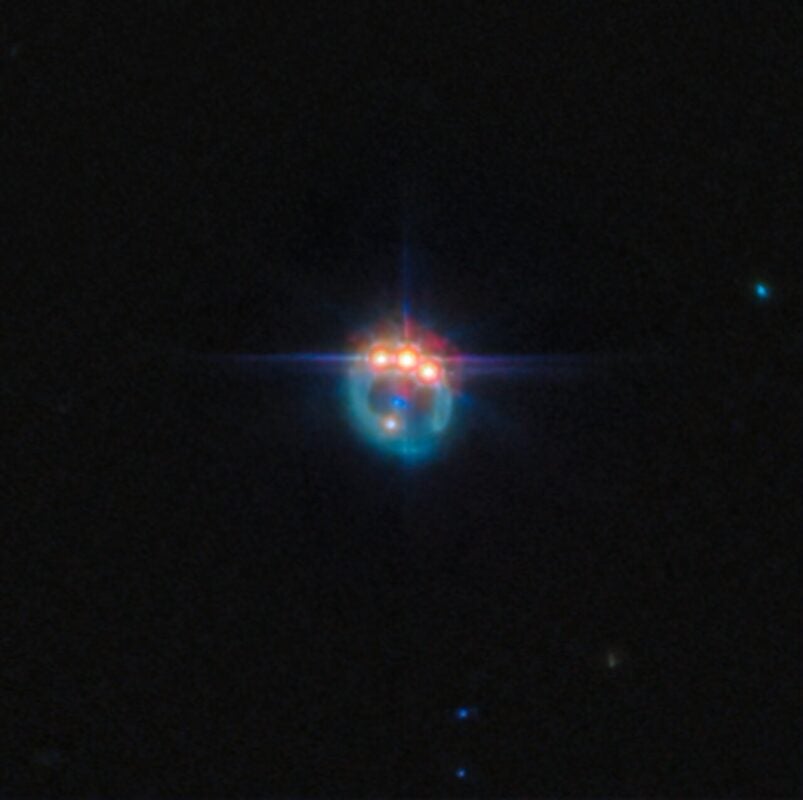
In the new image from the James Webb telescope, the elliptical galaxy creating the gravitational lens appears as a small blue dot in the center of the ring, acting as a natural telescope that magnifies the light from the most distant quasar. This observation has revealed that the black hole of this quasar is spinning at over half the speed of light, suggesting that it has grown mainly through mergers, rather than accumulating material from different directions.
The image was taken with the MIRI (Mid-Infrared Instrument) of the James Webb as part of a broader study on dark matter and its distribution in the universe. With these recent observations and others obtained using other telescopes, RX J1131-1231 is considered one of the best lensed quasars discovered to date.
