4 of the best fertility trackers

You use your smartphone to listen to music, read your email, play games, organize your social life, write shopping lists–you may even use it to call people sometimes. Many people – even most, if you look at certain demographics –  use their phone to some degree in almost every aspect of their lives.

If you’re a woman of childbearing age, why not use it to monitor your fertility? I know, some of you are about to close that tab, but don’t think that fertility tracking doesn’t apply to you. Whether you’re trying to have a baby, or trying to avoid having one, knowing where you are in your cycle can help you plan for either scenario. If you’re trying to get pregnant, you can maximize your chances by having sex when you’re ovulating. If you’re not trying, then you know which days to avoid. Even if a baby isn’t remotely on the horizon, knowing where you are in your cycle can help you make sure everything is working as it should. Lets take a quick look at some of the top– and more importantly, personally recommended– apps in this area.

WomanLog

WomanLog

Available for iOS and Android, WomanLog is a classic of the category. It’s been around for ages, the prediction algorithm is accurate, and it tracks all the information a woman could conceivably (no, that wasn’t a pun) need. There’s also a pro version. If you’re just tracking your periods, and not concerned about pregnancy, the free version is probably fine. By upgrading, you’ll be able to add extra details, including the elements needed for various types of family planning.

My Days - Period & OvulationMy Days – Period & Ovulation

My Days is another staple, as well as being an app I’ve tried personally. To a certain degree, it’s quite similar to WomanLog, but MyDays has fewer features aimed at pregnancy prevention (or encouragement!). The vast majority of the app’s features are available in the free version, and the pro version really just removes ads and lets you add a password. If you’re not trying for a baby, it’s a great starting point.

Period Calendar / TrackerPeriod Calendar / Tracker

Available for Android only, Period Calendar is an exceedingly popular app. Again, it’s very complete and is suitable for women who just want to track their period, or women concerned with pregnancy. One of its most popular features seems to be great options for choosing how you feel, which can be helpful in deciphering patterns, like when you get migraines or cramps. It’s also cuter than average.

GlowGlow

Glow is one of the newcomers on the market, and takes a whole new approach to the topic. It has a much more social, community feel, and looks radically different to its competitors. As soon as you open the app, you create an account and tell Glow if you are trying to conceive. It then uses that knowledge to present information that’s relevant to you, rather than giving you the bare information and leaving you to draw your own conclusions. It takes a holistic approach, offering you tips for healthy living and emotional calm, as well as the option to connect to other women who are at the same stage of life as you.

When I started using fertility apps, I tried a few to see what they were about. I settled on WomanLog, but appreciate that many are very similar. Some have passwords, others have more skins, and some let you track more or less factors, but deep down, they’re all pretty much the same. The key is deciding if you’re happy to pay, and then working out which one has the best combination of features for you. Something none of the the traditional apps offer, however, is the wow-factor, or the impression that the developers have done any updates since about 2001.
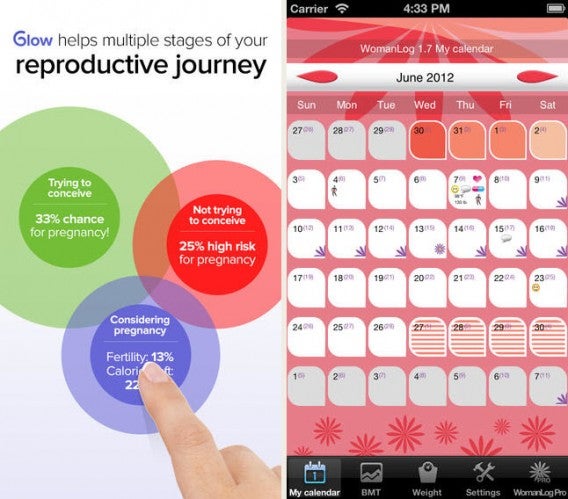
Glow vs. WomanLog

Much difference?

When I saw Glow, I immediately recognized something different. Not only did it claim to use a new type of highly-accurate information on which to base its predictions, it looked completely different, much more modern, and incorporated social aspects. It even has a fascinating crowd-funded fertility treatment plan. In other words, it has that wow factor I was looking for.

On the other hand, when I checked my period tracker this morning, I immediately went back to WomanLog and its blocky pink screen. Why? Glow just feels like it’s trying too hard. It looks great, but the reminders to input information, daily suggestions to call my mother or eat my vegetables, and helpful advice to de-stress by painting my toenails with a friend, are just too much. I have to admit, I was disappointed. When I saw it, I knew it was something special and really wanted it to work for me.

Unfortunately, it’s just not my kind of app. Some types of apps attract innovation. Music players, for example, look vastly different to the ones we saw 10 years ago. If they didn’t, they’d be laughed out of the App Store. Other types clearly don’t, and fertility tracking apps are among them. Glow has taken a first step to change that, and it’s most welcome. Unfortunately, it’s not the step for me.

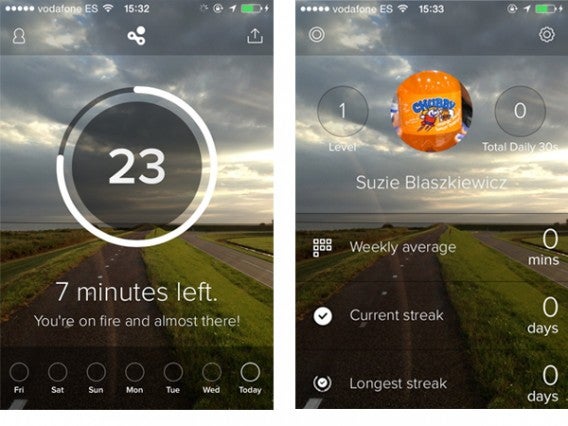
App of the Week: Human for iOS

Softonic’s App of the Week highlights some of the most unique, coolest, and most interesting mobile apps for iOS and Android. This week, it’s Human for iOS, a fitness app with a twist. Unlike some of the more complicated fitness apps and gadgets currently storming the market, Human takes a more simple approach to tracking your activity.

The goal is simple: walk at least 30 minutes a day. The passive activity tracking app runs in the background on your iPhone, tracking your daily movements and counting down until you reach your ‘daily 30’. Every day that you hit your goal, you’ll get a push notification to congratulate you on reaching it. Human doesn’t only track walking, but any physical activity, including running and biking.

Speaking with co-founder and CEO Renato Valdés Olmos, he says the app is “tailored to a less fitness-oriented audience,” encouraging people to get up and moving more than they normally would. Apparently, it’s been working. “We’ve seen users increase their level of physical activity by 75% in just 6 weeks.”

Human for iOS

He’s also noted some interesting trends. “Users in the Midwest are moving a lot less than those in coastal areas, sometimes as little as 10 minutes a day”, says Olmos. It’s these users that will see the biggest benefits of using the app, and they’re already talking about expanding with different daily goals for different types of users. “For some users, 30 minutes is too much, and we recognize that offering different daily goals would be really useful to our users.”

The app itself has a great UI that counts down how many minutes you have to walk to reach your goal, overlayed on top of some really nice background images that change daily. “Right now, the focus is on minutes to keep it simple,” says Olmos, but they plan to add more detailed data as they get to know more about their users needs.

If you’re looking to get more active but don’t know how or where to start, Human is the perfect way to do it.

Titanfall has a novel way of treating cheats

Titanfall’s anticheat systems and policies have been announced, and in an interesting twist cheaters will be allowed to continue playing, but only with other cheats.

Cheating is an unfortunate reality in online gaming, with ‘aimbots’ being particularly popular. An aimbot is a hack that gives you automatic aiming, and sometimes shooting too, removing any skill involved in the game. While they can get cheats lots of experience points, and lots of ‘wins’, it ruins the fun for other players.

Titanfall’s anticheat system is called ‘FairFight‘, and works by analyzing player data to detect suspicious behavior. If a player is found to be cheating, they will see the message in the image below. Instead of being stopped from playing altogether, cheats will be allowed to play with other cheating players. Developer Respawn describes these games as ‘the Wimbledon of aimbot contests.’ It’s a great way of punishing cheating.

Players who feel they have been unfairly banned can email anticheat@respawn.com, but so far we have not seen many complaints online of FairFight unfairly banning players. You can also be put into these ‘aimbot contests’ for playing with friends who are cheaters – if you make a party and any of the members are banned, you’ll only be able to play against other cheaters.

Read our full review of Titanfall.

Source: Titanfall

RELATED STORIES

Watch the Goat Simulator launch trailer

Goat Simulator is released for Windows PCs on April 1st, and you can now see its launch trailer, which is an hilarious parody of the impressive Dead Island reveal trailer from 2011. Watch both below.

Goat Simulator started life as little more than an experiment, but has been developed into a full game since footage of it went viral on YouTube. The 1st Alpha Gameplay video has over three million views. We don’t know a great deal about the game except that you’ll play a goat, and destroying things seems to be the point. It will have a low gravity facility, a water park, a breakable Stone Henge and an exploding gas station which features in the launch trailer.

The trailer uses slow motion reverse footage, parodying the technique used for the reveal trailer of zombie survival game Dead Island.

Default player


brightcove.createExperiences();

Default player


brightcove.createExperiences();


You can pre-order Goat Simulator on Steam.

RELATED STORIES

Plants vs. Zombies 2 “Far Future” expansion pack drops tomorrow for iOS

The first expansion pack for Plants vs. Zombies 2 is coming tomorrow. Called Far Future, the update includes a new level in the (you guessed it) future. Players will also be treated to 3 new plants and new zombies.

Citron deals heavy damage, Laser Bean pierces zombie shields, and Star-Fruits shoot stars all across the level. Zombies will be dressed in futuristic red outfits with updated takes on the iconic traffic cone and bucket. They will also have three new vehicles: the helmet tank, jetpack, and cone “mech.”

http://angry-birds-go.en.softonic.com/android

Plants vs. Zombies 2 was first released last year as a free-to-play title. While some games have been ruined by the free-to-play mechanic (looking at you, Angry Birds Go!), Plants vs. Zombies 2 remains fun without having to spend real money.

The update will arrive tomorrow for iOS. No word on when we can expect the update to come to Android.

Download Plants vs. Zombies 2 for Android

Download Plants vs. Zombies 2 for iOS

Source: EA

RELATED STORIES

Twitter wants you to share more photos

Twitter is updating its apps to allow users to upload up to four pics at once and tag up to 10 friends. Tagged friends don’t count against the 140 character limit so you can still caption photos.

Instagram has been dominating social photo sharing but Twitter aims to change that. In 2012, Twitter launched its own photo filters so users can upload pics directly from Twitter, instead of sharing from Instagram. The social network also added photo editing tools to its apps earlier this year.

Twitter multiple=

Now with multiple photo uploads and friendly tagging, sharing photos with Twitter has never been easier. Still, users may still prefer apps like Instagram for its community and focus on photography.

iOS users will get multiple photo uploads today but Android users will have to wait. The company says the feature is “coming soon” to Android but provided no specific date.

Download Twitter for Android

Download Twitter for iOS

Source: Twitter

RELATED STORIES

Google Play Music now lets you upload songs in Chrome

You can finally upload tracks from the browser to Google Play Music. Previously, you had to download the Music Manager app to monitor and upload your music. With the new Google Play Music Chrome app, everything is handled inside the browser.

Google Play Music mini-playerDownloading music can also be done within Chrome. If you have a new computer, you can set Google Play Music to download your entire music library. The new interface also supports drag-and-drop uploads.

Besides getting rid of the Music Manager app, Google has added a mini-player for Chrome. You can thumbs up/down tracks, skip, shuffle, and repeat. Album art is displayed prominently, making it easy to see what’s currently playing. Unfortunately there is no search feature in the mini-player.

Google will be rolling out this new feature “soon” but you can enable it now. Go to play.google.com/music and click on the settings (gear) button. Click on “Labs” and you’ll see an option to enable “Google Play Music for Chrome.” Enable it and the site will refresh. You’ll now see a button at the top to “Add music.” There’s a handy tutorial to help you set it up as well.

Source: The Verge

RELATED STORIES

Instagram tests Facebook Places check-in feature to take on Foursquare

Facebook is looking to integrate its Places check-in feature into Instagram. Currently, Instagram only supports checking in using Foursquare.

It makes sense that Facebook is testing Places integration in Instagram. Getting users to use Facebook’s own check-in system keeps them using Facebook products. Facebook could also advertise to users with suggested restaurants, bars, and other locations.

It’s unlikely that Facebook will remove Foursquare integration in favor of its own. Instagram currently supports sharing photos with third-party apps like Twitter, Flickr, and Tumblr.

Location data is also valuable for Facebook to analyze where its users are going and to anticipate their needs. With Instagram’s library of photos and check-in data, Facebook could make personalized suggestions based on where your Instagram friends have been.

Source: Fast Company

RELATED STORIES

The creator of 2048 tells us the secret behind the game’s success

At just 19, Italian freelance programmer Gabriele Cirulli created 2048, a puzzle that’s got millions hooked. Luckily, we got the chance to talk him to find out more about this addictive game.

As he’s admitted in another interview, the idea of ​​2048 isn’t original – it came to him via a contact. Games like 1024! and Threes (Android/iPhone) already exist, but it’s 2048 that’s stealing the limelight. The obsession began when it appeared in Hacker News. Then, things got crazy.

Fabrizio: Why “2048”? What does it mean?

Gabriele: I was inspired to create 2048 because of two games: 2048, from Saming, and 1024!, from Veewo Studio. My idea was to unite the features of both games, so I ended up using “2048” as the name in my version too.

F: You said on Twitter that players have spent 521 years playing the game in total– in six days…

G: I hope I haven’t gotten anyone in trouble! It’s really hard to stop playing (it happens to me too sometimes), and sometimes this makes us forget about the more important things.

F: Aren’t you afraid that you’ll end up like the creator of Flappy Bird?

G: Although on a much smaller scale, I think I’ve already gone through that phase. During the first week, due to the game’s unexpected success, many people suggested that I should earn money through advertising or creating an app. This is not what I wanted to do, but I needed the two stressful days I had before making the decision not to monetize the game. Once I made the decision, I stopped feeling awkward.

The original game will always be free.

F: Have you ever won?

G: I still haven’t managed it! My record score is 16,000 points, in a game where I had enough to match two 64s to win, but I lost because I didn’t figure it out right away.

F: Do you know if anyone has managed to accumulate 32,784 in a box?

G: So far I’ve only seen people get up to 4096 or 8192. The highest total score I’ve ever seen is 73,000 points.

F: Why are you “anti-apps”?

G: For two reasons. The first is ethical: I will not make money off of something that I didn’t invent – it would be unfair. The second is technical: the game is open source, and this means that anyone can take the source code and publish it as an app. I don’t think this genre needs competition, that would only lead to market saturation. The original game is always available on Github, for free.

F: Which is your favorite version of the game?

G: Yesterday I discovered the “doge” version of 2048 and I found it really funny. Also, I really like the artificial intelligence that has been created to beat the game, 2048-AI, mainly because it can win, while I can’t.

I don’t want to earn money for something I didn’t invent.

F: How many people have won in 2048 to date?

G: Out of a total of 51 million games, only 530,000 have been won. That’s about 1% of the total.

F: What’s the best technique for winning 2048?

G: A technique I discovered online that I’m using for now (although it’s not working for me), is to use only three directions, while maintaining the highest number in one corner. This allows “chain reactions” to start which makes it easier to reach high numbers, since they’re all lined up and ordered.

I hope I haven’t gotten anyone into trouble!

F: Do you have plans for the future? Any new games?

G: Right now, I’m trying to return to the freelance projects I was working on before launching 2048. I haven’t made ​​any plans yet, though I doubt that I’m going to create any new games.

If you haven’t already, give 2048 a try.

Meet Mylar: security based on the idea ‘there’s no trusting a server’

Researchers at Massachusetts Institute of Technology (MIT) are working on a system called Mylar, which would ensure that all data from a website held on servers is encrypted at all times, to protect against spying programs like PRISM. The idea is that a web service would never be able to decrypt data – that power would only be available to users.

There’s no trusting a server.

The Mylar system only decrypts information on your computer – but the servers will not hold any encryption keys so any data requested from it would be almost unusable. As Mylar creator Raluca Popa says “the server doesn’t have the ability to give unencrypted data,” as Mylar works with code running in a person’s browser that allows the data to be shown in its intended form.

Despite data being encrypted on servers, Mylar is able to search without unscrambling it. The system will allow users to share data without their encryption keys being made vulnerable to discovery, too.

The system is being tested by a group of hospital patients in Boston. The website is used to collect patient data, but is can only be decrypted and viewed by the patients or their doctor.

Speaking to MIT Technology Review, University of Pennsylvania researcher Ariel Feldman says while the system is impressive, he can see a barrier to it being used – if a users loses their encryption key somehow, the data is lost forever.

Source: MIT Technology Review

RELATED STORIES