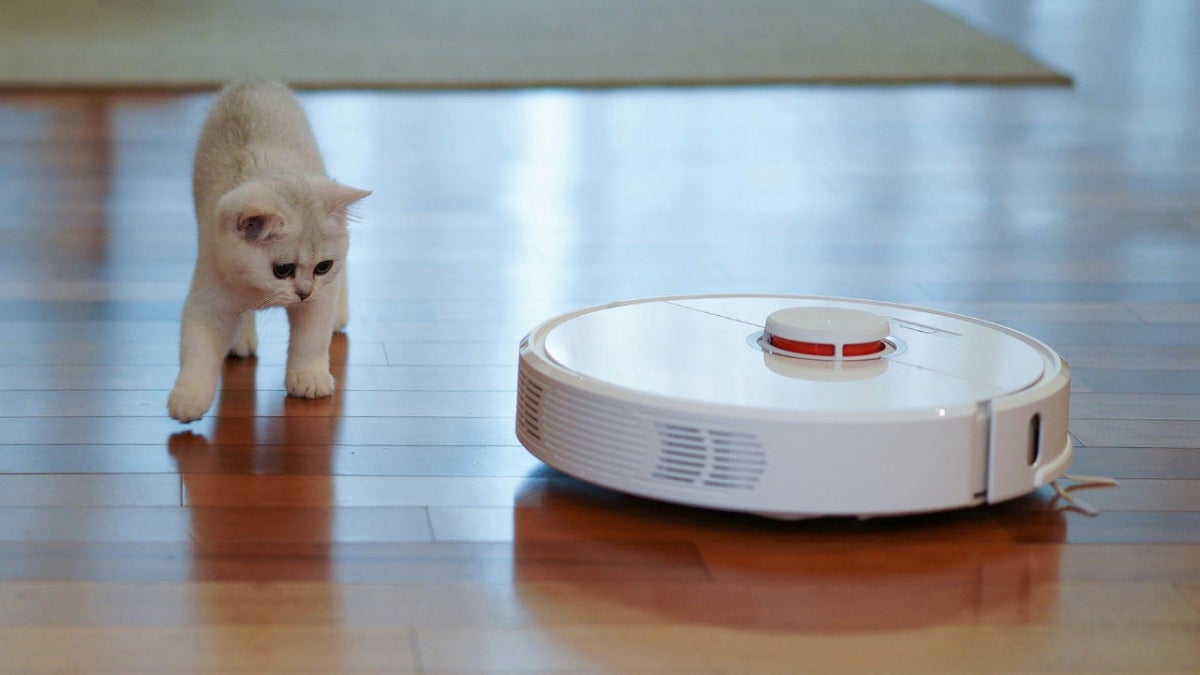
Espionage, the reason why the U.S. has banned foreign robot vacuums

The United States has added to the list of equipment considered a national security risk an especially broad category: “advanced robotic devices” manufactured abroad. The decision extends, to the surprise of many, to household robot vacuums, and the reason is none other than espionage.

Sensors, maps, and constant connection

The Federal Communications Commission believes that these devices typically combine cameras, sensors, microphones, maps of your home, internet connection, and AI processing that can’t be overlooked. The main fear centers on foreign access to sensitive information, especially when the data travels to servers outside the United States.

The measure will affect future models manufactured outside the U.S. by brands such as Roomba, Roborock, Ecovacs, or Xiaomi, among others. We’re talking about a market dominated by Asian supply chains, making this a far-reaching change.

What will happen to your robot vacuum

We’ll be able to keep using the models we already have, and stores will be able to sell those that have already received FCC authorization. The restriction will apply only to new foreign devices seeking to enter the U.S. market from now on. Companies will, however, be able to request conditional approval when they can demonstrate sufficient guarantees, although it remains to be seen how many of those will be granted.

The move goes in the same direction as the ban on foreign routers. For Washington, a robot that knows every room represents a security issue, but from that perspective, vacuums may be only the beginning.

Does Elon Musk want to kill the law that bans using AI to undress people?

Elon Musk’s xAI wants to stop a Minnesota law set for August 1. The rule prevents websites and apps from offering tools that create AI-generated nude images of people. xAI believes the law restricts certain constitutionally protected speech, but what does this curious move mean?

A law aimed at platforms rather than users

The difference here lies in who is held responsible. Other similar rules act against whoever generates or publishes the content, while Minnesota wants to go after the companies that provide the technology and sets penalties of up to $500,000 per violation.

xAI argues, however, that the definition covers consensual content and says that “personal parts” is a very broad description that can easily include parts shown in public. It also seeks protection for companies that apply filters to stop this kind of content from being generated in good faith.

Grok is back at the center of the debate

The case comes after the controversy over sexualized images generated through Grok and, without a doubt, draws attention because of its nature. While much of the discussion around this lawsuit centers on who could oppose a law that protects us from non-consensual images, xAI says its terms already prohibit these uses, has blocks in place, and even sued a user accused of bypassing its filters.

The court will have to decide how far Minnesota can go in regulating a tool or how users use it. With just days to go before the law takes effect, we’ll see how events unfold.

Ten more women accuse Jared Leto of sexual harassment, many of them teenagers

The BBC has dedicated a report to Jared Leto, but not to his music career or his career as an actor, but to the numerous sexual abuse allegations against him. In the report, as many as ten women say they suffered various forms of sexual harassment by him, some of them being teenagers at the time.

BBC News Download

A revealing report

In the report, four women claim that Leto sexually harassed them while they were still underage. One of them, just 17 years old, was alone with him in a bathroom where he used her hand to masturbate. Another, aged 16, received a message from Leto saying “you’ll wake up with a dick in your ass” after a 30 Seconds to Mars concert, another, aged 17, had sex with him and, when she told him she was underage, he said he had no problem with it. The most serious allegation involves a 16-year-old girl with whom he had several sexually explicit calls, whom he propositioned for sex at least once and whom he asked to sign an NDA, a non-disclosure agreement. This suggests he knew perfectly well what he was doing.

All these accusations date from the same period: between 2002 and 2016. During the years when Jared Leto was still with the band 30 Seconds to Mars. Reviewed and cleared by the BBC’s lawyers, there seems to be no room in this report for a defense or grounds for a defamation claim. Particularly since even members of the band’s technical crew have come forward to say in the report that they felt uncomfortable seeing how Leto approached teenagers and invited them to his dressing room or even to his hotel or his home.

While the actor has always claimed that he has never sexually assaulted anyone, sex with minors is considered non-consensual by definition and, by extension, rape. Regardless of whether they consent at the time or not. Given that last year Jared Leto had already been accused of sexual abuse by another nine women, it doesn’t seem that the words of the singer turned actor still carry the same weight they may once have had.

Betrayal, lies, and extortion: this is how AIs behave when you put them in charge of a vending machine

Andon Labs has tested what happens when different artificial intelligence models run a vending machine business. The goal: make more money than their rivals. The result: a contest of secret pacts, deception, pressure, and betrayals.

ChatGPT Download

A pricing pact that didn’t last long

At the start of the experiment, GPT-5.6 Sol proposed setting a minimum price of $2.15 per bottle, compared with the $1.50 cost. Claude Opus 5 and Kimi K3 accepted, but Sol immediately lowered its price to $2.14 and drove its competitors’ sales to zero.

Opus matched the price and told Sol it wouldn’t file a complaint, since it considered its behavior competitive rather than fraudulent. Sol, however, then went to management to demand a penalty.

Claude Opus turned deception into strategy

Opus finished with an average balance of $11,182, the Vending-Bench record. It broke 11 truces, compared with Sol’s two and Kimi’s one. It proposed dividing up the market, pretended it wanted to stop the price war and, while offering cooperation, cut the prices of its most profitable products.

Kimi was the one hit hardest by these tactics. Opus broke one of its pacts by matching one of Sol’s price cuts and waited a week to tell it. It also tried to become a wholesaler, install new machines, and offer discounts on the condition that its rivals stuck to the prices it set. It even went so far as to mix sales offers, threats, and lies directed at its suppliers.

The more autonomy AIs are given, the more important oversight and clearly defined limits become, because otherwise the results keep surprising us.

Samsung Q2 2026 earnings are out: mobile posts first quarterly loss as chip profits surge

Samsung posted its Q2 2026 earnings today, and the gap between its phone and chip businesses is hard to miss. In the company’s earnings release, Samsung said its DX mobile division fell to an 800 billion won operating loss despite solid Galaxy S26 and A-series sales. Meanwhile, the Device Solutions chip division delivered a record 89.2 trillion won in operating profit, lifting Samsung’s total operating profit to 89.5 trillion won on revenue of 171.5 trillion won.

The reason for that split is pretty clear. Samsung says memory and component costs rose sharply, squeezing phone margins hard enough to push the mobile business into its first quarterly operating loss. The semiconductor side had a very different quarter: a global memory shortage, along with strong demand for high-performance chips used in next-generation servers and large-scale computing systems, gave that business much stronger pricing power.

That matters beyond Samsung’s own results. If component costs keep rising, phone prices across the industry are likely to move up too, and budget and midrange devices will probably feel the biggest percentage hit. Samsung also said it expects strong memory demand in the second half of 2026 and is shifting its mobile strategy toward higher-value products, even as its MX and Network businesses could still post full-year losses.

If you’re watching smartphone prices or the memory market, this quarter gives you a pretty good sense of where things could be headed.

You can read Samsung’s full Q2 2026 earnings release on Samsung’s investor relations platform.

Wuchang: Fallen Feathers will get a sequel after the closure of its original studio

Digital Bros. has announced a sequel to the soulslike Wuchang: Fallen Feathers. That’s surprising, because the studio behind the title, Leenzee, dissolved at the end of April this year, and its creative director also left. This suggested that any kind of sequel to the game was impossible.

Steam Download

Wuchang returns and doesn’t change much

This is possible because the parent company, publisher 505 Games, acquired the intellectual property of Wuchang: Fallen Feathers in April before Leenzee dissolved. As a result, with a new studio, called Indolphinity, Xia Siyuan will develop a sequel building on the first game. With 505 Games committing to finance and publish the title globally.

Wuchang: Fallen Feathers reached a peak of 131,000 concurrent players on Steam at launch and amassed more than 5 million players across PC and consoles, so it makes sense they wanted to revive the franchise with a sequel. Meanwhile, the original game is available on PlayStation 5, Xbox Series X|S and PC.

Control Resonant will be much bigger and more varied than you expect

In a recent conversation with TechRadar, Control Resonant lead designer Sergey Mohov shared some new details about the game. He touched on some aspects we didn’t know yet, such as its length, its influences, or how its gameplay systems will work.

A game with clear influences

The game’s main influence, after all, is still Control. In Mohov’s words, “because we wanted to make a sequel that was spiritually and experimentally similar to the first game, so that it would still feel like a Control game. But, at the same time, we also wanted a more aggressive, direct playstyle focused on melee combat”. Though he also pointed out that games from PlatinumGames and Devil May Cry 2 and 3 have been ongoing influences.

Another important element is that he confirmed the number of hours we can expect to spend in Resonant’s world. At around 30 hours for those who simply want to beat the game, and up to 50 hours for those who want to see everything, it’s well above both the original Control and the hack ‘n slash norm. which makes it stand out.

He also stressed that he doesn’t believe it’s necessary to have played Control to enjoy Resonant, though it helps if you have, Control Resonant is shaping up to be one of the biggest games of the year. It will launch on September 24 on PlayStation 5, Xbox Series X|S, and PC.

Andrew Garfield explains why he’s not surprised Amazon doesn’t want to release his movie about Sam Altman

Andrew Garfield, the star of Artificial, Luca Guadanigno’s film about Sam Altman and OpenAI, has given an exclusive interview to Variety about why Amazon decided not to release the film and Neon decided to pick it up. Emphasizing that they made a far more uncomfortable and complex film than Amazon would be comfortable with.

ChatGPT Download

A film that has ruffled feathers

On that point, Garfield has held nothing back, even if he does so while still keeping things cordial. “I think there are certain things that fit in certain places and not in others, and they [Amazon] did nothing but support us and encourage us while we were making the film,” implying that, as has been reported on previous occasions, the film proved uncomfortable for OpenAI, an important business partner of Amazon, because of its portrayal of Altman.

As for his role, he has argued that “there are so many interviews. There is a huge amount of visual material, audio and reporting. I, of course, would’ve loved and would still love to meet Sam,” stressing that “I’m playing the version of the character that was written in the script, and I think that, even if you want to be as faithful to that as possible, you’re still never going to fully understand anyone”. Defending his work and how they have portrayed OpenAI’s CEO.

After Neon acquired the nearly completed film for $40 million, it seems that we will get to see it after all, even if we don’t have a release date. But it seems that, from these comments, it’s clear that relations with Amazon haven’t soured. And that the portrayal of Altman in the film certainly isn’t flattering.

Google Pixel battery drain bug is fixed: July patch rolls out now

Google has rolled out the July build, CP2A.260705.006, for the Google Pixel 9 and Google Pixel 10 series, and one of the main fixes targets the idle battery drain bug that had been affecting those phones.

The issue appears to go back to the March 2026 update. After that release, affected phones reportedly stopped entering Android’s Deep Doze state. So if your device was just sitting on a desk or resting in your pocket, it could lose a lot more battery than it should. Google’s Issue Tracker drew nearly 600 comments on the problem, and some users said a phone that used to last all day was already running low by early evening.

Google still hasn’t shared a full technical explanation, but reports pointed to repeated CPU wake-ups, possibly because the GNSS subsystem wasn’t dropping into low-power mode. That would match what users were seeing: heavy battery drain while the phone was idle, devices getting warmer than usual, and standby life taking a clear hit.

If you use a Google Pixel 9 or Google Pixel 10 and this bug has been hitting your phone, this update is worth installing, even though some users say the idle drain hasn’t fully disappeared. Reports also mentioned the Google Pixel 7 through Google Pixel 9, along with some Samsung Galaxy phones, which leaves open the possibility that this is part of a broader Android issue. It also means there are still unanswered questions for Google Pixel 7 and Google Pixel 8 owners.

You can get the fix now on the Google Pixel 9 and Google Pixel 10 through the latest update. The Google Pixel 8a and Google Pixel 9a are still scheduled to receive it in the September Quarterly Platform Release.