Corporate espionage? Several employees from Stability AI would be behind an alleged attack on Midjourney

Midjourney says it has banned employees from Stability AI, its rival company, accusing them of causing a disruption to the systems earlier this month during an attempt to extract data from its generative AI.

Midjourney ACCESS

The AI company released an update on their Discord server on March 2nd, acknowledging that a prolonged server interruption was preventing generated images from appearing in user galleries.

In a summary of a meeting that took place on March 6th, Midjourney stated that behind this interruption was “botnet activity from paid accounts” (which the company specifically links to Stability AI employees).

Nick St. Pierre, a Twitter user who was able to hear the details of this meeting, said on the social network that Midjourney’s services were disrupted because “someone at Stability AI was trying to take over all the pairs of prompts and images in the middle of Saturday night.” St. Pierre also confirmed that Midjourney had linked several payment accounts to a person on the Stability AI data team.

Pierre directed his accusations at the CEO of Stability AI, Emad Mostaque, who responded on Twitter saying that he was investigating the situation and that Stability had not ordered such actions to be carried out.

“It is very confusing that two accounts have done this, and furthermore the team has not been scraping, as we have been using synthetic and other types of data, given that SD3 surpasses all other models,” said Mostaque, referring to the AI model Stable Diffusion 3, currently in preview phase. The executive stated that if the disruption was caused by a Stability employee, this would not have been intentional and “obviously it was not a DDoS attack”.

Midjourney ACCESS

After this incident, Midjourney said on their Discord server that they have banned all Stability AI employees from using their service “indefinitely”. In addition, the company has implemented a new policy that will similarly prohibit access to employees of any company that engages in “aggressive automation” or causes service disruptions.

Even more Apple AI: now we can animate photos with just one sentence

With Keyframer, Apple reinforces, once again, its position in the field of artificial intelligence and shows us another card.

Apple continues its advance in the field of artificial intelligence —without making too much noise— with the launch of a tool capable of animating static images using large language models (LLMs) based on simple text prompts. This tool, named “Keyframer”, represents a qualitative leap in the way we can carry out animations with photographs and is one more piece of a puzzle that Apple should show us soon.

Apple Developer Download

Another piece of Apple’s strategy

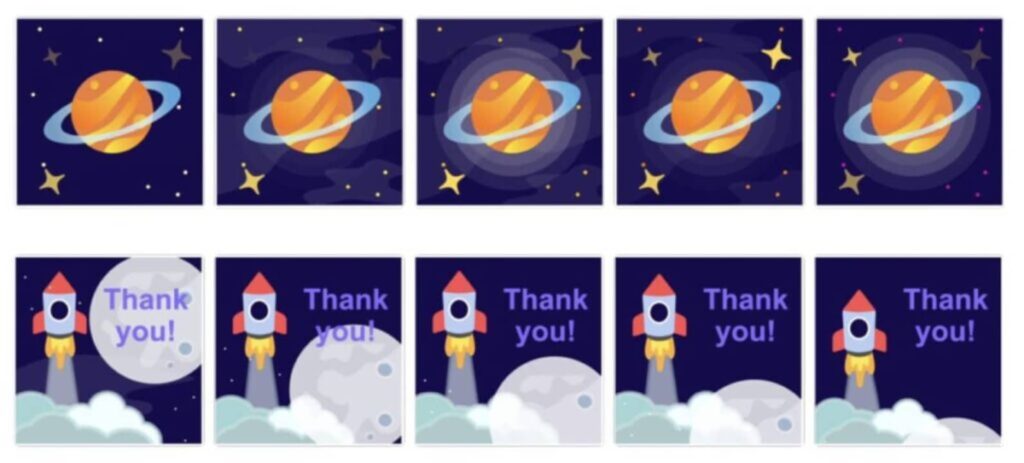
The new Apple tool, detailed in depth in a recent paper titled “Keyframer: Empowering Animation Design Using Large Language Models”, allows us to transform scalable vector graphics (SVG) images into dynamic animations using simple text commands. For example, when loading an image of a spaceship, the user can request “generate three designs where the sky changes color progressively and the stars blink”, and Keyframer will produce the necessary CSS code to carry out this animation.

The main advantage of Keyframer, however, lies in its ability to allow users to refine their creations through successive indications, thus optimizing the creative process without the need to define all design elements from the beginning. According to Apple, which has interviewed designers and engineers, this tool is “much faster when it comes to making animations” and “does things that used to take several hours to do”.

Apple Developer Download

With Keyframer, Apple reinforces, once again, its position in the field of artificial intelligence and shows us one more card —perhaps its application in Keynote— of its strategy before iOS 18 arrives and completely changes what our iPhone will be able to do with a simple request to Siri.

Revolutionizing Imaging Technology: Nvidia Unveils Perfusion, an AI with Extraordinary Results

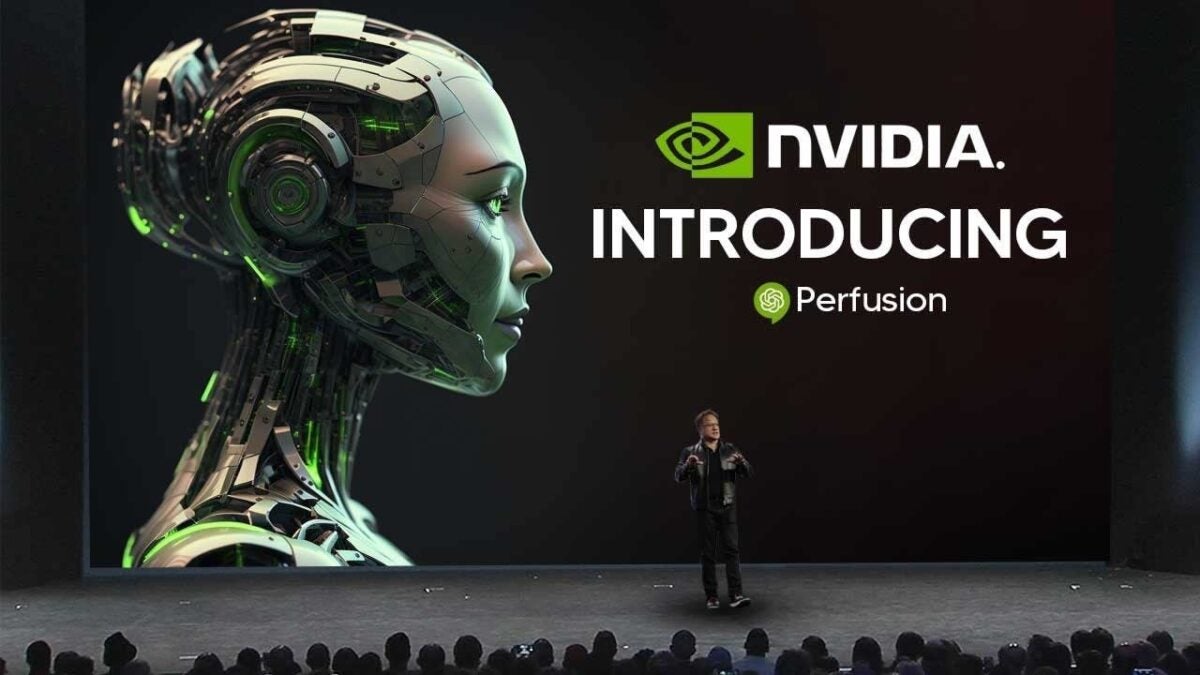
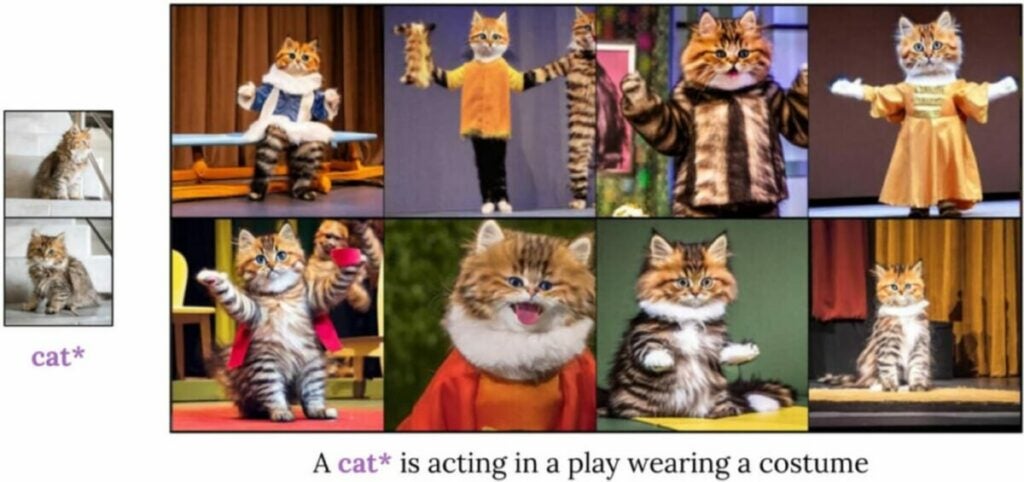
Nvidia has presented Perfusion, a new artificial intelligence capable of generating images with more promising results than those of the competition.

When it comes to generating images automatically based on your own ideas, the two most popular artificial intelligences among users are DALL-E 2 and Midjourney. Both are tools capable of creating images with astonishing quality, to the point where they can appear real.

DALL-E 2 ACCESS

Now, a heavyweight in the technology industry wants to compete head-to-head with these popular AIs and has launched its own image-generating artificial intelligence. Nvidia, the company known for creating graphics cards for PCs, has developed Perfusion, an AI that allows the creation of images from natural language descriptions.

By simply inputting the image we want to generate using text, Perfusion will produce an image that closely matches the given instructions. Yes, the result will be “approximate” as it is not a perfect image-generating AI (currently, none are).

Despite Perfusion not being perfect (yet), the results obtained through this AI seem to be more accurate than those of its competitors. Nvidia’s artificial intelligence is based on Stable Diffusion, a language model created by LMU Munich and Runway, but it includes certain mechanisms that simultaneously generate multiple concepts in new images.

Perfusion offers users the ability to combine different customized elements with a set of images that function as concepts, thus creating images with much greater precision than other image generators by having greater control in the generation process.

Midjourney ACCESS

Nvidia is fully immersed in the world of AI. In addition to Perfusion, Nvidia has also developed Omniverse Audio2Face, a tool that enables the generation of 3D animations from audio. Furthermore, it has been known since the beginning of the year that the company is developing AI-driven drivers to optimize the performance of its graphics cards.

Some of the links added in the article are part of affiliate campaigns and may represent benefits for Softonic.