The internet has evolved remarkably over the last four decades, going from 1,000 devices in 1982 to more than 40 billion today. This accelerated growth raises an intriguing question: what is the real “weight” of this vast digital network? Currently, it is estimated that there are more than 200 billion zettabytes of data stored on the network, which poses a challenge to understanding its true magnitude. The impact of the internet: more than a physical weight, a symbolic force Using Einstein’s famous formula (E=mc²), some experts are trying to calculate the weight of the data stored on the internet […]
The Internet has evolved remarkably over the last four decades, growing from 1,000 devices in 1982 to more than 40 billion today.
This accelerated growth raises an intriguing question: what is the real “weight” of this vast digital network?
Currently, it is estimated that there are more than 200,000 million zettabytes of data stored on the web, which poses a challenge to understanding its true magnitude.
While we can’t really weigh the internet, we can theoretically weigh the massive volume of energy it consumes, which some experts say equates to approximately 2 ounces. This is massive compared with an email, weighing in at two ten-thousandths of a quadrillionth of an ounce. pic.twitter.com/6jGFlEiUsE
The impact of the Internet: more than a physical weight, a symbolic force
Using Einstein’s famous formula (E=mc²), some experts are trying to theoretically calculate the weight of the data stored on the internet; however, estimates suggest that the energy mass of all this information would be less than a milligram.
Likewise, a more tangible comparison has been proposed using DNA as a unit of measurement: one gram of DNA can store up to 215 petabytes, which would imply that 1.1 tons of DNA would be needed to store the entire internet, a “weight” comparable to that of a small car.
On the other hand, physicist Russell Seitz has suggested that the weight of the internet could be analyzed through the electrical energy consumed by servers and repeaters. Although this approach could result in a weight equivalent to a handful of strawberries, it is considered an outdated method since data flows constantly between various devices and transmission media.
Despite these uncertainties, the impact of the internet on our lives is undeniable. It cannot be measured as a physical entity, but its influence is immense and is perceived more in a symbolic and philosophical realm. As we reflect on the interconnectivity that the web provides us, the question of its “weight” transcends matter, leading to a deeper exploration of our digital world.
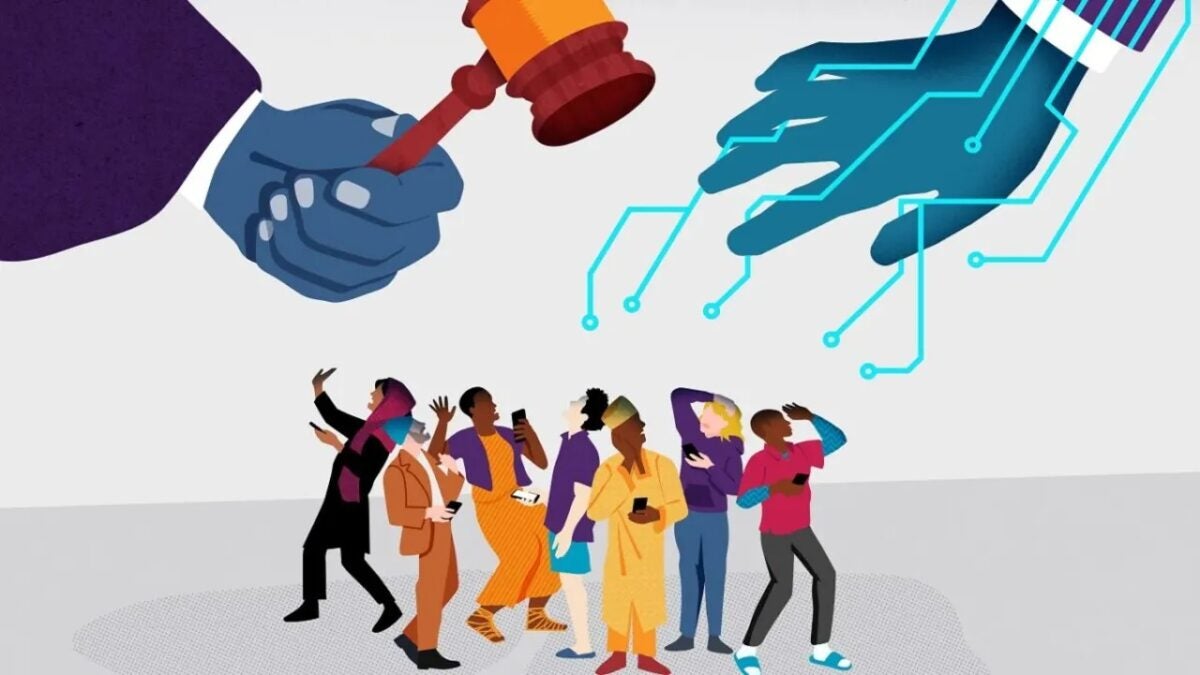
Cloudflare ha presentado un incidente de nulidad contra la resolución que permite el bloqueo de direcciones IP, argumentando que LaLiga ocultó información clave al tribunal sobre el posible daño a terceros involucrados en esta medida. La situación ha escalado, con LaLiga acusando a Cloudflare de ser cómplice de delitos graves. En un comunicado, la organización liderada por Javier Tebas afirma que la empresa tecnológica prioriza sus intereses económicos y proporciona cobertura a organizaciones criminales, alegando que, bajo el pretexto de defender una Internet abierta, en realidad se beneficia a expensas de otros. Una denuncia que va más allá de España.
Cloudflare has filed a nullity incident against the ruling that allows the blocking of IP addresses, arguing that LaLiga concealed key information from the court regarding the potential harm to third parties involved in this measure.
The situation has escalated, with LaLiga accusing Cloudflare of being complicit in serious crimes. In a statement, the organization led by Javier Tebas claims that the technology company prioritizes its economic interests and provides cover for criminal organizations, alleging that, under the pretext of defending an open Internet, it actually profits at the expense of others.
Cloudflare ha denunciado ante los juzgados a LaLiga por bloquear miles de páginas webs en su lucha contra la piratería. Añade que las acciones de LaLiga son “desproporcionadas” y “suponen una clara amenaza para la internet abierta” https://t.co/bFfotwZP1u
The conflict is not limited to Spain. LaLiga argues that in countries like France, Germany, Italy, and Portugal, other rights holders have also taken legal action against Cloudflare for its lack of cooperation in the fight against audiovisual fraud.
In Italy, the Milan Court issued court orders requiring Cloudflare to block domains related to illegal activities, imposing daily fines of 10,000 euros for non-compliance.
LaLiga emphasizes that this supports the perception that Cloudflare is not complying with intellectual property laws in several territories.
In terms of numbers, Cloudflare claims that the blocks affect millions of users, while LaLiga denies this assertion, limiting the figure to “barely a few hundred”. This disagreement has led LaLiga to create a mailbox (afectadoscloudflare@laliga.es) where the supposed affected can report their incidents. The situation seems to be at the peak of tension, with the possibility of a joint complaint being filed in response to Cloudflare’s legal actions.
The complexity of this litigation highlights the growing battle between copyright institutions and digital platforms in an increasingly interconnected world.
A successful test of a 50 Gbps fiber optic connection has been carried out by Nokia and Openreach in the UK, marking a significant milestone in internet speed in the country. This trial, conducted in Ipswich, showed download speeds of 41.9 Gbps and upload speeds of 20.6 Gbps, which are up to twenty times faster than current connections, according to Openreach. How fast is 50 GB/s in the real world To put these speeds into perspective, downloading a high-definition movie over a 100 Mbps connection takes approximately […]
A successful 50 Gbps fiber optic connection test has been carried out by Nokia and Openreach in the United Kingdom, marking a significant milestone in internet speed in the country.
This test, conducted in Ipswich, showed download speeds of 41.9 Gbps and upload speeds of 20.6 Gbps, which are up to twenty times faster than current connections, according to Openreach.
Openreach and Nokia test UK’s first live ‘hyper-fast’ 50Gbps fibre broadband connection
To put these speeds into perspective, downloading a high-definition movie over a 100 Mbps connection takes about seven minutes.
With a 1 Gbps connection, this same process is reduced to 40 seconds, while with the new 50 Gbps technology, the movie would be ready almost immediately.
The applications of this high speed are multiple and range from entertainment to the educational and healthcare sectors. Technologies such as virtual reality (VR), augmented reality (AR), and 8K video streaming require high bandwidth and low latency to function optimally.
In addition, this connectivity will enhance remote work and facilitate faster and more useful educational environments, which is especially relevant in a post-pandemic world.
In the field of health, high-speed internet is crucial for telemedicine, AI-driven diagnostics and the real-time transmission of medical images. This will enable faster remote consultations and more efficient patient care, especially in urgent situations.
Nokia has highlighted that its range of PON technologies will enable future upgrades to the Openreach network, ensuring that the growing demand for high-speed services can be met in the future.
Although the United Kingdom joins China and the United Arab Emirates in testing these speeds, there is still no confirmed date for a full deployment of this technology.
It is part of the Saturday routine for many of us: a movie on Netflix, a pizza from our favorite pizzeria (ordered online, of course), and relaxing, because we have earned it. However, thirty years ago the reality was similar but not the same: you could watch a movie, yes, but at the video store. And eat pizza, of course, but by calling on the phone. The internet has made life easier for us, but not so long ago it was pure science fiction… until a movie got ahead of reality by a few months. Double at signs and a quarter of trending topic Although there […]
It is part of the Saturday routine for many of us: a movie on Netflix, a pizza from our favorite pizzeria (ordered online, of course), and then relax, because we’ve earned it. However, thirty years ago, the reality was similar but not the same: you could watch a movie, yes, but at the video store. And eat pizza, of course, but by calling on the phone. The internet has made our lives easier, but not so long ago it was pure science fiction… until a movie got ahead of reality by a few months.
Double the @ symbols and a quarter of a trending topic
Although it is said that the first time someone ordered a pizza was in 1994, the truth is that we have to go back twenty years earlier, when a man with Moebius syndrome who could not communicate normally, Donald Sherman, used a proto-Internet to call a pizzeria with an artificial voice. Domino’s Pizza hung up immediately, but a classic neighborhood shop, Mr. Mike’s, accepted the order and sent it to his home. It did not cause a stir in any way, but it took a first step into history.
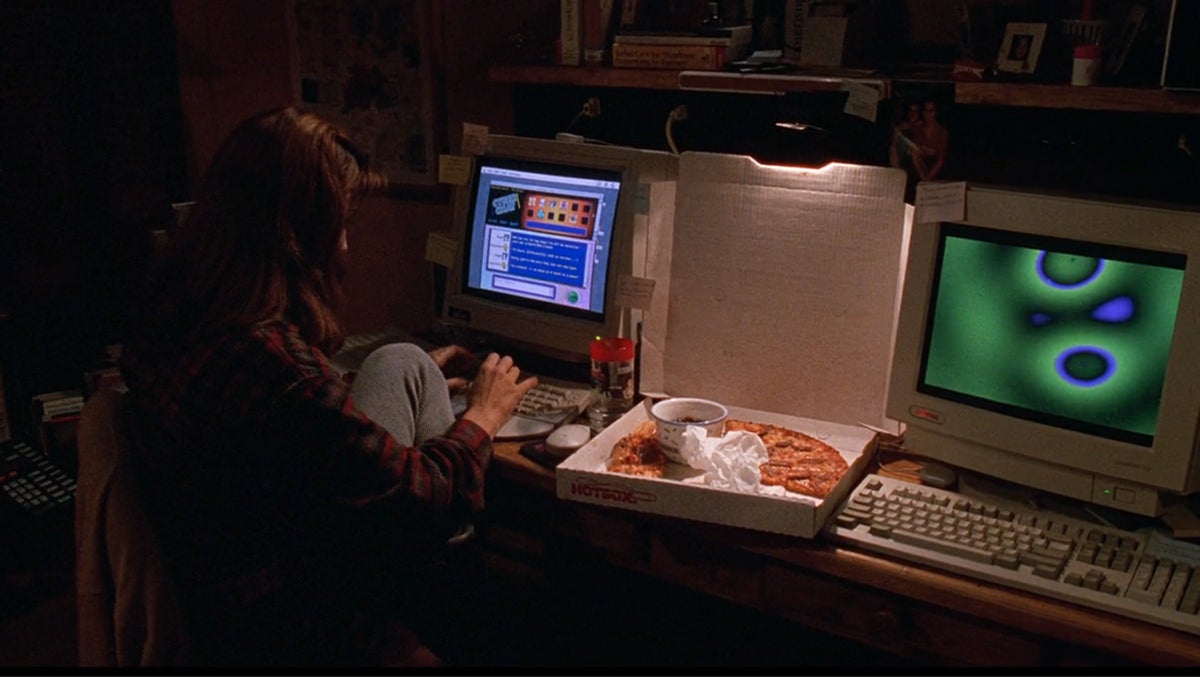
In the mid-90s, the Internet still seemed like an impossible future promise for most of the population, who didn’t even have computers. However, on July 28, 1995, just a month before the release of Windows 95, The Net, a movie starring Sandra Bullock that showed us the infinite capabilities of the Internet, premiered. You could be a hacker, surrounded by computer screens, uncover international conspiracies, and of course, order pizza.
To give you an idea of how lost the screenwriters (and the world) were 30 years ago, they needed the help of a specialist at UCLA (the University of California) to explain to them what the World Wide Web was, because they didn’t understand anything. It was he who told them that in the future everyone would have access to the Internet and could do all kinds of things. While they were filming, Time magazine released a legendary issue in which all the articles were about the Internet, and they thought that perhaps their little science fiction madness might have a connection to reality after all.
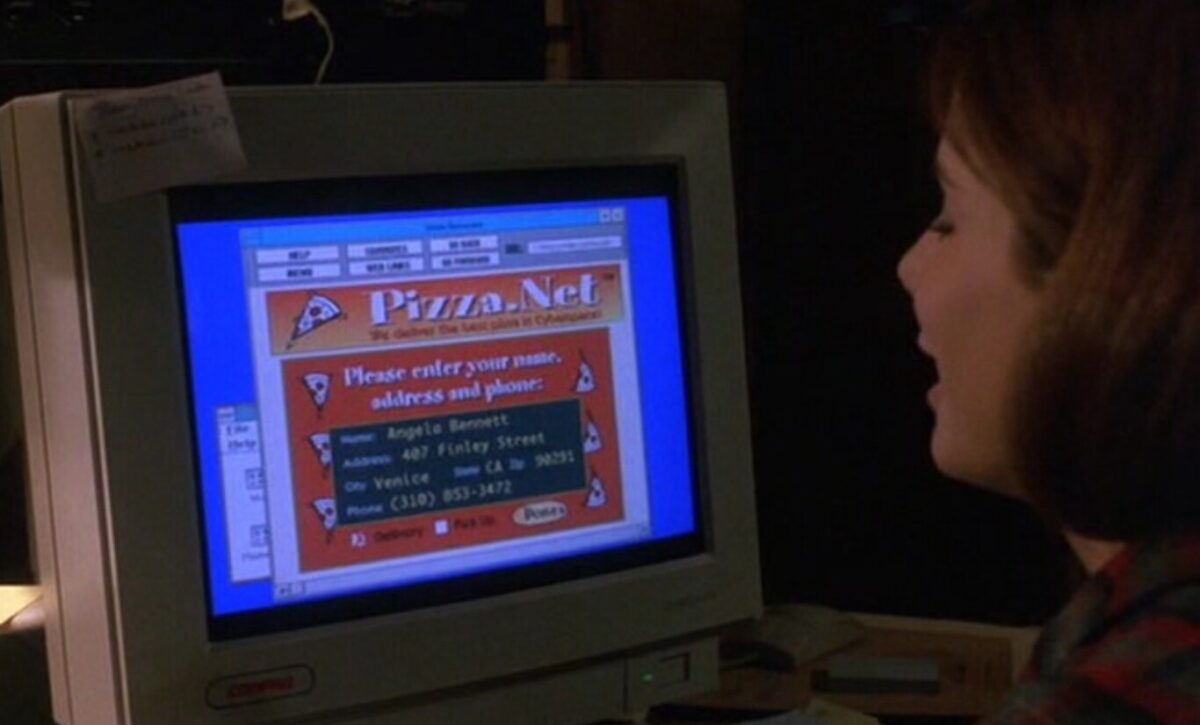
But, to show the greatness of what was to come, why ask for that particular food and not anything else? In the movie, we see how Sandra Bullock’s character logs onto pizza.net (yes), and the idea came from the director, Irwin Winkler, who asked, as a wacky thought, “What if you could order pizza over the Internet?”. The screenwriters didn’t understand anything: Why would anyone do that with a phone nearby? In the end, they accepted for a simple reason: the character is isolated and doesn’t want to talk to anyone, so she even (even!) orders her food online. What a fantasy, right?
Ordering food, the future
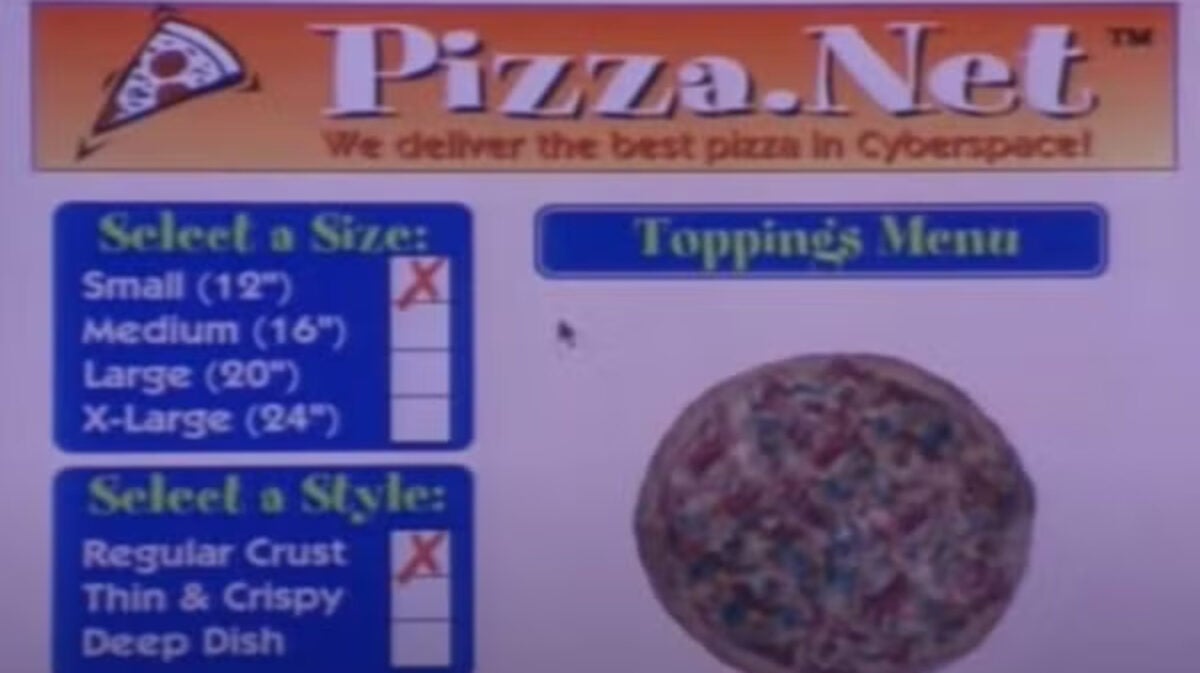
Although pizza.net (“We deliver the best pizza in cyberspace!”) now seems like a primitive page, at that time they designed it to be colorful and vibrant, as they imagined the websites of the future would be. They were not far off, of course. In fact, what is surprising is that the website’s interface (in 1994, think about that) was completely interactive, and Bullock could click anywhere, so he could murmur what he was doing while clicking here and there.
As a curiosity, a large pizza (20 inches), with regular crust -the other options were “thin and crispy” and “deep dish”- with garlic, anchovies, and extra cheese (a matter of taste) cost 14 dollars. Quite expensive for the time, but of course, after all, it was a cyberspace pizza. So far, so good. There is just one problem, and that is that, although it was ahead of its time in the filming, in real life Pizza Hut started testing the possibilities of ordering pizzas online as early as September 1994 through the service… PizzaNet. In the end, the Internet was not so far off.
That said, these pizzas could only be ordered if you had Internet in 1994 in the Santa Cruz area, a city in California with just under 60,000 people. The promoter was the owner of a store in the city who wanted to see what would happen if users were given the opportunity. However, there were no clickable options like in the movie: it was a form where you had to put your chosen pizza, address, and phone number. And, of course, pay at the door, no online payments. Of course, a couple of years later PizzaNet closed and paved the way for the first generation of online food.
Ah, that’s right! Don’t let them fool you: Pizza Hut was not the first sale that took place on the Internet. That was the album Ten Summoners’ Tales by Sting, which Phil Brandenburger from Philadelphia bought on CD with a credit card for $12.48 plus shipping costs. Who would have thought that the future would inevitably involve Sting and a slice of pizza?
The great rival of the United States and the second most powerful country in the world (economically speaking) has a certain problem with freedom of expression, a consequence of being an authoritarian country with a single party and a single leader. And in its mission to continue expanding its unique worldview, they have taken another step: even controlling satellite internet. Beijing has published its proposed regulations for satellite broadband, which includes the requirement for operators to perform real-time censorship. In its latest draft of regulations, the Cyberspace Administration of China proposes […]
China, the great rival of the United States—and the second most powerful country in the world (economically speaking)—has a certain problem with freedom of expression, a consequence of being an authoritarian country with a single party and a single leader. In their mission to continue expanding their unique worldview, they have taken another step: controlling satellite internet.
Beijing has published its proposed regulations for satellite broadband, which include the requirement for operators to perform real-time censorship.
In its latest draft regulations, the Cyberspace Administration of China proposes that organizations or individuals using terminal equipment with direct connection to satellite services are forbidden from:
“Producing, copying, publishing, or disseminating content prohibited by laws and administrative regulations, such as content that incites the subversion of state power, overthrows the socialist system, endangers national security and interests, damages the national image, incites the secession of the country, undermines national unity and social stability, promotes terrorism, extremism, ethnic hatred, ethnic discrimination, violence, pornography, and false information.”
The government wants to control everything, no matter how we access the network
It clarifies that the affected equipment includes handheld, portable, and fixed civilian terminals, as well as terminals installed in aircraft, ships, and vehicles—essentially, any device that allows users to access satellite communication systems for voice calls, text messages, and data exchange.
The document states that providers must adjust their operations to national security and network security requirements, and avoid illegal activities.
This includes complying with Chinese cybersecurity laws, data security, and personal information protection, in addition to potentially being responsible for user activities.
“If a direct satellite service provider of terminal equipment discovers that a user has posted or transmitted information prohibited by laws and regulations, they must immediately stop the transmission, take measures such as deletion in accordance with the law, preserve the relevant records, and report to the competent authorities,” stipulates the Chinese censorship regulation.
The regulations even require that anyone using satellite broadband to publish news—distribute video and audio content—must obtain a license. The deadline for receiving comments is October 27, 2024.
China launched its first space broadband satellites in August. In total, 108 satellites are expected to be launched this year to initiate the Qianfan constellation, followed by 540 more in 2025. China aims to have 15,000 satellites in low Earth orbit by 2030 and cannot miss the opportunity to control them all.
The Starlink service from SpaceX already has more than 3 million customers worldwide, as announced by the company this week.
Starlink service for users (not companies) starts at $120 per month for unlimited data, while the one-time purchase of the satellite dish costs $599. With all this, Elon Musk’s company has reached 3 million customers.
“Starlink connects over 3 million people to high-speed Internet in nearly 100 countries, territories, and many other markets,” SpaceX stated in a social media post on Tuesday, which also included a short video showing Starlink satellite dishes installed and providing internet connection in various locations around the world.
Starlink is connecting more than 3M people with high-speed internet across nearly 100 countries, territories and many other markets.
SpaceX sent its first batch of 60 satellites to low Earth orbit in May 2019 and now has around 6,000 of its small satellites orbiting the planet.
Those first Starlink satellite deployments soon paved the way for the launch of a beta service in October 2020. By February 2021, the service already had 10,000 users worldwide before quickly growing to reach 1 million users in December 2022 and 2 million customers just nine months later.
Elon Musk, CEO of SpaceX, also posted a message of gratitude to the customers and congratulated his team for reaching 3 million subscribers in 99 countries.
Congratulations to the @SpaceX team on passing 3 million customers in 99 countries!
Starlink satellites are not only used by residential and business customers, but also by airlines for in-flight internet and cruises so that passengers can stay connected at sea.
Technology has also been used to help disaster-affected areas get back online while normal internet services are being repaired.
Some augmented reality and virtual reality applications from Vision Pro may require broadband speeds of 400 Mbps.
Augmented and virtual reality technologies have advanced the concept of the metaverse, now capable of manipulating the real world and immersing users in digital experiences. And that brings challenges in terms of bandwidth and network capacity.
This year has seen the long-awaited debut of Apple in this dynamic technology with the launch of its Apple Vision Pro. And Apple refers to its metaverse technology of augmented reality and virtual reality as “spatial computing”, which “seamlessly combines digital content with the physical world”, using hand and eye tracking for a smooth digital experience.
And for the Apple Vision Pro and other similar devices to have widespread use, our foundational networks must guarantee ultra-fast and low-latency connectivity. This is essential to accommodate the significant increase in traffic and provide seamless immersive experiences.
Without a top-level network, the Apple Vision Pro has no future
The Apple Vision Pro is designed to be used in a “controlled environment”, ideally at home, but there are already examples of people using it outside the home.
Features like spatial video and spatial video capture, immersive FaceTime, and high-definition video playback require high-performance WiFi connectivity, which requires fast speeds, low latency, and high-bandwidth internet connectivity (fiber optic). Some augmented reality and virtual reality applications may require broadband speeds of 400 Mbps.
This would likely make this technology useless for this large segment of the population. Currently, the Federal Communications Commission (FCC) requires consumers to have access to minimum real download speeds of 25 Mbps and minimum real upload speeds of 3 Mbps.
The FCC has finally decreed that 25Mbps and 3Mbps are not "broadband" speed. Hallelujah. It's all about 100Mbps and 20Mbps now https://t.co/WEklt0yyN1
However, this level of home network performance does not meet the demands of an immersive VR environment, especially when other devices are being used simultaneously.
The revision of the minimum broadband speed definition to 100 Mbps is being debated. However, researchers estimate that to achieve the ultimate immersive multimedia experience, between two and five Gbps may be necessary, indicating that even this proposed increase may not be enough.
Apple Vision Pro is an interesting vision of what the future could hold for metaverse technology of augmented reality and virtual reality. Its commercial launch is an interesting litmus test not only to determine to what extent consumers are ready and willing to experience these immersive experiences, but also to what extent networks are prepared to offer them.
Many activists, founders, and citizens still believe in the liberating power of the Internet. And there are still ways to reignite the fragile flame of…
We have been living in the Internet era for almost three decades. And since the majority of the world’s population is under thirty years old, this means that many billions of people do not know what a world without internet is like.
But for those of us who remember life before the global network, it is evident how much has changed in these thirty short years. Even in this time, our way of thinking about the Internet has changed.
If the early days of the Internet were characterized by boundless, almost dizzying optimism, today’s Internet is much more likely to be seen, at best, with weary cynicism.
In the worst case scenario, many of us talk about the Internet with a tone of absolute distrust.
How has the state of global internet freedom changed over the last year? Find out when we launch our 2022 #FreedomOnTheNet report on October 19th! pic.twitter.com/DuiOaPvXIR
The level of freedom that exists on the internet under examination
Every year, the charity organization Freedom House studies the state of freedom on the Internet worldwide. And last month’s Freedom On The Net 2023 report revealed that internet freedoms worldwide declined in 2023, for the thirteenth consecutive year.
After all these years of decline, today it seems strange to think of the Internet as a force for good, for liberation. However, that was the original vision of the founders of the Internet. What has happened to the forgotten dream of a free Internet?
Despite the atmosphere of pessimism surrounding the Internet, it is important to remember that not all is lost.
Many activists, founders, and citizens still believe in the liberating power of the Internet. And there are still ways to fuel the fragile flame of freedom on the web and encourage it to burn as brightly as the Internet’s founders intended.
Fortunately, there are tools that citizens can use to bypass state censorship. And among us there are those who want to use these tools to reverse the trend of decreasing freedom on the Internet.
VPN providers are at the forefront of the battle to redirect the Internet. Their products allow Internet users to regain their power and reclaim the original idea of a free and open web.
In most territories, VPNs are completely legal and allow internet users to safeguard their privacy while browsing and accessing online content with geographic restrictions.
PlayStation 5 Slim will require the Internet so that we can use it, in all its variants, whether with or without a disc reader, in a tough blow for users
Sony is not known for making the most sensible or popular moves with its hardware. In the past, they have removed features from their consoles once released in new models, and sometimes these new models have been inferior to the older ones. It’s a common occurrence with the Japanese company, which is why when they announce a revision of their consoles, it is always met with skepticism and caution. Something that doesn’t seem to be different with PlayStation 5 Slim.
According to images published on the Internet depicting the initial setup process of the new PlayStation 5, popularly referred to as PlayStation 5 Slim, it has been confirmed that it would require an internet connection to activate the disc reader. Initially, this would only need to be done once, registering the reader with the motherboard it is connected to. Speculations suggest that the reasons for this requirement could be to comply with the regulations of the Digital Millennium Copyright Act in the United States.
— HazzadorGamin, Dragon of Dojima (@HazzadorGamin) October 31, 2023
Indeed, many users on the Internet have already lamented that this is a severe blow to preservation efforts, as well as a significant attack against consumer rights. To activate the new PlayStation 5 consoles, not only will an internet connection be required, but Sony’s servers must also be operational. There is no assurance that this will continue to be the case in the coming years, let alone decades. Not to mention the probable scenario of a temporary outage that could last hours or even days, rendering a newly purchased PlayStation 5 useless.
If confirmed, these are terrible news for all consumers and a user-unfriendly move that, while not unprecedented for Sony, demonstrates a complete lack of consideration for their customers.
Now it’s the turn of the most unexpected: Twitch. What’s the point of an app designed to do live shows for several hours launching Stories? Go find out.
It’s part of your daily routine on social media: take a look at Twitter, watch a couple of TikTok videos, and, of course, see what your friends are up to on Instagram Stories. The social network, which borrowed the concept from Snapchat (and, in the process, left it in the dust), popularized the format in such a way that everyone wanted to jump on the bandwagon. The latest one, the most unexpected.
Twitter launched (and quickly removed) Fleets, YouTube is still trying with Shorts, Facebook has also named its version “Stories,” and even WhatsApp allows you to show everyone in your contact list what you’re up to. They are all exactly the same: short videos or photos, preferably taken in the moment, to keep creating content on whichever social network you’re using. Hey, BeReal built its entire existence on this.
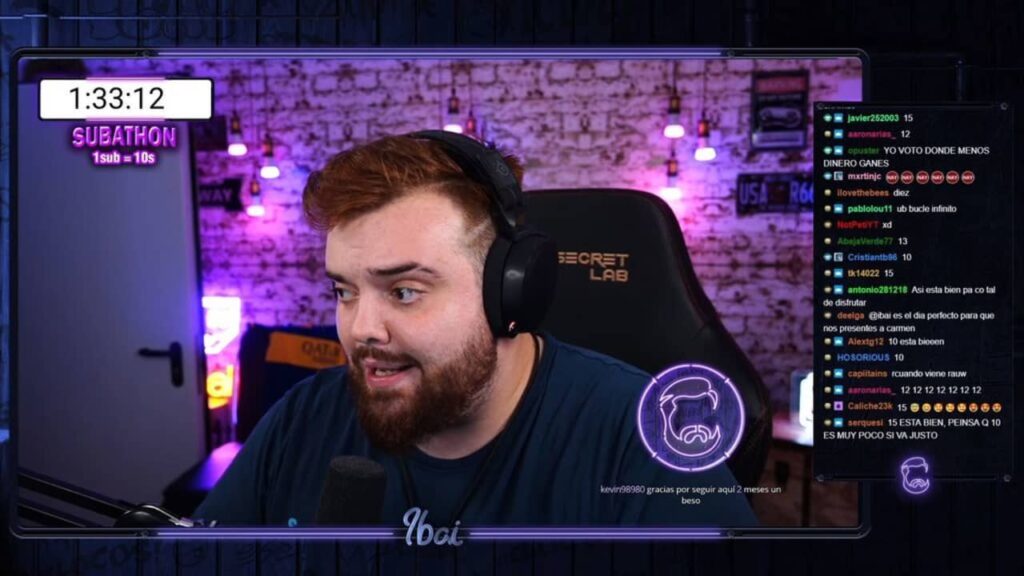
Now it’s the turn of the most unexpected one: Twitch. What does an app designed for streaming hours-long live broadcasts have to do with launching Stories? Who knows. Trial and error. And it’s… well, exactly what you’re thinking. Users can share short videos on their channel that will be deleted after 48 hours. They must have really stretched their imagination to figure out how to make Stories work. Yes, they’re called that. Imagination at its finest.
For now, only partners and affiliates who have streamed once in the last month will have access to this absolutely new tool. What’s the point? Well, it will allow creators to update their lives to their followers while they are away from home or announce that they are going live hours before it happens, as they currently do on other social networks.
The problem is that where we used to find differentiation between different platforms, it’s now a mishmash of… the same thing. All the time. Without stopping. The same post repeated seven times, the same TikTok video commented on by Ibai on Twitch, re-uploaded to YouTube, retweeted on Twitter, ignored on Facebook… Is this all there is? Is there nothing more after this? BlueSky, you are our last hope.