The popular franchise ‘Jujutsu Kaisen’ returns to the anime and manga scene with the new series titled ‘Jujutsu Kaisen: Module’, which focuses on the grandchildren of the original characters Yuta Okkotsu and Maki Zenin, taking the story to a future where the fight against curses continues. In this sequel, elements of science fiction such as alien invasions are introduced, an unexpected twist for fans of the original series. Similar, but better This new installment is not only a continuation but also an opportunity for the creator Gege Akutami to address the criticisms received for the ending of the series […]
The popular franchise ‘Jujutsu Kaisen’ returns to the anime and manga scene with the new series titled ‘Jujutsu Kaisen: Module’, which focuses on the grandchildren of the original characters Yuta Okkotsu and Maki Zenin, taking the story to a future where the fight against curses continues. In this sequel, elements of science fiction such as alien invasions are introduced, an unexpected twist for fans of the original series.
Similar, but better
This new installment is not only a continuation but also an opportunity for creator Gege Akutami to address the criticisms received for the ending of the original series, which many fans considered rushed and with loose ends. With the art of Yuji Iwasaki, known for his work on ‘Cipher Academy’, Akutami can fully focus on writing and planning the story, which promises a more polished narrative.
Akutami has expressed his intention to learn from past mistakes and not repeat them in ‘Jujutsu Kaisen: Module’. With a renewed focus, the author is committed to developing charismatic and well-rounded characters that do not rely entirely on the legacy of the original series, which could provide a refreshing change in the narrative dynamics.
The first advances of the series suggest that the protagonists, Yuka and Tsurugi Okkotsu, are well-developed and have characteristics that make them appealing to fans. Additionally, the sequel aims to serve as a space to unveil some mysteries that were left pending in the previous series, a strategy that could further reconnect with an audience eager for answers. ‘Jujutsu Kaisen: Modulo’ seems to be designed not only to continue the story but to refine it significantly.
Originally, Rumiko Takahashi just wanted to write a martial arts manga. Moreover, she wanted to create a series in which all aspects of daily life were somehow connected to the practice of it… And after creating Urusei Yatsura and Maison Ikkoku, she decided it was time to feature a man as the protagonist. There was just one problem: what if her female readers abandoned her? What if she didn’t know how to write men? Immediately, the solution came to her mind: the man could turn into a woman every now and then. Thus, Ranma 1/2 was born, which began to be published […]
Originally, Rumiko Takahashi just wanted to write a martial arts manga. Moreover, she wanted to create a series where all aspects of daily life were somehow connected to the practice of it… And after creating Urusei Yatsura and Maison Ikkoku, she decided it was time to feature a man as the protagonist. There was just one problem: what if her female readers abandoned her? What if she didn’t know how to write male characters? Immediately, the solution came to her mind: the man could turn into a woman every now and then. Thus, Ranma 1/2 was born, which began publication on August 19, 1987, and still continues to provide entertainment, almost 40 years later. That’s quite something!
Life is tough and you have to fight
If Ranma 1/2 were made now, there is no doubt that it would have a swarm of people behind it complaining about being “inclusive.” However, the author has stated on more than one occasion that she was not pursuing any kind of social agenda but simply wanted to create a fun series for women and children (although, curiously, we all ended up enjoying it equally). However, there is a question that every otaku has asked at some point, and that in Japan they are too modest to ask directly: What would happen if Ranma, turned into a girl, got pregnant?
There are theories of all kinds, from those who say she should stay as a girl for nine months to avoid losing the baby to those who believe she would evaporate the moment she became a boy, or that somehow she would continue. Everyone has their own fetishes. However, what not many know is that Takahashi herself already answered the question. That said, if you were expecting something definitive that would change your understanding of the work, you are in for a deep, profound disappointment.
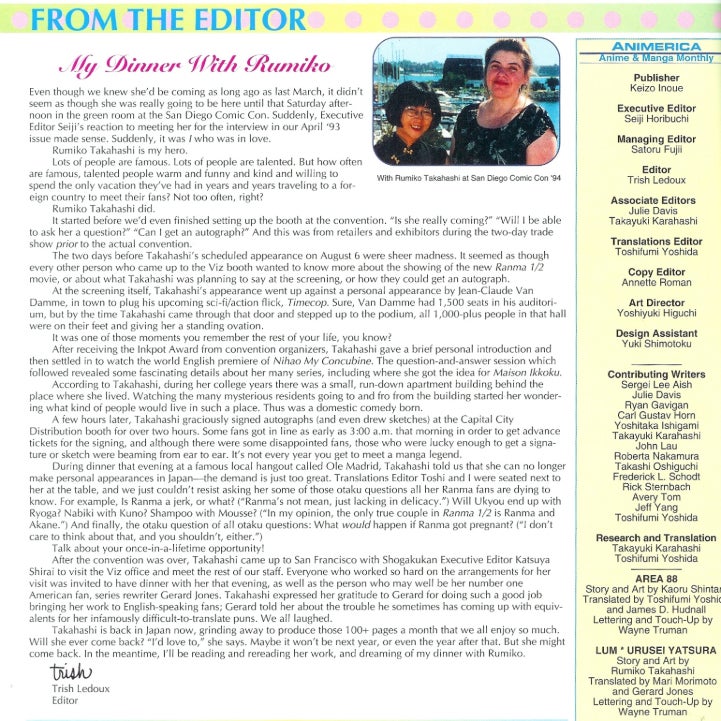
Although some say it was a public interview, that is not true: the author, as a good Japanese person, would never respond to an otaku nonsense like this precisely because she knows she has a reputation to uphold. Tracing its origin, the famous phrase was said to her at a private dinner during the San Diego Comic-Con in 1993… to her anime translator from that time! This, Trish Ledoux, who later also adapted Inu Yasha and Video Girl Ai, shared her experience with the mangaka in Animerica magazine.
For example, she asked him if Ranma was an idiot (“Ranma is not bad, he just lacks delicacy”), which couples would end up together in the end (“In my opinion, the only real couple is Ranma and Akane”) and, finally… What would happen if Ranma got pregnant. The answer is what you might imagine: “I don’t want to think about it, and you shouldn’t either”. For years, Takahashi has had a way to respond to all her annoying fans: basically, with a textbook “What are you talking about?” After all, her manga wasn’t about that, but about romantic entanglements.
During that 1993, Takahashi drew, signed, thanked, answered in broken English, and announced that she would love to return to Comic-Con (although it can’t be said that she actually did, to be honest). Ranma 1/2 ended its run in 1996, and since then it has remained in the hearts of fans. So much so that even now its remake on Netflix is one of the most popular on the platform. As for the author, she continues to write and draw manga at 67 years old, and it doesn’t seem like Mao, her current work, will be the last. After all, we all want her to live forever.
Netflix has welcomed a new success in the world of horror anime with the premiere of ‘The Summer When Hikaru Died’ (‘Hikaru ga Shinda Natsu’), which concluded its first season with a total of twelve episodes. The series, set in a rural Japanese village, tells the story of two friends, Yoshiki and Hikaru, whose friendship is cut short when Hikaru mysteriously dies. Subsequently, a creature takes over his body, and only Yoshiki is able to notice that his friend is no longer who he used to be. Despite this disturbing reality, Yoshiki decides to maintain […]
Netflix has welcomed a new success in the world of horror anime with the premiere of ‘The Summer When Hikaru Died’ (‘Hikaru ga Shinda Natsu’), which concluded its first season with a total of twelve episodes. The series, set in a rural Japanese village, tells the story of two friends, Yoshiki and Hikaru, whose friendship is cut short when Hikaru mysteriously dies. Subsequently, a creature takes over his body, and only Yoshiki is able to notice that his friend is no longer who he used to be. Despite this disturbing reality, Yoshiki decides to maintain the charade as strange events begin to occur around him.
Waiting for the manga
With the success of ‘The Summer When Hikaru Died’, it has already been confirmed that the second season is in progress, although not many details about its development have been revealed yet. The production has shared a first poster showing Yoshiki and Hikaru walking by the sea, generating expectations among the fans of the series. However, the path to a new installment may not be as quick as expected, due to the limitations of the source material.
The original manga by Mokumokuren only has seven published volumes, and the anime has adapted up to chapter 26 out of a total of 39. This means that the series has exhausted much of the available content for adaptation, and it is expected that any further development they want to undertake may be delayed. Some rumors suggest that, given the manga’s monthly publication pace, the second season may not arrive until 2027, which would leave fans waiting for new episodes for a considerable time.
Despite these challenges, the CygamesPictures studio does not seem overloaded with other projects, which could facilitate a more agile production if new chapters of the manga are obtained in the near future. However, the success of the first season suggests that the series is a priority for the studio, generating some hope among its followers.
On December 1, 2003, Tsugumi Ohba and Takeshi Obata published the first chapter of what was destined to be one of the great series of contemporary manga, only they didn’t know it at the time. However, Death Note marked an entire generation and is still being honored and parodied today, almost 20 years after its tumultuous ending. It had an anime adaptation of 37 episodes, several video games, four movies, and two Japanese live-action series, as well as two short sequels. However, no one expected that what would sink the very lucrative […]
On December 1, 2003, Tsugumi Ohba and Takeshi Obata published the first chapter of what was destined to be one of the great series of contemporary manga, only they didn’t know it at the time. However, Death Note marked an entire generation and is still being honored and parodied today, almost 20 years after its tumultuous ending. It had an anime adaptation of 37 episodes, several video games, four movies, and two Japanese live-action series, as well as two short sequels. However, no one expected that what would sink the very lucrative franchise would be… Netflix.
Light, note in the notebook: Netflix
Over the years, all kinds of names were rumored for the inevitable American adaptation based on Death Note. Zac Efron, Shane Black (I wish we could see an alternate universe where he made his version), and even indie filmmaker Gus Van Sant were working on it, and it was even leaked that they wanted to completely remove Ryuk and turn the story into a revenge tale without shinigamis involved. Finally, the chosen one for the victory was a more or less independent filmmaker who, four years after perpetrating this adaptation, would become one of Hollywood’s greatest Midas Kings: Adam Wingard.
Wingard had just tasted success with You’re Next, a film that cost only 1 million euros and grossed 26, and everyone thought he was the right one to bring the manga universe to Seattle for about 40 million dollars. Believe it or not, at that time all the movie studios fought for the rights to such a franchise, and in the end, the one who came out on top was Netflix, which did not imagine that the news would be received with absolute coldness by otakus around the world.
They had reasons to be suspicious. Although Death Note did many things right (such as the design of Ryuk, voiced by Willem Dafoe), the vast majority was a tremendous blunder: it tried to stray so far from the original material to be its own project with its own rules that it lost its way. In fact, it seemed to misunderstand its own characters, who were very humanized despite the almost psychopathic madness of the original manga. Of course, as soon as the casting was announced, fans crucified it for its obvious whitewashing (using Western actors instead of Asian ones, and changing everything related to Japan), and there was little Wingard could do to cope with the wave of insults that came his way on social media.
The best thing that can be said about Death Note now, eight years after its release, is that it tried. However, it failed with the whole team: the proposal was not understood, it was not interesting enough, and to make matters worse, the critics panned it, giving it a practically total suspension. To make matters worse, before the release, Wingard had already announced that Netflix wanted at least one sequel that was in production. In fact, the last news about it was in 2021, where it was promised that it would take into account the people’s criticisms to avoid repeating the same mistakes. As of today, we haven’t heard anything else, and perhaps that’s for the best.
Wingard knew how to rise from absolute failure and became one of the architects of the “Monsterverse” thanks to the two films that pit Godzilla against Kong. With such a huge amount of money as they have recalled, I don’t think he is inclined to return to the story of Light and company: live-action adaptations of mangas are only for the bravest.
For me, for years, Kirby was white. It’s not that I have color blindness, it’s just that on the cover of Kirby’s Dream Land, his first game from 1992, there was no pink anywhere, and since the game was made for Game Boy, there was no way to notice the colors. Masahiro Sakurai wanted a deliberately easy game to teach those new to action titles, and in fact, Kirby was just a temporary substitute: everyone on the team was convinced that at some point they would find their hero and stop using, during testing, that ball called […]
For me, for years, Kirby was white. It’s not that I’m colorblind; it’s just that on the cover of Kirby’s Dream Land, his first game from 1992, there was no pink anywhere, and since the game was made for Game Boy, there was no way to notice the colors. Masahiro Sakurai wanted a deliberately easy game to teach those new to action titles, and in fact, Kirby was just a temporary substitute: everyone on the team was convinced that at some point they would find their hero and stop using that ball called “Popopo” during testing, which they ended up becoming so fond of that they decided to make it the protagonist: its success was immediate and dazzling. And it still lasts even now, 33 years later!
I’m a pink, pink ball in a pink, pink world
In 1993, Kirby returned for a second game, the legendary Kirby’s Adventure for NES (which introduced the option to copy the abilities of your enemies by inhaling them) where it was revealed that the white ball was actually pink, much to the surprise of the entire team. It sold incredibly well despite the fact that, at that time, most games were already being made for 16-bit systems and the NES was considered, almost, a thing of the past. It was so successful, in fact, that the following year, in May, they decided it was time to launch Kirby beyond video games.
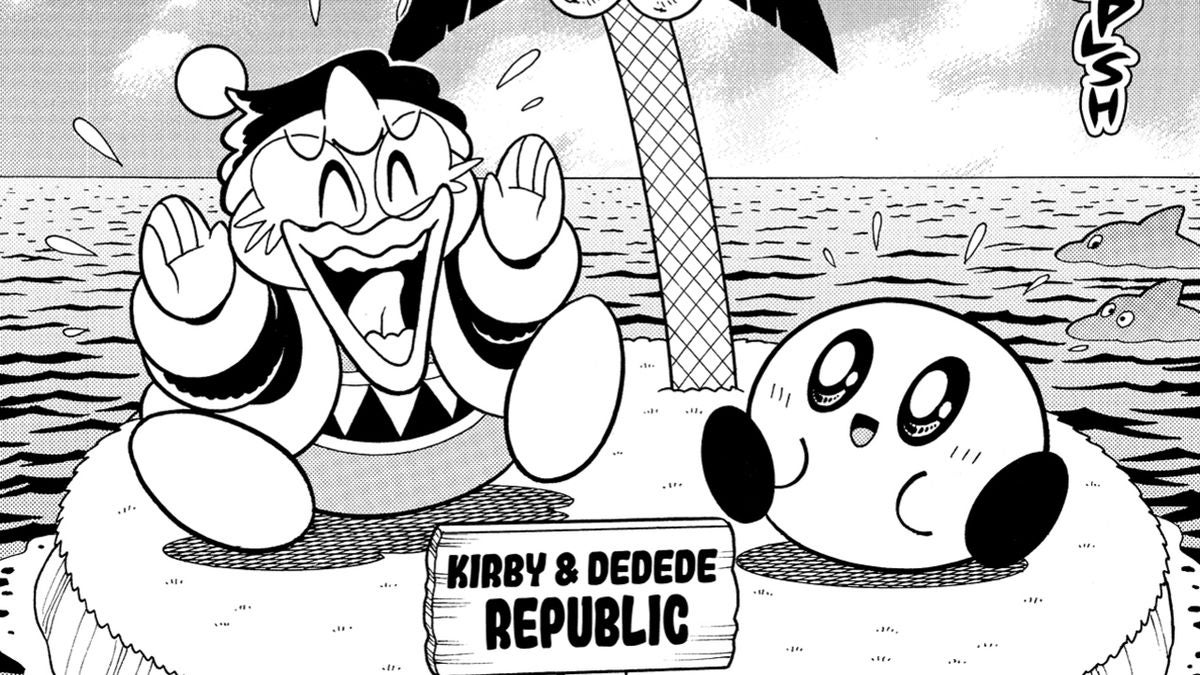
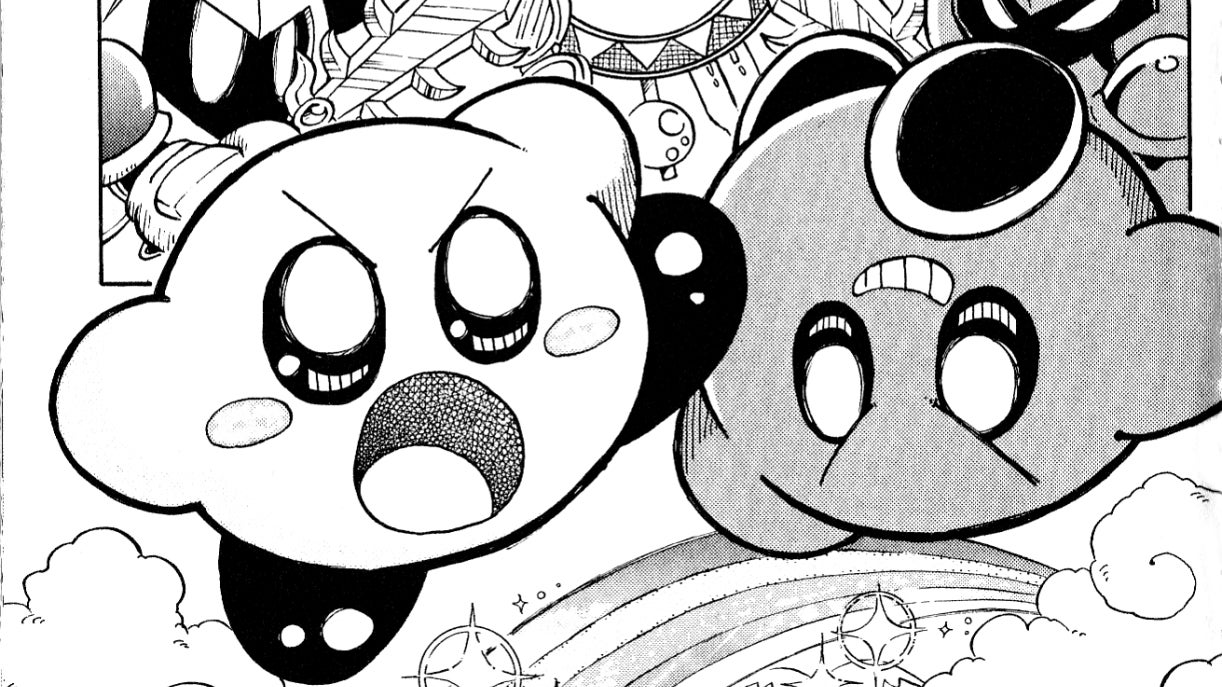
Hoshi no Kirby: Dedede de Pupupu na Monogatari (something like Kirby of the Stars: The Story of Dedede Living in Pupupu) was a manga written and illustrated by Hirokazu Hikawa that followed the adventures of friends Kitby and Chirby trying to find the treasure of Dream Land. Obviously, along the way, they would encounter, especially as games were released, Meta Knight, King Dedede, Waddle Dee, and the rest of the iconic characters from the saga, but living their own adventures and expanding the lore. It lasted 12 well-utilized years, compiled into 25 volumes of manga, but the magazine CoroCoro decided, in 2006, that it was time for it to come to an end.
But eleven years later, in 2017, and without any kind of final announcement, it was simply republished. And it continues to be published even now! You don’t need to wonder what is happening in the plot, because the truth is that it is a manga famous for how repetitive it is: it is based on slapstick and silly comedy and, unlike other comics based on video games, like those of Sonic, there isn’t much lore to hold on to: that hasn’t stopped over 10 million copies of the volumes from being sold and it remains a coveted item for collectors.
Also, 34 children’s novels have been published where Kirby teams up with Waddle Dee and they get into different environments (hot springs, snowy mountains, music festivals, etc.) that, indeed, do not excessively expand their story: after all, Kirby still has that essence with which Sakurai created him. In other words, simple enough to engage a new audience but complex enough that seasoned experts take time to achieve a hundred percent.
If you’re still craving more, because everything Kirby is not enough for you, you can also watch the 100 episodes of the series Right back at ya!, which this time did delve into the origins of the pink ball and how it ended up becoming the protector of Dream Land as part of the Star Warriors. And to think that it all started from a design that was almost discarded at first for being too simplistic!
In the streaming era, it would be logical for everything to premiere simultaneously everywhere, but that is not the case. Especially not when we talk about Asian productions. Japanese, Korean, and Chinese productions tend to premiere locally first and then release them to the rest of the world, which leads to certain problems when it comes to adjusting the conversation. In particular, because it is easy for part of the audience to have already seen these movies and series by the time they reach outside their countries. That is the case with The Nobility of Flowers. An anime that premiered […]
In the streaming era, it would be logical for everything to premiere simultaneously everywhere, but that is not the case. Especially not when we talk about Asian productions. Japanese, Korean, and Chinese productions tend to premiere locally first and then release them to the rest of the world, which leads to certain problems when it comes to adjusting the conversation. In particular, because it is easy for part of the audience to have already seen these movies and series by the time they reach outside their countries.
That is the case of The Nobility of Flowers. An anime that premiered on July 9 in Japan and, although its first season has not yet finished, is taking Japan by storm.
But not only in Japan. The series is causing a sensation on social media from everyone who can watch it, in one way or another. Now it arrives on Netflix, almost two months after its initial release, so that we can all catch up with one of the big sensations of anime this year. But what does The Nobility of Flowers have to sweep like it is doing? It is a believable, sweet romantic comedy that is easy to empathize with its characters at all times.
The plot follows two boys, Rintaro Tsumugi and Kaoruko Waguri. Rintaro attends the public Chidori High School and Kaoruko goes to the private all-girls Kikyo Academy. There is a clear rivalry between the two institutions, as Chidori is considered to only have troubled boys from lower-class backgrounds, while Kikyo has honorable girls from affluent families.
Both fulfill that stereotype, but they also challenge it, and that is the premise of the series. Rintaro is tall and has an intimidating appearance, but as Kikyo will discover right at the beginning of the series, he is a shy and insecure boy with a big heart. However, attending two rival schools, even though they want to get to know each other better and deepen their friendship, it won’t be easy at all. Much less when their feelings for each other start to grow over time.
With remarkable direction and commendable pacing, the series excels at conveying the emotions of both boys, perfectly balancing comedy, romance, and touches of drama. Something that has earned it great popularity among fans not only of romance but of anime in general.
Manga is already tremendously popular in itself
But this shouldn’t catch anyone by surprise. It is an adaptation of the manga by Saka Mikami that has 18 volumes published and is still ongoing, which is one of the most popular series in the Magazine Pocket magazine. And it is because of the tremendous personality of its character design, the sweetness and rawness of its narrative, and its ability to convey those complex emotions and situations without belittling them, but without making them excessively dramatic, to the point of making them exaggerated or too intense.
In addition, given the pace of adaptation, it is to be expected that there will be a second season of the series. At the very least. Especially considering the success it is harvesting on social media.
That’s why, taking advantage of its premiere on Netflix, you should watch The Nobility of Flowers if you are interested in romantic comedies, romances, or stories about teenagers trying to overcome their situation despite everything. Because few series have as much heart and sensitivity as this one. And even if it were just for that, it would be worth watching.
In recent years, several renowned manga authors have faced serious health difficulties that have significantly impacted their work. Among them is Gege Akutami, creator of Jujutsu Kaisen, who has confessed that the process of finishing his work has been a true ordeal. Likewise, Yoshihiro Togashi continues to deal with health issues that have led him to multiple hiatuses in Hunter x Hunter. The most delicate situation, however, is that of Ai Yazawa, whose acclaimed series Nana has been on hiatus since 2009 due to her own difficulties. Na, na, we will solve this Yazawa has wanted to offer […]
In recent years, several renowned manga authors have faced serious health difficulties that have significantly impacted their work. Among them is Gege Akutami, creator of Jujutsu Kaisen, who has confessed that the process of finishing his work has been a true ordeal. Likewise, Yoshihiro Togashi continues to deal with health issues that have led him to multiple hiatuses in Hunter x Hunter. However, the most delicate situation is that of Ai Yazawa, whose acclaimed series Nana has been on hiatus since 2009 due to her own difficulties.
No, no, we will solve this
Yazawa has wanted to offer her followers a ray of hope, expressing on several occasions her desire to conclude Nana. With the recent release of the book The World of NANA, both the 25th anniversary of the series and the 40th anniversary of the author’s career are celebrated, which includes an extensive interview with her. During this conversation, Yazawa revealed that when the hiatus began, Nana was already in its final arc.
Additionally, Yazawa has mentioned that she might make changes to the original conclusion she had planned, although her main goal is to satisfy the fans who have been waiting for over a decade for the story’s ending. The narrative series of Nana revolves around two women with the same name who, despite having opposite personalities, end up sharing an apartment in Tokyo, while one of them aspires to be a singer in a punk band. Through her art, Yazawa has connected with a generation of readers who are eagerly awaiting her return.
Although there is still no official date for the resumption of Nana, the author has begun to recover and has slowly started drawing again. This creates growing optimism among the series’ fanbase, who continue to long for her definitive return.
The Akuma no Mi, known as Devil Fruits, are a central concept in the acclaimed anime and manga series One Piece, created by Eiichiro Oda. Since the first episode, these fruits have captured the imagination of fans with their special abilities and the mysteries they hold. Recently, Oda shared the fascinating inspiration behind these iconic fruits during an interview, revealing that his idea originated from the popular Japanese anime character, Doraemon. Doraemon, the secret behind One Piece According to Oda, the Akuma no Mi were conceived from fantasies that can satisfy needs […]
The Akuma no Mi, known as Devil Fruits, are a central concept in the acclaimed anime and manga series One Piece, created by Eiichiro Oda. Since the first episode, these fruits have captured the imagination of fans with their special abilities and the mysteries they hold. Recently, Oda shared the fascinating inspiration behind these iconic fruits during an interview, revealing that his idea originated from the popular Japanese anime character, Doraemon.
Doraemon, the secret behind One Piece
According to Oda, the Akuma no Mi were conceived from fantasies that can satisfy everyday needs. For example, the Gomu Gomu no Mi, which the protagonist Luffy consumed, grants him the ability to have a rubber body, allowing him to reach objects without needing to get up. This concept not only reflects the author’s creativity but also a certain functional laziness that Oda decided to translate into a powerful ability. The mangaka confessed that he wishes he could consume Nico Robin’s Hana Hana no Mi, which would allow him to streamline his work, referencing his desire to improve efficiency in his tasks as a creator.
Over the years, Oda has enriched the world of One Piece with a wide variety of concepts, with the Akuma no Mi being one of the most significant. As fans continue to explore this universe, the fruits remain a topic of debate and speculation, as each new revelation raises more questions about their origin and meaning. With the series constantly evolving, the interest in these mysterious devil fruits shows no signs of waning.
One Piece, the famous work of Eiichiro Oda, has transcended barriers over the years, establishing itself as a global phenomenon and a fundamental pillar of the manga industry. However, its beginnings were marked by skepticism, especially from Kazuhiko Torishima, an iconic figure at the Shueisha publishing house and known for his role in the creation of Dragon Ball. Torishima, who at the time was an influential editor within Shonen Jump magazine, had no faith in the potential of One Piece, even stating that it would be a complete failure and that it wouldn’t be long before […]
One Piece, the famous work of Eiichiro Oda, has transcended barriers over the years, establishing itself as a global phenomenon and a fundamental pillar of the manga industry. However, its beginnings were marked by skepticism, especially from Kazuhiko Torishima, an iconic figure at the Shueisha publishing house and known for his role in the creation of Dragon Ball. Torishima, who at the time was an influential editor within Shonen Jump magazine, had no faith in the potential of One Piece, even claiming that it would be a complete failure and that it wouldn’t be long before the series was canceled.
The editor of Shonen Jump has never been the sharpest pencil in the case
Despite initial doubts, One Piece not only became a bestseller but also surpassed Dragon Ball in popularity and several records. The series, which narrates the adventures of a group of pirates in their quest for the greatest treasure in the world, has maintained its relevance in pop culture for over two decades. In an ironic twist of events, after its dizzying success, Oda informed Torishima, in an annual Shonen Jump meeting, that he had lost the bet on the future of the series, highlighting the magnitude of his triumph.
“One Piece will not become a popular manga! Don’t say nonsense!” Torishima used to exclaim when referring to the work in its early days. Today, however, time has proven Oda right, who has seen his creation flourish like the golden goose of Jump. The series has not only won legions of fans worldwide but also a place in the history of manga, demonstrating that the riskiest bets can yield the greatest dividends.
The movie Guardians of the Night: The Infinite Fortress has marked a milestone in its premiere in Japan, earning almost 11 million euros on its first day and reaching a total of 34 million euros during its opening weekend. This success defies expectations, surpassing the figures achieved by its predecessor, The Infinite Train, which had previously been crowned the highest-grossing anime film in history with a budget of 15 million euros. The phenomenon of Guardians of the Night Since its release, the production by Ufotable has sparked interest in […]
The movie Night Watch: The Infinite Fortress has made a milestone with its premiere in Japan, earning almost 11 million euros on its first day and reaching a total of 34 million euros during its opening weekend. This success defies expectations, surpassing the figures achieved by its predecessor, The Infinite Train, which had previously been crowned the highest-grossing anime film in history with a budget of 15 million euros.
The phenomenon of Demon Slayer
Since its release, the production made by Ufotable has sparked public interest, driving viewers to theaters to discover the outcome of the narrative that follows Tanjiro and his group in a fortress dominated by demons. With palpable enthusiasm, fans are eager to see how the story will unfold in this trilogy of films that will conclude the saga.
As The Infinite Fortress continues to capture the public’s attention, its success has also had a positive effect on manga sales, elevating it in international rankings. This phenomenon not only highlights the popularity of Demon Slayer, but also raises the quality standard in the anime industry, at a time when competition is becoming increasingly fierce.
The delivery has been acclaimed for its unique artistic style, which has been considered a significant advancement compared to previous works of Kimetsu no Yaiba. Critics have noted that the visual and narrative quality of this film sets a new benchmark within the genre, with images that rival top-tier cinematic productions.
With the impressive start of The Infinite Fortress, the future looks promising for the franchise and its creator, Koyoharu Gotouge, as well as for the anime industry in general. Expectations are high for a potential world record that, if it continues at this pace, could position the film at the top of the global box office.