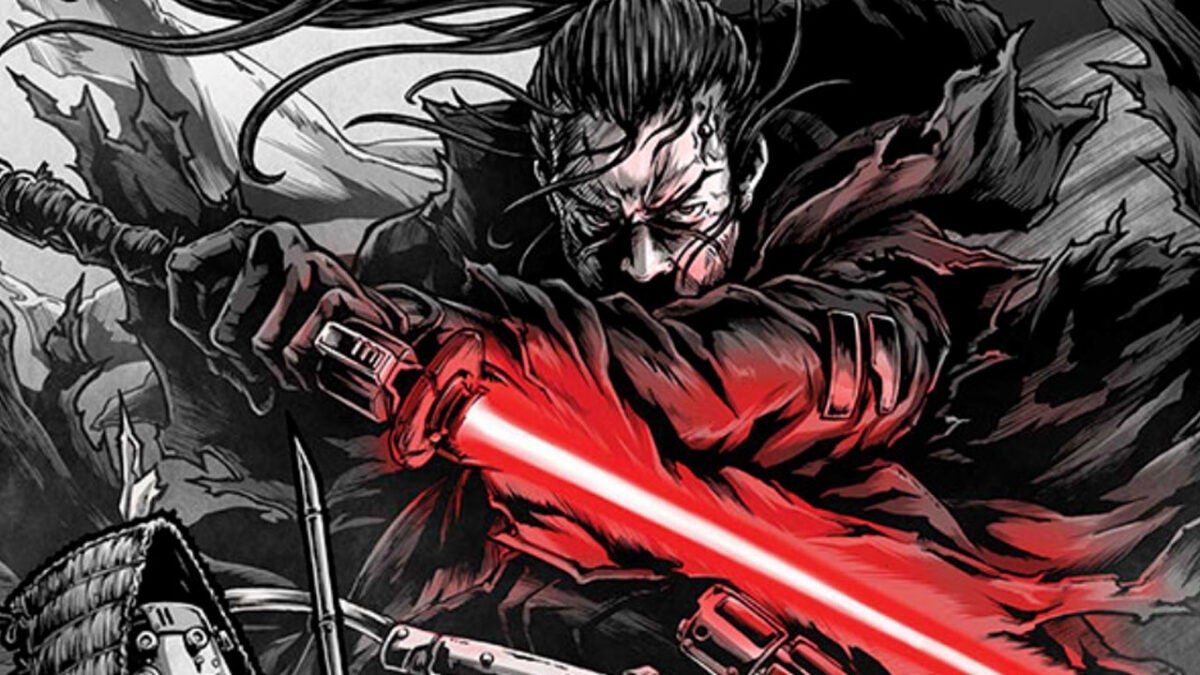
The third season of Star Wars: Visions, recently released, has been received as one of the best installments of the saga, but it has not been without controversy. In an unexpected turn, director and action specialist Lorenz Hideyoshi has accused the production of Visions of plagiarizing his 2019 fan film, Dark Jedi, particularly in the choreography of a lightsaber duel. Disney could be in trouble Hideyoshi, known for his work on major productions like Dune and John Wick 4, made his comparison public through his Instagram account, presenting a video that […]
The third season of Star Wars: Visions, recently released, has been received as one of the best installments of the saga, but it has not been without controversy. In an unexpected turn, director and action specialist Lorenz Hideyoshi has accused the production of Visions of plagiarizing his 2019 fan film, Dark Jedi, particularly in the choreography of a lightsaber duel.
Disney might be in trouble
Hideyoshi, known for his work in major productions like Dune and John Wick 4, made his comparison public through his Instagram account, presenting a video that puts his brief filming side by side with the episode titled The Bandits of Golak. In it, he pointed out that both the camera angles and the movements of the characters are remarkably similar, despite the fact that in Visions the protagonists use different weapons.
The stuntman has questioned the creative decisions made by the Visions team and suggested that greater originality in future projects would be beneficial. In his post, he highlighted the absurdity of the apparent lack of originality, suggesting the need for the entertainment industry to seek new ideas instead of resorting to existing approaches.
Additionally, Hideyoshi expressed his concern about the potential use of artificial intelligence in future productions, indicating that such practices could only lead to a decrease in creativity in the industry. “If not with practices like these, the effort will be attempted to be saved with AI in the not-so-distant future. Whoever wins, creativity loses,” he stated, emphasizing a fear that is quite present in the current landscape of cinema and television.
The controversy raises questions about the future of originality in entertainment, a topic that will surely continue to be debated among creators and fans alike.
Chainsaw Man is one of the trendiest animes. It makes perfect sense not only because it is excellent, but also because the manga is still ongoing and is causing a stir both in Japan and in the West. Its newly released movie is making waves at the box office and is on track to become the highest-grossing anime film in history, and even without the announcement of its second season, it seems that its future is bright. But what awaits the fans now that they have to wait again? Obviously, they can enjoy other works of […]
Chainsaw Man is one of the trendiest animes. It makes perfect sense not only because it is excellent, but also because the manga is still ongoing and is causing a stir both in Japan and in the West. Its newly released movie is making waves at the box office and is on track to become the highest-grossing anime film in history, and even without the announcement of its second season, it seems that its future is bright. But what awaits the fans now that they have to wait again?
Obviously, you can enjoy other works by the author, Tatsuki Fujimoto. But as a mangaka, it is true that those who only watch anime may feel disappointed for not having anything to sink their teeth into. And those who already read his mangas, if they are up to date with what he has written, may feel the same way. But Fujimoto has written numerous short stories that have now been adapted into anime and will be released in a series that promises us one thing: to tear our hearts out, shatter them, and let us marvel at how it does so in the process.
An anthology that promises to offer us the best of the author
Tatsuki Fujimoto 17-26 is the name of this anthology released on November 7 on Prime Video. This will be an adaptation of Tatsuki Fujimoto Before Chainsaw Man, which is divided into two parts, 17-21 and 22-26, which will be presented here under the same name.
The uniqueness of the series is that, in the style of Animatrix or Star Wars: Visions, each episode will be directed by a different studio and director. The aim is not to create a unified style, but precisely the opposite. It seeks to emphasize the different aspects of the author’s work, utilizing the strengths of each of those involved to give more weight to each of the chapters.
Composed of eight chapters, the studios involved are Zexcs, Lapin Track, Studio Graph, 100studio, Studio Kafka, and P.A. Works, working on episodes 1, 2 and 3, 4, 5 and 7, 6 and 8 respectively. Among these studios, Lapin Track stands out particularly, having produced the excellent and underrated Sarazanmai and Undead Girl Murder Farce, and P.A. Works, known more recently for the adaptation of Skip and Loafer.
In fact, the episodes with the most potential coincide with those from the most interesting studio. Lapin Track is not only responsible for two very particular chapters, Sasaki Stopped a Bullet and Love is Blind, but both are written by Teruko Utsumi, a capable screenwriter who has worked with the studio before, with the first directed by Nobukage Kimura, an rising star who previously directed I’ve Been Killing Slimes For 300 Years And Maxed Out My Level, and the second by Nobuyuki Takeuchi, a director with nearly 40 years of experience who has worked with legends like Kunihiko Ikuhara and Akiyuki Shinbo.
Even so, it is impossible to know which episode will steal the show. All the studios have good source material, and it is undeniable that they will want to give their all with an author who has proven that, when well adapted, succeeds with everything they release. Therefore, it is to be expected that the series will be among the most talked about of the year.
That’s why you shouldn’t miss Tatsuki Fujimoto 17-26 for anything in the world. Whether you’re a fan of Chainsaw Man or have never seen it, this is the anime series of the season that you must watch above all others. It’s not just that it has self-contained episodes, but it’s also a perfect gateway into the unique universe of one of today’s most celebrated and beloved authors. This makes it a series that, whether better or worse, is essential for any anime fan. And almost also for those who are not.
The third season of Star Wars: Visions has arrived on Disney+ with a mixed reception, polarizing fans of the iconic saga. This new volume, which features prominent anime studios like Production I.G, Wit Studio, and Studio Trigger, explores a wide range of styles and narratives, reigniting the debate about what truly constitutes the Star Wars universe. Disconnected from the classic? While the series has been praised for its innovation and experimentation, many episodes seem disconnected from the traditional essence of the franchise. For example, The Duel: Payback and Child of Hope have […]
The third season of Star Wars: Visions has arrived on Disney+ with a mixed reception, polarizing fans of the iconic saga. This new volume, which includes prominent anime studios such as Production I.G, Wit Studio, and Studio Trigger, explores a wide range of styles and narratives, reigniting the debate about what truly constitutes the Star Wars universe.
Disconnected from the classic?
Although the series has been praised for its innovation and experimentation, many episodes seem disconnected from the traditional essence of the franchise. For example, The Duel: Payback and Child of Hope have been highlighted as examples of how innovation can occur without betraying the central narrative of Star Wars. In contrast, episodes like The Song of Four Wings and Yuko’s Treasure have faced criticism for straying too far from the expected identity, generating frustration among the purists of the saga.
The most ardent followers feel that episodes like Yuko’s Treasure, which features a talking teddy bear, and The Song of Four Wings, with its questionable stylistic elements, could alienate the fan base by breaking the internal logic of the Star Wars universe. This type of visual element, while potentially appealing, raises an essential question: where should Lucasfilm set the creative boundaries?
The series aims to be a laboratory of creativity, but it is essential that creators maintain a minimal connection to the fundamentals of Star Wars. With the arrival of this season, a broad debate is anticipated about what fans expect and what Star Wars really is. At such a delicate moment for the franchise, Lucasfilm could benefit from establishing clearer guidelines on the identity of its iconic universe, thus ensuring that the series remains a space for experimentation while not forgetting its roots. Star Wars: Visions promises to continue generating passionate conversations while solidifying itself as a divisive phenomenon in the fan community.