How to: share and sync files in Dropbox

There are several ways to share information online: email, IM apps, FTP clients and online file storage services. The latter have recently become quite popular, which means you have a wide choice to select from, each one of them with different features, data plans and fees. But if there’s one online file sharing and syncing tool that stands out of the crowd, that’s Dropbox.

Dropbox is a bit different from the standard file sharing service. It has a desktop client (with versions for Windows, Mac, Linux and iPhone),  it’s seamlessly integrated with Windows Explorer and it’s meant not only to share files with family and friends, but also to sync data among different computers.

share and sync files in Dropbox

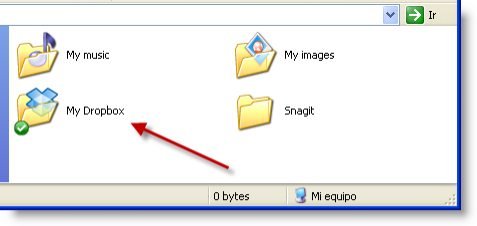
Using Dropbox is easy as pie. First of all, download the client and install it on your computer. The installation process will also enable you to create a Dropbox user account and select the data plan that best suits your needs – including a basic 2-GB option for free. Once the installation is finished, the computer will be linked to your online Dropbox account, and you’ll see a new folder on your system called “My Dropbox”.
share and sync files in Dropbox

Whatever you save, create, erase, copy or move into this folder will automatically be synced with Dropbox online, and also with any other computer that you’ve linked to your Dropbox account. This ensures you’ll be able to access the same synced contents from all your computers, and always have the latest versions of your documents at hand.

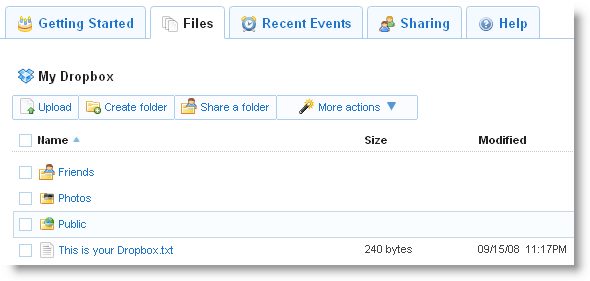
Now, what about sharing? Dead easy as well. Go to your online Dropbox account, create a new shared folder and send an invitation by email to anyone you want to share the contents of this folder with. The downside is that they’ll need to register as Dropbox users as well, but being such a handy service, they won’t regret it. From that moment on, you’ll be able to share files with those people without any hassle: simply drag and drop any file to your local folder, let Dropbox sync contents in the background and your friends will be able to access them online almost instantly.
share and sync files in Dropbox

Manage your passwords safely in SplashID

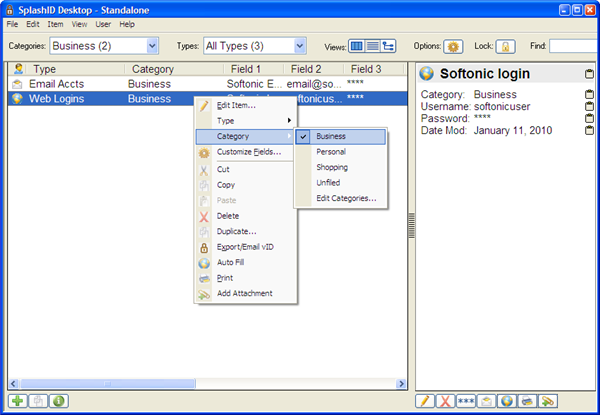
After having it on my New Year resolutions list for several years in a row, I’ve finally made up my mind and started using a password manager. It’s the kind of decision you’re constantly postponing for several reasons: they take a long time to configure, they’re uncomfortable to use, they’re not safe enough… But I’ve definitely overcome all those excuses and started off this year with a new program on my computer: SplashID.

Manage your passwords safely in SplashID

SplashID is the best password manager out there. It’s not free, but it’s worth every cent. It’s got two great characteristics that make it unique: total customization and support for multiple platforms. Regarding customization, SplashID lets you create as many categories as you need to organize your passwords, as well as edit each entry with the appropriate fields. As for cross-platform support, SplashID has clients for Windows and Mac, and aslo a plethora of mobile devices including iPhone/iPod Touch, Android, Windows smartphone, Blackberry and Palm. The best thing about this multi-platform technology is that you can sync data wirelessly between different clients, so if you’re using the SplashID desktop client on your Windows laptop and you have it on the iPhone as well, you can have a synced copy of all your passwords both on the computer and on the phone, available anytime, anywhere. Continue reading “Manage your passwords safely in SplashID”

Backing up Windows – what’s your plan?

thumb.pngIt’s January and the web is alive with New Year’s resolutions. If you’re stuck for ideas, let me make a suggestion: backing up your computer is essential and a great starting point. I’m going to run through your options, so if you’re new to the game, you’ll know where to start.
There are two places to back-up your data, online or offline. Each has pros and cons –  online means less effort, but you’ll probably have to pay (this being a notable exception). You can probably wrangle a free solution for offline back-ups, but you’ll have to do more work, backing up and saving away from your computer.

CrashPlan is a Softonic favorite that allows you to carry our online or offline backups. You’ll have to register, but the process is easy and – for a back-up tool – quick. It also offers you plenty of options in the one program, so you can check them out and see if online or offline is the one for you.

Cobian Backup is another star player. This free app has a major attraction – it performs automatic back-ups, which you’ll have to store offline. It also allows you to pick exactly what you want to back-up; not everybody needs to back-up their whole system every day.

GFI Backup – bet you thought free, automatic and encrypted was asking for too much, right? Well you’d be wrong, because GFI Backup will give you all three, and more. Looks a lot like a wonder-app to me!

Carbonite‘s the tool for you if all that seems like too much hard work. This program stores your data online and, once it’s configured, you can pretty much forget all about it. This makes it perfect for people who want minimal involvement with their back-ups. Obviously there’s a fee for this, but for lots of people, a few dollars a month is a small price to pay. Continue reading “Backing up Windows – what’s your plan?”

Create calendars for 2010 the easy way

A few weeks ago I wrote a tutorial about how to use EZ Photo Creations to create a fully customizable calendar with your photos, notes, personal important events and other elements. But for those of you who don’t care that much about design and just need a functional calendar that’s easy to create, here’s Calme 2010.

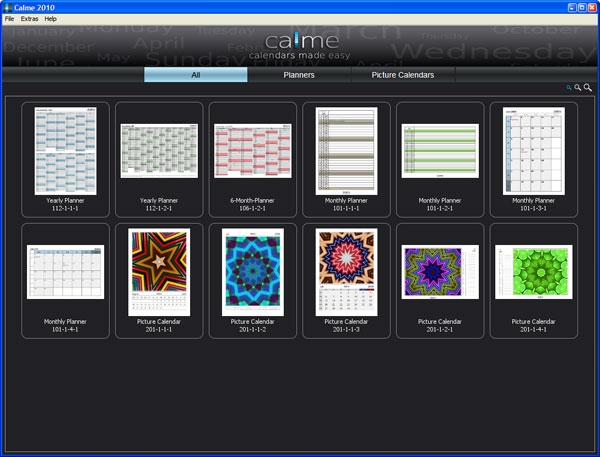
This simple, intuitive application has been especially developed to create calendars for 2010. It includes a bunch of ready-made templates that you can personalize with your own images, text format and color schemes. The templates include in Calme 2010 are divided into Picture calendars – perfect to show off your best shots – and Planners, which are more oriented to work-related tasks and projects. In both cases, calendars create with Calme 2010 are designed to be printed, as you can’t add personal notes to them within the program.

Create calendars easily with Calme 2010

Calme 2010 however does include a bunch of customization options. You’ll be able to insert your own photo in Picture calendars, select the text font and color scheme, set up the calendar’s format and margins, add a border and more. There’s also a special tool to add official holidays, though the list of supported countries is not very populated yet (Austria, Switzerland, Germany, Turkey and the United States). All actions can be conveniently previewed on the program’s interface, so that you can make sure the calendar looks exactly the way you want before printing it. Continue reading “Create calendars for 2010 the easy way”

Preview iTunes songs in your browser

itunes-logo.pngOne thing that’s always annoyed some people about the iTunes Store is that simply to preview a track, you have to download or open iTunes first to do so. However, Apple have finally seen sense on this issue and decided to allow users to preview tracks in their browsers whether or not they have iTunes installed or open.

You can try for yourself by going to the iTunes top 100 albums charts, selecting the album you’d like to preview and then pressing the play button.

The play button doesn’t appear until you hover your mouse cursor next to the track and you still get an annoying prompt to open it in iTunes first but at least you can dismiss it. If you decide that you want to buy a track or album, just click on the “View in iTunes” link on the right.

iTunes Preview

Previews are performed using QuickTime in 44.1 AAC 300+ kbits/second quality and limited to 30 seconds per track.

Could this be a sign that Apple are willing to move towards a more universally accessible and convenient web-based iTunes rather than a standalone application? It would certainly make sense to do so with all the different mobile devices now on the market which can all browse the net and are thus able to use a browser based iTunes service without having the actual application installed. Apple definitely have to be a little bit more innovative about how they take iTunes forward in the new decade especially in light of the success of other music apps such as Spotify.

Easier access to your Gmail contacts with Mailbrowser

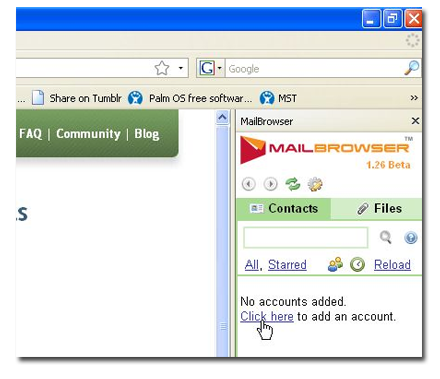
A few months ago I installed Xobni and since then my experience of Outlook has improved tenfold. I was looking for something similar for Gmail in order to better navigate my bulging inbox, and I came across MailBrowser. This free little extension for Firefox and Internet Explorer adds an Xobni-style sidebar to Gmail, giving you a much clearer view of your contacts and allowing you to sift through attachments much more easily.

After installing MailBrowser, open up Firefox (or IE) and you’ll see the MailBrowser sidebar displayed on the right of the browser. You can toggle this sidebar on and off using the MailBrowser icon that appears underneath it. Click ‘Add an account’ and enter your Gmail credentials. The app will then begin indexing your contacts and files, which can take a while if you have a big inbox. Make sure you have plenty of memory, because all this data is downloaded to your hard drive.

mailbrowser1

Your contacts are displayed in the sidebar à la Xobni, and you can ‘star’ any that you wish to mark out. Now, if you want to manage your Google contacts or schedule Google Calendar events with any of your contacts you can do so simply with the click of an icon. Continue reading “Easier access to your Gmail contacts with Mailbrowser”

Ask OnSoftware: The best free DVD authoring tools

This Ask OnSoftware topic is a hardy perennial which we’ve received lots of emails about. Most recently, reader Alvas wrote to ask:

I just can’t settle down with Nero. Its bloat just disturbs me. Now I am settled with Burnaware Free. Can you guys please recommend some good VCD/DVD authoring tools?

Of course we can!

Alvas is completely right about Nero. While it’s very easy to use for relative newcomers,  it’s so overloaded with features that it can feel totally overwhelming. After all, what do most of us want Nero to do? Burn DVDs, surely? So if you’re sick of Nero too, here are some suggestions for quality, free DVD authoring tools.

DVD Flick

dvd_flick_thumb.gif

For fairly experienced Windows users, DVD Flick could be the best solution. It allows you to compile your own DVDs, stitching videos together and adding menus. It may not be the prettiest program out there, and your menus may not look quite as good as the ridiculous ones I saw on the Blu-ray for Terminator 2 last night… but DVD Flick is a sturdy and reliable little app.

Sothink DVD Movie Maker

sothinkdvd-th.gif

Boasting a sexier user interface than DVD Flick, DVD Movie Maker is one of several great apps from Sothink. It performs mostly the same functions, but includes more templates for creating DVD menus. Our editor Nick liked its features for including subtitles on your DVD as well as its good support for multiple formats.

InfraRecorder

infrarec-th.gif

This is my recommendation, mainly because I used it quite a lot over Christmas. InfraRecorder is  a quick and simple DVD writing tool that does away with such graceful touches as menu creation templates. What it does, though, is handle burning DVD images and video files: and it performs these tasks with the minimum of fuss. If you’re looking for a basic, high-speed DVD writing app for your Windows machine, go for InfraRecorder.

Don’t forget that if you have any software related questions, just email us at:

ask@onsoftware.com

…and if we like your question, we’ll answer it here on the blog.

Friday Timewaster: Little Rocket

Little Rocket is an absolutely charming little exploration game you can play in your browser. Fly the little rocket around, using the mouse to direct it, and left click to activate thrust (it works like Asteroids). Your task is to collect 16 pink stars – and there are a variety of ways to get them. There are little puzzles and tasks to complete around this little universe, and you’ll need to stop off at planets to refuel along the way.

I really like the lightweight physics of Little Rocket – the planets all have gravity, and there’s something really pleasing about using it to circle in and land. The chilled guitar soundtrack perfectly accompanies the relaxed, unhurried experience. If you found the holidays stressful and need to relax; forget yoga, play this instead!

Sunday is VVVVVV day!

v.pngDistractionware, AKA Terry Cavanagh is releasing his now highly anticipated platformer VVVVVV on January 10th. There should be a demo, which will be reviewed here as soon as possible.

Why should you be excited? Cavanagh is already the author of several distinctive, highly playable yet thought provoking titles, and VVVVVV looks like being the best of the lot.

To help you get in the mood, why not check out these free titles from last year? There’s the contemplative Pathways, intense Bullet Time, eerie Judith and the excellently atmospheric platformer Don’t Look Back.

The games are quirky, but always well designed. Expect some difficulty, too, although I’d say Cavanagh’s games are only difficult in comparison to many of today’s too easy console games. Make sure to visit thelettervsixtim.es, and play the game when it comes out – it should be an excellent start to what I hope will be a vintage year for indie games.

iPhone essentials: for the traveller

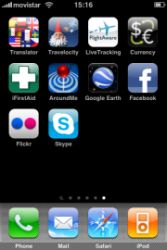
Travel main imageIf you were lucky enough to get an iPhone or iPod Touch for Christmas then you might be wondering which apps you should be throwing onto it. Well, here’s the first in a series of posts that will show you how to use your device to improve your everyday life. Each of these ‘iPhone essentials’ articles will focus on a specific need and highlight the best apps to help you in that particular field. We kick off with a guide to the best stuff to install if you’re traveling. Whether you’re heading off on a round-the-World trip or simply a short city break, these free iPhone apps will help your travels go as smoothly as possible and ensure that you have a great time wherever go.



[Note: you’ll need iTunes installed to open the links in this post]

Find your way around with Google Earth

Google EarthGoogle Earth is by far the most popular travel tool on the App Store – and deservedly so. It allows you to navigate the whole World, swishing across continents with a swipe of your finger before zooming into street level with a reverse pinch. As with the desktop version, Google Earth permits effortless switching between satellite and street maps, as well as offering tons of suggestions of places to visit and where to eat and drink.

Discover places to go with AroundMe

AroundMePresenting Google Maps’ mammoth database of businesses in a more accessible way, AroundMe helps you discover what’s around you based on your current location. It provides one-click access to lists of the nearest: banks, bars, cafes, gas stations, hospitals, hotels, movie theaters, parking, pharmacies, pubs, restaurants, supermarkets, taxis and theaters. It’s very quick and easy to use, and is well stocked with information, even in areas that are further off the beaten track.

Manage your itinerary with Travelocity

TravelocityTravelocity makes for a good personal assistant to have to hand throughout your whole trip. Not only does it help you track flights and book hotels, but it includes a wealth of destination guides and links to local events. It also offers shortcuts to car rentals and train tickets, flights, hotels and last minutes deals. I’d recommend this one for anyone who likes to act on the spur of the moment and plan their trips on the fly.

Continue reading “iPhone essentials: for the traveller”