Exploring The Legacy: A Detailed Examination of The Lara Croft Collection

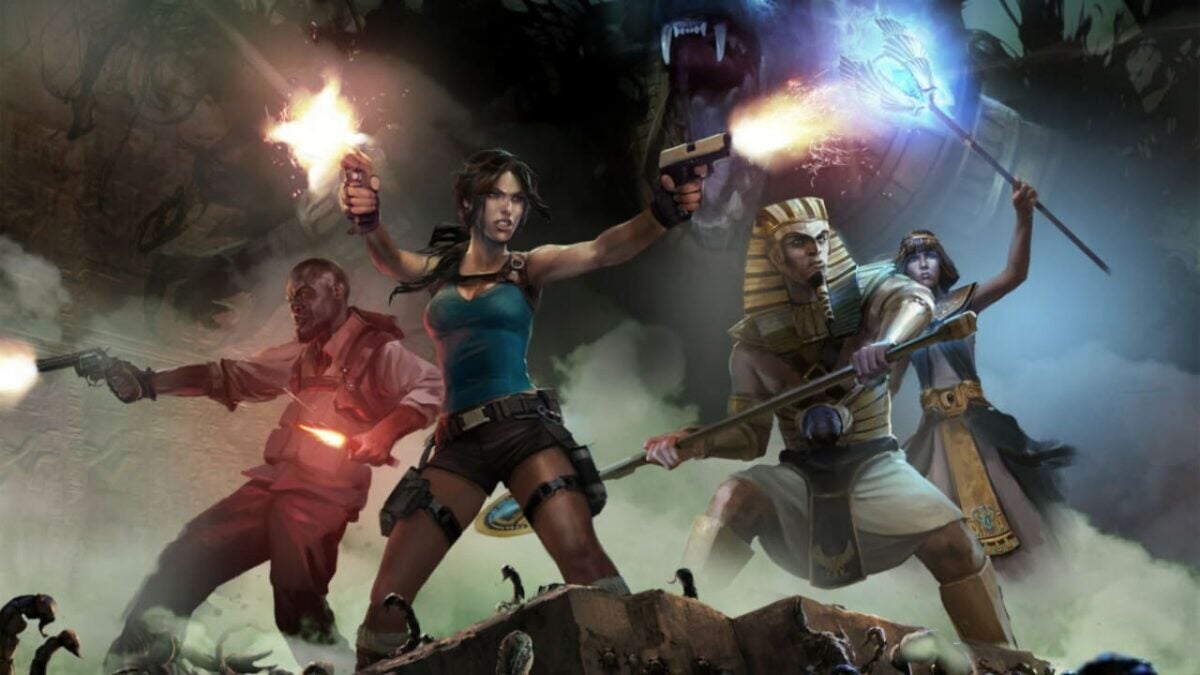
The Lara Croft Collection is an outstanding twin stick shooter that manages to combine being a Tomb Raider with being a remarkable arcade game.

Historically, Tomb Raider has been a platform game. Or at least, it used to be. It always had its share of action, but its shift towards being a full-fledged adventure game, sometimes focusing more on platforming and puzzles, other times more on action, and more recently, leaning towards cinematic adventure, has been noticeable. These changes have aimed to adapt the franchise to the sensibilities of each era, striving to keep it relevant, with varying degrees of success. But despite the changes, it has always felt like the same game. Like Tomb Raider.

The Lara Croft Collection takes an even more abrupt turn than any of the previous games in the franchise. With a top-down view, we control Lara, but the game is a twin-stick shooter. We move Lara with the left stick, aim with the right stick, and use the buttons for various actions, particularly shooting. This gives it a much more direct, arcade, old-school style that is very different from anything we’ve seen from Tomb Raider so far. Even older than the franchise itself.

But that’s the key. It’s true that the game is a twin-stick shooter. What’s undeniable is that it also remains a pure Tomb Raider-style adventure game. With all that entails.

In the game, there are traps to avoid, enemies to kill, vast chasms to navigate, and puzzles to solve. All the franchise’s elements are here, but with a different and more old-school control scheme than what is customary in the franchise. This, in turn, gives it a much more frenetic pace, making it feel very distinct compared to other games in the franchise. Especially in combat, where everything feels more intense and violent than is typical in Lara’s case.

But at the end of the day, it’s still a Tomb Raider. Jumps require calculation and contemplation. Puzzles require a bit of thought. Traps require careful navigation. And while none of it is overly complex, as the core gameplay revolves around shooting, it brings the experience closer to what defines a game in the franchise.

Steam DOWNLOAD

What aids in this is that the story is exactly what we would expect from a Tomb Raider game. Something straightforward, a bit silly, and direct. We jump right into the action, with Lara needing to stop some villains from triggering an apocalyptic event after they steal the treasure she was planning to appropriate. The story isn’t very deep or overly significant, but it provides exactly what we need: an exotic setting and a good excuse.

Of course, all of this would be for naught if the port wasn’t good. But in fact, it is. The Lara Croft Collection includes Lara Croft and the Guardian of Light and Lara Croft and the Temple of Osiris, and there’s likely no better way to play them nowadays than on the Nintendo Switch. Perfectly smooth, without any noticeable glitches of any kind, the game is a joy to play, whether connected to the TV or in handheld mode. This makes it a perfect solution for a game with a strong old-school, arcade-style focus, where comfort and enjoyment add an extra layer of fun.

However, we must acknowledge that beyond being a Tomb Raider, it is, first and foremost, a twin-stick shooter. An arcade game. A title that shines brightest when played with friends in doubles (or triples, or even quadruples!), where its real essence lies in replaying levels and attempting to conquer challenges. This is where its difficulty and true allure lie. It’s not just appealing, it’s genuinely enjoyable. A small gem that may not grab attention as much as the franchise reboot that Crystal Dynamics would deliver a few years later, but undoubtedly, it’s an excellent addition to your library if you’re a Tomb Raider fan. Most importantly, if you appreciate the concept of a modern game with an unmistakable classic flavor.

Some of the links added in the article are part of affiliate campaigns and may represent benefits for Softonic.

See E3 2019’s National Videogame Museum Showcase

Step back in time with this cool display of video game history from E3.

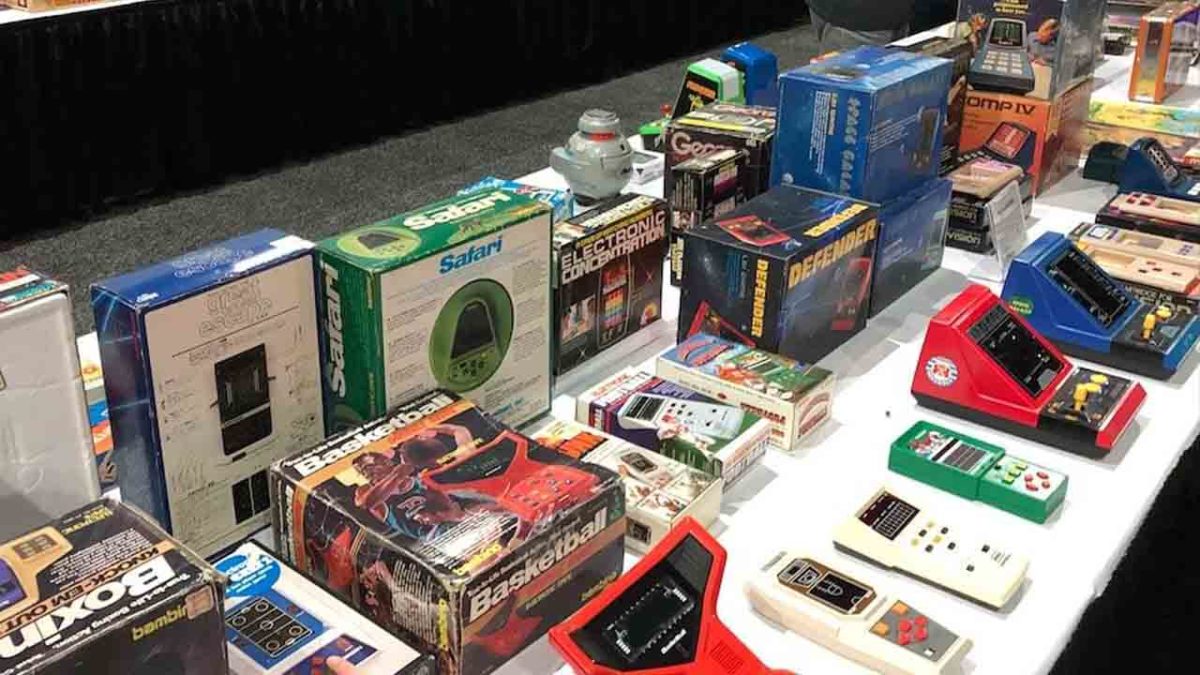
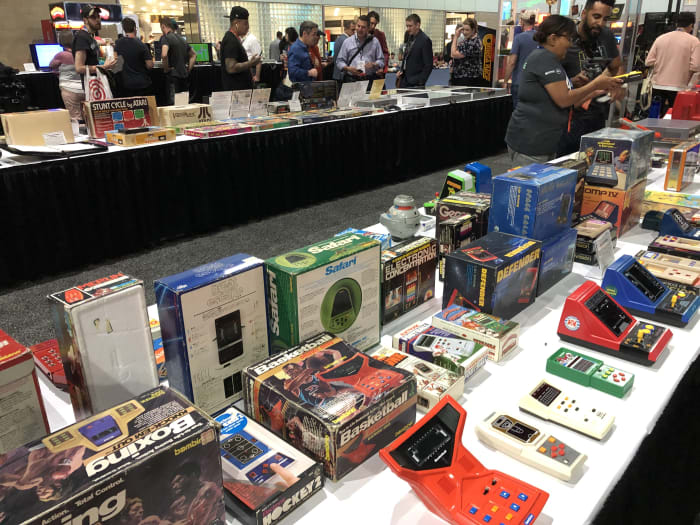
NVMThe National Video Game Museum (NVM) shows up each year at E3 and delivers a huge showcase of games, consoles, and memorabilia from multiple generations of gaming history. Some of these can be seen behind protective glass. Others can be picked up and examined. Many of them are hooked up to power and fully playable! What’s more…

There are often no lines!

With so many people wandering around the convention floor on the hunt for big titles – the next release from Microsoft, Nintendo, Bethesda and more – these consoles are usually available to players at any time. Anyone who appreciates historical video games can walk in, pick up a controller, and hop straight into nostalgia city with little wait!

Except for Ms. Pac Man…everyone wants to play Ms. Pac Man.

That said, let’s talk about the NVM! We have a few pics of the most fascinating games of all time! Please enjoy…

E3 2019’s National Videogame Museum Showcase

DOOOOOOOOOM!
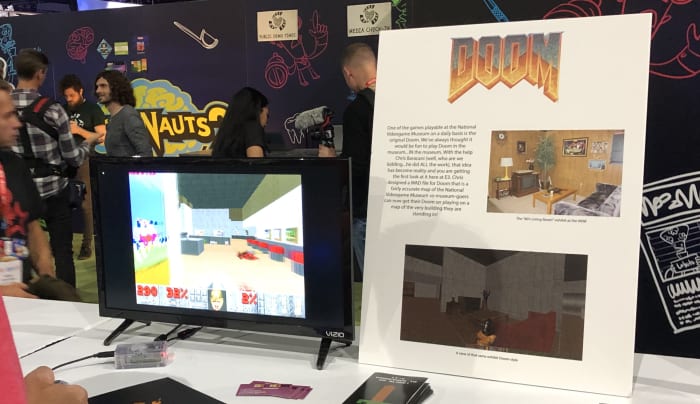
DoomStarting off right, here’s the original Doom!

With Doom: Eternal coming down the line from Bethesda, we wanted to throw a shoutout to the original first-person shooter experience. To this day, it’s still fascinating to watch people run around the cubic world, blasting away the two-dimensional demons of hell.

We’ve come a long way!

I can’t believe how far we’ve come in my lifetime. 1994-2019 from gaming

Mario Kart
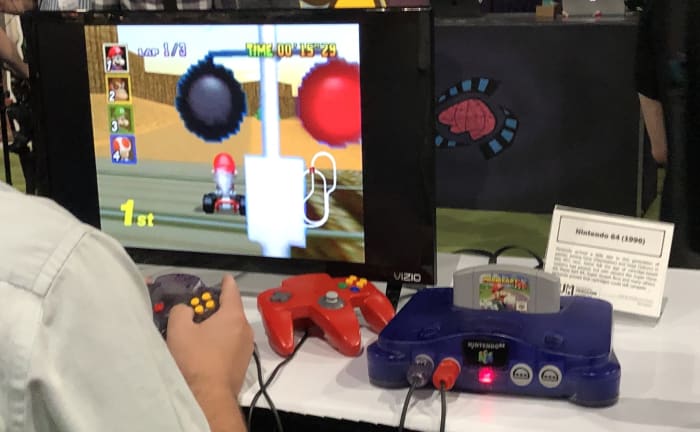
Mario KartNot gonna lie: you get a little star-struck in the face of greatness such as this. We personally love Mario Kart, but began playing in the Gamecube era with Double Dash (which will always be our favorite, let the record state). However, we never expected to be in the presence of the original!

It holds up well. It holds up SO WELL. A game that old shouldn’t be allowed to play that smoothly, or be that fun. It’s humbling, really.

Sonic the Hedgehog: Supersonic Pinball
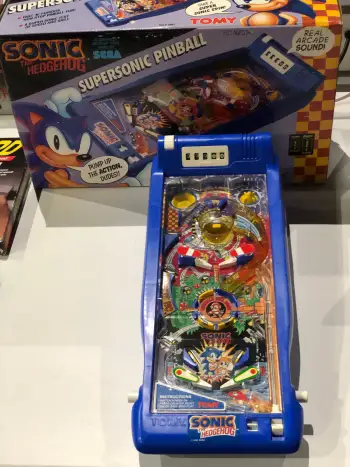
SanicLook at how cute this thing is! Sorry, we forgot a banana for scale, just trust us: it’s adorably small.

It serves as a good reminder: video games weren’t always released as just the video game alone. Back in the day, a huge variety of toys and other merchandise launched around popular titles like this.

Hopefully, with such a lovable legacy, the upcoming movie will do well after the Sonic re-design…

Pong IV: The Console
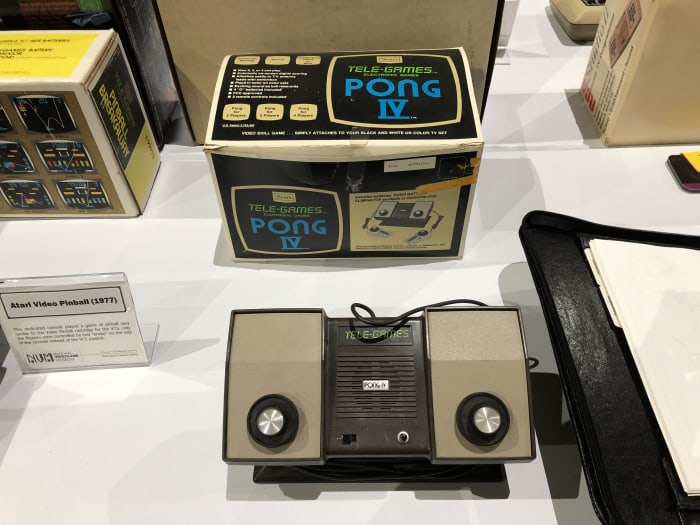
PongAh, “tele-gaming”. Remember that? Because we sure don’t!

If you’re wondering, this console was meant to plug into your black and white, or color television. Oh yeah. It’s so old the box says black and white… OR color television. That’s somehow wonderful, don’t you think?

The Board Games
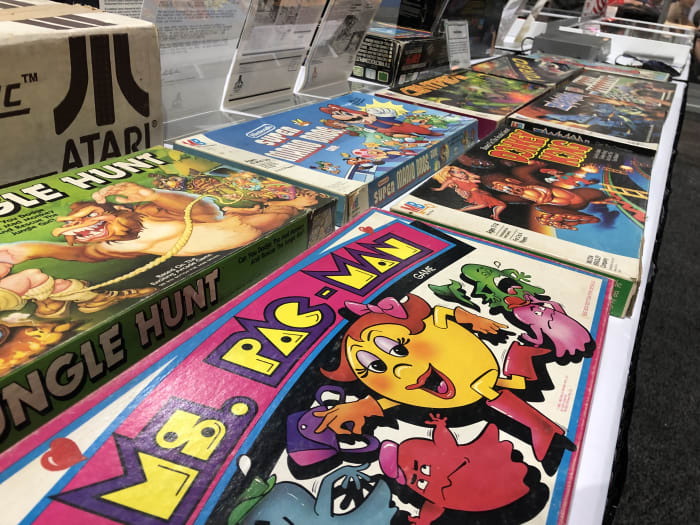
Board GamesIf you think board games = bored games, you’re missing out!

Right near the Sonic pinball game, we found this huge selection of board game adaptions, so many they wouldn’t fit in one photo! Sadly, these are not meant to be played anymore. We can only imagine what kinds of pieces, boards, and rules were to be found inside.

Choose-Your-Own-Adventure Books
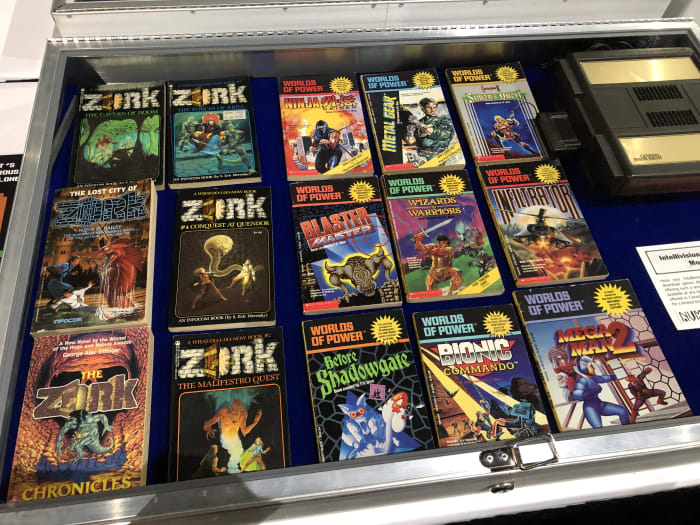
CYOAWhen dinosaurs roamed the earth, sometimes you had to play video games in your head. From Blaster Master to Mega Man 2, there were novels that allowed you play games without a console, using imagination!

The NES and a RED NINTENDO TV
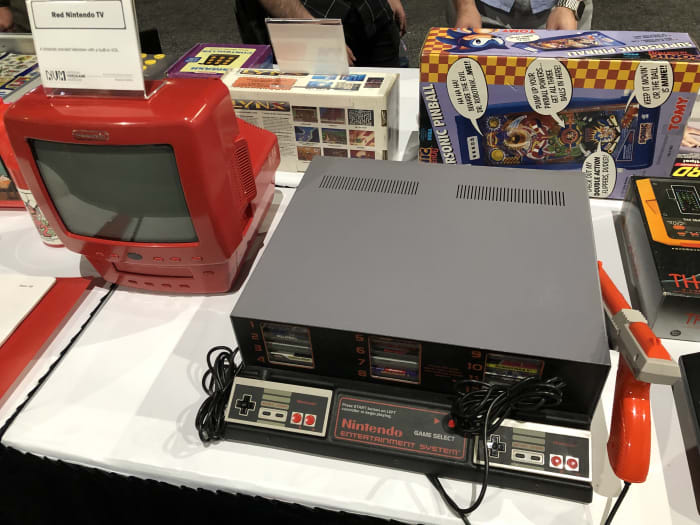
SO COOOOLPerfection.

Taking a step back from the N64 and Mario Kart, we had the original Nintendo Entertainment System (NES). Unfortunately, this one wasn’t turned on at the time, which is a crying shame; considering they had the Zapper light gun, it might have been loaded with Duck Hunt inside!

Duck hunt VR just got real from gaming

Oh, but we aren’t done yet!

On another table, there was actually a playable NES. At the time, we found it open to the next player with Super Mario World loaded up and a number of games sitting nearby. Take your pick, and try not to get too excited!

(Your eyes aren’t deceiving you, that’s Battle Toads)
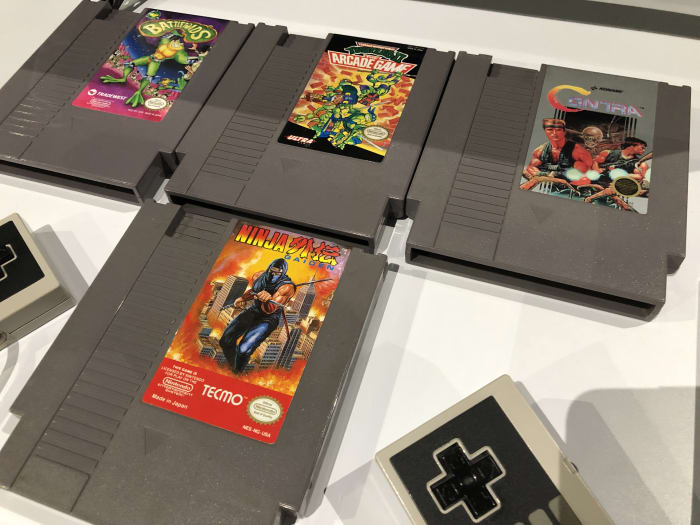
GAMES

Atari Galore

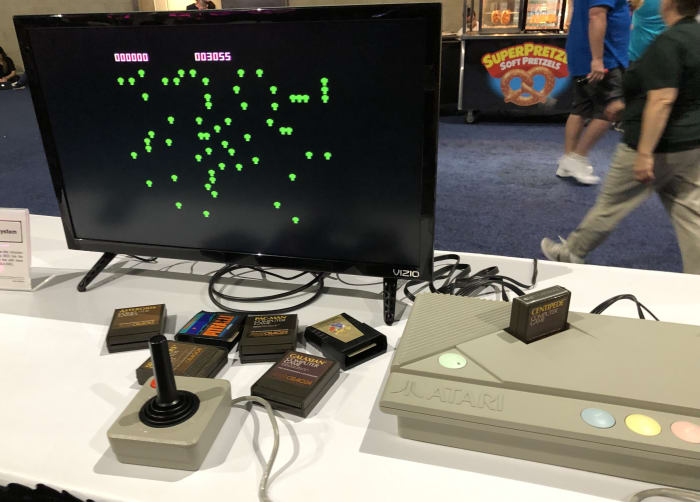
AtariAtari is one of those systems that even modern kids should be able to understand. Even if they didn’t play on the console seen above, they’ve likely enjoyed titles like Centipede, Pac Man, or Asteroids in updated versions. They’re the games that keep on giving! Or, at least, the ones that keep being ported to new devices with fresh graphics.

Still, the National Videogame Museum kindly gave visitors a chance to try them out for real, in their First Form. Aside from Centipede, there were a few others on the table…
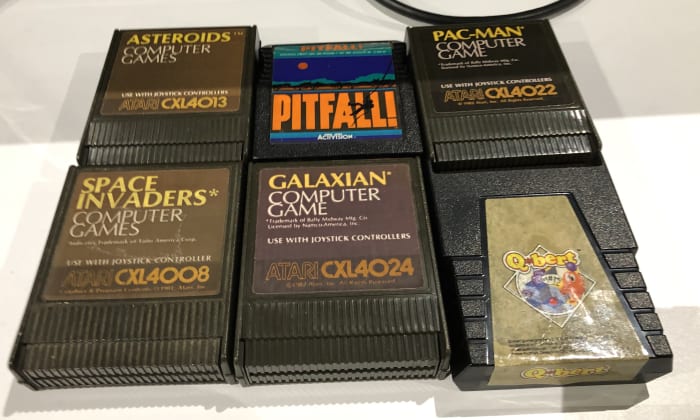
More!Miscellaneous Merch

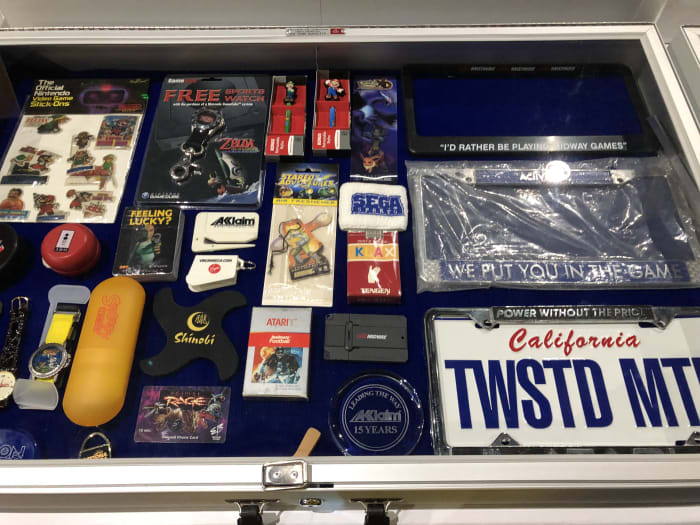
Whoa, Merch!Ready for a little game of “I-Spy”? Good, because here we go:

Even though modern video games release collectibles – the Nintendo Amiibos, for example – they will never be as old and cool and fabulous as these ancient relics. Can you find… the Zelda Watch, free with the purchase of a Gamecube? The “Feeling Lucky?” playing cards themed around Tomb Raider? Maybe the gigantic license plate for Twisted Metal?

Along with those, we were surprised to find an entire case with pins for olden video games. We never really thought of pins as that big a deal until we saw the impressive collection of promotional buttons! Can you find… the “Play Me” Atari pin? The Yoshi’s Island for DS badge? How about the Warner Brother’s Games pin? The “IMB Means Exceptional Service” badge?
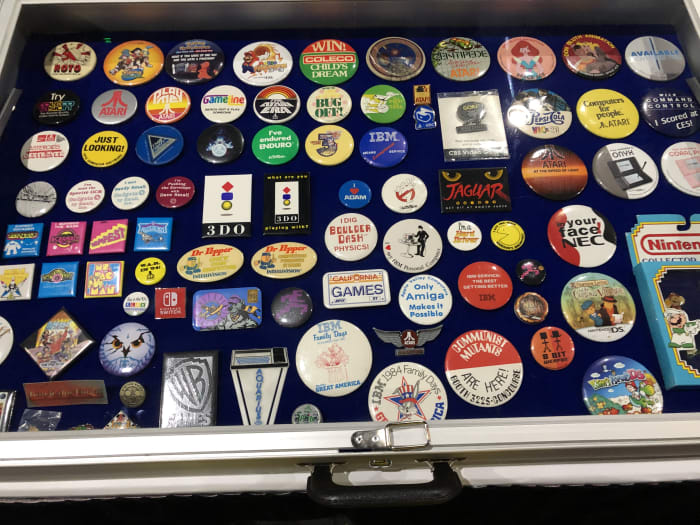
PinsAll the Old Arcade Consoles

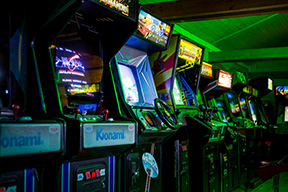
From classics to niche titles, the arcade showing was strong:
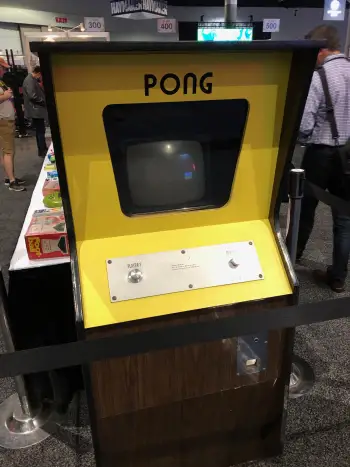
Pong! Again!Yeah, they had the full Pong console as well! Please note, for hilarity’s sake, that each player of this iconic game must use a single knob to move their “paddle” up and down to block the ball. Those were simpler times!
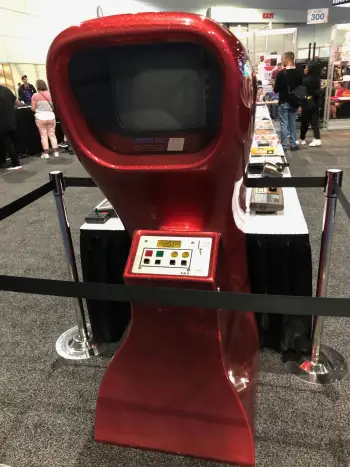
Computer SpaceThis console plays Computer Space (1971), a game that feels like the lovechild of Pong and Asteroids. Unfortunately, it was roped off during E3 and we did not get to play.
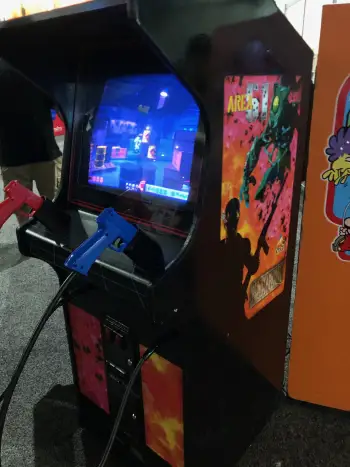
Area 51There we go: a millennial title!

Released in 2005, Area 51 could be found in all the arcades! We have fond memories of walking past these stations as two players would co-op shooting aliens with the attached guns!

And why did we walk past? Probably to play the even better co-op arcade shooter, Time Crisis… That game swallowed many of our quarters.
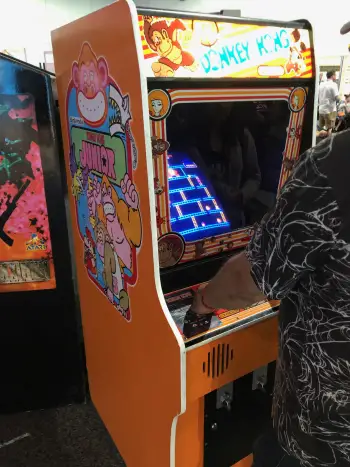
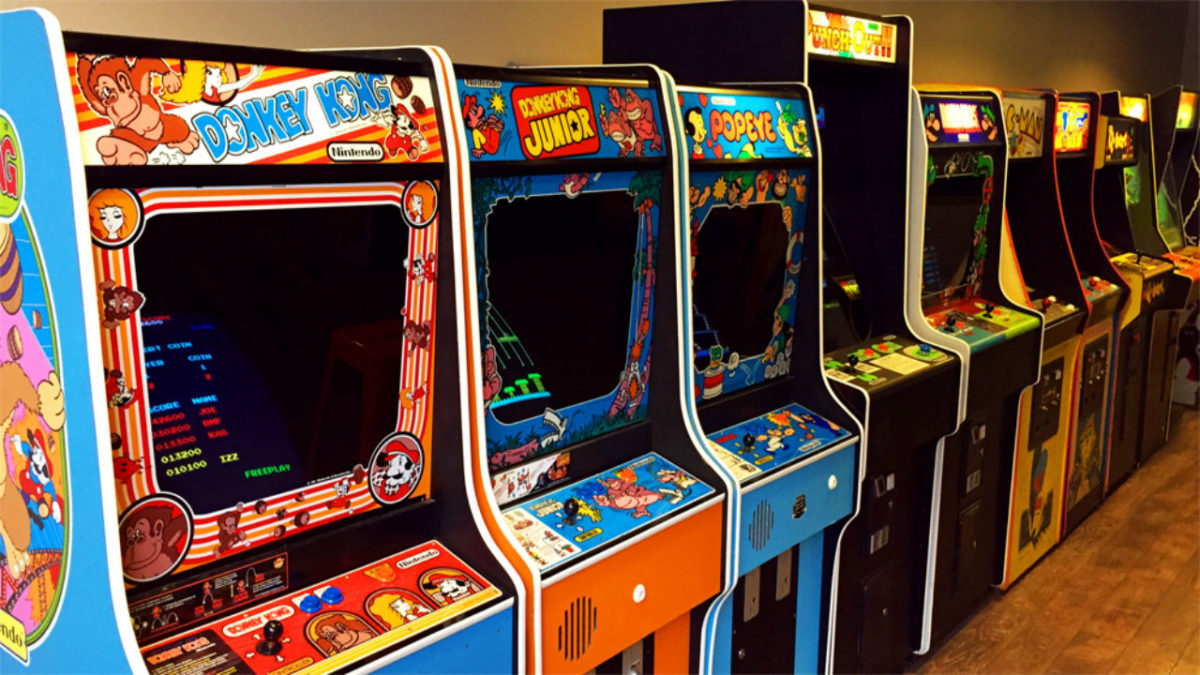
Jump Man?Remember how some games give off the star-struck feeling? Well, here’s one: Donkey Kong!

Now, reportedly, the protagonist character is actually called “Jump Man,” and isn’t actually Mario. We’re not sure what to think about this ourselves, so take that information as you will.
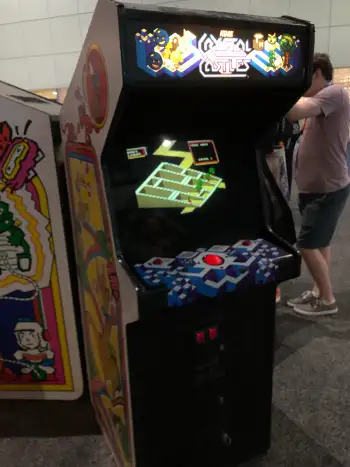
Crystal CastleCrystal Castle asks an important question: what would it be like to play a bear searching for gems, being hunted by monsters, on an eclectic grid system where movement is controlled by the player rolling a ball?

The answer was this wonderful game, which still both intrigues and confuses us (in the best ways) since we tried it as kids!
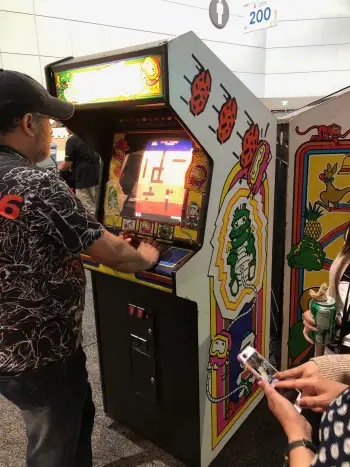
Dig Dug Again!Second to last, we have a classic. It may not have extensive remakes, but Dig Dug still holds a special place in our heart as the arcade game that our parents would always gladly talk about when the subject of video games came up. Family times!

And what better game to finish with than…
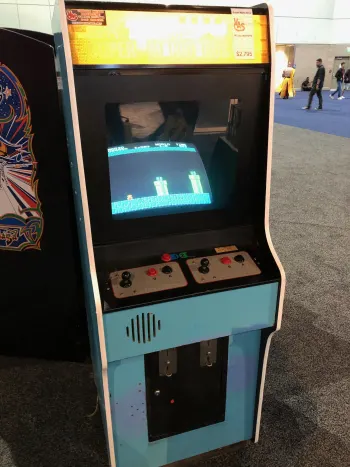
SMB!SUPER MARIO BROS! 

Growing up, we played Super Mario Bros Deluxe on the Gameboy Color. It’s hard to describe the excitement of playing on a full console, remembering all the secret transport pipes, the mushroom blocks, and the hidden vines to heaven. This game truly deserves all the love it’s received through the many, many years.

Game Over

We enjoyed our time walking through the annals of video game history and taking in the sights. If you missed E3, but still want to see more, visit the National Videogame Museum! Nothing deepens appreciation for modern games like a short (or very, very long) walk through the years of gaming that started before Pong and led up to the newest reveals of E3 2019.
The Rise and Fall of Arcades

arcades

It’s probably difficult these days to explain what an arcade is to a young kid. “Why would anyone leave their home to play video games?” they might ask, or, “What’s up with these graphics?”

It’s no surprise that there are far fewer arcades now than there were in the ’70s and ’80s. How did such a prolific multi-million dollar industry turn into a niche hobby? To look at how this happened, we’re going to look at a few distinct eras of arcades, and how they changed drastically throughout the decades.

The rise and fall of arcades

Aliens and Table Tennis

It’s crazy to think that two lines and a dot kickstarted the multi-billion dollar video game industry.

pong

Developed by Atari, Pong was the first commercially successful video game. Its simple, approachable gameplay and competitive social design made the game a popular staple at bars across the country. The game was much more intuitive than previous arcade games like Computer Space.

Beyond its gameplay, Pong showcased the potential of arcade games as a social, public activity. The game was multiplayer only and could be played easily with only one hand, and it was common for people to ask strangers to play Pong with them after buying them a drink. Atari co-founder Nolan Bushnell recalled that many people told him that they met their spouse in a bar playing Pong.

After Pong showed the world that arcade games were a profitable business model, many companies went right to work creating their own games. The most popular game to succeed Pong was Taito’s Space Invaders. Designed as a successor to Atari’s Breakout, Space Invaders had the player controlling a laser cannon against an alien invasion.

It may seem obvious now, but a game with targets that not only moved but shot back was incredibly innovative at the time. The game was one of the first to feature background music, which would dynamically speed up as the aliens moved faster at the end of a stage. Most importantly, the game popularized the concept of a high score, as the game allowed players to save high scores to the machine for others to beat. The game combined multiple groundbreaking gameplay innovations with a sci-fi theme, which was highly popular at the time. Space Invaders was an instant hit and its release was seen by many as the beginning of the Golden Age of Arcades. By 1982, the game grossed over $2.2 billion dollars in quarters, with the only comparably profitable entertainment product being the theatrical run of “Star Wars.”

A Yellow Puck and the Golden Age of Arcades

I’m going to show you a picture. Tell me, who is this character?

pac-man

Show this picture to anyone and they’d be able to tell you that it’s Pac-Man. According to the Davie-Brown Index, Pac-Man is the most famous video game character of all time (yes, even more than Mario), as he is identifiable by 94% of American consumers. Created by Namco designer Toru Iwatani, Pac-Man was made in response to the huge number of space shooters and other male-centric games on the market. Iwatani wanted to create a game that would appeal to everyone, especially women, and decided on eating as a theme. The unique maze-chasing gameplay and broad appeal quickly made Pac-Man a worldwide phenomenon.

Pac-Man himself became gaming’s first-ever mascot, having a personality that was lacking in other games that starred spaceships or soldiers. Even all of the ghosts had names and personalities, each employing different chasing tactics to take down Pac-Man. Intermissions played between levels showing Pac-Man chasing the red ghost Blinky, the first ever instance of cutscenes in a video game. Pac-Man had more personality and universal appeal than any other arcade game at the time. Pac-Mania quickly gripped the ’80s, as the yellow dot muncher appeared on everything from cereals, to Saturday morning cartoons, to even hit records. The game showed the arcade industry that designing games with memorable characters and casual appeal were the way to go.

Other games starring quirky characters and innovative gameplay soon followed, including Donkey Kong, Q*bert, and Frogger. The arcade demographic was widened significantly by these games, as the player base was now much more evenly spread across gender and age groups. The popularity of these simple to learn but hard to master games was universal and leads to many of these games still being fun to play today.

However, the simple design of these games led to tons of imitators flooding arcade markets. Donkey Kong had Crazy Kong, Pac-Man had K.C. Munchkin, and basically every other popular arcade game had scores of imitators. The Golden Age of Arcades ended when these clones saturated arcades, tiring consumers.

Meanwhile, home video game consoles like the Nintendo Entertainment System started to catch up with arcade games in terms of technical prowess, which would become a growing problem for the arcade industry. Arcade attendance took a major hit as home consoles provided unique and complex games that you could play in the comfort of your home, like The Legend of Zelda. The simplistic gameplay loops of arcade games were failing to draw customers, and the advanced graphics of arcade games no longer wowed gamers.

Choose Your Fighter!

street fighter II

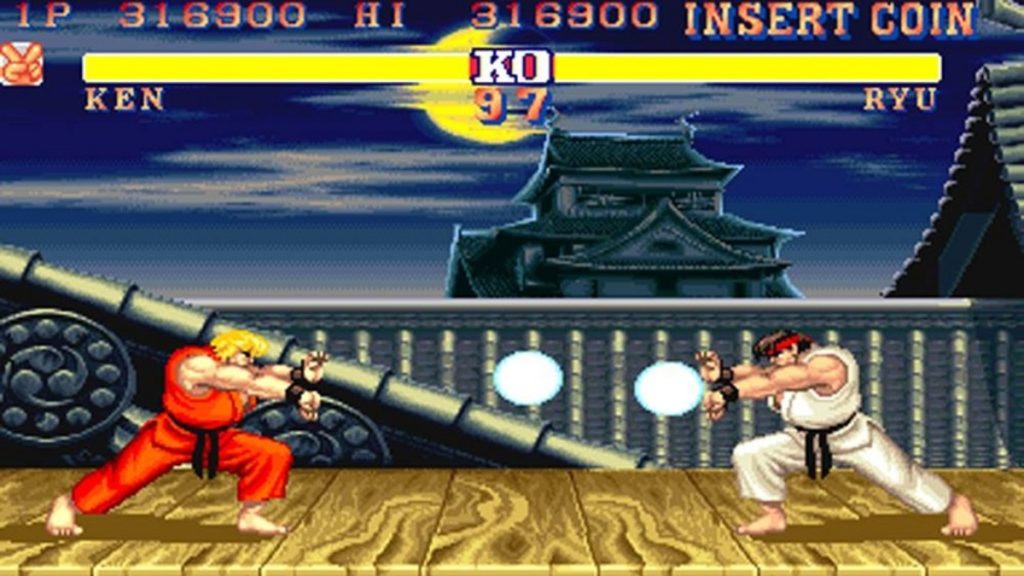
Arcades may have slipped in popularity in the late ’80s, but by the early-to-mid-’90s they got their second wind. After the mediocre-at-best reception to their game Street Fighter, Capcom went back to the drawing board and completely overhauled the gameplay and style for their next entry: Street Fighter II.

Street Fighter II contained eight playable characters, each with strong and memorable personalities and special moves. Control was fluid, and for the first time, players could pull off combos by linking moves to each other. The fantastic gameplay and charming cast of Street Fighter II singlehandedly popularized the fighting game genre and reinvigorated interest in arcades. Kids would crowd around Street Fighter II machines, waiting for their chance to challenge the best player at the arcade. Street Fighter II was an astronomical success, and Capcom quickly went to work creating updated versions with additional characters and enhanced gameplay.

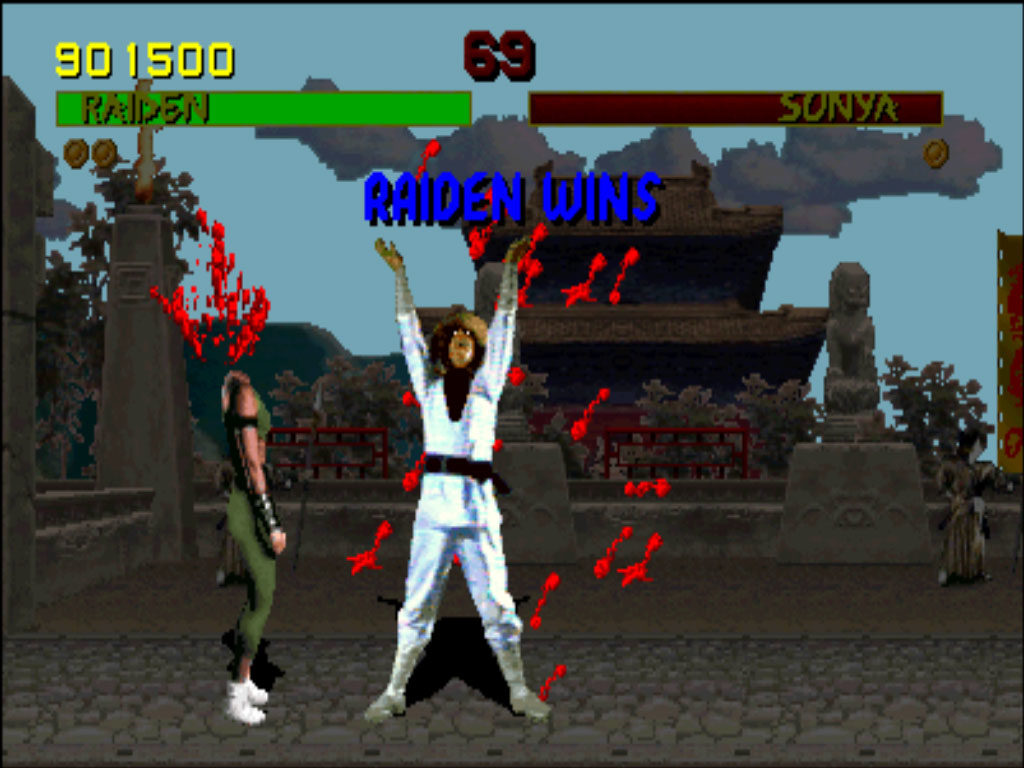
Following the success of Street Fighter II, Midway released the bloody fighting game Mortal Kombat. The game stunned the public with its realistic human characters and incredible levels of bloody violence. Controversy soon followed, which only served to increase interest in the game. Many imitators tried to capitalize on the success of Mortal Kombat, creating exploitation games that featured plenty of blood but none of the satisfying gameplay or badass characters of MK.

mortal kombat

The 1v1 fighter genre of games brought the social aspect of gaming back to the arcades as players gathered for a chance to prove their skills. Oftentimes players would exchange tips on how to pull off difficult special moves or unlock secret characters. No longer were gamers competing for a high score, they were now facing each other one on one to determine who was better at the game, providing a thrilling competitive experience that had real stakes. This hardcore competitive gaming experience sustained the arcade market for years, but casual gamers were turned away by the new arcade environment. Game designers repeatedly tried to make games for the new primary demographic, mostly teenage boys, leading to stagnation in game design and waning interest. By the late ’90s, arcades found themselves in trouble once again.

The Last Hurrah

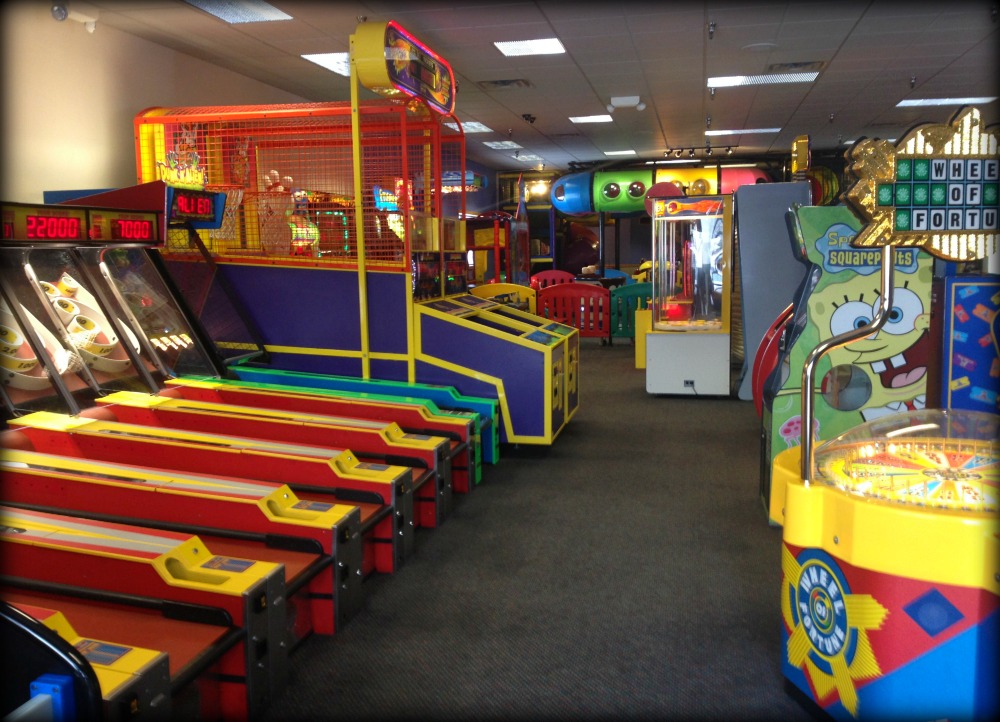
As home consoles advanced to the point where they could easily provide arcade-quality games, arcades could no longer serve as solitary attractions. Oftentimes arcade games were instead found as additions to bowling alleys, movie theaters, and mini-golf courses. Arcades found some success as part of new family fun centers like Chuck E. Cheese or Funway, which combined video games with other attractions like go-karting or animatronic bands.

An important innovation of these family fun centers was redemption games, which were arcade games that spit out tickets. Depending on the player’s game performance, they would receive more tickets, which could then be spent on toys and other prizes. Redemption games quickly overtook traditional arcade games in popularity, especially among kids.

family arcade

By far, the most notable breakout arcade game of this generation was Dance Dance Revolution, an innovative and accessible game that attracted both casual and hardcore audiences. The game’s combination of music, physical exercise, and challenge made it an instant arcade classic. Like DDR, many new arcade games relied on gimmicky peripherals that couldn’t be emulated on home consoles. Games increasingly incorporated advanced technology like virtual reality in order to have an edge over the home gaming market.

While the home console market hit arcades hard enough, the true nail in the coffin was the rise of the mobile gaming industry. These games, primarily controlled via touchscreen, were either free or very inexpensive to play. They often featured straightforward but addicting gameplay mechanics similar to the arcade classics of the ’80s. The mobile market absolutely destroyed the arcade industry. In desperation (or adaptation, depending on how you look at it) many arcades simply created arcade versions of popular mobile games like Temple Run or Doodle Jump. Outside of family fun centers like Chuck E. Cheese and the rare arcade megaplex like Gameworks or DisneyQuest, arcades almost completely ceased to exist.

Booze + Video Games = $$$

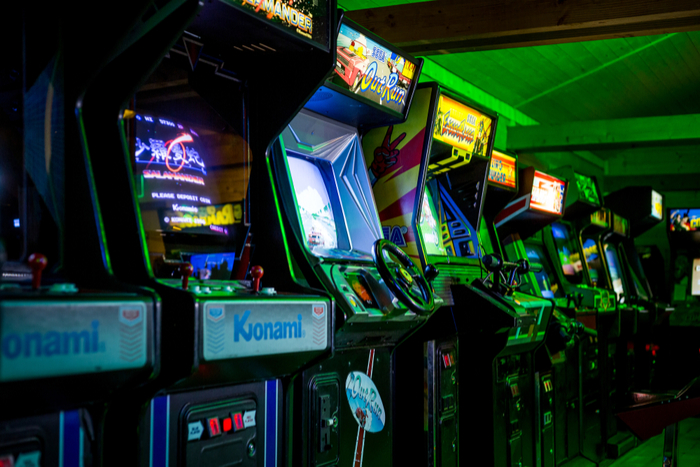
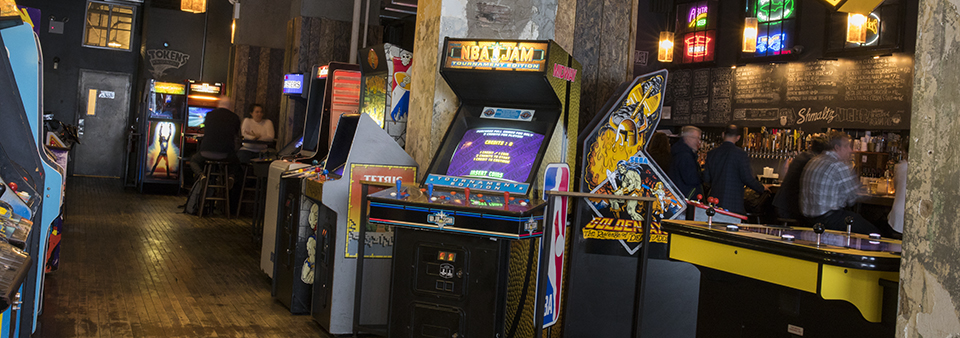
Recently, “barcades,” which combine bars and arcades, have enjoyed a surge of popularity. The games are free or only cost a quarter, just like they used to, and the games featured are mostly ’80s classics and fighting games rather than redemption games or upscaled mobile games. The industry is based on nostalgia and has proven to be popular in major cities across the U.S. While traditional arcades may have lost the battle against the home console market, the new barcade industry is enjoying a comfortably successful niche market.

barcades

Do you have fond memories in the arcade? What was your favorite game? Let us know!