Since the first official game of James Bond in 1984 (there were earlier ones but without rights, pirate-style), the saga had something in common for a decade: with a controller in hand, no one seemed to fully exploit agent 007.
It didn’t help, of course, that the games still had to fight to be seen in 8 bits, with titles like Panorama to Kill, Goldfinger, or The Living Daylights, which adapted a completely original story and even had audio tapes explaining the story from the mouth of the very actor who played Q, Desmond Llewelyn. And then, GoldenEye arrived.
Agitated, mixed, improved
In 1992, the franchise didn’t know where to turn with consoles, and a final game was released for Mega Drive titled James Bond 007: The Duel, in which the agent had to overcome 5 levels, face Jaws, and escape. The problem was that, at that time, Timothy Dalton had made his last appearance as the agent in License to Kill, and they had not yet found someone to replace him.
In doubt, they used his image on the cover and pixelated it within the game, although it didn’t matter much to anyone: despite receiving decent reviews, James Bond was part of the past, and there was little that could be done to revive the interest of the youth.
This impasse only lasted until, in 1994, they announced that Pierce Brosnan would take the helm of the saga in a new spectacular film: GoldenEye. And of course, with the relaunch, they had to have their corresponding video game: immediately, Rare and Nintendo began working on a possible game based on the movie, especially after the success of Donkey Kong Country.
Moreover, from Nintendo, having little faith in the producer, they proposed making a 2D platformer for Super Nintendo, which at that time was still selling non-stop and showed no signs of stopping. A perfect plan. Or not?
Back then, no matter how well they sold, movie adaptations were worth nothing: 2D platforms of Robocop or Batman that only slightly resembled the original title and that, in reality, would only go down in history for the most dedicated fans. Fortunately, Martin Hollis raised his voice in that meeting and insisted that the game should be made in 3D and developed for Nintendo’s new console, the Ultra 64 (which would eventually be, of course, the Nintendo 64).
What was the problem? By the time the console hit the market, the movie would have already left theaters and even the VHS market. At Rare, they were convinced it didn’t matter: the essential thing was to make a good game. The license was secondary.
They were right, of course: the game was released more than a year and a half after the movie, on August 25, 1997, but by then Pierce Brosnan was already starting the promotion for Tomorrow Never Dies, which would come out four months later, and the hand game ended up benefiting them.
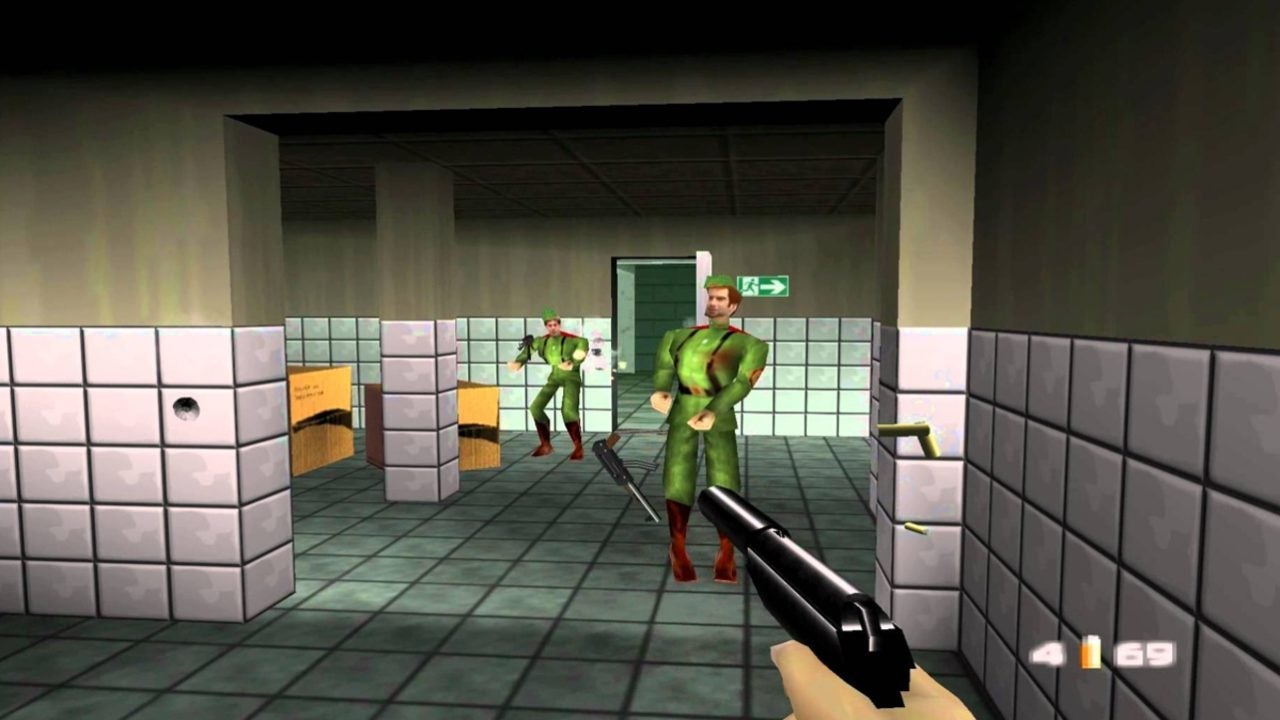
It cost an absolute fortune for the time and they took much longer than usual, yes, but the result was incredible. No one cared that GoldenEye was a 1995 movie: the graphics, the extended story, the mapping, and the levels made the risk worth it. After all, masterpieces are not created every day.
It has been almost 30 years since the release of GoldenEye 007 and those who played it at the time still remember it as a canonical moment when they discovered that FPS games were not just for computers. And now, with the new 007 First Light about to be released, it’s time to ask ourselves if perhaps, none of this would have been possible without a brave person saying “I don’t see this for the SNES”. Hero.