The AI manages to decipher scrolls charred by Vesuvius

A 21-year-old computer science student has won a global competition to see who could decipher the first text from a charred parchment from Herculaneum, an ancient Roman city.

A 21-year-old computer science student has won a global competition where participants competed to decipher the first text from a charred scroll found in Herculaneum, an ancient Roman city. This scroll was completely charred due to the infamous eruption of Mount Vesuvius in 79 AD.

Google Chrome DOWNLOAD

The achievements of this student open the possibility of understanding hundreds of texts from the only intact library that has survived from ancient Rome.

Luke Farritor, from the University of Nebraska-Lincoln, developed a machine learning algorithm, which has managed to detect Greek letters in several lines of the battered scroll. To do this, Farritor used small-scale differences in the texture of the parchment and trained his neural network with them.

After the eruption of Mount Vesuvius, hundreds of scrolls were buried under 20 meters of volcanic ash. The initial attempts to open the scrolls almost caused their disintegration, and many scholars feared that the remaining documents could never be unrolled or read.

The Vesuvius Challenge offers a series of recognitions, including a cash prize of $700,000. To receive it, the participant must decipher four or more passages from some of the rolled scrolls. On October 12th, it was announced that Farritor had won one of the prizes, $40,000. Thanks to his invention, more than 10 characters have been read on a surface of papyrus as small as 4 square centimeters.

Until now, researchers had to rely on the study of open scrolls. However, the more than 600 scrolls preserved in the National Library of Naples, the United Kingdom, and France, remain unopened.

Google Chrome DOWNLOAD

Is AI causing more layoffs than ever? IBM is clear about it

One of the first major companies to confirm that it will stop hiring for jobs that could be filled by AI, IBM, has said…

IBM does not foresee more layoffs due to artificial intelligence; quite the opposite. The company will hire more employees than it lets go from now on. Great news for a sector that fears AI might be the end of the road.

ChatGPT DOWNLOAD

One of the first major companies to confirm that it will stop hiring for jobs that could be performed by AI, IBM, has stated that it has no intention of laying off any programmers as a result of this technology.

Its CEO added that, although some job positions were expected to be lost due to artificial intelligence, the company will hire a much larger number of employees.

For the first time, we don’t see AI as a threat

In his speech yesterday at the Fortune CEO Initiative conference, as reported by Insider, IBM CEO Arvind Krishna stated that he had no intention of letting go of a single programmer due to AI. “I will get more,” he added.

Krishna believes that instead of costing them their jobs, AI will enhance programmers’ productivity by 30%. This aligns with similar studies that conclude AI will increase job opportunities for most people rather than replace them.

It might be surprising that Krishna reassures about job losses related to AI, given that the CEO previously mentioned he anticipated around 30% of IBM’s functions would be replaced by AI and automation within a five-year period, equivalent to about 7,800 jobs.

Krishna now states that while he expects to gradually eliminate administrative functions in human resources, IBM is increasing the number of software engineering and sales roles in the next three to four years, with more positions being added than removed.

“We added 8,000 roles. We subtracted about 800,” Krishna said. “The first thing that can be automated is repetitive, non-creative work.”

IBM’s CEO mentioned that while AI could take over around 10% to 20% of “low-level” tasks, it was unlikely to automate someone’s entire job.

ChatGPT DOWNLOAD

The world’s largest tabletop gaming event uses AI for its drawings and creates chaos among fans

From Essen they have decided that the images of the tickets, the posters and so on are made with AI, with some frankly ugly drawings (those smiles, those six fingers) that have covered them with a patina of unprofessionalism that can take its toll.

It’s possible that Essen doesn’t ring a bell to you. At first glance, it’s just a German city without anything special, but it hides a secret not everyone knows: it’s the place where the world’s largest tabletop gaming fair has been held since 1983, spanning across numerous gigantic industrial halls where fans, stores, conferences, novelties, signings, and even exclusives gather. The problem is that this year, four decades after its start, they have messed up. Big time.

DALL-E DOWNLOAD

Artificial board games

If there’s something that sets tabletop games apart from any other hobby, it’s the fact that, if you want them to be even a bit original, they have to involve human creativity. You can’t create mechanics out of thin air; they need to have a specific art style and feel genuine. Or at least, that’s how it has been until artificial intelligence entered our lives.

When you can save a few bucks on something as crucial as the presentation of your gigantic fair, how can you resist it? Essen has decided to use AI for ticket images, posters, and other materials, resulting in drawings that are frankly ugly (those smiles, those six fingers) and have given them an unprofessional appearance that might cost them dearly.

To calm the situation, Spiel Essen has announced that they only wanted to understand the capabilities of AI and that “protecting the rights of artists is a priority.” They said this while covering the city with these deformed drawings. Could it be the worst defense ever made? Certainly, especially considering that the fair starts the day after tomorrow on the 5th, and they have run out of time to change it after the backlash on social media.

Last year, over 200,000 people attended Essen, and even more will attend in 2023. It’s hard-earned money that could have been well spent on paying an artist to create something truly original. Moreover, at the beginning of the year, it was announced that after forty years, the convention would have a mascot, Meeps, an adorable tiger created by game illustrator Michael Menzel. Now, it has disappeared from all sites to be replaced by this genuine outrage. Absolutely dreadful.

DALL-E DOWNLOAD

The new chatbots from Meta allow you to ask questions to Snoop Dogg

As artificial intelligence becomes more common, the competition among big tech companies to differentiate themselves is becoming increasingly challenging. Dominating the sector without a distinguishing element that makes an AI stand out from the rest is getting more complicated. While OpenAI and Google have their own approaches, Meta is taking a different path by opening the code of Llama 2 to developers and assimilating the personalities of various individuals for their chatbots.

Different AI for different purposes

The concept under which Meta presents this idea is the motto “Different AIs for different things.” Its purpose is to allow users to access different AI-based chatbots that adapt to the task they need help with. Currently, it is not possible for each user to personalize their own chatbot. Instead, a series of bots with different personalities have been made available to assist in specific tasks. For example, users can chat with chefs, personal trainers, or literary editors.

The most interesting part is that these bots will represent the personalities of certain celebrities, at least during the beta phase of this feature, which is already underway. For instance, the personal trainer is named Victor, but he will have the personality of retired basketball player Dwyane Wade. This means that a professional athlete (at least seemingly) will design a training plan for users and motivate them to achieve their goals.

There are also bots representing American football star Tom Brady, Paris Hilton, Kendall Jenner, MrBeast, and Snoop Dogg. The latter has sparked particular curiosity, and many people have started to wonder in what specific situation they might need assistance from the rapper; the topic is generating a lot of interest.

At the moment, these AIs do not have access to real-time information from Meta, but they serve the purpose of familiarizing users with this type of technology and making these kinds of applications increasingly appealing.

George R.R. Martin declares war on ChatGPT

The New York Times took the first step. After the New York newspaper updated its terms of use to prevent artificial intelligences from appropriating its content, writers of the caliber of George R.R. Martin and John Grisham have risen up against what they have called a “systematic and massive-scale theft”: ChatGPT would be being fed through copyrighted works without any permission or authorization.

The authors claim that OpenAI would be committing “blatant and dangerous infringements” against copyright rights, so the Authors’ Brotherhood has opted to go to court, led by writers like David Baldacci, Sylvia Day, and Elin Hilderbrand, among others.

One of the most significant statements during these days has been that of Mary Rasenberg, CEO of the Authors’ Brotherhood, directly confronting machine learning and artificial intelligence models as a threat that could destroy an incredibly rich literature, which fuels other major American industries. She has also commented that great books come from authors who invest years, if not their entire lives, in methodically refining and perfecting their works, so in the name of preservation, authors should have control over the uses made of their works by artificial intelligence.

George R.R. Martin in the eye of the storm

One of the authors most affected by this misuse is the author of the “A Song of Ice and Fire” series, George R.R. Martin, as ChatGPT is said to have generated an unofficial and obviously unauthorized prequel to the first book of the series, “Game of Thrones.” This sort of prequel would be called “A Dawn of Direwolves” and would use the same characters that already exist in the “A Song of Ice and Fire” saga.

Meanwhile, OpenAI is trying to defend itself against these accusations by explaining that the company respects the rights and work of the authors, and they are in discussions with multiple authors to find “mutually beneficial” ways to work together.

The leaders in artificial intelligence are meeting behind closed doors in the Senate

It was to be expected that as such an important and powerful tool as artificial intelligence continued to develop, the world would increasingly view it with greater skepticism. We could see something like this coming when The New York Times prohibited the use of its content for training any kind of artificial intelligence, although this is not comparable to one of the seats of U.S. sovereignty: the Senate.

A potential danger to society

Without falling into alarmism, artificial intelligence, like any powerful tool, has a multitude of uses that can pose threats to ordinary people. This includes AI that can imitate voices or create hyper-realistic deepfakes. As a result, leaders of major tech companies like Mark Zuckerberg (Meta), Sam Altman (OpenAI), Satya Nadella (Microsoft), and many others held a private forum with Senate representatives at the AI Insight Forum, closed to the general public. All we know about this meeting comes from subsequent statements.

For example, Mark Zuckerberg emphasized the importance of society as a whole working to minimize the risks of this technology, which also represents an opportunity to create a much better future for everyone. He also called for not underestimating the potential of these tools or their impact, as the industry is evolving rapidly.

Elon Musk, on the other hand, stressed the importance of having a federal control agency for artificial intelligence matters. There seems to be consensus among all tech leaders on the importance of regulating this technology to establish rules that allow for its ethical use and evolution.

However, some voices have categorized this closed-door meeting as an exclusive and opaque forum, harshly criticizing the lack of transparency among AI giants. They argue that this situation creates an opportunity for economic power to influence potential regulators. This doesn’t have to be the case, as long as there is an open forum in the future that allows all citizens access in one way or another.

Microsoft is considering adding AI-generated dynamic wallpapers to Windows 11

The trend of Artificial Intelligence continues to make its way into major companies, even to reduce costs in areas like artistic design. Microsoft, one of the companies that strongly embraces this technology, is now considering releasing dynamic wallpapers for Windows 11 created by generative AIs.

This is neither the first nor the last case in which we see this trend. However, it’s noteworthy that companies as large as Microsoft are not opting for established artists and editors who could create dynamic wallpapers that might be superior to those generated by AI. Nonetheless, the current trend is leading them to consider using this system for potential dynamic desktop backgrounds.

Windows 11 DOWNLOAD

Artificial Intelligence remains in vogue

This idea is just one of the many that Windows has in mind alongside AI. The company founded by Bill Gates considers this technology one of its short-term priorities and is working on numerous features where these systems can be implemented. This way, Windows 11 would become an operating system fully open to advances in Artificial Intelligence.

The possibility of AI-powered dynamic wallpapers is just one of the functionalities that this technology brings. For example, Windows has already released Bing Chat, a generative text AI similar to Chat GPT, which can be used in browsers like Microsoft Edge and Google Chrome.

Bing Chat is already operational and is based on GPT-4

The lights and shadows of Artificial Intelligence

In objective terms, the possibilities of Artificial Intelligence today are fascinating and reaching limits that were unimaginable not too long ago. However, behind these tools, in addition to potentially dangerous uses, both in criminal and ethical contexts, there are also significant privacy gaps that the European Union has not yet fully addressed.

Artificial Intelligence has grown significantly in recent years, but in 2023, we are witnessing such rapid advances that there isn’t enough time to properly regulate them. Therefore, in this scenario, AI is also generating many social problems, making it sometimes the only barrier to carrying out harmful actions through AI is the conscience of each individual.

Windows 11 DOWNLOAD

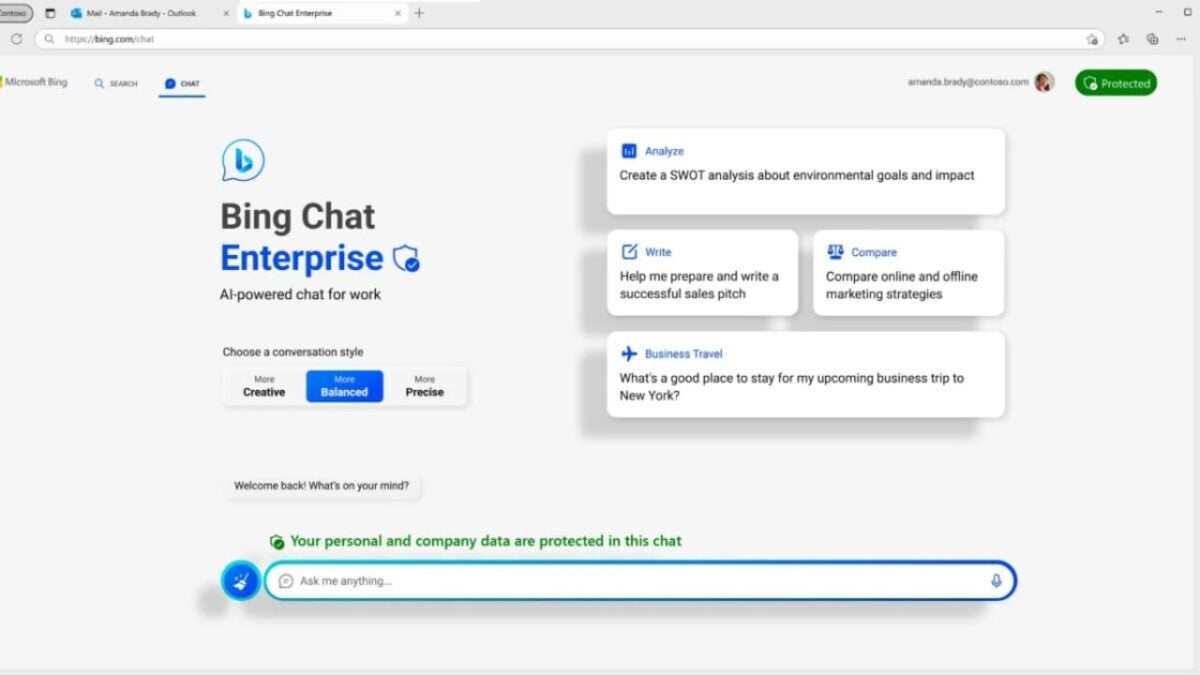
Microsoft is enhancing the administrative options for Bing Chat Enterprise

It was expected that with the new era of technological change led by artificial intelligence, most news would be positive, but it’s also normal to occasionally see some that are not as positive. Microsoft is at the forefront of this milestone in the evolution of machines, aiming to imbue Microsoft Paint with generative artificial intelligence and also adding AI to the Skype application. The company has also sought to incorporate these learning models into Bing Chat, a chatbot that, for many users, was lacking in certain aspects.

Bing DOWNLOAD

Bing Chat Enterprise at the cutting edge

While Microsoft claimed that any administrator of Bing Chat Enterprise had the necessary access to add and remove new users, many administrators of this application suggested that this wasn’t really the case. They argued that they should have more control in this process, especially when offering the use of the chatbot in lower protection rings, so they could have more usage and even customization permissions.

They had some valid points, as Microsoft has acknowledged the need for this and recently announced on their blog that through the Bing Chat Enterprise planner, organizations can select a group of users. Once Bing Chat is open normally (after signing in with a Microsoft Enter ID), it will have access to the Enterprise version at the protection level set by the administrator.

Microsoft has also stated that revoking these permissions from any user will revert their status to a regular consumer of Bing Chat. Additionally, they mentioned plans to incorporate tools and materials in the future designed to help employees make the most of Bing Chat Enterprise.

Bing DOWNLOAD

These errors are quite common because Bing Chat Enterprise is still a preliminary application accessible through Microsoft 365 E3, E5, Business Standard, and Business Premium. However, it is expected that the final version will be integrated into the Microsoft 365 suite in September.

The future is horrible: an AI-made singer just signed a record deal

What's the trick? That this model does not age, grow, complain or demand labor rights because… she is made by artificial intelligence.

In 2018, at the age of 19, Noonoouri appeared for the first time on social networks. Soon after, she was parading for Christian Dior, Valentino or even Kim Kardashian’s care and beauty line. In 2023, at the age of 19, Noonoouri is about to record her first album. What’s the catch? That this model doesn’t age, grow, complain or demand labor rights because… she’s made by an artificial intelligence.

Youtube DOWNLOAD

No no, Noonoouri

The father of the influencer in question is Joerg Zuber, a CGI artist from Munich who used the voice of a real singer to create Noonoouri’s voice, passing it through various filters to make it recognizable. Ethical boundaries are wobbling merrily before you right now, but apparently they weren’t enough to stop Warner from signing her to a record deal.

To be honest, the numbers aren’t spectacular either. I mean, she’s not exactly Hatsune Miku: she has 400,000 followers on Instagram and her first song, ‘Dominoes’, has been seen by 73,000 people. The track is as summery and entertaining as it is utterly soulless, like a reminder of what, at its core, is AI itself. But watch out, because there’s a catch.

Although artificial intelligence has obviously been used to create Noonoouri’s music and chores, her creator knows it’s frowned upon, so she has rushed to make another video making it clear that her character is CGI. “Every time you can see me or, like now, hear me, there are humans in the background,” explains the model herself practicing the beautiful craft of excusatio non petita, accusatio manifesta.

Zuber says that it has been two years of work on his musical project and that it is only the beginning: Alle Farben has written its first song and will take part of the royalties for the author’s rights, which will be divided between the authors, the father of the creature and the record company. Will it be the new virtual success or will it remain in the oblivion of those things that could have been a hit but came to nothing?

Youtube DOWNLOAD

Zoom IQ is artificial intelligence on steroids

It had to happen. While some protect themselves from artificial intelligence, others embrace it as a way to reach new horizons. With Microsoft trying to add this technology to a large part of its applications and Adobe strengthening Adobe Express with generative artificial intelligence, Zoom makes a statement and chooses to strengthen and renew Zoom IQ with three different AIs. It has also taken the opportunity for a small rebranding and has abandoned its old name to become Zoom AI Companion.

Zoom AI Companion will feature the most popular generative AIs

This new Zoom assistant combines three of the most popular artificial intelligences to promote productivity, collaboration, and skill improvement: ChatGPT, Llama 2, and Claude. This functionality is included with the Zoom subscription of all users, and the company has assured that this tool will not use audio, video, chat, screen sharing, or any type of communication in any way to train Zoom’s artificial intelligence or third-party AI models. This provides several guarantees that users may greatly appreciate, especially since Mozilla has just initiated a petition to ask Microsoft if it intends to train its Copilot through user data.

The comparison with Copilot is not coincidental, as AI Companion could be strong competition for Microsoft’s tool, as it has several similar functions. Some of these include meeting summaries, as well as summary and task suggestions; both of which are very useful in the business world. In addition, Companion will offer content creation and message composition based on ideas and the ability to provide ideas through brainstorming.

But that’s not all. Zoom aims to improve AI Companion and keep it updated to help its users prepare for meetings, write complex summaries, and provide critical thinking. This makes it sound very promising, not only as an almost ideal assistant but also as one of the biggest quality-of-life improvements for many workers.