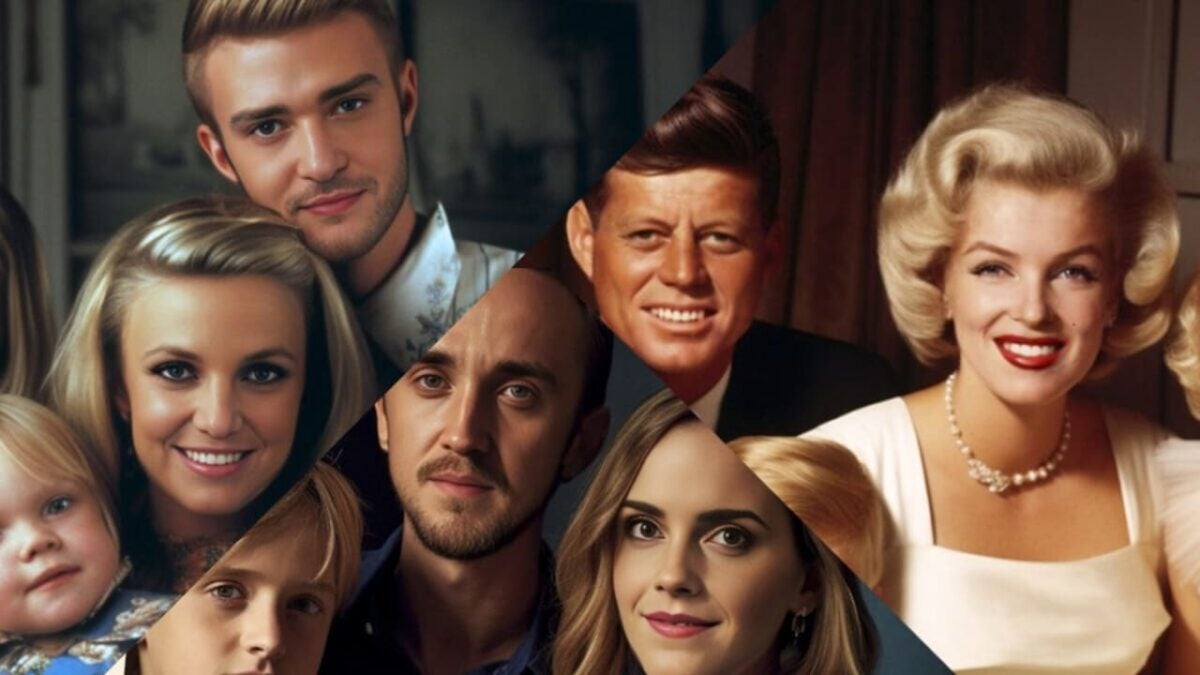
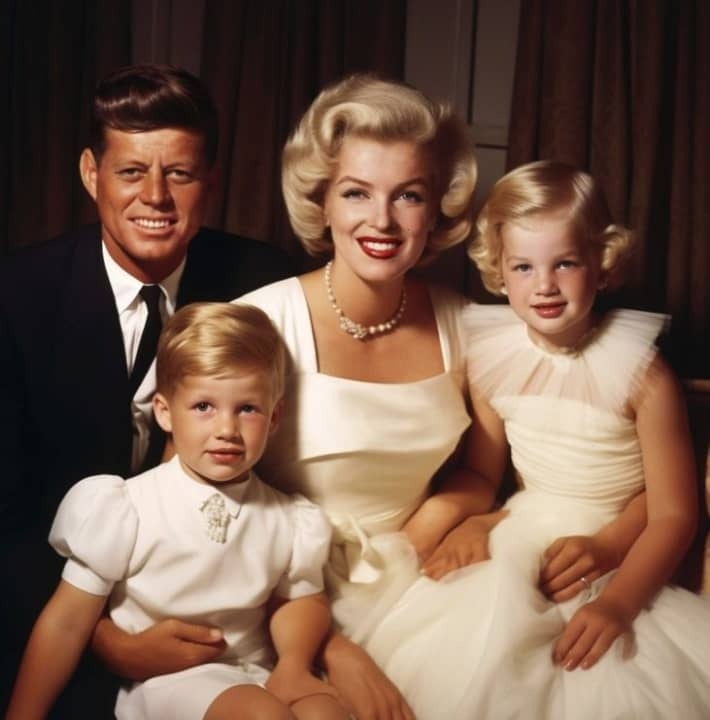
An artist has used artificial intelligence (and a bit of Photoshop) to show what the children of famous couples, both real and imagined, would have looked like.
Have you ever wondered what the children of Marilyn Monroe and John F. Kennedy would have looked like? Or those of Britney Spears and Justin Timberlake? Well, you no longer need to imagine anything: an artist has used artificial intelligence (and a touch of Photoshop) to show what the offspring of famous couples, both real and imaginary, would have looked like.
Jeremy Pomeroy (@mrpomeroyj_ai on Instagram) is the artist who took on the task of fulfilling our fantasies. Leonardo DiCaprio and Kate Winslet, Taylor Swift and Harry Styles, Brad Pitt and Jennifer Aniston… Pomeroy has dared to imagine it all and more. Below, we present you with the results of his “experiments”:
Meta has announced the launch of what will be its first artificial intelligence feature in one of its social apps.
Despite Meta (formerly Facebook) having developed its own AI named LLaMA, the company has not yet implemented any AI function in its products. While there is an Instagram chatbot in development (with an uncertain release), other social media platforms like Snapchat have already taken the lead in AI implementation.
Now, Meta wants to catch up in the midst of the AI revolution and offer its users the first AI-powered feature in one of its products: AI-generated stickers for Messenger. Yes, that’s right, perhaps it’s not the AI feature that users were expecting in a Meta app.
In a meeting accessed by The Verge, Meta’s VP of AI, Ahmad Al-Dahle, explained to employees that the company will leverage its image generation model to allow users to create stickers from text messages. Currently, the feature is being tested internally, but it will likely be released to the public in the near future.
“With AI-generated stickers, our users can have infinitely more options for self-expression, cultural representations, and even trend relevance,” Al-Dahle states. “Of course, stickers are just the tip of the iceberg.”
The VP of AI also states that Meta is “working on AI models that will transform any image you want in any way you want.” Among the possible functions, there would be the ability to “change the aspect ratio of your photo” or turn a photo “into a painting.”
This marks a first step for Meta in implementing artificial intelligence into its social media ecosystem. However, considering Zuckerberg’s ambitions, we can almost certainly expect to see many more AI functions in the coming years.
Artificial intelligence has begun to worry everyone, including the companies that make use of it. Microsoft has stepped up.
Microsoft has just endorsed a series of regulations on artificial intelligence, at a time when the company is navigating concerns from governments around the world about the risks of this technology.
The company also called for laws that clarify when additional legal obligations apply to an AI system and labels that make it clear when an image or video has been produced by a computer.
Act now on AI or be swept away by it
“Companies have to step up,” said Brad Smith, president of Microsoft, in an interview about the push for regulation. “The government has to move faster.”
The call for regulation comes on top of the rise of Artificial Intelligence, with the launch of the ChatGPT chatbot in November generating a flurry of interest.
Companies such as Microsoft and Google’s parent company, Alphabet, have since rushed to incorporate the technology into their products. That has stoked concerns that companies are sacrificing security to get to the next big thing ahead of their competitors.
Lawmakers have publicly expressed concern that these artificial intelligence products, which can generate text and images on their own, will create a flood of misinformation, be used by criminals and put people out of work.
Creators of modern AI ask to be regulated by governments
In response to that scrutiny, artificial intelligence developers have called for shifting some of the burden of policing the technology to the government.
Sam Altman, CEO of OpenAI, which is responsible for ChatGPT and counts Microsoft as an investor, testified before a U.S. Senate subcommittee this month that the government should regulate such technology.
The move echoes calls for new privacy or social networking laws by Internet companies such as Google and Facebook parent Meta.
Initial ideas for governance of superintelligence, including forming an international oversight organization for future AI systems much more capable than any today: https://t.co/9hJ9n2BZo7
In the interview, the Microsoft president said the company was not trying to shirk responsibility for managing the new technology, as it was offering specific ideas and was committed to pursuing some of them, regardless of whether the government took action.
And he endorsed the idea, supported by Mr. Altman during his appearance before Congress, that a government agency should require companies to obtain licenses to deploy “highly capable” AI models.
A professor at A&M University, more specifically in the branch of agricultural sciences and natural resources, thought to copy parts of the students' work and ask ChatGPT if he had written something like that. The problem is that ChatGPT lies to please us.
If you are already starting to see ads on Instagram to encourage you to get a hair graft on the crown of your head, I’m sure you remember Encarta, an encyclopedia on CD-Rom that made students’ lives easier before El Rincón Del Vago and the Internet turned the cut-and-paste into an art form. Encarta ceased to appear in 2009 after 16 years of lights and shadows, but it had an advantage for teachers: it was easier to catch students’ copies than asking ChatGPT… among other things, because Artificial Intelligence tends to invent its authorship.
What happened in Texas was not in a high school, but in an entire university where all the students in a class failed and were banned from graduating because of new technologies. The thing is that a professor at A&M University, more specifically in the branch of agricultural sciences and natural resources, thought of copying parts of the students’ papers and asking ChatGPT if he had written something like that. The problem is that ChatGPT lies to please us.
It was May 16: Dr. Jared Mumm, aware that students could use Artificial Intelligence to help them with their papers, wanted to know to what extent. The problem is that ChatGPT is not able to find the difference between an original thought and an artificial one, so he claimed to have written all the papers. All of them. Anyone would think that chat is not perfected, but Mumm came to the only logical conclusion: absolutely all of his students had lied. A zero.
The funny thing is that there were students who did not even know what the hell ChatGPT was, but even though they tried to get the dean and the president of the university to take action on the matter, they preferred to turn a deaf ear. And although the students gave proof to the professor with receipts of the books they bought to do the work or different dates in their Google Docs proving that it was not even remotely a copy-paste, their professor replied that “he wouldn’t grade shit done with AI”.
After the controversy erupted, of course, the university rushed to tell the media that the problem was being solved and that several students had been exonerated, except for one who admitted to having usedChatGPT sometime during the course. I guess he will be called “the sucker”. Other students, however, have preferred to leave the trouble behind and write another paper to get out of trouble.
No matter how much we fear AI, in the end one thing is clear: at the current level, it is still a glorified Google search engine that, always wanting to please, will give you the right answer. This is going to make university jobs in the future much more complex to evaluate, but definitely, asking a machine if it has done something machine-like is not the best idea.
For your peace of mind, I will tell you that I have passed this article through ChatGPT and it has told me that it has not been written. woof.
Some of the main announcements of Google I/O 2023 will have artificial intelligence as the protagonist.
Google I/O 2023, an annual event aimed at developers, will soon be held this Wednesday, May 10 at the iconic Shoreline Amphitheater in Mountain View, California.
Since its inception, this conference has been highly anticipated by Google and tech followers in general, eager to learn about the latest news from the Android world and much more. Now, a new report from CNBC may have revealed some of the main announcements of the event. To the surprise of few, these would be centered on artificial intelligence.
One of the big headliners will be the launch of PaLM 2, the new version of Google’s language model (LLM). CNBC itself describes it as an LLM intended for “general use” (like ChatGPT). Moreover, it would be the “most advanced and recent” model that the company has released to date. It is worth noting that the first version of PaLM was announced in April 2022, months before the boom caused by ChatGPT and so on.
CNBC also claims that Google will announce a new “generative experience” centered around search. We will also see Bard, its chatbot, again, which will be introduced in a revamped form. Among other things, it will be expanded to Japanese and Korean languages. Unfortunately, the chatbot is only available in the United States and the United Kingdom for the time being.
That’s not all. Google will also unveil more AI-based tools centered around Workspace. This would include the generation of templates in Google Sheets and images in Google Slides and Google Meet. Last March the company already announced new AI features for Gmail and Google Docs, but they have not yet been released to the public.
It’s not all going to be artificial intelligence: new Pixel on the way
It’s no secret that we will also see the new Pixel Fold and Pixel Tablet at Google I/O 2023. During the event, they are expected to announce the release date. For the time being, the company has shared on its YouTube channel, Made By Google, a small preliminary glimpse of these devices.
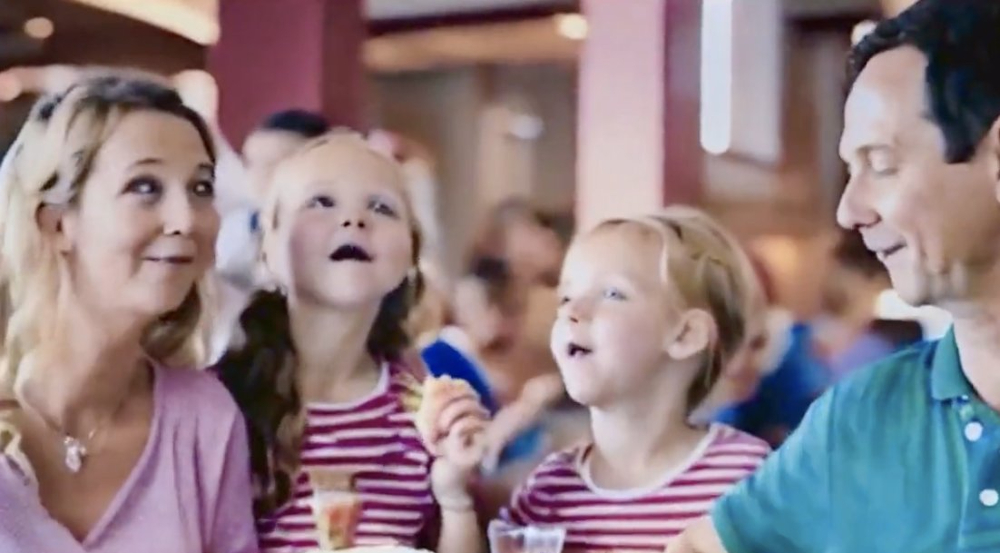
"Are you ready for the best pizza ever?" a male voice says as a boy tries to eat a piece through his upper lip. It's just the start of a fake spot
Artificial intelligence can do creative things, yes. The question we should be asking ourselves is whether we want it to do them, because the results when it has no human control are, so far… Terrifying. The infinite ‘Seinfeld’ who streamed on Twitch, ended up spouting transphobic jokes and earned himself a ban from the platform will go down in history. Now a new sample of a nightmarish dystopian future appears with the fake pizza ad that will appear in your nightmares.
This ad was created with ChatGPT-4 for the script, using Midjourney for the images, Runway Gen2 for the video clips, Eleven Labs for the voiceover, Soundraw AI Music for the soundtrack and Adobe After Effects for editing and graphics. We don’t know if we’ll ever see this kind of credits in movies instead of actors, directors and editors, but what is clear is that the result is, by all accounts, creepy.
“Are you ready for the best pizza ever?” says a male voice as a boy tries to eat a slice through his upper lip. It’s just the beginning of a fake spot in which we have smoke coming out of an arm, people eating cardboard and the tagline “Pepperoni Hug Spot: like family, but with more cheese.” If we are positive about the future, it is a first step towards a future where ads are simpler and cheaper to make. If not, it’s a sign of how AI has a long way to go before it takes our jobs.
The author, Pizza Later, has opened a website so you can buy merchandising (well, a couple of T-shirts) and find out what the heck this is all about. In his own words, “We make delicious pizza slices with love and extra pepperoni. Our dough is like a fluffy pillow for the most delicious toppings to nap on.” With “the secret is in the dough” I was already convinced, IA, really.
If AI eats people’s jobs, what will happen to those unemployed positions? Will it be a benefit for ordinary people or for businessmen?
Overnight, in 2023 it seems like we’ve woken up straight into the future. Artificial Intelligence has turned everything so upside down that it is difficult to even imagine the job landscape in a few years. If AI eats people’s jobs, what will happen to those unemployed positions? Will it be a benefit for ordinary people or for businessmen? Although we all intuit the answer to this question, let’s see what conclusions Ethan Mollick, a Wharton College professor who has realized AI saves time and money, has come to.
It’s a drag to work
Mollick’s experiment was simple: he needed a marketing plan to kick off Wharton Interactive’s Saturn Parable, a grandiloquent name that hides a simulation to learn how to be a group leader. What would take days to do with a lot of people around him giving their opinions, was completed in just half an hour using Bing, ChatGPT4, MidJourney, ElevenLabs and D-iD on his own.
With these tools and a little ingenuity, Mollick created a marketing plan: branding, website, promotional video and even social media posts. At the very least, the professor is sure that a human team could have done better… But not so fast. Supply and demand. Are we doomed to a future of mediocre websites and marketing campaigns… Or maybe this is the beginning before AI learns what creativity is?
But the most interesting part of the experiment is posed in its conclusion: “When we can all do superhuman amounts of work, what happens? Do we do less work and have more leisure? Do we work more and do the work of ten people? Do employers benefit? Workers? I’m not sure”. Listen: anyone who says they have a magic recipe or that they know exactly what is going to happen in a few years is lying.
AI may change the world, it may stay the same. It certainly has the potential to lose 80% of jobs. It may do so and the world goes into global crisis, or it may gain millions of other jobs and we live better. There may be many who don’t even need to lift a finger to earn money. Hopefully, as Mollick points out in his conclusions, “we will live in a future where we do less of the boring work to focus on the more creative work we enjoy doing.”
The future of sci-fi movies is now. All that remains to be seen is whether we like living in it.
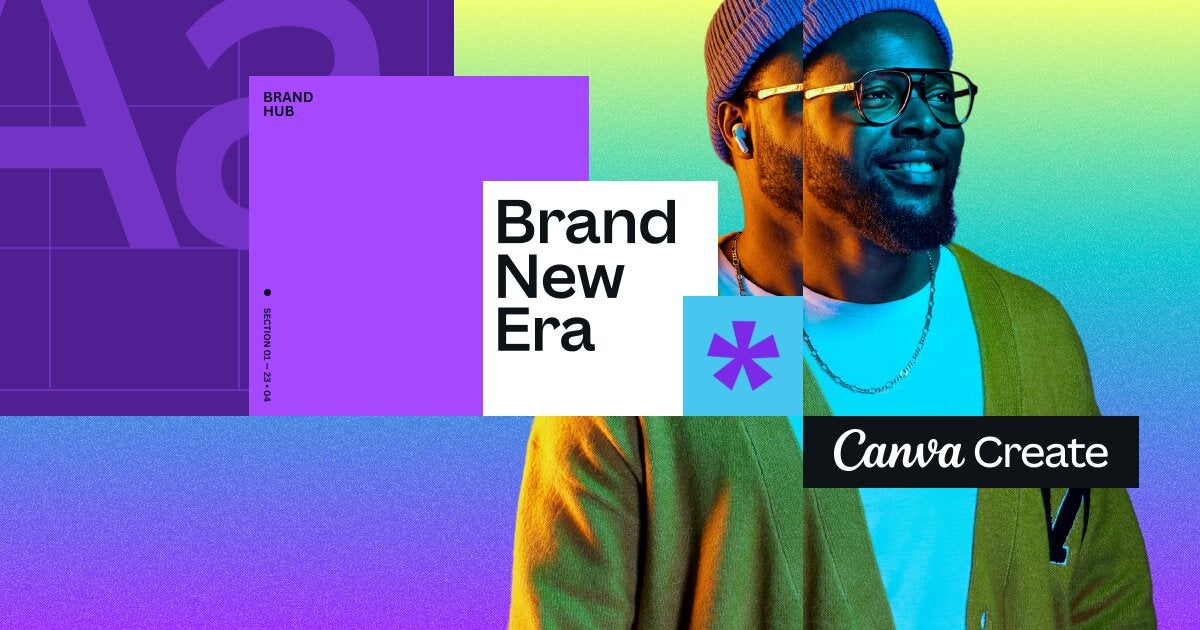
Canva, at Canva’s Create 2023 event, has announced all kinds of new features especially useful for marketing and branding.
One day we’re going to come home and discover that our refrigerator has artificial intelligence. The world is changing at full speed and introducing AI into literally everything from video editing to programming. The latest to take the plunge has been Canva, which has announced an update full of little details that are going to make all the difference… And that should worry Adobe and its Photoshop.
More features, it’s war
Experts are already warning: it’s not that AI is going to replace your job, but that, in the future, you will be replaced if you don’t know how to work with the tools AI gives you. You can see it perfectly in the case of Canva, which at Canva’s Create 2023 event has announced all sorts of new functionalities especially useful for marketing and branding.
The idea is to form a simple way to create a unified visual identity in order to create images for social networks or presentations very quickly, leaving graphic designers to focus on more pressing issues. Using logos, fonts, colors and style guides, reusable templates can be formed and assets can be grouped for specific campaigns, projects and events.
Forget about those files that appear in Google Drive and you don’t know where they came from because they don’t match the rest of the brand image: in Canva you will be able to restrict them by colors and fonts. In addition, the different versions will become a single one and you can activate the workflow within the application itself. In other words: forget about whether the correct one is V2 or V2_OK_DEF, in Canva you will always have the latest one (and you will be able to review all the changes made).
There’s a lot more hidden inside the new Canva, like the Magic tools, which change a part of all your designs (an outdated logo, a color you no longer use, a layout) with just one click, or remove anything you don’t want in an image, from an unnecessary object to a dog in the background. In fact, by proxy, you can even change one object to another like magic.
Canva has said it has used a mix of different AI tools, wanting to become the ultimate app for making layouts, presentations and even international marketing campaigns. We’ll have to see what Adobe‘s next move is after this check on the king.
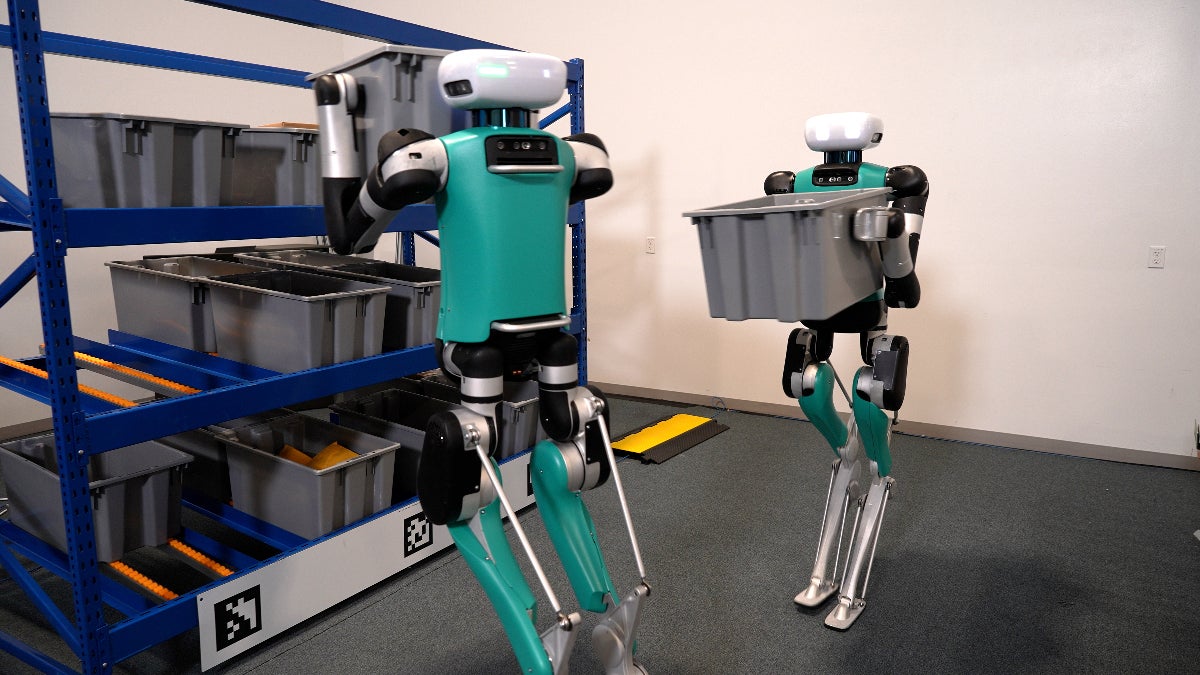
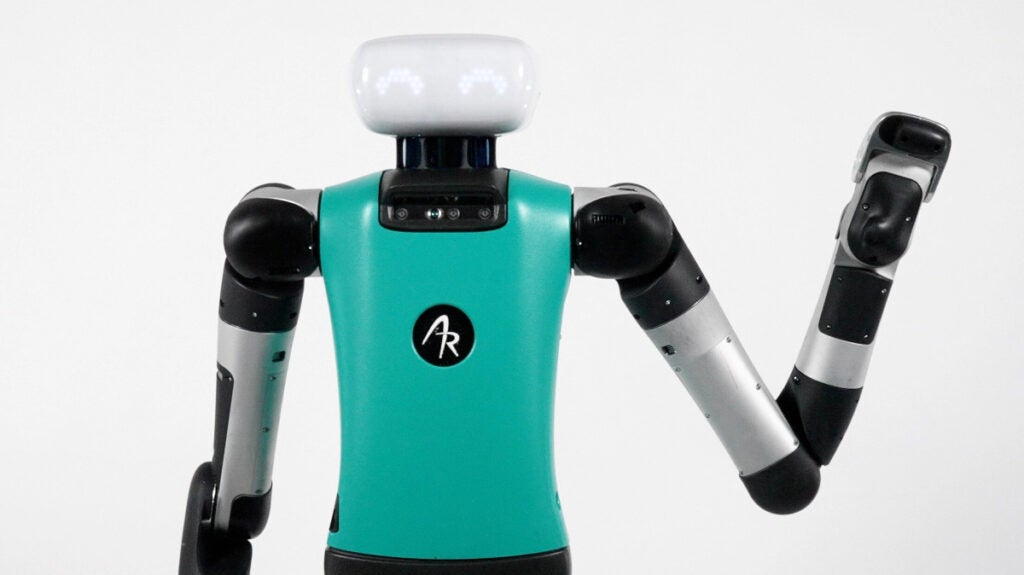
Agility Robotics has decided to take that headless bipedal contraption and put one with eyes on it, supposedly to improve human-robot interaction.
“Robot”, in its more classical Slavic variant, means “forced labor”. And, at the moment, robots, having no human feelings whatsoever, that’s exactly what they do for us. But rarely has the future hit us so head-on as with Digit, created in 2020 by Agility Robotics for Ford and tasked with packaging and distributing courier services. What no one imagined is that three years later, that robot would look almost human.
Kiss my shining metallic eyes
Agility Robotics has decided to take that headless bipedal contraption and put one with eyes on it to supposedly improve human-robot interaction. Digit is created to improve operations in company warehouses, and to avoid collisions of any kind, the eyes will now serve as the lights of a car, and will show when it is about to turn and to which location.
You may be afraid that robots, especially as artificial intelligence becomes more and more latent, will take away human jobs, but Jonathan Hurst, co-founder of Agility Robotics, thinks otherwise: “When people and robots work together in logistics operations, working conditions improve for people, warehouse efficiency improves, the distribution chain moves better. Everybody wins.
At the moment, Digit’s activities are not very varied. It can walk, jump and crouch, but its main function is to pick up and put down different types of objects up to 15 kilograms. One can only imagine that, in the future, with the technological advancement of ChatGPT and other artificial intelligence mechanisms, Digit could become just another companion to chat with. And then we will have reached the ultimate science fiction.
Is a machine capable of creating valid and exciting artistic and creative material? Can an artificial intelligence understand human feelings and make us emotional?
“Softonic, my dear friend, your name is synonymous with software. Whenever I need something new, I know I can count on you to help me.” It may not be the best poem ever created, but for a poem created by ChatGPT in just fifteen seconds, it could be worse. Right now, poetry without copyright or human hands doesn’t interest us in the slightest. It has no quality, metrics, rhyme… Or knowledge of human feelings. But this has only just begun.
A poem written by ChatGPT
However, ChatGPT 4 is capable of doing more extraordinary things, such as talking about climate change in Shakespearean style, but it still keeps the question hanging over our heads: Is it art? Is a machine capable of creating valid and exciting artistic and creative material? Can an artificial intelligence understand human feelings and make us emotional?
To prove it, we asked ChatGPT 3 to write us a poem about love and spring. “Love blooms like flowers in spring, when the days are longer and the sun shines brighter. Hearts are filled with joy and hope, as nature renews itself with gentle caresses,” she tells us. She wouldn’t win any contests but it’s only fair to point out that the program was born on November 30, 2022 and she has a lot to learn.
If creativity is the unusual, the unique, the never-before-seen, AI-created poetry lags behind because it is very unlikely that they can, at least for now, do anything other than try to replicate the human brain. Or, put another way, “They are sooner made to imitate than to be original. They learn to say the least surprising thing”, as Guillermo Marco and Julio Gonzalo write in El País.
To put it another way: if the result is fun and original, it’s because the basis itself is. If we ask ChatGPT to make us a Becquer-style poem about a man using a fork to poke into a socket, the result will seem original, but it is only because the initial idea is original: as the program is designed to preserve the meaning of the text, the aesthetic extravagances have to come from outside, with the human hand as the orchestra conductor.
If there is no intentionality there can be no art, and artificial intelligence, however useful it may be, is not yet capable of reflecting and understanding human feelings so much that its poems have a motive or a reflection behind them. Oh, and as you had been left wanting: “A curious man, eager to know, approached the socket with a fork in his possession. But danger lurked there, and his curiosity was going to cost him.” Pure poetry for a day like today.