It is not that suddenly millions of teenagers have started reading ‘The Metamorphosis’ by absolute chance or hive mind. Or maybe a little yes.
You never know what the next trend on TikTok will be, the platform that has popularized forgotten Netflix movies overlooked by the algorithm, books that barely sold in their first edition, more or less absurd songs, and even historical events that the Generation Z wouldn’t otherwise know about. It’s a mishmash filled with ideas, memes, trends, youth, and an inexplicable weirdness that millennials (not to mention the Gen X) find hard to comprehend, which has suddenly put Franz Kafka in the spotlight.
It’s not that suddenly millions of teenagers started reading ‘The Metamorphosis’ by pure coincidence or hive mind. Or maybe it’s a little bit of both. It all started during the MET Gala when a cockroach made its way onto the red carpet. The initial video made a joke about it, as if it were a tweet: “Has the 2023 MET Gala brought Kafka to life!?” It went viral with over 2,000 comments and 433,000 likes, and the snowball effect began.
But it didn’t stop at ‘The Metamorphosis.’ Soon, young people started comparing any cheesy teenage WhatsApp message to phrases from ‘Letters to Milena’ (“It’s never enough of what I have of you in my hands”), and memes, profiles, biographies, and real-life comparisons, combining the author’s cynicism with the everyday life of any young person, have grown exponentially.
The hashtag #kafka already has a total of 547 million views (quite impressive, right?), including top quotes from Franz Kafka with hundreds of thousands of likes, love declarations with millions of views, and even parodies that say, “When he calls you beautiful, but Kafka said, ‘In a way, you are material for poetry, you are filled with nebulous subtleties that I want to spend a lifetime deciphering.'”
And the comments are not joking around: “I love you, Kafka,” “I need a Kafka in my life,” “They want a Kafka, but they’re not a Milena”… And no, there’s no post-irony or attempt to joke; they are completely serious. If you thought TikTok was all about dances, copying each other, and leaving originality (and culture, while we’re at it) behind, it’s time to stop yelling at a cloud and embrace the booktokers, their love for Kafka, and the absurdity of life. And if you don’t like it, who knows, maybe the next video will be about cats, right?
Dying for fifteen seconds of video, something that could only happen in 2023. And yet, here we are.
It’s surprising that at this stage of life, we still have to explain it, but… Drinking excessive alcohol, especially when it exceeds a certain level of alcohol content, is not good. Putting your life at risk for a TikTok challenge based on consuming such type of alcohol is even worse. Dying for fifteen seconds of video, something that could only happen in 2023. And yet, here we are.
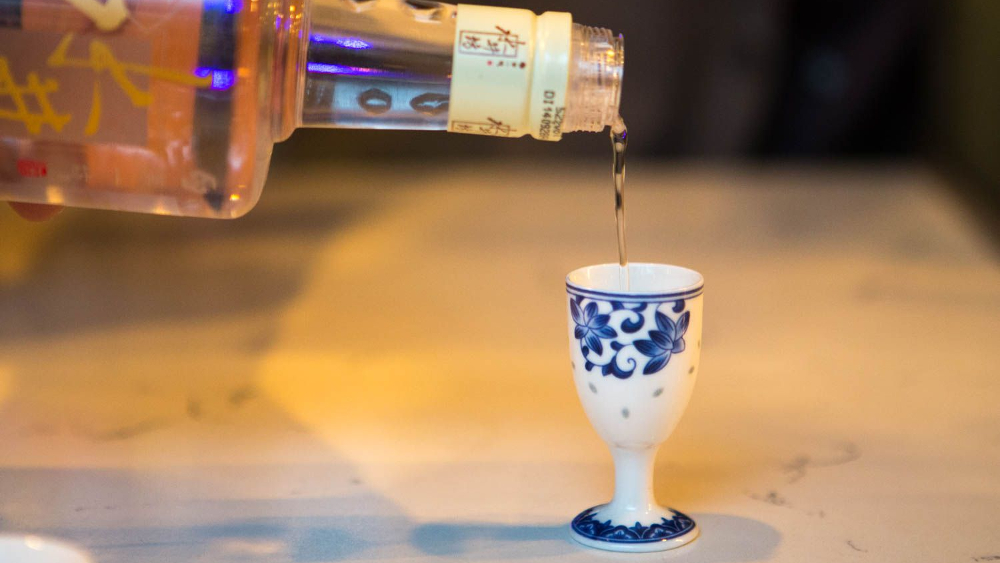
Let’s start by talking about Baijiu, a Chinese distilled liquor that has an alcohol content ranging from 28% to 65% and, despite being rarely consumed outside of China, outsells any other spirit: five billion liters annually, which is three times the total vodka consumption on the planet. It is a cheap yet influential liquor in China, where it is a tradition to serve the highest-quality Baijiu to judge someone’s loyalty before starting a business. According to Chinese culture, you only truly know someone when they are drunk.
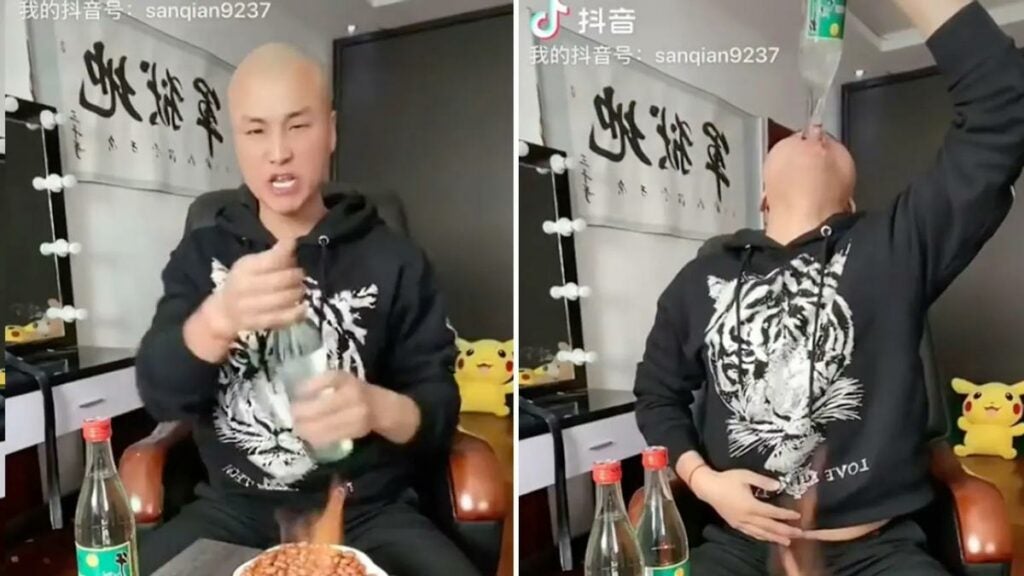
However, this wasn’t the experience for Sanqiange, a Chinese influencer also known as “Brother Three Thousand,” who on May 16th participated in a live stream on Douyin, the country’s version of TikTok that cannot be downloaded in the rest of the world. During the livestream, Sanqiange took part in something called a “PK,” a dare game where he rapidly consumed at least four bottles of Baijiu, one after another.
The livestream ended at 1 a.m., and he went to sleep. Twelve hours later, when his family found him, he was dead. Sanqiange’s death is shocking because doing livestreams while drinking was not something new for him; it was part of his regular content, similar to the “King’s League” in Spain or going to Andorra.
The death of Wang, the person behind the name, has sparked a debate about what streamers can or cannot do and how to regulate an industry that is both lucrative and young. It highlights the challenges of navigating a multimillion-dollar industry that is still relatively new, and the mixture of these factors can result in unfortunate outcomes like this.
Morirte por quince segundos de vídeo, algo que solo podía pasar en 2023. Y, sin embargo, aquí estamos.
Sorprende que a estas alturas de la vida tengamos que explicarlo, pero… Beber alcohol en exceso, sobre todo cuando pasa de cierta graduación, no es bueno. Poner en riesgo tu vida por un reto de TikTok basado en beber ese tipo de alcohol, aún peor. Morirte por quince segundos de vídeo, algo que solo podía pasar en 2023. Y, sin embargo, aquí estamos.
Hablemos primero del Baijiu, un licor destilado chino que tiene una graduación de alcohol entre el 28% y el 65% y que, sin apenas consumirlo fuera de su país, vende más que cualquier otro espirituoso: cinco mil millones de litros anuales, o lo que es lo mismo, tres veces todo el vodka que se toma en el planeta. Se trata de un licor barato pero tan influyente allí que, antes de empezar un negocio, los miembros tienen como tradición servir Baijiu del más alto nivel para juzgar su lealtad: según la cultura china, solo conoces a la otra persona cuando está borracha.
Esa no es la experiencia de Sanqiange, un influencer chino también conocido como “Brother Three Thousand”, que el 16 de mayo participó en un directo en Douyin, el TikTok del país, en una versión de la app que no puede descargarse en el resto del mundo. Durante la retransmisión, Sanqiange participó en algo llamado PK, un juego de atrevimientos en el que se ventiló él solo al menos cuatro botellas de Baijiu, una detrás de otra.
El directo terminó a la una de la mañana y entonces se fue a dormir: doce horas después, cuando su familia se lo encontró, estaba muerto. La muerte de Sanqiange es sorprendente porque lo de hacer directos donde se chuzaba no eran una novedad, sino parte de su contenido habitual, como puede ser en España la King’s League o marcharse a Andorra.
La muerte de Wang, la persona tras el nombre, ya ha impulsado un debate sobre lo que pueden o no pueden hacer los streamers y cómo se puede regular una industria al mismo tiempo multimillonaria, novata y joven, tres adjetivos cuya mezcla solo puede dar como resultado cócteles como este.
The state of Montana has been the first in the United States to ban TikTok permanently.
For years, the United States has been immersed in a political debate about the prohibition of TikTok. The popular social media platform, owned by ByteDance, has been accused multiple times of being a security risk and a “dangerous tool of propaganda.”
As it stands, attempts to ban TikTok began under the Trump administration and are still ongoing. However, it appears that the wheels are finally starting to turn: the state of Montana has become the first in the United States to definitively ban TikTok.
According to The Guardian, Montana Governor Greg Gianforte has signed a law that prohibits hosting TikTok on app stores. This measure is one of the most drastic actions taken against the social media platform, and it seems that more is to come. TikTok has come under scrutiny due to its connection with China and what this could mean for “US national security.”
As far as we know, the ban will take effect on January 1, 2024. Additionally, any entity or app store offering TikTok for download will be fined $10,000 per day. However, these fines will not affect TikTok users themselves.
As if that weren’t enough, TikTok is not the only one that has been affected by this situation. Gianforte has also announced that he will ban the use of apps that collect and send information to countries considered “adversaries” of the United States on government devices. This includes WeChat (China) and Telegram (Russia).
In case you experience these prohibitions firsthand, you can always use a VPN. With NordVPN, you can save 59% plus get an additional 3 months, along with a 30-day money-back guarantee. You also have other options like ExpressVPN, which offers an extra 3 months for free and a 30-day refund period. Of course, we can’t forget SurfsharkVPN, which provides an 82% discount on its services plus two months for free. Here are the links and detailed information:
That’s why it’s so nice to see that creators like Zequio and Becky manage to fit viral after viral, always using originality as their flag.
There are so many content creators on the internet that sometimes, amidst fake podcasts recorded to create false controversies, people screaming while watching a trailer, or official plagiarizers of jokes, those who truly create original content are at risk of being buried under the terrible and always tumultuous waters of the internet. Perhaps that’s why it feels so satisfying to see creators like Zequio and Becky succeed viral after viral, always relying on originality as their banner.
After spending enough years on the internet, one knows that when faced with a video titled “The Battle of Consoles,” all that’s left is to sigh out of boredom. However, when in the video, the protagonists are PlayStation, Xbox, and Nintendo discussing Activision, ‘Call of Duty,’ and, of course, ‘Zelda,’ things change. In just one minute and ten seconds, Zequio perfectly summarizes everything that others have been trying to make us see through extensive and repetitive speeches.
“Why are you fighting over an external franchise? Why don’t you focus on making your own games the best they can be? Games like Zelda, for example,” says Nintendo, aware that the battle over Activision and multi-platform games will only have one clear winner: never, ever bet against Nintendo. After years of uncertainty about ‘Tears of the Kingdom,’ with many assuming it would be a hastily made sequel to ‘Breath of the Wild,’ the Japanese company has once again made a strong statement and changed the history of video games. Well, considering that it’s an industry where something “changes history” every month, it’s not exactly groundbreaking.
Being a Nintendo fan means being downtrodden for eleven months of the year and incredibly proud during the one month when you can say, “Oh, sure, your little shooting game is nice, but when are you going to make another ‘Super Mario Odyssey’? Oh, you don’t know?” If we overlook the fact that they would sue a dog if its paw pad resembled Kirby, it’s hard not to have sympathy for a company that marches to its own beat. And if they happen to get a ‘Call of Duty’ by chance on the Switch, well, that’s just a bonus for them.
The singer’s new TikTok video, between parody and sharpest sarcasm, only reaffirms their love. It is that you have to love them.
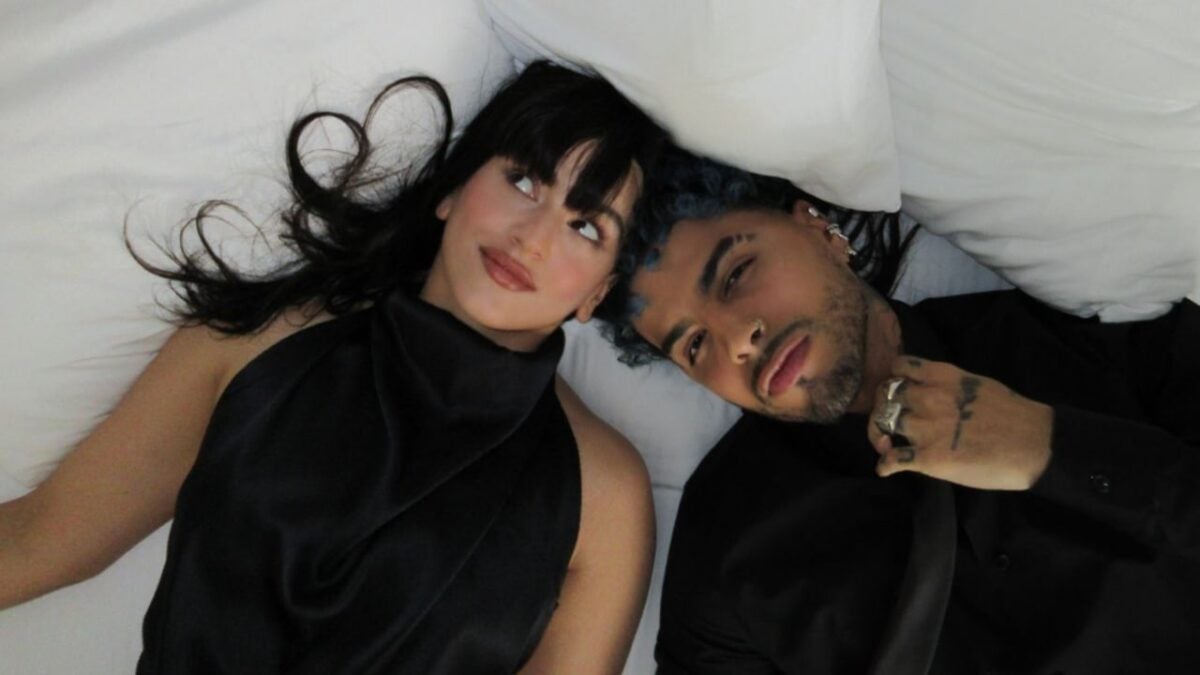
Raúl Alejandro Ocasio and Rosalía Vila may not come to mind, but if we talk about Rosalía and Rauw Alejandro you will surely know who they are at first glance: the most international couple of singers who have just sealed their engagement in the video for ‘Beso’ after a three-year relationship in which they have shown that you can believe in love between celebrities (at least until they break our hearts collectively). And the singer’s new TikTok video, between parody and the sharpest sarcasm, only reaffirms it. You just have to love them.
In it, Rosalía imitates her partner while his laughter can be heard in the background, with phrases such as “I’m going to buy a car, okay? Something simple, a Ferrari”, “Thank you, God, for this fried chicken. More adobo, more adobo” or, looking at the fridge, “No arroz con jamonilla, no chuleta, no tostones”. Each of the things the singer says have already been repeated by her fans in the comments continuously. And, despite the huge amount of money they both accumulate, it is always nice to see them interacting as if they were a normal couple.
They are not, of course: the singer has been able to show the video to her 30 million followers and in just one day already has 2 million likes. Almost nothing. Rauw Alejandro is no slouch either: he has 14 million followers on TikTok and some of his videos exceed 98 million views. Read that again: 98 million. A normal couple, wow.
Considering that the singer tried to enter ‘Tú sí que vales’ at the age of 15 but was rejected by the jury and that her boyfriend was going to be a soccer player before discovering music and, in fact, was depressed after suffering an injury that split his career in two, the road to here has been a succession of happy events that has ended with the two of them together forming one of the most powerful power couples in Latin music. And Rosalía’s blue-wigged, Puerto Rican-leaning Rosalía impersonation has only made their fans fall even more in love.
Of course, they have an important request: now it is Rauw who has to imitate the singer in her daily life. What is clear is that they themselves are the ones who run their social accounts and don’t care much about what they will say: proof of this is the test that the ‘Motomami’ singer did of her song ‘Hentai’ in a week in which jokes and memes with “I love you ride, like my bike” went viral continuously.
The two have been able to break through all the criticism and prove that they are an authentic couple. And nothing says “authenticity” like a blue wig and the phrase “Diablo, baby, you got a giant ass, that ass of yours has got me crazy”. No one said being the hottest artists would be easy in 2023, did they?
It’s a bit like what happened to Paula Gonu, who between extremely uncomfortable laughs couldnt believe the delirious conversation that she had had to endure and that, of course, she posted on TikTok.
Riding in a cab requires luck, expertise and conversational skills that not everyone has. Depending on the day, the conversation can revolve around city traffic, soccer, one’s experiences or, if you get the worst possible choice on the destination dice, politics. And you’re lost. You don’t want to contradict the person who is taking you somewhere, after all. This is a bit what happened to Paula Gonu, who, amidst the most uncomfortable laughter, could not believe the delirious conversation she had to endure and which, of course, she has posted on TikTok.
Faced with the education of some, who have been in the profession for years and know perfectly well how to treat anyone who gets into the car, there is the rudeness of a few who, if they touch you, can ruin your day. When Gonu, the 30-year-old Catalan influencer, got into that cab, she didn’t imagine that the driver would be one of the latter.
Neither short nor lazy, the cab driver thought that the best topic of conversation was not the weather or work, but the breasts. More specifically, hers. “It hasn’t been in fashion for long,” the man insisted, trying to bring up conversation in the most unexpected place, “it’s a new fad of not wearing a bra”. Gonu, normalizing the scene and, we suppose, trying to calm down for not calling him everything, tried to conclude with “I don’t know, I’ve never had one”. And since there was a reply, the driver suddenly felt free to insist on the subject.
“Never? Really? Well, you’re comfortable like that, aren’t you? Let her air, right?” You know those times when the most awkward, cutting silence would be more pleasant than anything that could be said? Well, that was one of them. And alas, the boy filled it in with more words harping on the subject, just in case it hadn’t been clear: “But it looks like it depends on how it looks, the little tippy tip looks”. Ah, yes, I have read this one: a love poem by Gustavo Adolfo Becquer, right?
Crazy Taxi
If you still haven’t taken your hands to your head (or have had some retching), wait, there’s more: “It depends, some of them wear very… thin clothes, you can see the tip”. Someone should have reminded the gentleman (whom you can imagine saying “I am not a sexist” at the bar) that FakeTaxi is fiction.
The influencer herself wrote about the incident, saying “I laughed nervously, with the ‘tip’ comment I wanted to vomit. I was wearing a plain cotton top from Zara, just so you know”. The video has half a million views and around 416 comments, mixing words of encouragement with those from people who try to imitate or even surpass the disgust of the taxi driver. It seems that sometimes in real life, there are people who are even more repulsive than those hiding behind a pseudonym.
The next time you get into a taxi and the driver shows you photos of their pets, talks about how well Atlético Madrid is doing, or brags about their family, remember that anything is better than having a conversation about bras, breasts, and “tips”. Sometimes it’s better to have nothing to talk about.
Literature has returned to being one of the main hobbies among Generation Z thanks, paradoxically, to TikTok.
You may have read that Generation Z searches on TikTok rather than Google. It’s not true (it was a phrase taken out of context that talked about fashion shopping habits), but it’s getting closer and closer to reality. Maybe some of you think that the influencers on Instagram, Twitter, YouTube or -in extreme cases- the press have the upper hand when it comes to recommending and turning an unknown novel into a hit with the public, but the truth is that this is the merit of TikTok and the booktokers. Don’t you know them yet?
“Addictive and quick to read books“, “Booktok books that I do recommend”, “If you’ve read it, I like you”, “Books in 60 seconds”… No matter how much the cultural establishment has tried to promote reading through campaigns and somewhat outdated comments from authors unknown to young people, the truth is that literature has once again become one of the main hobbies among Generation Z thanks, paradoxically, to TikTok. If this is all Greek to you and you were one of those who believed that TikTok was destroying culture instead of promoting it, don’t worry: we all have a boomer inside us.
Booktokers can sell out copies of books that were released four years earlier, make and break phenomena: publishers have stopped looking at the most brainy websites to focus on influencers who, in just one minute, are able to sell a book to their followers. Novels like ‘It Ends with Us’, ‘The Atlas Six’ or ‘The Seven Husbands of Evelyn Hugo’ might never have had more commercial trajectory if it weren’t for a teenager who discovered them and quickly made them viral.
The phenomenon of recommending books through videos has been around since the days of booktubers. But since 2016, the change of favorite social network has also brought with it a change in attitudes. It is no longer of interest that you convince me in ten minutes of the goodness of a new young adult novel. Now you have one. If it can be less, even better. Studies are showing that, all over the world, Gen Z took refuge in reading after the pandemic and confinement. With no friends or nights out, TikTok became a key place to have a new hobby, get ideas, recommend and devour page after page. It’s not so strange after all, is it, or don’t you rely on your friends to pick your next book?
Don’t judge TikTok by its front cover
Obviously, this phenomenon has, for publishers, the same problem as any influencer: except for very specific phenomena, it is impossible to know the real phenomenon in sales of the novels that are promoted. They know that they influence, but not how much. It is not a problem: the cost for the company to send a hundred copies is minimal for the result they can obtain.
Some may complain that great literary masterpieces such as ‘Crime and Punishment’ or ‘Don Quixote’ are not represented in this new generation of readers. Frankly, there is no need for that. At TikTok, they know how to encourage reading what they want to read: their opinion leaders keep going, novel after novel, teen saga after teen saga, browsing everything that affects them personally. Maybe that’s why we’ve seen an increase in millennial and Gen Z literature like the fabulous ‘Supersaurus’ or the very punk ‘Taller de chapa y pintura’. You have to give the reader what they want to read.
But it’s not all about recommendations: booktokers are aware that their channels should not just look like simple Teleshops or automatic recommenders, and that’s why they often upload short sketches, identifiable jokes, memes and more, following trends that transcend the community itself. TikTok has a unique language, narrative guidelines that are different from any other social network, and it was not going to be less in the literary recommendation.
Want some names to know where to start? Jot some down: @anne.r.r._@saraar_fer@libroslibroslibroslibros or @andreorowling are just a few to start with. From there, let yourself go: TikTok’s algorithm is chaotic and impulsive and nothing foretells which video will become a hit and which won’t… But it usually gets right what we want to see. And, therefore, what we’re going to read.
Sit back, enjoy and search for #booktokers in the TikTok search engine: You have to know how to adapt to the times!
A new bipartisan bill has been introduced by US senators that could lead to the banning of TikTok, the Chinese-owned social media app, in the country. The bill, known as the Restricting the Emergence of Security Threats that Risk Information and Communications Technology (RESTRICT) Act, seeks to address potential risks posed by foreign technology by enabling the government to identify and respond to emerging threats in a proactive manner.
Under the proposed legislation, government agencies would have the authority to take action against services they consider to be threatening, as long as they have access to personal data belonging to more than one million US citizens. The bill would establish a formal process for such actions to be taken.
It should be noted that while the RESTRICT Act does not specifically mention TikTok, it does encompass companies from countries that are viewed as adversarial to the United States, including China, Cuba, Iran, North Korea, Russia, and Venezuela. The bill aims to address the potential security risks associated with foreign technology companies and establish a process for the government to proactively respond to emerging threats.
A spotlight on the RESTRICT act
The RESTRICT Act contains several provisions, including the creation of processes by the Secretary of Commerce to identify and prevent transactions involving foreign adversaries’ interest in information and communications technology products that may pose a risk to national security. Particular focus will be placed on evaluating technology products used in critical infrastructure, telecommunications products, and emerging technologies with significant national security implications.
The legislation mandates that the Secretary of Commerce take comprehensive measures to address the risks associated with untrusted foreign technology products. This will involve considering concerning activity identified by other government entities.
Additionally, the Secretary of Commerce must collaborate with the Director of National Intelligence to provide declassified information to the public and business community to educate them about transactions that are denied or mitigated due to undue or unacceptable risks.
Why is TikTok seen as a threat to US national security?
According to Senator Mark Warner (D-VA), who is the primary sponsor of the RESTRICT Act, TikTok is perceived as a threat to US national security because of its potential to enable surveillance by the Chinese Communist Party and promote malign influence campaigns within the United States.
Recently, the House Foreign Affairs Committee proposed the Deterring America’s Technological Adversaries Act (DATA Act), which would direct President Joe Biden to impose sanctions or ban TikTok if his administration finds that the platform has shared US user data with individuals affiliated with the Chinese government.
While the House bill is focused primarily on TikTok, Senator Warner’s Senate proposal is more comprehensive. It seeks to establish a system to assess and penalize foreign companies that pose a threat to US security, rather than solely focusing on TikTok.
TikTok refutes claims that it stores US user data in China
Concerns have arisen over how TikTok manages US user data and whether it stores such data in China. While there is no conclusive evidence to support claims that TikTok currently stores US user data in China, industry experts have raised concerns about the potential national security risks posed by the company’s connections to China and its parent organization, ByteDance.
In the event that TikTok were to store US user data in China, it could potentially provide the Chinese government with access to sensitive information such as browsing history, location data, and device information, among others. The Chinese government could leverage this data to perform surveillance, gather intelligence, or carry out cyberattacks.
TikTok collects an extensive range of user data, including location data, device information, browsing history, as well as personally identifiable information such as email addresses and phone numbers. The platform claims to utilize this data to personalize the user experience, provide improved recommendations, and deliver targeted advertisements.
Despite the fact that TikTok maintains that it stores US user data in the United States and Singapore, it is noteworthy that the company has previously come under regulatory scrutiny and legal action over its handling of user data. Hence, it is important to continue monitoring TikTok’s management of US user data and take necessary measures to reduce any possible national security risks.
Despite TikTok’s assurances to limit safety risks, negotiations with the Committee on Foreign Investment in the United States (CFIUS) have been ongoing for more than three years. The RESTRICT Act could deal a severe blow to TikTok’s US operations, potentially resulting in a ban or severance of ties with American companies. Therefore, it is crucial for marketers to keep an eye on the developments surrounding the RESTRICT Act, as it could have implications for marketing strategies that depend on the platform.
The RESTRICT Act represents a significant step in addressing the potential national security risks posed by foreign technology companies, including TikTok and its Chinese-owned parent entity ByteDance. The legislation seeks to establish a formal process for government agencies to identify and respond to emerging threats, with particular emphasis on evaluating technology products used in critical infrastructure, telecommunications products, and emerging technologies with significant national security implications.
Whether or not the act will actually result in the ban of the use of TikTok on US soil remains to be seen, but the grounds for a ban or at least an insistence by the US government about greater transparency on the part of ByteDance definitely seems to be present. We’ll keep you updated as the situation unfolds.
Many public universities across the US have already started banning the popular social media app TikTok. Recently, two of the country’s largest colleges followed suit in banning the platform from campus networks and devices.
The two latest universities to join in on the US fight against the Beijing-owned TikTok are the University of Texas and Texas A&M University. This sudden uptake in universities banning the social media platform comes from the executive orders issued by several state governors. The University of Texas’s Technology Strategy Advisor sent an email to all students informing them of this ban. Included in the letter, they also stated that the university is taking these steps to comply with Governor Gregg Abott’s directive against the platform.
Texas universities and Auburn have banned Tiktok from campus Wi-Fi so now students can only access the site via their own data plans. Is this necessary to protect national security or a gross violation of freedom speech? pic.twitter.com/ET2LCt2zSe
Governor Abott isn’t the only one that places greater emphasis on banning TikTok from government and now public educational centers. He merely joins other states like Alabama, Arkansas, Florida, Georgia, Idaho, Iowa, Oklahoma, and South Dakota that have already implemented this ban in public universities.
However, along with banning the app from public universities, Governor Abbot also banned TikTok from any government devices in early December. The main reason given for these bans is concerns related to data security and privacy stemming from the app’s Chinese ownership.
Governor Abbot listed these concerns as a growing threat and gave Government agencies until February to plan and implement the necessary changes. However, none of the other potentially harmful concerns were mentioned.
The staff at Texas University cited that they’re taking the necessary steps to ensure any information and data contained on the University network is safe. Banning TikTok from university networks and university-owned devices should eliminate the risk of this information getting out to other countries.
According to the governor’s directive, TikTok harvests an excessive amount of information from users device’s. This includes data related to when, where, and how they use the internet. This information, which could contain troves of personal or sensitive information, is then delivered to the Chinese government.
At the moment, TikTok still finds itself in a strange predicament amongst the US population. While the popularity of the app continues to remain strong, it’s also under intense scrutiny at the federal and state levels. Even though the Biden administration banned TikTok from Government devices and networks, the concerns were initially raised by the Trump administration.
Ironically, the US government is taking such a stand against TikTok, while many other apps headquartered in the US also use similar tactics in harvesting data, such as Facebook, Twitter, and Instagram. However, since these are US headquartered companies, they have more recourse when pushing back against these policies.
Regardless of what the general public thinks of the ongoing TikTok controversy, the bans on the app in universities will continue. Many students simply stated that if they can’t use the app on campus networks, they’ll simply switch to their data plans to access TikTok. This brings with it other concerns such as bans creating inequality among peers while also limiting free expression. We look forward to seeing what the response will be to the new concerns.