{
"de-DE": "",
"en-US": "Justin Cabrera is a tech content writer with Softonic.com. Prior to joining Softonic, Justin was a overcaffeinated radio DJ and know-it-all music critic with WPGU 107.1. His two favorite things in the world are video games and music culture.",
"es-ES": "",
"fr-FR": "",
"it-IT": "",
"ja-JP": "",
"nl-NL": "",
"pl-PL": "",
"pt-BR": "",
"social": {
"email": "",
"facebook": "",
"twitter": "",
"linkedin": "https://www.linkedin.com/in/justin-cabrera-62037a107/",
"web": "https://www.clippings.me/justincabrera"
}
}
Discover how gamers are overcoming disabilities to compete at a world-class leve.
If you watched the Super Bowl, then you probably saw Microsoft’s “We All Win” commercial.
The ad depicts a bunch of kids with various mobility limitations who all share a love for gaming. Many of them can’t use both of their hands, which makes using traditional controllers difficult for them. Fortunately, these kids were able to game to their full potential with the Xbox Adaptive Controller.
Created in partnership with The AbleGamers Foundation, The Cerebral Palsy Foundation, SpecialEffect, Warfighter Engaged, and more, the Xbox Adaptive Controller is a highly customizable controller designed by and for the disabled gaming community. Because no two instances of disability are the same, the controller comes equipped with ports for every input on an Xbox controller, allowing the user to connect whatever accessories would help them most.
Each port matches a button, letting the user create the perfect controller for their needs
Various extensions like pedals, joysticks, switches, and buttons allow the controller to fit the player’s specific needs. With their perfect setup, disabled gamers are no longer held back by their controllers, and they can get back to the hobby that they love.
The Xbox Adaptive Controller is far from the first device aimed at helping disabled gamers. Custom controller manufacturer Evil Controllers makes customized Xbox and PlayStation controllers that make it easier for disabled gamers to play. Their one-handed controllers allow gamers to use the full capabilities of a typical controller with only one hand. For those with muscular dystrophy, cerebral palsy, or other conditions that limit motor mobility, Evil Controllers has created controllers that can be used by moving your head and mouth.
With or without special controllers, disabled gamers have made a splash in eSports. For most disabled gamers, fighting games are a natural fit due to their highly customizable control schemes, mind games, and dedicated competitive scenes.
Mike “BrolyLegs” Begum is a competitive Street Fighter and Smash Bros. player with arthrogryposis and scoliosis, preventing him from using his arms or legs. To play, BrolyLegs uses his cheek, tongue, and mouth to work a standard Xbox controller. While many players are surprised by BrolyLegs’ control scheme, he has proven his skill time and time again in Street Fighter tournaments, besting players with his Chun-Li (Chun-Li is considered one of the hardest and most technical characters in the game, and BrolyLegs is considered one of the best).
For BrolyLegs, traveling the world and competing in tournaments has changed his life. He has said that tournaments help him make friends and fuel his self-confidence. Playing his trademark rushdown, aggressive style with Chun-Li allows BrolyLegs to express himself to people in ways he otherwise wouldn’t be able to. While some players pity or even outright dismiss BrolyLegs in tournament, he is always quick to show them up with his immaculate spacing and mental play. Above all, BrolyLegs says he wants to be seen as a gamer and a competitor just like everyone else. Through his Street Fighter success, he hopes to inspire other disabled gamers to compete and accomplish their dreams.
Gaming is an amazing hobby and it should be as accessible as possible to anyone that wants to play. If you’d like to help the disabled gaming community, check out AbleGamers.
Scientists create gloves that let you touch virtual objects
The new battle royale shooter had a surprise release. Have you played it yet?
The rumors were true. After last weekend’s mysterious teaser stream, Respawn’s new battle royale shooter Apex Legends is available to download. The free-to-play title is a spinoff from Respawn’s Titanfall series. Taking place 30 years after Titanfall 2, Apex Legends has a bunch of colorful mercenaries fighting for control of the limited resources of the Outlands. The game is its own unique entity, as it does not feature Titans or wall-running. The gameplay reveal trailer can be seen below:
The game is an eclectic mix of Fortnite, Overwatch, and Titanfall. Like Overwatch, Apex Legends features several distinct playable characters, all with unique active, passive, and ultimate abilities. At launch, there are six playable Legends, with two additional characters that can be bought either using real money or in-game currency. The heroes each have distinct personalities and voice lines, giving the game a bit more flair than competitors like PUBG.
Team formation is key to Apex Legends, and the pre-game character selection has been tweaked to make sure teams have balanced roles. In most character-based team games you’ll have games where you don’t have an essential character, like a tank or a healer, because some living legend decided to pick Hanzo instead. Apex Legends alleviates this by forcing your team to pick their characters one at a time. If you see your team lacks a healer, you’ll have to pick one to ensure success. For a breakdown of every current Legend, watch the video below:
Gameplay-wise, Apex Legends more closely resembles CoD’s Blackout mode than either Fortnite or Titanfall. Like Titanfall, the gunplay is tight and satisfying, and the movement is fast-paced and fluid. Though the game lacks Titanfall’s iconic wall-running, vaulting over objects and navigating obstacles still feels smoother than other battle royale games. Like Blackout, organizing your items and attachments is surprisingly simple and streamlined, even while playing with a controller. One of the biggest ways Apex Legends differentiates itself from other battle royales is that it is entirely team-based. Every match has 20 teams of three competing to be the last one standing.
Apex Legends has some built-in features for those who want to cooperate but don’t like voice chat. When the match is beginning, a leader is randomly chosen who pings which location the squad will land in. While other players can offer suggestions, the leader ultimately chooses where the squad will land. During the match, players can use the detailed pinging system to highlight loot, enemies, and escape routes, allowing the team to coordinate their movements cleanly. While high-level players will inevitably forgo these options for voice chat, it’s a nice inclusion for more casual players who don’t want the stress associated with voice.
Apex Legends is currently free to download on PS4, PC, and Xbox One. If you’ve played it, let us know what you think! And if you haven’t played it yet, just click below to get started:
Go back to the future with these mind-blowing shoes.
Like many people, we were disappointed when 2015 finally rolled around and we still had to tie our shoes by hand. We didn’t have hoverboards either, but self-lacing shoes were the least we could’ve gotten.
Four years later, Puma has answered our cries with the Puma Fi. The Fi (standing for fit intelligence) is a self-lacing smart sneaker that is designed for both everyday and athletic use. A video showing off its capabilities and design can be seen below:
The shoes have a clean, understated profile. The jet black color and streamlined design resemble that of a sports car.
A small micromotor protrudes from the top of the shoe, which uses a touchscreen to tell the tiny fibers within the shoe when to tighten and loosen. Swiping up or down on the shoe causes it to tighten until the cables feel enough tension, though the tightness can be adjusted with additional swipes. When tightening, the micromotors make a satisfying whirring sound, not unlike Marty McFly’s Air Mags. By placing the tightening mechanism on top of the shoe as opposed to in the sole, Puma hopes to let the shoe feel more natural than other smart sneakers.
The shoes are water-resistant but unfortunately not waterproof. The charge on the sneakers lasts around five-to-seven days according to Puma, and can be charged with either a wireless Qi pad or by removing the batteries and placing them in a charging case (similar to Air Pods).
Google Project Jacquard weaves tech into our clothes like in Black Panther
The shoes can be tightened through an iPhone or Apple Watch app, so users can adjust them without ever having to touch their shoes. Through the app, the shoes can be adjusted at a more precise level, and each shoe can be tightened or loosed individually.
While the shoes won’t be available commercially until Spring 2020, Puma is offering pairs for free in an open beta test. Puma has said to stay tuned to its Pumatrac app for an announcement as to when to sign up for the beta test. Once released to the market, the shoes will be priced at $330.
The description for the event reads: “Xbox Live players are highly engaged and active on Xbox and PC, but now they can take their gaming achievement history, their friends list, their clubs, and more with them to almost every screen.” Microsoft clearly didn’t want people to know this yet, as the conference listing has been removed from the Game Developers Conference schedule.
Almost 20 years ago, Microsoft revolutionized online gaming with Xbox Live. The service introduced many features that are now standard, like friends lists, universal usernames, voice chat, parties, achievements, matchmaking, lobbies, and more. Basically, every online gaming service, from PlayStation Network to Steam, has been built off the foundation of Xbox Live. The obvious exception is, of course, Nintendo.
Nintendo has been infamous for their complete inability to make a decent online service. For a company that makes some of the most creative and innovative games ever, online seems to be the one concept Nintendo cannot get right. From 12-digit Friend Codes to a lack of matchmaking and voice chat, Nintendo disappointed online gamers consistently, but their incompetence was tolerable enough because their services were free. Nintendo Switch Online was Nintendo’s first attempt at a premium online service, and reception has been overwhelmingly negative due to the service’s lack of basic features like built-in voice chat.
Xbox Live coming to Switch could provide a much-needed boost to Nintendo’s online community. The ability to party up with friends and chat with them through supported games would provide Nintendo fans with the functional online service they’ve begged for. While we don’t exactly know how the service will work on the Switch, it certainly can’t hurt the console’s online reputation. Also, though it’s unclear if Xbox Live would cost money on the Switch, it should be noted that the Switch version of Minecraft uses Xbox Live for multiplayer at no additional cost.
Nintendo and Microsoft have shown that they’re willing to work with each other over the past few months, including teaming up to make a commercial that promotes crossplay between their consoles. Bringing Xbox Live to Switch is the next step in this relationship, so who knows what collaborations the two companies will make in the future?
If you ever wondered how Super Mario would fare in a 1-on-1 game with LeBron James, you need to read this.
Crossovers and gaming have a long history with each other. Some of the most successful franchises in gaming today are based on unlikely crossovers. Who would’ve ever thought we’d see Mario fight Sonic and Mega Man in Super Smash Bros? Or seeing Cloud Strife fight alongside Donald Duck in Kingdom Hearts?
While Smash and Kingdom Hearts are two beloved games that everyone loves, here are some really weird crossovers that may have flown under your radar.
5 most bizarre crossovers in gaming history
5. The guest characters in Tony Hawk
Can he shred? Listen bud, he’s got radioactive blood
The Tony Hawk series is acclaimed for its fast-paced arcade skateboarding gameplay, iconic soundtrack, and innovative combo system. The megapopular series exemplified skating culture in the late ’90s to early 2000s and helped to popularize extreme sports.
What you may or may not remember, however, is just how many weird guest characters hopped on board. While you had access to basically every major pro skater you could imagine, you could also choose from more colorful characters from popular culture. You could pop ollies as Marvel superheroes like Spider-Man, Wolverine, and Iron Man, grind along rails as Shrek, and hit 1080 melons with Darth Maul and Jango Fett. Even Tony Hawk Pro Skater 5, which is a horrible game, included guests like the Teenage Mutant Ninja Turtles, Lil Wayne, and Tyler the Creator.
Unlocking all of these characters required searching every inch of every level for secrets, but the novelty of seeing Wolverine skate past Darth Maul was totally worth it.
4. Fortune Street/Mario Hoops 3-on-3
While mashing together Mario characters and Square Enix characters may sound strange at first, it’s really no weirder than Kingdom Hearts. However, when you mix both franchises with a Monopoly-style board game you get the bizarre stitched-together game Fortune Street. Like Monopoly, Fortune Street has players rolling dice and traveling a board to buy property. Instead of playing as a boot or a top hat, players can take control of Mario, Dragon Quest’s Slime, and other mismatched characters. The series is popular and enduring in Japan but has yet to achieve the same success overseas.
Mario Hoops 3-on-3, another collab between Square Enix and Nintendo, makes slightly more sense. For the most part, the game is your standard arcadey Mario sports game, complete with exaggerated gameplay and crazy power-ups. What makes this game unique among Mario sports games is the inclusion of Final Fantasy characters like Cactuar, Black Mage, and Moogle. If, for whatever reason, your dream is to see Waluigi get dunked on by the White Mage, then this is the game for you. The music is also incredibly infectious.
3. Mario meets LeBron
Mario should get scouted by the Cavs soon enough
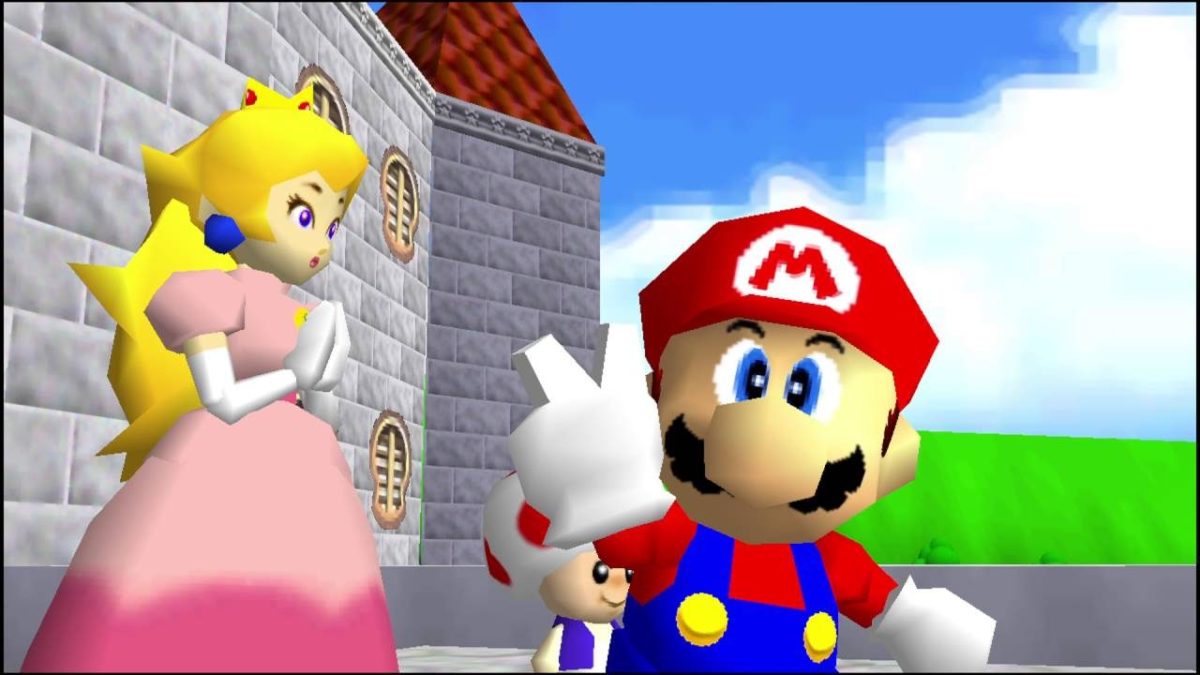
In the most unlikely basketball crossover since “Space Jam,” Mario, Luigi, and Princess Peach face off against NBA superstars in NBA Street Vol 3. Giving LeBron the humbling he deserves as Mario himself was an amazing feeling back in the day, but don’t hold your breath on the Mario crew appearing in the next 2K. The Mario crew appearing in the NBA Street series is all the more hilarious as the game features a much grittier art style and aesthetic than the more pristine NBA 2K series.
The inclusion of Mario and friends was part of a licensing agreement between EA and Nintendo. The agreement also saw the Mario Bros. as playable characters in SSX On Tour, letting the brothers pull off radical midair snowboarding stunts. The most bizarre crossover to come out of this agreement, however, was the inclusion of Punch-Out boxer Little Mac in EA’s Fight Night Round 2. Little Mac is the only cartoonish boxer in the game, and his 3-D model looks absolutely horrifying.
Mac really went downhill after taking down Mike Tyson
2. Dream Mix TV: World Fighters
Want to see Solid Snake fight Optimus Prime? What, you’ve never even thought of that? Even so, make it happen with Dream Mix TV: World Fighters. Dream Mix is a Smash-like fighting game released only in Japan. Developed through a collaboration between Konami, Hudson, and Takara (a popular Japanese toy company), Dream Mix presents its fights through the lens of an intergalactic TV show. Desperate to boost ratings, a bunch of TV executives summon heroes from across the universe to do battle, including Bomberman, Simon Belmont, Megatron, and Tyson (yes, from Beyblade).
The game is a side-scrolling platform fighter like Smash. Instead of racking up damage percent, fighters in Dream Mix knock hearts out of their opponents. If you collect enough of your opponent’s hearts, their soul will leave their body and fly around. If you can collect their soul before they do, you eliminate them from the match. The game is something that needs to be truly seen to be believed, so here you go.
1. Monster Hunter and literally everything
If you’re a fan of the long-running series Monster Hunter, then you probably know that the games have plenty of crossovers. You may not realize the staggering amount and sheer variety of crossovers involving Monster Hunter, so I’ll list them some of them out for you:
Hello Kitty
Metal Gear
Inyusha
Dead Rising
Attack on Titan
Hatsune Miku
Zelda
Mario
Metroid
Star Fox
Animal Crossing
Fire Emblem
Street Fighter
Mega Man
Devil May Cry
One Piece
Neon Genesis Evangelion
JoJo’s Bizarre Adventure
Sonic the Hedgehog
Pizza Hut
Resident Evil
Yu-Gi-Oh
Ace Attorney
Sailor Moon
Hunter x Hunter
Marvel vs Capcom
Super Smash Bros
The Witcher
Is there anything Monster Hunter hasn’t crossed over with? The answer, of course, is no. The Pizza Hut collab has to be the greatest crossover in gaming history.
Is Nintendo stuck in a creative rut? Here’s how they can break out.
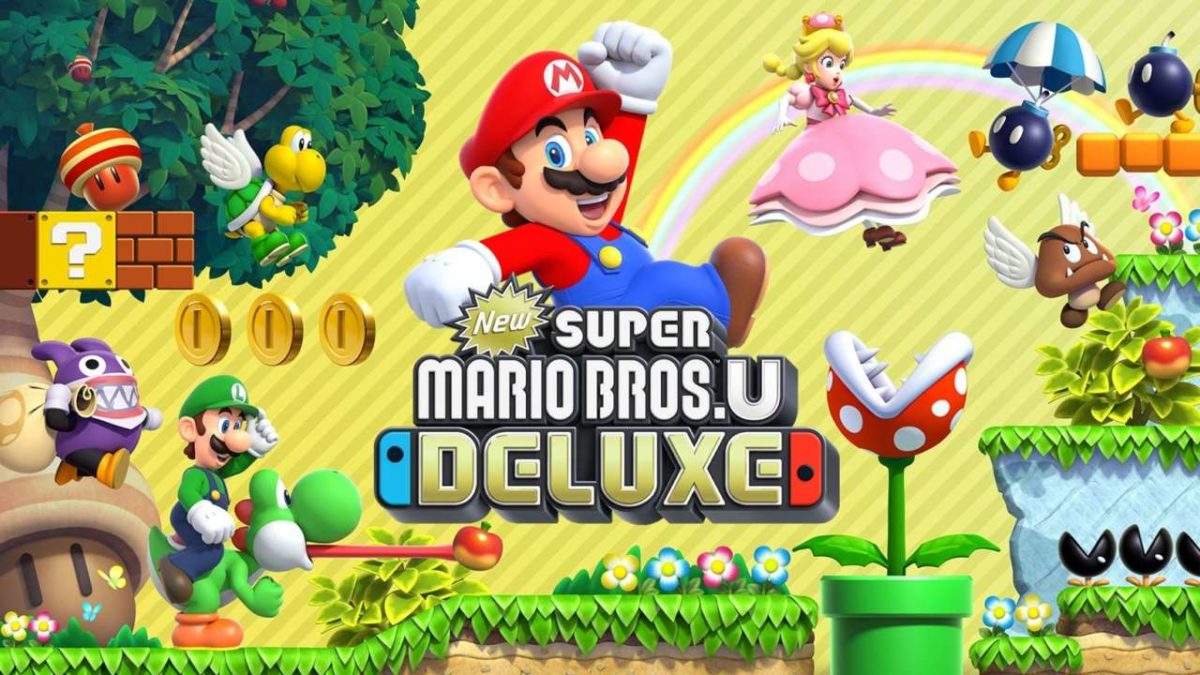
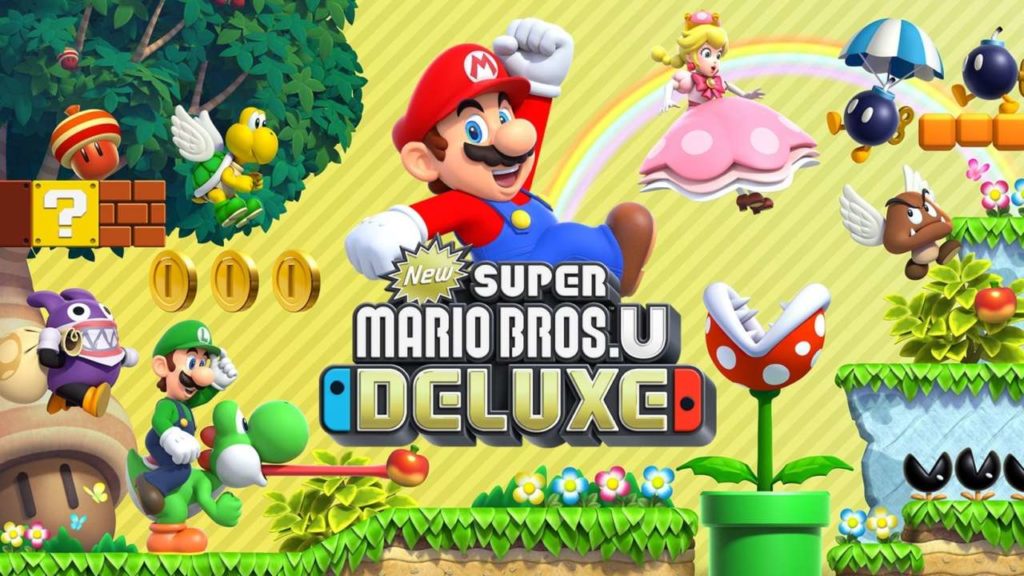
Nintendo just released New Super Mario Bros. U Deluxe to critical praise and high sales. The game is an enhanced port of the Wii U’s New Super Mario Bros. U that includes the game’s New Super Luigi U expansion. The game is the latest installment in the New Super Mario Bros. series, meaning it’s a well-made 2D Mario platformer. The game is a perfectly serviceable 2D Mario game, offering tight, challenging gameplay and a large amount of content. Something just feels missing from the whole package, however. If New Super Mario Bros. U Deluxe is fun and well-made, then why is it not exciting? Why is the release of a new Super Mario Bros. game, arguably the most iconic and successful franchise in all of gaming, not a bigger deal?
A problem with packaging
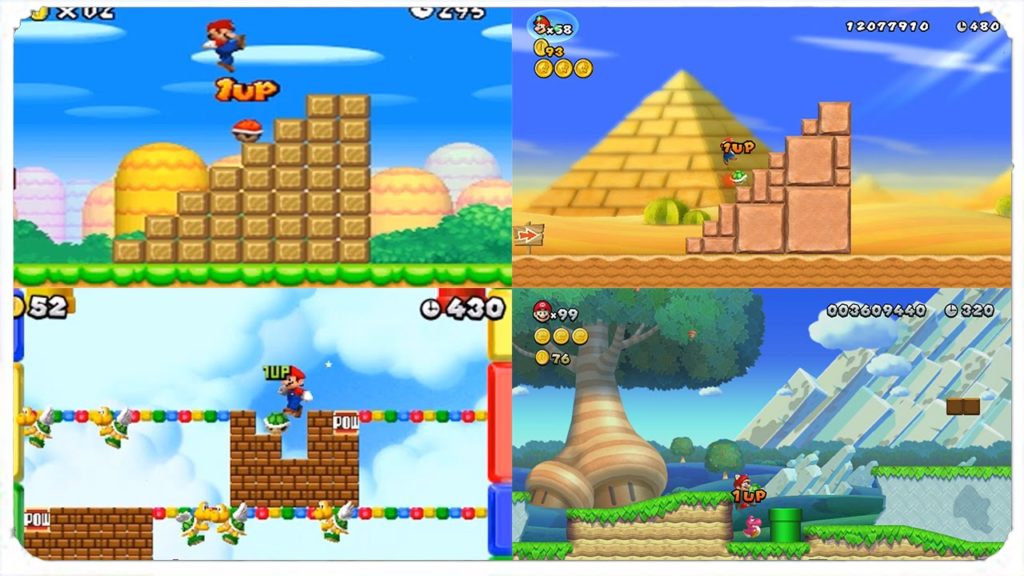
There are four games in the New Super Mario Bros. series: New Super Mario Bros., New Super Mario Bros. Wii, New Super Mario Bros. 2, and New Super Mario Bros. U. Without looking it up, I’d like you to try and point out which game is which on the screenshot below:
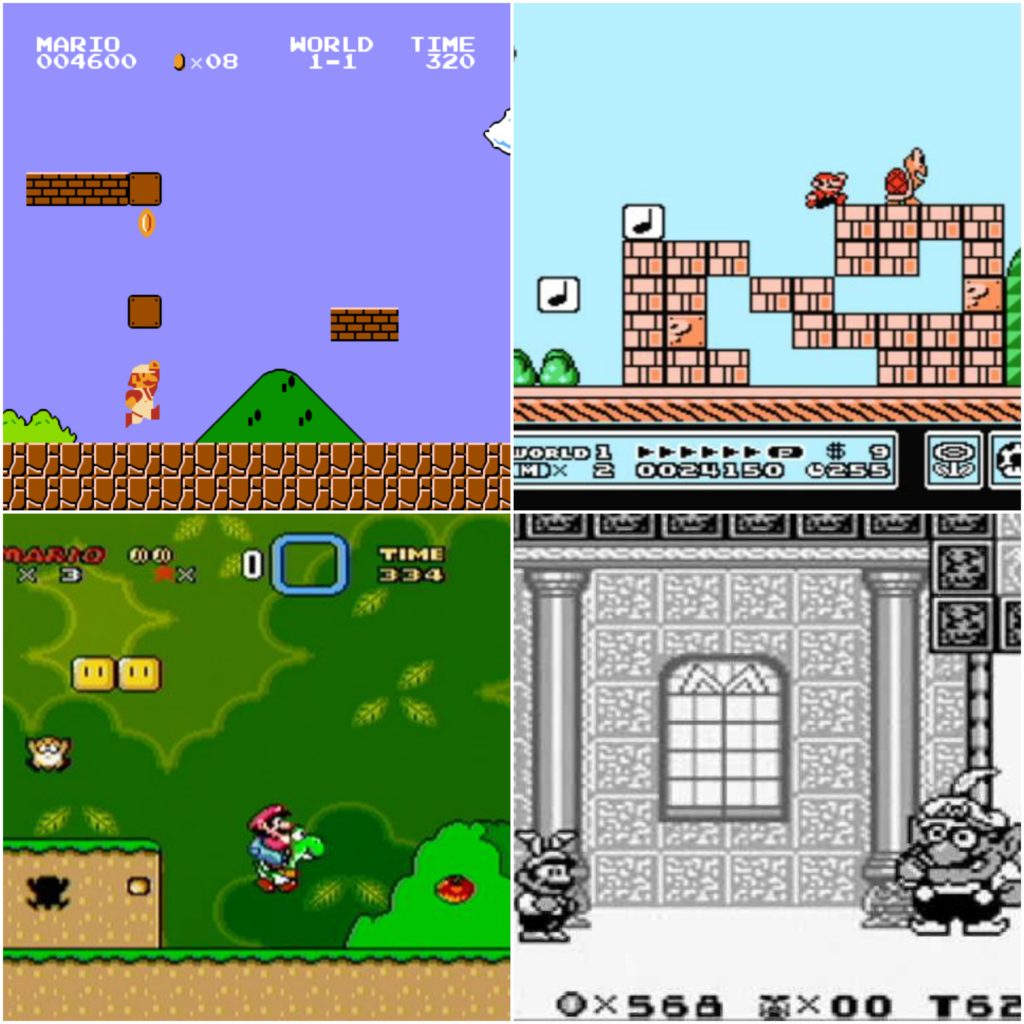
Pretty hard isn’t it? That’s what happens when four games come out with the exact same art style. When the original NSMB released for the DS in 2006, it was legitimately “new.” It was the first time we saw a 2D Mario game with 3D models and the streamlined modern Mario art style. This quickly wore thin as three more games were released with the exact same art style within six years. Sure, the games look nice and colorful, but they look absolutely sterile in comparison to series’ like Donkey Kong Country, Wario Land, or Rayman. Take a look at how the classic 2D Mario games looked in comparison to each other:
These games were much, much more distinguishable from each other. Like the NSMB games, they appeared on different consoles, but they remained distinct by having different art styles and a degree of stylization in each. By stylization, we mean creating an art style that differs from the standard Mario fare, telling the player instantly that they’re in for a brand new and different experience, with a great example being the Paper Mario series’ storybook aesthetic. Back then, it was exciting to have a new 2D Mario game come out because it was a wholly different experience than the last one. Even the music of the NSMB series has remained very similar throughout the years. Compare the overworld track from the original NSMB to one from NSMBU.
While the upbeat guitars and cheerful “BAH!” sounds that made up NSMB’s soundtracks were different and cute at the time, the style has worn far past thin when it’s still in use over six years later. Aesthetically, the NSMB is comparable to the Madden franchise in how little it evolves throughout the years. It’s highly disappointing that the series shows so little growth and creativity, as other recent Mario games show that Nintendo is still able to make masterful and creative worlds.
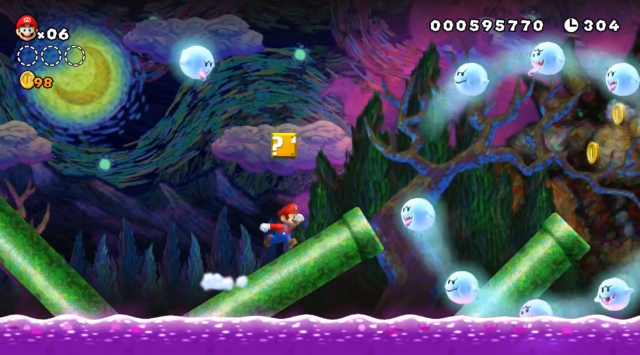
Last year’s Super Mario Odyssey saw Nintendo taking plenty of risks with the Mario formula, and with a huge payoff. The game saw Mario exploring a city with realistic humans, exploring an ancient waterfall complete with dinosaurs, bouncing around on stylized polygonal food, and invading Bowser’s samurai castle. The theming of Odyssey is a far cry from NSMB’s standard formula of plains-desert-ice-lava. Even within NSMB, Nintendo has shown flashes of creative brilliance, like with the painted world in NSMBU, but these levels are extremely few and far in between.
How to shake things up
In this writer’s humble opinion, a nice way Nintendo could shake up the 2D Mario series is with a 2D hand-drawn art style. While making a game like this is extremely time-consuming, the end result is a fluid and detailed looking game that clearly had a lot of passion put into it. Take a look at Wario Land: Shake It! below, as it uses hand-drawn animation and looks absolutely gorgeous.
Wario himself has hundreds of different animations, giving him tons of character and personality. Over the years, Mario has lost a distinct personality, becoming a sanitized and quirkless entity that serves more like a mascot than a character. 2D hand-drawn animation could go a long way in giving Mario and the crazy world he lives in the personality it deserves. Making levels feel like a cohesive, lived-in world as opposed to a series of tiles would add significantly to the atmosphere and theming of the game.
Honestly, gameplay-wise, the 2D Mario series doesn’t need to change much. Throughout the NSMB series, Nintendo has proved that they are still masters of level design and fluid controls. The additional moves like the triple jump, wall jump, and mid-air spin are also all welcome inclusions to Mario’s moveset, and they should definitely stay.
The problem lies more in the gameplay being hampered by safe theming, leading to uncreative level design. Nintendo has also shown that they’re capable of making memorable characters in the Mario universe, as shown by spinoff games like Paper Mario and Mario & Luigi. Including these wackier characters as playable characters, allies, enemies, and bosses would give the game a more unique feel. Ditching the Koopalings and replacing them with original bosses alone would go a long way. Instead of just Mario, Luigi, and a couple of Toads, let players choose Wario, Waluigi, Donkey Kong, or some of the more obscure Mario RPG characters like Geno or Fawful. It’s a shame that NSMB only showcases the blandest and safest side of the Mario universe because the Mushroom Kingdom is actually a rich and colorful world full of interesting characters.
The Legend of Zelda: Ocarina of Time turns 20. Here’s how it changed gaming forever
By revamping the aesthetics and exploring the more surreal side of the Mario universe, Nintendo can start getting people excited about 2D Mario games again. The New Super Mario Bros. series, while solid games in their own right, have stifled the Mario series creatively and should be totally revamped. Hopefully, Nintendo switches things up, and the announcement of a new 2D Mario game can be the big deal that it’s supposed to be.
What do you think of these suggestions? Have any of your own? Let us know!
Here’s how Nintendo could take the lead in mobile gaming.
The invention of the smartphone sent shockwaves throughout the gaming industry. Most of the public now had powerful computers in their pocket, and hundreds of thousands of games to choose from. Unlike console and PC games, most mobile games are free to play, allowing the player to use real money to buy in-game content that would be difficult or impossible to obtain otherwise. This monetization model has proved to be extremely successful, and as of summer 2018, mobile games make up 51% of the gaming industry’s revenue (console games make up 25% while PC games make up 24%).
Nintendo was struggling around the time when mobile gaming was really hitting its stride. Nintendo’s Wii U was getting crushed in the console gaming market due to underpowered hardware and bafflingly awful marketing. After a few years of slugging along, the 3DS became a highly successful portable console, but still faced harsh competition from mobile games. Nintendo faced multiple quarters where they operated at a loss. Facing investor pressure, Nintendo went back on their statements against mobile gaming and entered the market in 2016. Despite its necessity, it was a surprising move considering how traditional and stubborn Nintendo is known to be.
How Nintendo currently approaches mobile games
As a console manufacturer, Nintendo designs its mobile games to be supplementary experiences. What this means is that Nintendo is not trying to make mobile games that imitate or replace their full-fledged console entries. Instead, they tend to have simpler, more lightweight gameplay that appeals to a mobile audience. Nintendo does this in order to create brand awareness for their properties among the enormous mobile game market, ideally encouraging customers to buy Nintendo consoles and games. With this in mind, it’s extremely unlikely that we’ll see any full-blown, high production value Mario or Zelda games on mobile any time soon.
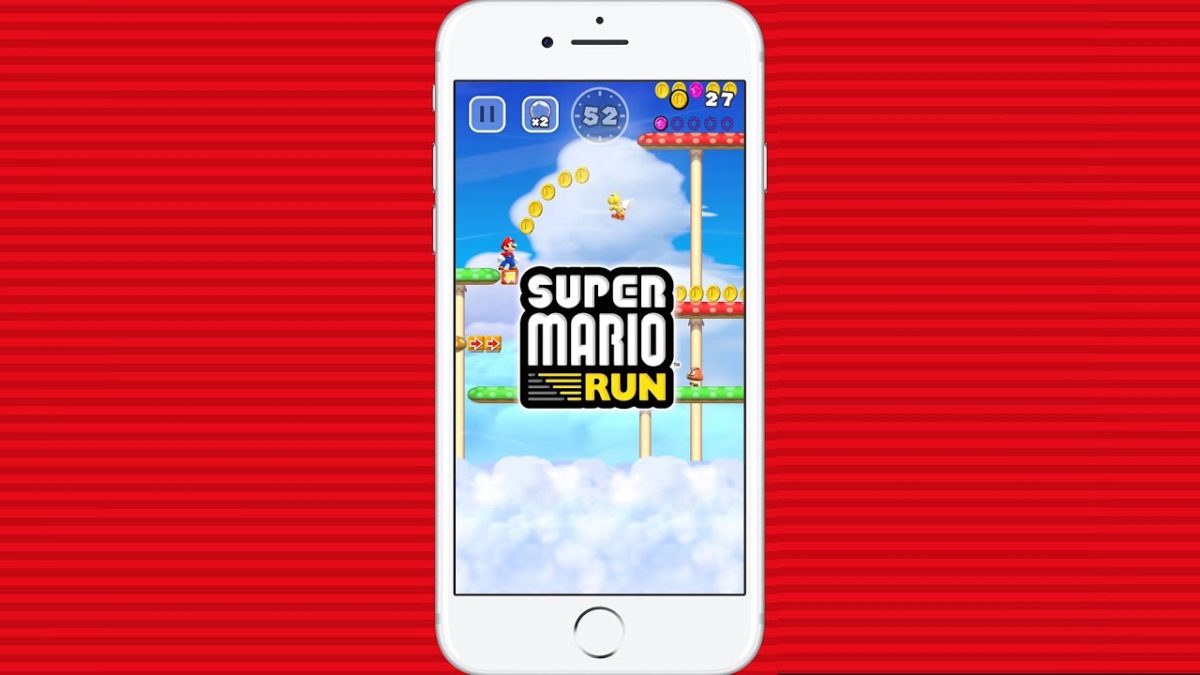
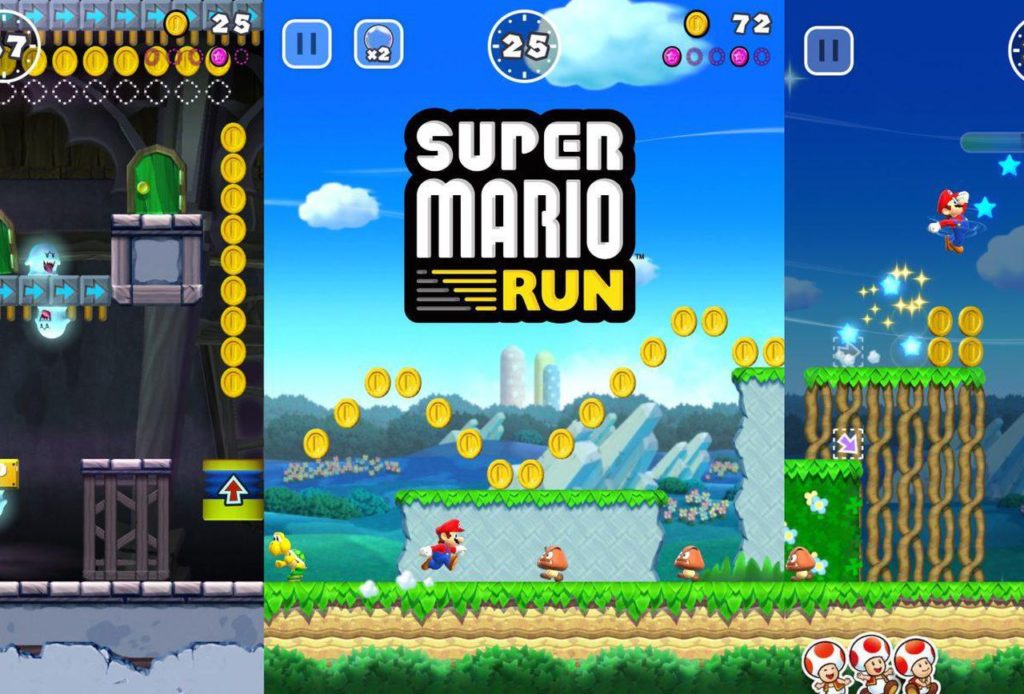
So far, Nintendo has released five mobile games: Miitomo, Super Mario Run, Fire Emblem Heroes, Animal Crossing: Pocket Camp, and Dragalia Lost. Interest in Miitomo, a diet version of the 3DS game Tomodachi Life, waned quickly in the months after its release. Super Mario Run, however, ended up becoming a decent success for Nintendo, who translated the classic 2-D Mario formula into that of an endless runner. While the game’s first few levels are available for free, players must spend $10 to unlock the full game, leading to widespread criticism. Fire Emblem Heroes and Animal Crossing: Pocket Camp both became much more profitable games, despite lacking the massive brand recognition of Mario. Both games follow a more traditional free-to-play model, and feature microtransactions. Dragalia Lost is largely seen as a generic mobile gacha/collection game with higher production value.
Before you ask, Nintendo was not involved in the development or release of the smash hit Pokémon Go, though former president Satoru Iwata was involved in its conception. Nintendo does not fully own the Pokémon franchise, and licensed out its characters to developer Niantic through The Pokémon Company. Despite this, the success of Pokémon Go caused Nintendo’s stock value to skyrocket, further showing them the potential of mobile gaming.
While Nintendo has been heading in the right direction since the fiscally disappointing release of Super Mario Run, here are some ways they could really shake up the mobile games market.
How Nintendo could succeed with mobile games
1. Stick to the free-to-play model
Though Super Mario Run was successful, it did not meet Nintendo’s fiscal expectations. Super Mario Run had all the ingredients of a record-shattering hit, so why didn’t it happen? Even with one of the most recognizable brands in the world and the proven endless runner formula, general audiences could not get behind the game’s $10 price point.
Mobile gamers are used to being able to download games for free, with the ability to purchase in-game content in small increments. Games like this can be mostly be played in their entirety for free, and money is only needed for exclusive content or power-ups. Super Mario Run, on the other hand, locks most of the game behind the $10 paywall and does not feature microtransactions. $10 is a huge price for entry in the world of mobile games, and Super Mario Run has since failed to hit the 10% premium adoption rate that Nintendo hoped it would.
Nintendo seems to have learned from its mistake, as moving forward, all of its mobile games have followed the tried-and-true freemium model. If Nintendo is to become successful in the mobile games market, they need to follow the established formula and make the barrier for entry as low as possible.
2. Nintendo should start with high profile franchises and work their way down
While Nintendo’s main objective with mobile games is to increase brand awareness of their IP’s, they need to prove themselves in the mobile arena first by releasing games based on their most popular franchises. Nintendo wisely chose Mario Kart as their upcoming mobile game, as the franchise is far and away the most popular racing series in the world. By establishing consumer trust with bite-sized versions of AAA franchises like Mario Kart, Zelda, and Donkey Kong, Nintendo can give themselves more freedom to experiment with lesser-known franchises.
Nintendo could drum up more interest in some of their more niche franchises like Star Fox, Pikmin, or F-Zero by introducing new games in the mobile game market, creating more mainstream brand awareness and possibly leading to more mainline entries in the series on consoles. Newer Nintendo franchises like Splatoon or Arms could also benefit immensely from the awareness that comes with a popular mobile game.
Watch: Fastest Super Mario Bros. speedrun in history
If there’s one thing to be learned from Pokémon Go, it’s that social mobile games are the best kind of mobile games. A huge part of Pokémon Go’s success was that the game encouraged you to seek out fellow players and encourage your friends to download the game. Games that encourage sociability create long-lasting communities. Allowing players to team up with (or against) friends helps organically spread the popularity of the game, and this combined with the free-to-play model can lead to thousands of players at least trying out your game. Social features, as well as social media integration, are key to a mobile game’s success, and Nintendo must incorporate these features into all of their mobile games moving forward.
Do you enjoy Nintendo’s mobile games? Which Nintendo games would you like to see on mobile? Let us know!
How to get Game Boy games on your iPhone in less than 10 minutes
Is Apple about to make a huge splash in the gaming industry?
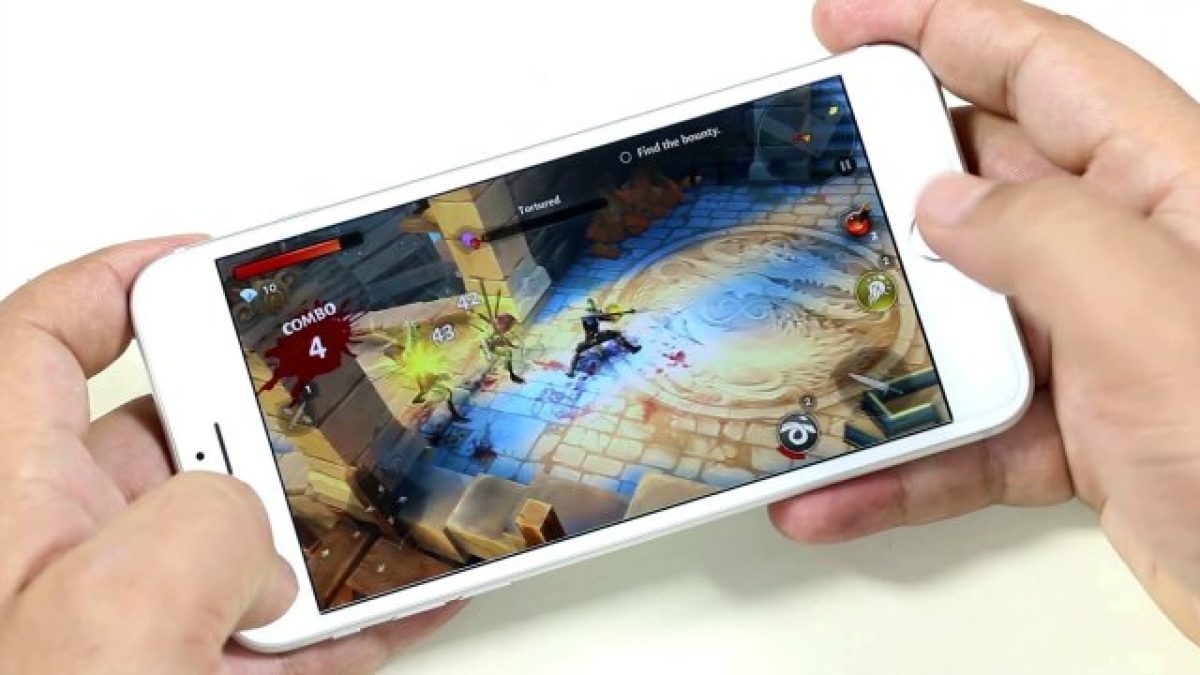
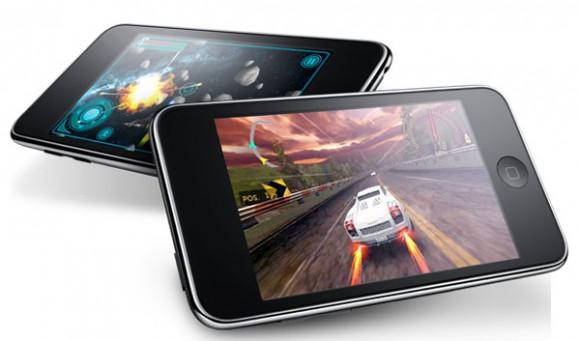
Rumors are swirling that Apple is in the early stages of developing a subscription-based service for games, similar to Netflix’s model for movies and shows. There are few details about the service beyond this, as we don’t know if this service is being developed for mobile devices, home computers, or both.
Making a gaming service is a puzzling move on Apple’s part for multiple reasons. Even though Apple basically created the mobile gaming market with the App Store, they’ve never really gone all in on the gaming industry. Though Apple has placed tight quality control restrictions on the App Store, for the most part, they’ve been content to lay back and get their (sizable) cut from in-app purchases. Additionally, though Macs have received increased support from game developers over the years, the vast majority of PC gamers play on either Windows or Linux. Apple does not seem to mind this as their core Mac audience usually buy their devices for business or creative purposes. With this in mind, it’s relatively safe to assume that Apple’s upcoming gaming subscription service will focus on mobile gaming.
What would an Apple gaming subscription look like?
A subscription for mobile games wouldn’t make much sense, as the most popular mobile games by far are free titles that heavily utilize microtransactions. Why would anyone pay to play free games?
To make the subscription price worth it, Apple would have to offer some sort of premium content. Games could lock special levels, characters, or power-ups behind the subscription service, incentivizing hardcore players into subscribing. This model would make financial sense, as research has shown that mobile games make their money not from casual players, but from “whales.” Whales are hardcore players who pour tons of money into freemium games. Locking content behind a subscription would encourage whales and completionists to make the dip. There’s also the possibility that instead of locking content, the subscription would give a small amount of money to spend in every game included in the service. This would give players a brief glimpse into the premium side of popular games, encouraging them to spend more money after their subscription credits run out.
Another possibility is that Apple could focus on “premium” iOS games rather than free to play ones. These games are often console quality and cost around $10-$20, but don’t feature additional microtransactions. Examples of these games include Civilization VI and XCOM: Enemy Within. Apple could allow subscribers to play these games at no additional cost, which would encourage people to play these games who would have never before considered them due to their price.
By combining these two ideas, it’s possible that Apple could have a success on their hands. The subscription hinges entirely on how it is embraced by whales. If whales don’t see value in paying for a subscription, the service will fail.
The pivot from 2D to 3D gaming was a tricky transition for game companies. Discover how they pulled it off.
By the mid-’90s, the 16-bit era was coming to an end. The advancement in technology brought us some incredible games that looked, sounded, and played better than their 8-bit counterparts. Games like Super Mario World, Super Castlevania IV, and Mega Man X showed that developers had perfected 2D gameplay and level design.
But as gaming technology was advancing, gamers were looking towards the future for the next big thing: 3D. Some 16-bit games, like Star Fox or Pilotwings, simulated 3D gameplay, while others, like Donkey Kong Country and Mortal Kombat, imitated 3D graphics. Though these games were great, the unveiling of the Nintendo 64 and PlayStation truly gave gamers their first look at the potential of 3D video gaming.
The challenge of 3D game design
Creating 3D games brought an entirely new set of challenges for game designers. With only one plane to work with, it’s much easier to design levels and obstacles for 2D sidescrolling games. The ability to move in infinite directions in 3D makes for significantly more complex level design.
Watch: Fastest Super Mario Bros. speedrun in history
Every part of a 3D level is much more spread out than it would be in a 2D level, causing poorly designed 3D worlds to feel empty. Empty levels were hardly ever a problem in 2D games because everything was designed to be tightly packed and compact. With infinite movement, exploration becomes a key part of 3D level design. In 2D levels, everybody knows that you’re supposed to head to the right, but 3D levels, in their resemblance to the real world, naturally encourage players to head off in different directions and explore. This makes designing linear levels a challenge, which could cause some players to get lost. Some 2D games were more natural conversions to 3D than others. It’s significantly easier to imagine a nonlinear game with a top-down perspective like The Legend of Zelda playing in 3D as opposed to a sidescroller like Mario. For games that didn’t transition as easily, the challenge for game designers was to create levels that incorporated elements of 2D games enough to retain fans while taking advantage of the 3D world to keep things fresh.
Nearly every major game franchise at least attempted to make the transition from 2D to 3D during this time. To show you how the transition was made from a game design perspective we’re going to look at two major platforming games and their first 3D entry: Super Mario 64 and Sonic Adventure.
Mario makes the jump to 3D
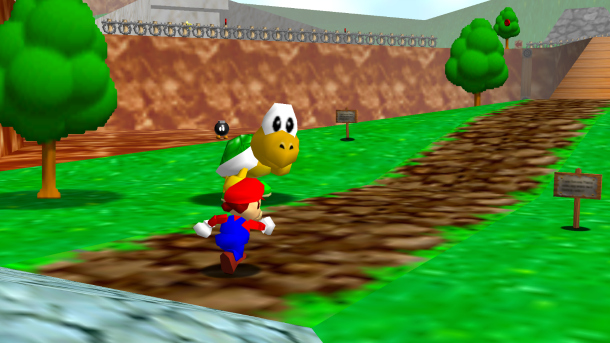
Nintendo knew right away that creating a 3D Mario game wasn’t as simple as changing the camera perspective. In the 2D Mario games, the objective was the same in every level: get to the end by running to the right. While this linear design was considered early on in Mario 64’s development, Nintendo quickly realized that moving around in 3D was fun enough on its own. 2D Mario basically had four moves: run, jump, crouch, and swim. The fun of 2D Mario games wasn’t in using those moves, but in avoiding obstacles to reach the end of the level.
In Mario 64, Mario’s moveset has been upgraded dramatically to match the more complex level design. Mario could now wall jump, triple jump, long jump, backflip, side jump, and more. This gave players significantly more options in choosing how to navigate a level, adding a high skill cap to the game without making it too complicated for more casual players. This moveset has proven so fun to use that it served as the base for every 3D Mario game since, including 2017’s Super Mario Odyssey.
The level design factored in this movement. It would be a waste to give Mario an expansive, in-depth moveset and have the goal be simply reaching the end of a level. Instead of having dozens of small levels, Mario 64 has 15 huge worlds, each with multiple objectives to complete.
There are two major reasons for this. First, 3D technology was in its early stages and development was expensive, so Nintendo saved time and money by creating 15 large varied levels as opposed to a huge number of small levels. Second, 3D level design is much more conducive to slower-paced, exploration-based worlds than tightly packed platforming challenges. Simply navigating a 3D world with Mario’s new moveset was fun enough, and having varied objectives allowed players to explore more lifelike worlds than were ever possible in 2D. The massive 3D worlds of Mario 64 blew people’s minds back in 1996, and their open-ended structure combined with Mario’s diverse moveset gave them a replay factor that was unmatched by 2D games in the series.
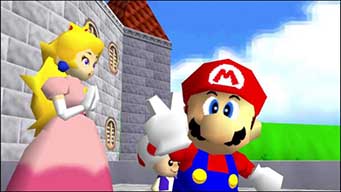
It’s pretty much unanimously agreed upon that Super Mario 64 is the best 2D to 3D transition in video game history. Nintendo made just the right adjustments to the popular Mario formula to help the game feel unique without overwhelming past fans. For being a first generation 3D game, Super Mario 64 holds up remarkably well today and is a shining example of Nintendo’s thoughtful game design.
The story of Sonic Adventure is very different than that of Super Mario 64. For starters, Adventure wasn’t Sega’s first attempt at a 3D Sonic game. Sonic 3D Blast and Sonic R were both early attempts by Sega to make 3D entries in the franchise and unfortunately, both games are awful (despite their wonderful soundtracks).
The Sonic franchise mostly took a backseat during the 64-bit early 3D era as Sega studied its competitors’ attempts at 3D game design. Unlike 2D Mario games, 2D Sonic games had a momentum-based platforming design that allowed skilled players to fly through levels by chaining bounces and jumps. Early Sonic games had much more spectacle than 2D Mario games, as technically impressive segments had Sonic flying through loops and running through pipes. Though these segments took control away from the player, they were impressive enough at the time to make up for it. Because Sonic is a significantly faster-paced platformer than Mario, it was technically unfeasible for Sega to create huge cinematic levels with N64/PSX/Sega Saturn era technology. Sega’s first big attempt at creating a non-spinoff 3D Sonic game came with the Dreamcast, a console with power more comparable to a PS2 than an N64.
While Mario 64 was an attempt by Nintendo to move forward with the Mario series, Sonic Adventure was an attempt by Sega to totally reboot it for the new generation. Sega tried to create a Sonic experience that was only possible on (what were at the time) next-gen consoles, complete with fully-voiced cutscenes, revamped character designs, and a complex story.
This cinematic approach to the game influenced the level design. Sonic Adventure features multiple hub worlds that unite all of the game’s levels. These hubs are massive and filled with secrets and NPC’s, making them seem more like lived-in worlds and less like 3D obstacle courses. These worlds were big enough to actually get lost in, but a helpful hint system mostly alleviates this.
The actual levels of Sonic Adventure resemble 2D Sonic levels in design and structure, as the goal of each Sonic level is to reach the end of the stage. (Note: There are seven playable characters in the game, but for the sake of simplicity we’ll be focusing on Sonic’s gameplay and levels). While Sonic’s moveset didn’t receive the overhaul that Mario got in 64, he received a simple but crucial move: the homing attack. By pressing the jump button in midair, Sonic will home in on enemies, springs, and other interactable objects. This simple addition helped alleviate the depth perception problem that plagued many 3D platformers, though it did arguably take some control away from the player. The only other significant addition to Sonic’s moveset is the ability to spin dash while moving, allowing the player to build up an insane amount of speed.
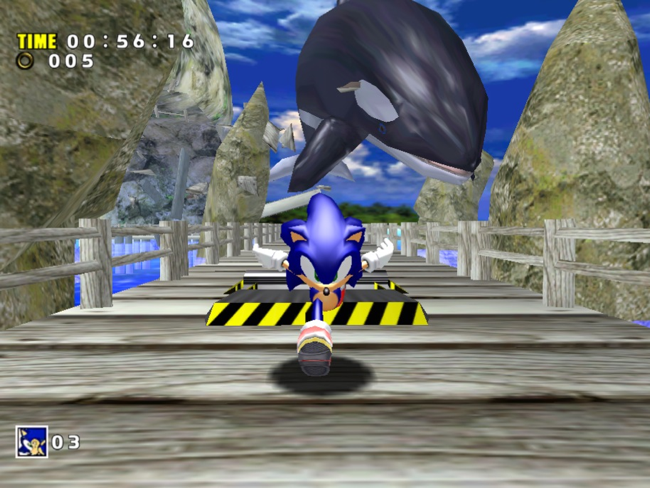
Sonic’s levels are focused on momentum and moving fast just like the 2D games, but they have a much greater focus on spectacle this time around. Moving far beyond simple loop-de-loops, Sonic Adventure had the blue hedgehog flying through a tornado, outrunning a killer whale, snowboarding down a mountain, and speeding down skyscrapers. These segments are flashy and entertaining, but they almost completely strip control away from the player. Attempting to jump or move around during these sections often breaks their scripting, either slowing Sonic to a screeching halt or sending him flying towards his doom. While it feels great to be moving so fast in a 3D space, the lack of direct control can make the game feel too much like a movie rather than a game. Each level is carefully crafted to be beaten in a certain way, and attempting to complete levels in an unorthodox way causes the level design to break down.
While Sonic Adventure succeeds in translating Sonic’s trademark speed to 3D, its focus on tightly scripted cinematic segments, as opposed to freeform gameplay, hurts the game as its flashy sections get less impressive with age.
What early 3D games are your favorite? Do they still hold up? Let us know!
Discover why this 1994 classic might be the deepest game ever created.
Even if you’ve never played Earthbound, you’ve almost certainly heard about it. You may know its protagonist Ness as that annoying kid from Super Smash Bros. that screams and throws fire everywhere. It’s also possible that you’ve heard rumblings from the Earthbound fanbase, a dedicated group of diehard fans that exists in spite of Nintendo’s lack of acknowledgment. People go on and on about how Earthbound’s a cult classic and one of the best RPGs of the 16-bit era.
You might not get what all the hype is about at first glance. The simple “Peanuts”-esque art style and Dragon’s Quest-like gameplay show a standard if quirky RPG that has a unique setting and amusing dialogue. However, if you actually sit down and play the game you’ll embark on a nuanced, introspective adventure that has you questioning the balance between wide-eyed wonder and cynicism, love and distance, and the reframing of our lives as “adventures.” While I’d have to think about calling it the deepest Nintendo game ever made, it is without question the most personal.
And yes, the game is worth the hype.
The World Beyond Your Front Yard: when the mundane meets the surreal
To understand Earthbound we must first understand its setting. Most RPGs of the ’90s took place in fantasy settings, with swords, spells, dragons, and the like. Earthbound instead takes place primarily in Eagleland, a pastiche of the United States.
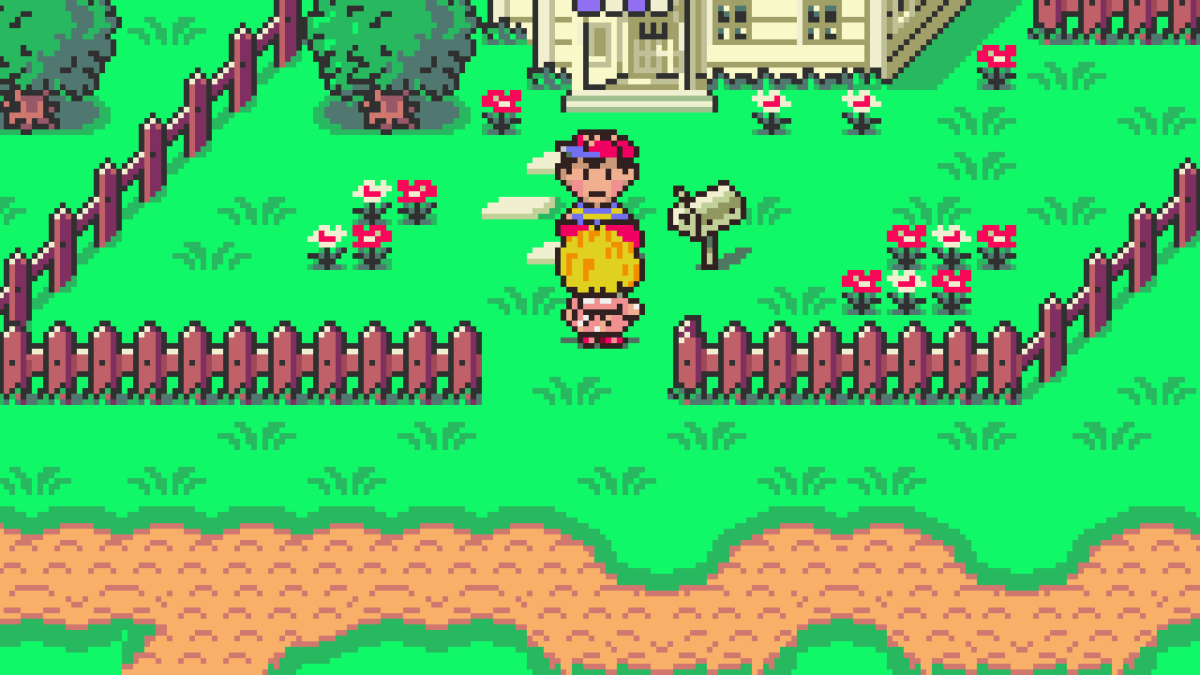
Instead of playing as some hero of legend, you play as Ness, a typical 13-year-old boy who likes baseball and riding his bike. After a meteor crashes into the mountains behind your house, you set off to investigate. It’s here that you see your first truly bizarre character: Buzz Buzz. Buzz Buzz is a fly from the future who tells you that you need to save the world from Giygas, an indescribable being of pure evil. From here you say goodbye to your mom and sister, you leave home, and your quest begins.
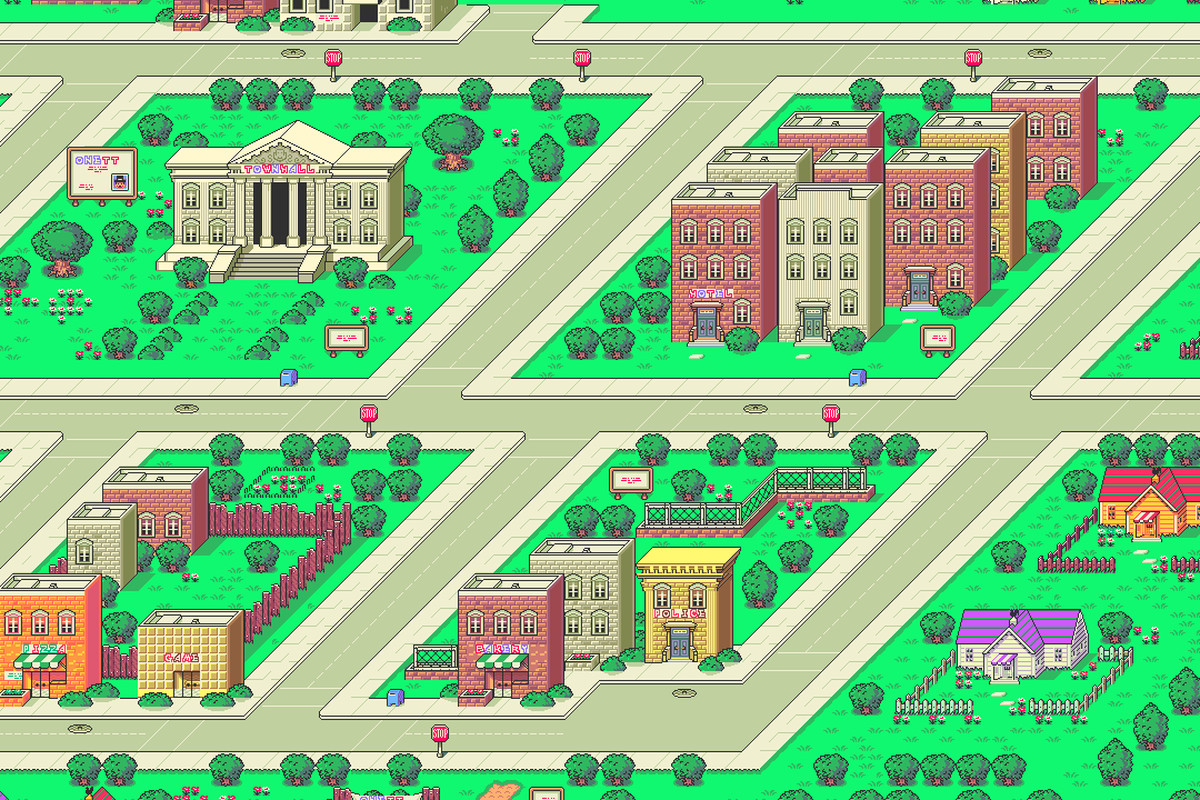
This idealized, Rockwell-esque setting further satirizes RPG tropes by replacing items like swords and potions with baseball bats and burgers. In the beginning of the game, the enemies you encounter are unspectacular animals like wild dogs, snakes, and crows. It’s certainly funny seeing a typical small American town recontextualized as an area from an RPG. This setting serves as more than just a humorous reframing of an RPG, it serves one of the main themes of the game: the relationship between the mundane and the surreal.
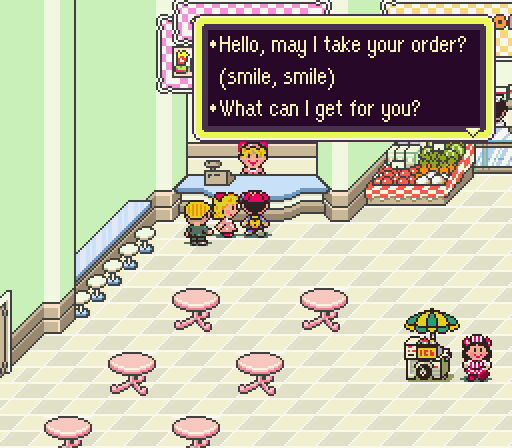
Healing items include burgers, fries, and coffee.
By starting with a normal, relatable setting and diving further and further into the bizarre, Earthbound plays out like a kid’s imagination running wild. As the kid makes stuff up as he goes along, his friends join him with their own ideas, leading to far out settings like a town with a zombie-infested circus, a neon city where “no” means “yes,” and a pyramid populated by angry hieroglyphics.
Think back to when you were a kid, and leaving your backyard was the beginning of an adventure. When you were with your friends exploring and playing, there was no telling what you’d come up with that day. Early on in your adventure, you encounter human adult enemies, such as mean old ladies, cops, and local punks. When you encounter people like this as a kid, you don’t think of these people as people with their own thoughts and lives. As a kid, they only seem like greedy, evil people who exist solely to ruin your fun.
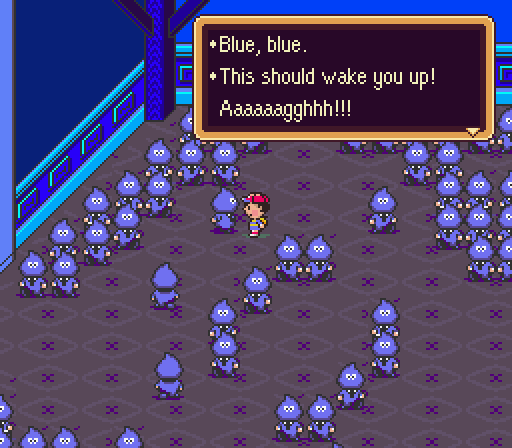
Sometimes the human enemies are weirder than the supernatural ones. The Happy Happyism Cult is obsessed with the color blue.
Earthbound recontextualizes the mundane (the real world) by presenting it as an adventure. In doing this, the game can present relatable, real issues through the lens of a child. The game pits Ness against the literal embodiment of evil, and Ness believes he can save the world armed with only a baseball bat and his psychic powers (Ness and his friends prove to be no match for Giygas). Ness and his friends aren’t fighting some evil dictator or greedy businessman or something, they set off to fight the very concept of evil itself.
As a kid, it’s common to believe highly in your ability to change the world for the better. We all think we’ll be good people who help others and act selflessly. However, as the pressures of adulthood slowly seep in, you become wearier and more bitter, limiting both your ability and desire to actually do good. For most people, their adventure against evil ends there.
This is not to say that the game presents the struggle to find meaning and goodness in the world as some childish, naive pursuit. Quite the opposite, actually. While trying to fight evil head on and find the ultimate meaning of life is a daunting and exhausting task, the game encourages people to find meaning and joy in the little things. The greatest example of this in-game is the cup of coffee.
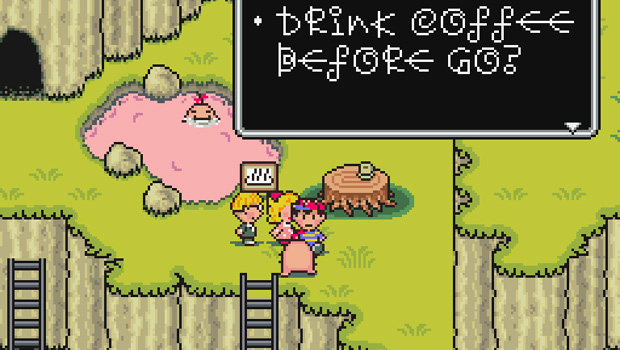
At an early point in your adventure, you encounter a friendly person who offers you a cup of coffee. If you drink it, the screen fades out into this psychedelic blue haze as relaxing music plays. Text then slowly scrolls up the screen telling you to relax, take a breather, and feel good about all you’ve accomplished so far. It tells you that you have done amazing things, and though you’ve felt plenty of pain and will feel more, if you keep your courage and sense of humor then you’re going to be fine. By recontextualizing mundane everyday acts, like relaxing with a cup of coffee, Earthbound helps show the player that their own lives are worth living as exciting adventures.
Giygas Attacks: When childhood and adulthood clash
While Earthbound presents itself like a child’s imaginary story, the game itself is the brainchild of designer Shigesato Itoi. This perspective is key: the game is a childhood adventure created by an adult. As the game progresses, it becomes clear that Itoi filled Earthbound with not only all of the whimsies of childhood but some of the more uncomfortable truths of adulthood. With this in mind, I believe that it’s best that you play Earthbound when you’re at some sort of transitioning period in life. Whether that be entering or leaving high school, going off to college, or entering the workforce, the sense that you’re being pulled in multiple directions with no right answer is essential to the themes of the game. The harsher realities of adulthood only really start becoming apparent towards the end of the game.
For example, lousy fatherhood is a running theme throughout the game. Ness’ neighbor Pokey is an obnoxious bully who lacks friends, but it can be argued that his behavior stems from his father abusing him. Pokey’s gradual transformation from annoying neighbor to Giygas’ reality warping right-hand man stems from a desire to control things for once in his life.
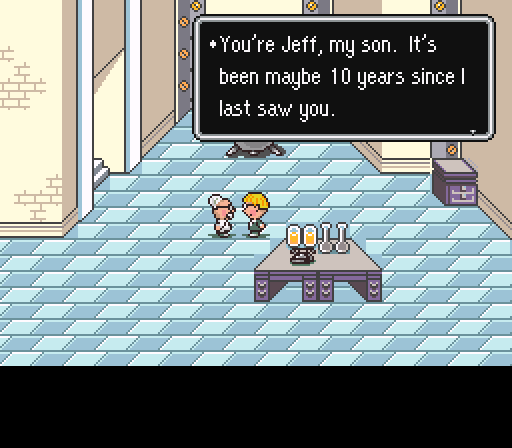
Ness’ friend Jeff is the party’s tech whiz who relies on gadgets and his own intuition instead of psychic powers. You encounter Jeff’s father, Dr. Andonauts, multiple times throughout the game. Like Jeff, Dr. Andonauts is a supergenius inventor. He is cold and distant toward Jeff, however, only visiting him once every few years. They’re so distant that Jeff refers to his father as “Dr. Andonauts” rather than “Dad.”
Dad of the year
Ness’ own dad isn’t exactly a shining beacon of fatherhood either. He is never shown throughout the game, being constantly busy with work. Ness’ father can only be talked to on the phone, and while he clearly loves Ness, he never stops work to make time for him, even as Ness is quite literally saving the world. Because of this, Ness quite literally views his dad as just a voice on the phone. Being a child, Ness only vaguely understands the nuances between raising and balancing a family, but he is old enough to feel disappointment and loneliness at his father’s lack of presence.
This is literally all you see of Ness’ dad
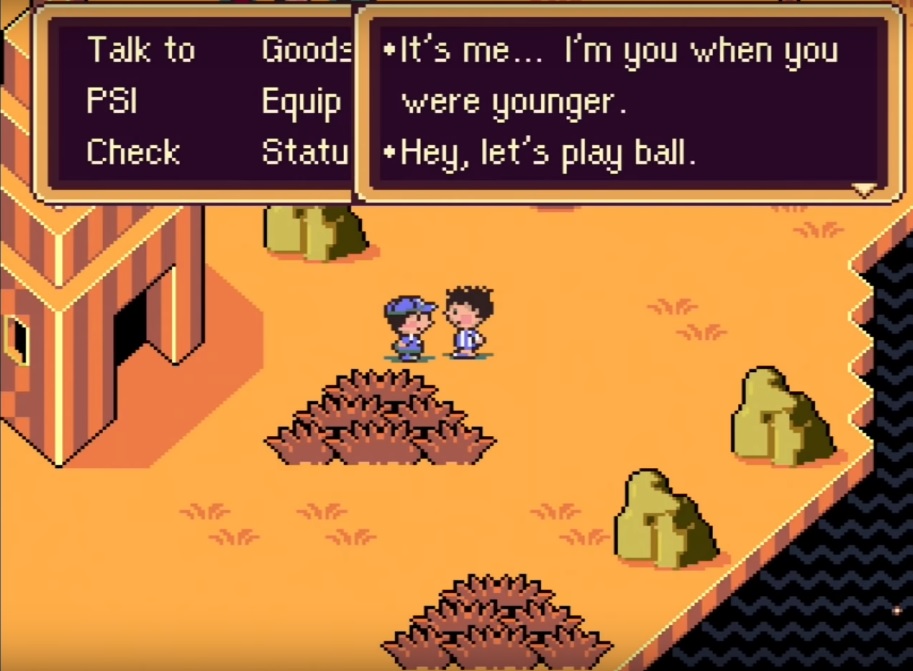
Toward the end of the game, Ness is knocked unconscious and enters a place called Magicant. Magicant is easily the most cerebral and introspective part of the game. It is Ness’ own subconscious, filled with little snippets of your adventure and Ness’ past, such as a snowman that Ness once made as a child that eventually melted away. You encounter both enemies and allies while exploring, and some enemies even comment on how much it hurt when you killed them. The most startling person that pops up in Magicant is Ness’ younger self. When spoken to, young Ness says this:
“It’s me… I’m you when you were younger.
Hey, let’s play ball.
Do you prefer reading comics or playing games?
What? You’re busy?“
Ness meets little Ness
Even Ness, who is still a child himself with an absent father figure, can’t make time for his younger childhood self. Kids are always trying to appear grown up in any way they can, quickly discarding things they think will make them look childish. This segment shows that the struggle against adulthood takes place at every point in a person’s life.
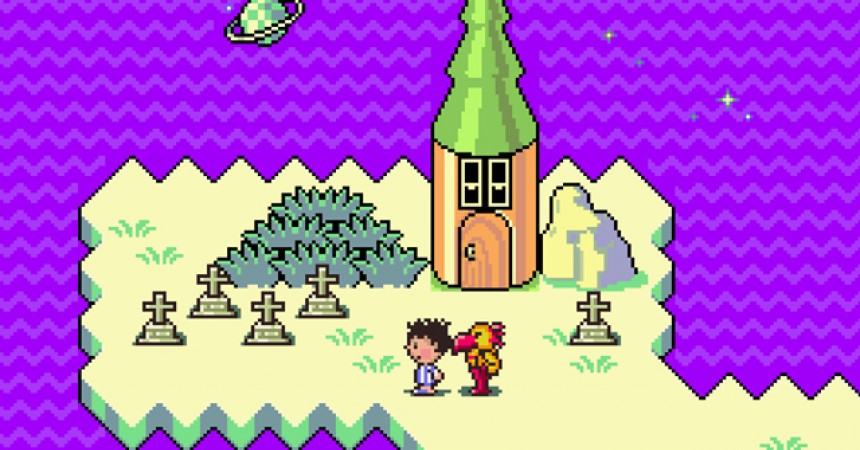
Further along in Magicant, Ness finds the Flying Men. The Flying Men are muscular birdlike creatures who say that they represent Ness’ courage. These Flying Men join Ness one at a time in Magicant and are essential allies in dealing with the level’s tough enemies. There are only a limited amount of Flying Men, however, and if enough die, they scold Ness for treating them like trash. After each one dies its gravestone appears near their house, explicitly displaying the gradual death of Ness’ courage in the face of adulthood issues he doesn’t understand. At the end of Magicant lies Ness’ Nightmare, the manifestation of Ness’ evil thoughts. He is an extremely difficult boss that has access to all of Ness’ abilities.
Ness and a Flying Man look at their fallen friends.
A surreal place like Magicant sends the mind racing. What would your Magicant look like? What essential people from your past and present would you find there? What precious memories would you relive? What would your childhood self say to you, and how would you respond? Could you beat your own nightmare?
Warning: ending battle spoilers follow!
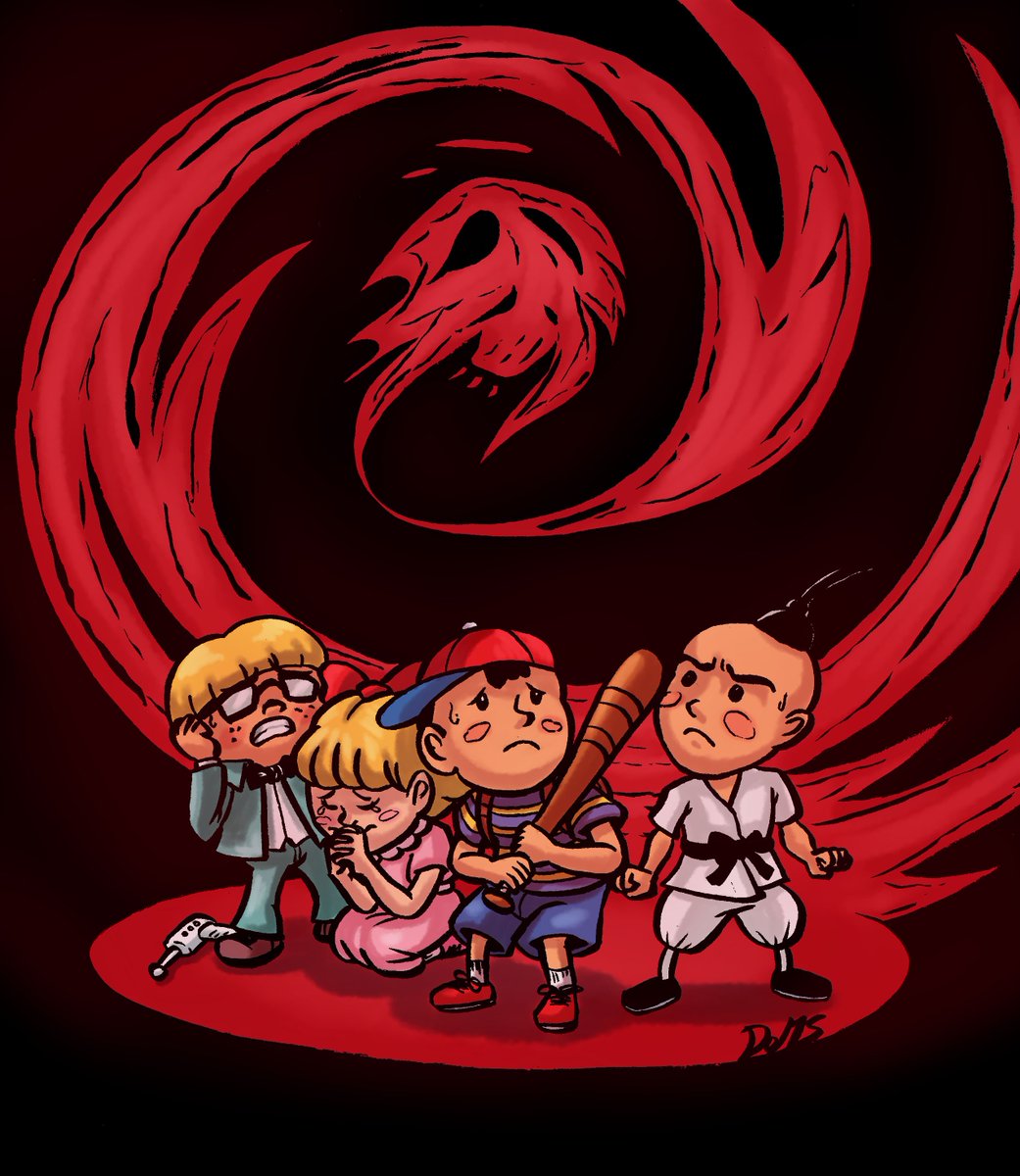
The climactic battle against Giygas is where the duality of childhood and adulthood come to a head. When Ness and his party finally get to face Giygas head-on, the player quickly realizes that they can’t hurt it at all. Giygas’ attacks are beyond comprehension (“You cannot grasp the true form of Giygas’ attack!”) and do obscene amounts of damage, sometimes wiping out party members in a single blow. Giygas’ attacks represent the entirety of the evils of the adult world crashing into a child at once, with the child having no idea what’s going on.
Giygas’ incomprehensible evil is based on a real traumatic event experienced by Shigesato Itoi. As a kid, Itoi once accidentally stumbled into the wrong movie at the theater. He watched a scene depicting a woman being brutally murdered and sexually assaulted, a moment that Itoi specifically points to as when his childhood ended. As a child, Itoi did not understand what he was seeing in the film, but he knew it was horrifying and damaging. Giygas reflects this assault in its dialogue (“It hurts… It hurts…”) and is a dramatic representation of the moment a person’s childhood dies in front of them.
The only thing the player can do to fight back is to pray. As the player prays, the game cuts to various characters you met earlier in the game. They sense something is wrong and pray for Ness and his friends, dealing massive amounts of damage to Giygas. If you haven’t played the game and ignored the spoiler warning, then I won’t reveal who the final person who prays for Ness is, it is something that truly needs to be experienced blind.
Through this battle, Itoi is trying to show that for many the transition to adulthood is sometimes sudden rather than gradual, and can be a confusing and painful experience, especially if one goes through a traumatic event. But by invoking all of your life experiences, from small joys to major milestones, and the strength of those who love you, you can make the leap to adulthood and fight against the fear and malice that would otherwise consume you.
Spoilers end here
The Legend of Zelda: Ocarina of Time turns 20. Here’s how it changed gaming forever
Itoi is not trying to equate adulthood with evil in Earthbound. Instead, he is trying to show that the sudden injection of adulthood into a child’s life can be a jarring, confusing, and distressing experience. Adulthood is not evil, and the pressures that come alongside it are normal. At first, the mundanities seem soul-crushingly boring and the new experiences are disheartening and confusing. However, like Earthbound, as you lean on your collective life experiences and those who love you, the mundane and the surreal combine with childhood and adulthood, reframing your life as the memorable adventure that it truly is. This adventure is often funny, heartbreaking, bizarre, confusing, exhausting, and touching, but it’s wholly your own. Like Earthbound, this adventure is personal.