In 2013, John Riccitiello resigned as CEO of Electronic Arts after a six-year period marked by challenges and controversies. During his tenure, the popularity of Activision’s Call of Duty franchise surpassed that of Battlefield, which contributed to the pressure on his leadership. Riccitiello made comments that were considered insensitive, such as suggesting that Battlefield players should pay to reload, which only worsened his image among fans. Bobby Kotick, the CEO that no one wants, says there are worse ones Recently, Bobby Kotick, former CEO of Activision Blizzard, […]
In 2013, John Riccitiello resigned as CEO of Electronic Arts after a six-year period marked by challenges and controversies. During his tenure, the popularity of Activision’s Call of Duty franchise surpassed that of Battlefield, which contributed to the pressure on his leadership. Riccitiello went on to make comments that were considered insensitive, such as suggesting that Battlefield players should pay to reload, which only worsened his image among fans.
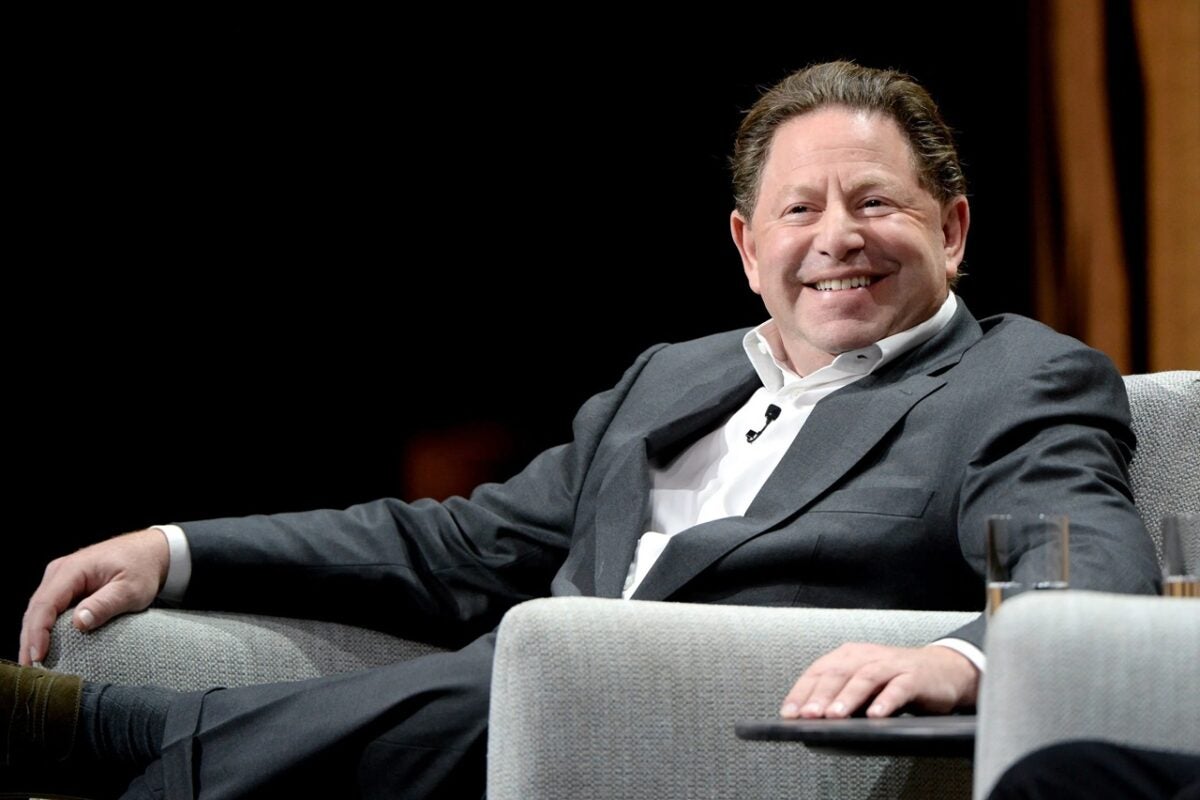
Bobby Kotick, the CEO that no one wants, says there are worse
Recently, Bobby Kotick, former CEO of Activision Blizzard, shared his critical opinion about Riccitiello, calling him the worst CEO in the video game industry. In a joint appearance on the “Grit” podcast with Bing Gordon, former creative director of EA, Kotick revealed that there was concern within Activision about the possibility of Gordon taking control of EA. “We feared that Bing was going to run [EA]. And we would have paid for Riccitiello to stay as CEO forever,” he commented.
Kotick also recalled that there were multiple attempts at a merger between EA and Activision. According to him, EA tried to buy Activision several times and held discussions about mergers. However, EA ultimately rejected significant opportunities to acquire popular franchises like Guitar Hero, Call of Duty, and Blizzard, which ended up in the hands of Activision.
Additionally, Kotick criticized the Warcraft movie, describing it as one of the worst he has seen and pointing out that it was a mistake for Blizzard to dedicate so much time and resources to this project. This perspective reflects a broader criticism of the strategic direction of some of the most influential companies in the industry at that time.
Sony Interactive Entertainment has announced a significant restructuring in its leadership, with Hideaki Nishino taking on the role of CEO in a context where the company has faced a challenging period following Jim Ryan’s departure. This move marks the return to a single presidency model, with Hiroki Totoki replacing Kenichiro Yoshida as president and CEO of Sony Group Corporation. The decision is framed by the need to simplify decision-making and provide clear direction to the PlayStation team. The co-CEOs are over: the CEO of Sony is Japanese again In a […]
Sony Interactive Entertainment has announced a significant restructuring in its leadership, with Hideaki Nishino taking on the role of CEO in a context where the company has faced a challenging period following Jim Ryan’s departure. This move marks the return to a single presidency model, with Hiroki Totoki replacing Kenichiro Yoshida as president and CEO of Sony Group Corporation. The decision is framed in the need to simplify decision-making and provide clear direction to the PlayStation team.
The co-CEOs are over: Sony’s CEO is Japanese again
In a statement, Nishino highlighted his interest in expanding the company’s franchises and taking technological innovation to the next level. His commitment is based on a vision of growth, focusing on strengthening the PlayStation ecosystem and connecting with a passionate and diverse user base. “We want to continue expanding our most beloved franchises,” said Nishino, who has been a key figure in PlayStation’s development strategy throughout his career at Sony.
For his part, Totoki emphasized his interest in building on the legacy of his predecessors and creating new value in all areas of the company. This leadership change comes less than a year after the company introduced a dual leadership model, which failed to provide the necessary stability. The fragmentation in leadership had raised doubts about the future of Sony and its games-as-a-service strategy, as it had become a hot topic in the industry.
The reorganization also implies that Hermen Hulst, who had shared leadership during the dual period, will continue as CEO of the Studio Business Group, overseeing PlayStation’s development studios and ensuring the integration of their franchises’ adaptations into film and television. This renewed focus suggests an intention to rejuvenate Sony’s organizational strategy at a time when the video game industry is rapidly evolving.
Sometimes it seems as if AI is the future, only it’s not generative AI, as evidenced by the inability of those who develop it to articulate why it is so.
If we based ourselves on what we read in the press and social media, it seems as if AI is the future. There is nothing that AI is not capable of. The work of a musician, illustrator, filmmaker, or even that of a teacher, accountant, or, of course, journalist, is on the verge of extinction. And if we were to ask people who advocate for its use, they would tell us that it is natural. That we cannot stop the advance of technology. That’s how it should be.
Even if we ignore the fact that there is no such thing as an objective advancement of technology that we must accept, this poses obvious problems. But to consider them, we should first ask ourselves how this technology works.
Okay. How do AI work? Basically, they take the inputs given by a human being and create a replica of what they specialize in using those inputs to contrast them with the keywords in their database. If we tell an AI that generates images “woman”, “blonde”, and “blue eyes”, it will give us an image of a blonde woman with blue eyes. It searches its database for images that have the tags “woman”, “blonde”, and “blue eyes” and creates a blended image from a certain number of those images.
That’s what OpenAI does. That’s what ChatGPT does. That’s what all generative AI does. It takes our inputs and gives us the response we’re looking for. In the case of OpenAI, by combining many images; in the case of ChatGPT, by relying on a limited amount of text. But essentially, they do the same thing.
So far, so good. But this generates two problems. The first one, where do they extract those databases from?, and the second one, what purpose does it serve if there are already humans doing it?
The first of the questions is something that people involved in these questions have always avoided answering. Look at Murati, CTO of OpenAI, when asked about the sources of information for their AI, she stated that “I’m not sure about that“. And she responds in that way not out of stupidity, but for something much worse: she knows that she cannot confirm that the content used by her technology is not stolen.
The second of the questions is something they also don’t know how to answer, that’s why they do it with vagueness. Reid Hoffman, billionaire who has invested in the startup Inflection AI, states that AI “will be a co-pilot for all professions” and that it will help “extend creativity” and help students “create much more interesting papers”.
Of course, everything he says is vague. Absurd. A student has to write papers that demonstrate their knowledge on a subject and their ability to research it, not that they are interesting. AI is already being used in many creative professions, but not to generate new content, but to eliminate the most tedious parts of the work, such as removing background noise from an audio track or cropping an image. And creativity does not “expand” just because someone introduces terms to generate something: creativity expands by producing creative works.
Even if we were to accept that it is acceptable to replace humans with machines to do certain jobs, something that only seems to be willing to do by CEOs of big tech companies, we would still have another problem. AI tends to generate hallucinations.
These statements are not only vague, but they are also ridiculous. Any technology that requires changing the entire industrial landscape on a global level and an energy leap that is not only not on the horizon, but also may be impossible, can only be defined as ridiculous.
The biggest drama of AI is that it is based on vague statements. Adolescent fantasies of puerile, evil, stupid technocrats, or any combination of those three. Because, furthermore, there is something even worse than all this: AI has no known utility.
As we have already said, AI is perfect for replacing humans. Beyond that, it does nothing that a human being doesn’t do. In order to do so – theoretically, because even if Altman were right, there is no evidence that AI could do anything different from what it does now, but with fewer or no hallucinations – it would have to have something it cannot have: understanding of natural language. Creativity. Understanding. Consciousness.
That is to say, even if Altman were right and we found a way to generate the amount of energy and industrial reconstruction without literally depleting the planet’s resources and definitively destroying the climate, he wants to invest tens of trillions in creating a worse version of a human brain. Something that already exists and potentially does not require destroying the world like a comic book supervillain to be produced.
With this, it is easy to conclude that AI is useless. And no. It has uses. As we have already indicated, every now and then there are functions that make life easier for professionals of all kinds, saving them from doing tedious and very complex tasks for a human being. But that is not what Altman, Murati, Hoffman, or others like them are looking for. They seek to be able to replace every qualified worker with an unqualified one to whom they can pay a fraction of what they used to pay each of them. Nothing more.
Because that is the only thing generative AI is good for in the business field. It does a worse job than humans and to theoretically do it without aberrant failures, without even being able to do what humans do, two revolutions would be needed, one technological and one scientific, currently considered impossible. All of this according to its own promoters.
That’s why AI is the future. It has been for three decades. What is not the future is generative AI, unless something changes so radically that it will be by itself something that will go down in history books as one of the greatest discoveries of humanity. And if your invention requires cosmic miracles to happen first, it seems to us that, perhaps, it is not precisely the future of anything.
Bob Iger is at a crossroads: Disney executives are pressuring him to buy a large video game company, whether he wants to or not
Disney has been in the video game industry even before every company wanted to venture into adapting their works. Since the 1980s, they had their own studios, high-budget adaptations, positioning themselves as a powerhouse in the video game world. What’s most intriguing about all of this is that, starting from the 2000s, something changed in their video game policy. They stopped paying much attention, selling off studios and licensing with an unusual disinterest. At least, until now.
According to Bloomberg, there’s an internal revolution happening at Disney. Executives close to Bob Iger, the company’s CEO, are pressuring him to acquire a major video game publisher. Among the options, the name that resonates the most is EA, proposed by some of these executives.
However, this doesn’t seem like something that will happen quickly or without complications. Bob Iger is in his second term at the helm of Disney, and while the first term was marked by significant acquisitions — he was responsible for purchasing Pixar, Marvel, Lucasfilm, and 21st Century Fox — his second stint is characterized by austerity. Seeking less risky moves, it’s logical that executives are pressuring him, as it’s not the kind of move typically expected from the company’s CEO.
Currently, Disney’s policy is to license its IPs to external companies. Recent examples include their collaborations with Square Enix for Marvel’s Avengers, Ubisoft for Star Wars: Outlaws, or Electronic Arts for the successful Star Wars Jedi titles and the upcoming Black Panther game. The success of these collaborations explains why Disney executives would be pressuring for an acquisition: they could also exploit these licenses for their film section. This raises the question of whether Bob Iger will ultimately succumb to the pressure from the executives. And most importantly, when.