Ron Perlman, the iconic actor known for his work in both film and video games, has been the voice of almost all the titles in the Fallout series since its launch in 1997. In a recent interview on The Joe Vulpis Podcast, Perlman revealed that his involvement in the franchise began in an unexpected way: “They gave me 40 dollars and a sandwich,” he recounted about his first collaboration with Interplay. Despite his low expectations, the first game sold 100,000 copies by the end of 1997, surpassing initial predictions and surprising Perlman himself. A man […]
Ron Perlman, the iconic actor known for his work in both film and video games, has been the voice of almost all titles in the Fallout series since its launch in 1997. In a recent interview on The Joe Vulpis Podcast, Perlman revealed that his involvement in the franchise began in an unexpected way: “They gave me 40 dollars and a sandwich,” he recounted about his first collaboration with Interplay. Despite his low expectations, the first game sold 100,000 copies by the end of 1997, surpassing initial predictions and surprising Perlman himself.
A Grateful Man
Over the years, Perlman has narrated several installments of the saga, but curiously, he has never played any of the games. “I’m not a gamer […] I don’t know which game goes with which team,” he admitted, pointing out his disconnection from the world of video games. His experience with Fallout boils down to recording a few lines of dialogue and receiving his payment, leaving the franchise as a “mystery” to him.
On the other hand, opinions about Bethesda’s approach to the series have been a topic of conversation. A leader of the New Vegas project has suggested that, although Bethesda has no animosity towards Fallout, it seems they do not fully understand its roots and, possibly, are not interested in them. This lack of connection has led to debates among fans about the direction of the franchise in its latest installments.
The story of Perlman and his relationship with Fallout is a reminder of how, sometimes, great phenomena in pop culture arise from unexpected decisions and initial lack of recognition. Still, the series has managed to become a true icon of the RPG genre, which raises the question: what does the future hold for Fallout and its legacy in the video game industry?
In the video game industry, there are many legendary franchises, but not so many that have managed to establish themselves over the decades. Many have a couple of decades at most, and the longest-lasting ones tend to be Japanese. This is logical considering that the Japanese market has never faced the cataclysmic problems that the American market has and has managed to have much greater prominence than the much more fragmented European market. That doesn’t mean there aren’t great franchises in the West. And one of them has become the latest big sensation in pop culture. Thanks […]
In the video game industry, there are many legendary franchises, but not so many that have managed to establish themselves over the decades. Many have a couple of decades at most, and the longest-lasting ones tend to be Japanese. This is logical considering that the Japanese market has never faced the catastrophic problems that the American market has and has managed to have much greater prominence than the European market, which is much more fragmented.
This does not mean that there are no great franchises in the West. And one of them has become the latest big sensation in pop culture. Thanks to an excellent first season of its series, Fallout is now on everyone’s lips. Something that does not seem to be changing with its second season.
The Fallout series places us in the year 2296 after the Great War of 2077 led to a massive nuclear exchange between the US and China. After two hundred years in bunkers, the survivors of the catastrophe began to emerge from their Vaults little by little after several generations living there. Some by their own choice, others because they had no other option. In the case of Lucy MacLean, a young inhabitant of Vault 33, her situation is the latter. After raiders from the Wasteland kidnap her father, she will have to leave the safety of the Vault to venture into the inhospitable thermonuclear desert of the future.
Only to discover that it is less inhospitable than I expected. In the more than 200 years since the war, a new society has been created in the desert, many humans have mutated into scavengers and literal mutants, and the retrofuturistic technology of this alternative world continues, to some extent, to function. With The Wasteland having its own technology and factions fighting against each other, Lucy soon discovers that it will not be easy to find her father not because everything there is empty and full of dangers, but because it is full of people and full of dangers.
That is its premise and why its first season worked well. It is plausible, it is funny, and moreover, it has no problem subverting our expectations. The people who join Lucy, the peculiar squire Maximus, and the even more peculiar bounty hunter Cooper, are authentic characters, and besides, it is exactly what Fallout has always been: a franchise about the absurdity of humanity.
Some video games that have always been about the same thing
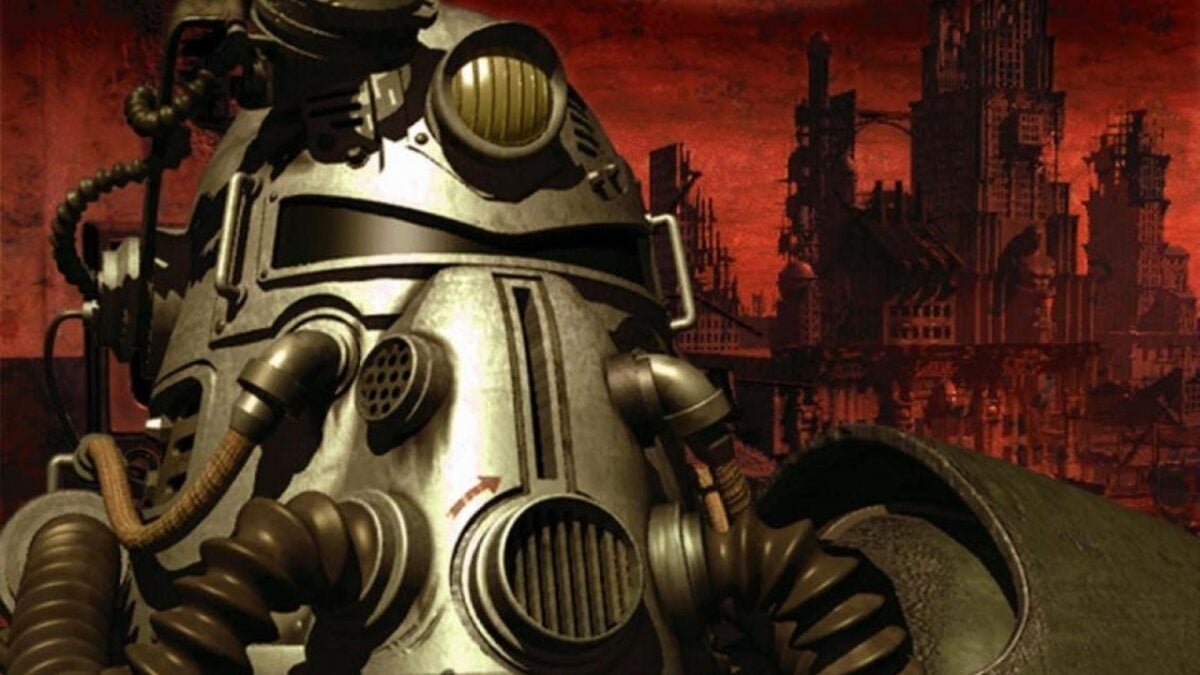
Fallout was created by Tim Cain and Leonard Boyarski in 1997 at Interplay. Being an immediate success, particularly in Europe, it presented us with a USA devastated by nuclear war, obsessed with its own past, and with an incomprehensible retro futurism. Thanks to its success, just a year later, they released Fallout 2, and in 2001, a spinoff, the underrated Fallout Tactics.
Unfortunately, the studio did not survive the ups and downs of the market. With RPGs becoming less popular in an era that prioritized elaborate graphics over the quality and depth of stories, they watched as the franchise fell into oblivion. Although not for very long. A company called Bethesda bought the rights to the franchise in 2004 for $1,175,000. A deal that, to this day, seems like a very wise purchase.
In 2008, the studio released Fallout 3 for PlayStation 3, Xbox 360, and PC. It wasn’t as deep and systemic as the original games and no longer had the same dark and depressing sense of humor, but it was much more agile, easy to play, and above all, it had spectacular graphics for the time. It is also true that it had an obscene amount of bugs, but that didn’t stop the public from acclaiming it: it was great. At least, until a studio formed by former Interplay employees decided to make their own version. And to show that Bethesda had barely scratched the surface.
In 2010, and publishing for the same platforms, Obsidian Entertainment released Fallout: New Vegas. Considered by most fans to be the best Fallout to date, it has the gameplay simplicity of Fallout 3 and its spectacular graphics, but recaptures the humor and depth of the original games. Its only problem being that it is one of the most broken games in video game history. Released to the market filled with bugs, it received harsh criticism because, at times, it could be unplayable. Even if, over time, it has proven to be one of the greatest cult games in video game history.
Fallout has never reached the levels of respect and celebration that New Vegas achieved. Something that has never sat well with Bethesda and particularly with its head, Todd Howard. That is why Obsidian has never had the opportunity to work on another installment of the franchise.
More Fallout for everyone (and the series in New Vegas)
After the success of New Vegas, it would take them 5 years to return to the franchise, but they would do so with a tremendously divisive game: Fallout 4. Visually spectacular, but with a marked division of opinions between those who think it is the weakest entry in the franchise and those who believe it simply does not have as strong writing as previous entries, it would integrate many more systemic elements in the style of Bethesda’s other flagship series, The Elder Scrolls. Allowing players to build houses and inhabit The Wasteland, that would be its main selling point. Making you feel like you were truly living in the post-apocalypse.
Something they would take even further with their latest release to date. Fallout 76, released in 2018 for PlayStation 4, Xbox One, and PC, was an absolute disaster at launch. Broken everywhere, nonsensical in its design, and with nothing to do, it was universally hated by critics and fans alike. But at Bethesda, they took the task of fixing it seriously. So much so that, over the years, it has become a highly regarded and beloved MMORPG, continuously expanding, celebrated as an excellent gateway into the Fallout universe.
Meanwhile, the series continues to draw inspiration particularly from the main installments of the franchise. While the first season seems to generally draw from the tone of Fallout 3 and Fallout New Vegas, rather than the originals or the more recent ones, this second season explicitly takes place in New Vegas, the setting of Fallout New Vegas. Demonstrating that they know exactly what the franchise’s strong point is.
In any case, Todd Howard has already said that this is just a stop along the way. His wish for the Fallout series is that it focuses on the future in the events of Fallout 76, even if it chronologically does not fit with the series as Fallout 76 takes place in 2102 and the series in 2296, 15 and 9 years after Fallout New Vegas and Fallout 4 respectively.
In any case, it seems that we have Fallout for a while longer. And whatever the series and the franchise have in store for us, what is clear is that Bethesda knows that what they have in hand has reached a broader audience. And they don’t want to let it slip away.
In a new vlog on his YouTube channel, veteran RPG designer and leader of Fallout 1, Tim Cain, revealed fascinating details about the pressure that the publisher Interplay exerted to transform Fallout into a real-time action game, similar to Diablo, instead of maintaining its turn-based RPG format. According to Cain, in 1996, a year before the release, Interplay’s marketing department was convinced that Diablo’s success demanded that Fallout be equally agile and dynamic. Fallout is not Diablo and it doesn’t need to be
In a new vlog on his YouTube channel, veteran RPG designer and leader of Fallout 1, Tim Cain, revealed fascinating details about the pressure that the publisher Interplay exerted to transform Fallout into a real-time action game, similar to Diablo, instead of maintaining its turn-based RPG format. According to Cain, in 1996, a year before the release, Interplay’s marketing department was convinced that the success of Diablo demanded that Fallout be equally agile and dynamic.
Fallout is not Diablo and it doesn’t need to be
Despite the insistence, Cain opposed the idea and was able to withstand the pressure by pointing out the large amount of time and resources that such a drastic change would require. Still, he shared his hypothetical vision of how a real-time system could have been implemented in Fallout, although he reaffirmed that he would never have done it either in 1997 or in 2025. This episode illustrates how the impact of Diablo negatively affected the perception of isometric perspective RPGs during that period.
Cain also highlighted that, interestingly, Diablo was originally conceived as a turn-based game, but switched to real-time just six months before its release, highlighting the flexibility and creative decisions that can arise in the video game industry. Following Fallout, Cain and other developers founded Troika Games, where they released Arcanum: Of Steamworks and Magick Obscura, a title that, while retaining elements of Fallout, incorporated a real-time combat mode.
In Cain’s discussion about the possible modifications he would have implemented in a real-time Fallout 1, he concluded that, despite any possible adjustments, the final result would not compare favorably to the classic RPG we know today. “I would never make a real-time Fallout, but if I had to, these would be the changes I would make,” Cain stated.